Tag Archives: ice

Cockpit’s View of Greenland’s Glaciers, Ice-Sheets, and Sea-Ice

The glaciers and ice-sheets of Greenland retreat and melt in a warming world. Towering almost 3000 meters above sea level the ice-sheet is so thick and heavy that it depresses the bedrock underneath below current sea-level. Monitoring the ice-sheet, outlet glaciers, and sea ice of Greenland, NASA’s Operation IceBridge flies aircraft packed with radars, lasers, and optical sensors each spring and summer all over Greenland. There are exciting blogs written by the scientists aboard as they live and work out of Greenland. And today I discovered that they also provide video feeds as their plane conducts measurements. Here is an example from yesterday:

I am not entirely sure on the exact location off south-east Greenland, perhaps this is the area near Helheim Glacier, e.g.,

Greenland's bed-rock elevation from Bamber et al. (2003) digital elevation model based on remotely sensed surveys of the 1970ies and 1990ies gridded at 5 km resolution.

Greenland’s bed-rock elevation from Bamber et al. (2003) digital elevation model based on remotely sensed surveys of the 1970ies and 1990ies gridded at 5 km resolution.

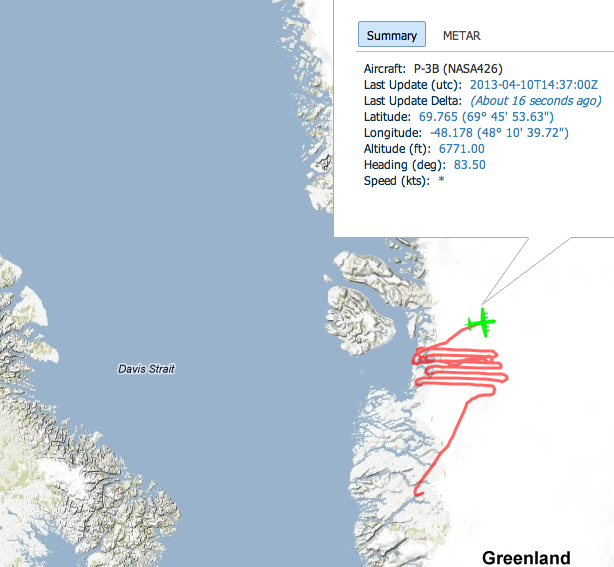
but this will become clear as soon as the data are released to the public. This usually happens within a few months. The wide and open data distribution and access is one of the greatest things about this mission. If you want to see where the plane is now, this is the screenshot I took just now (site)

Locations of NASA's P3 air plane near Jacobshavn Isbrae on April-10, 2013.

Locations of NASA’s P3 air plane near Jacobshavn Isbrae on April-10, 2013.

The evolution of Jacobshavn Isbrae retreat from 1851 through present. [From NASA's Earth Observatory]

The evolution of Jacobshavn Isbrae retreat from 1851 through present. [From NASA’s Earth Observatory]

Jacobshavn lost its buttressing ice-shelf during the last decade and now rapidly discharges ice from the Greenland ice-sheet directly into the ocean at a rapid rate. Most likely, the ice-shelf was melted by the ocean from below (Holland et al., 2008). This type of accelerated discharge raises global sea-level, because ice previously sitting on Greenland’s bedrock moves into the ocean where it eventually will melt. In response to the ice removed, the bed-rock rises as there is less mass above it to hold it down (Khan et al, 2010). All this has actually been measured by satellites (mass-loss) and ground-based GPS (bed-rock response). We live in a dynamic and rapidly changing world where our sensors and software show new patterns of physics that have never been seen before. There is so much more to discover …

Csatho, B., Schenk, T., Van Der Veen, C., & Krabill, W. (2008). Intermittent thinning of Jakobshavn Isbræ, West Greenland, since the Little Ice Age Journal of Glaciology, 54 (184), 131-144 DOI: 10.3189/002214308784409035

Holland, D., Thomas, R., de Young, B., Ribergaard, M., & Lyberth, B. (2008). Acceleration of Jakobshavn Isbræ triggered by warm subsurface ocean waters Nature Geoscience, 1 (10), 659-664 DOI: 10.1038/ngeo316

Khan, S., Wahr, J., Bevis, M., Velicogna, I., & Kendrick, E. (2010). Spread of ice mass loss into northwest Greenland observed by GRACE and GPS Geophysical Research Letters, 37 (6) DOI: 10.1029/2010GL042460

CCGS Henry Larsen: More on People, Places, and Services

The Canadian Coast Guard Ship is powered by such a diverse and talented group of women and men from Newfoundland, Labrador, and beyond, that one or even two posts here hardly do justice to describe how well they run their ship and its many facilities that many mid-sized cities do not have. Monday I wrote about the people who run the power plant and electric departments as well as the seamen who fight fires and run fishing fleet and port facilities. Today I want to show the airport and talk a little about the civil administration that oversees and manages all aboard the ship.
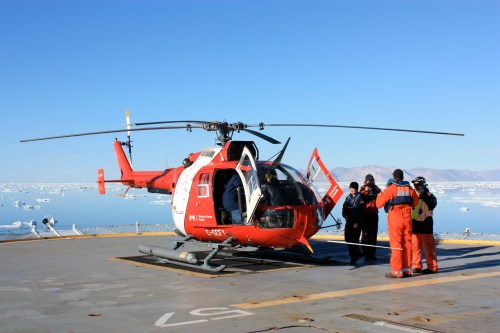
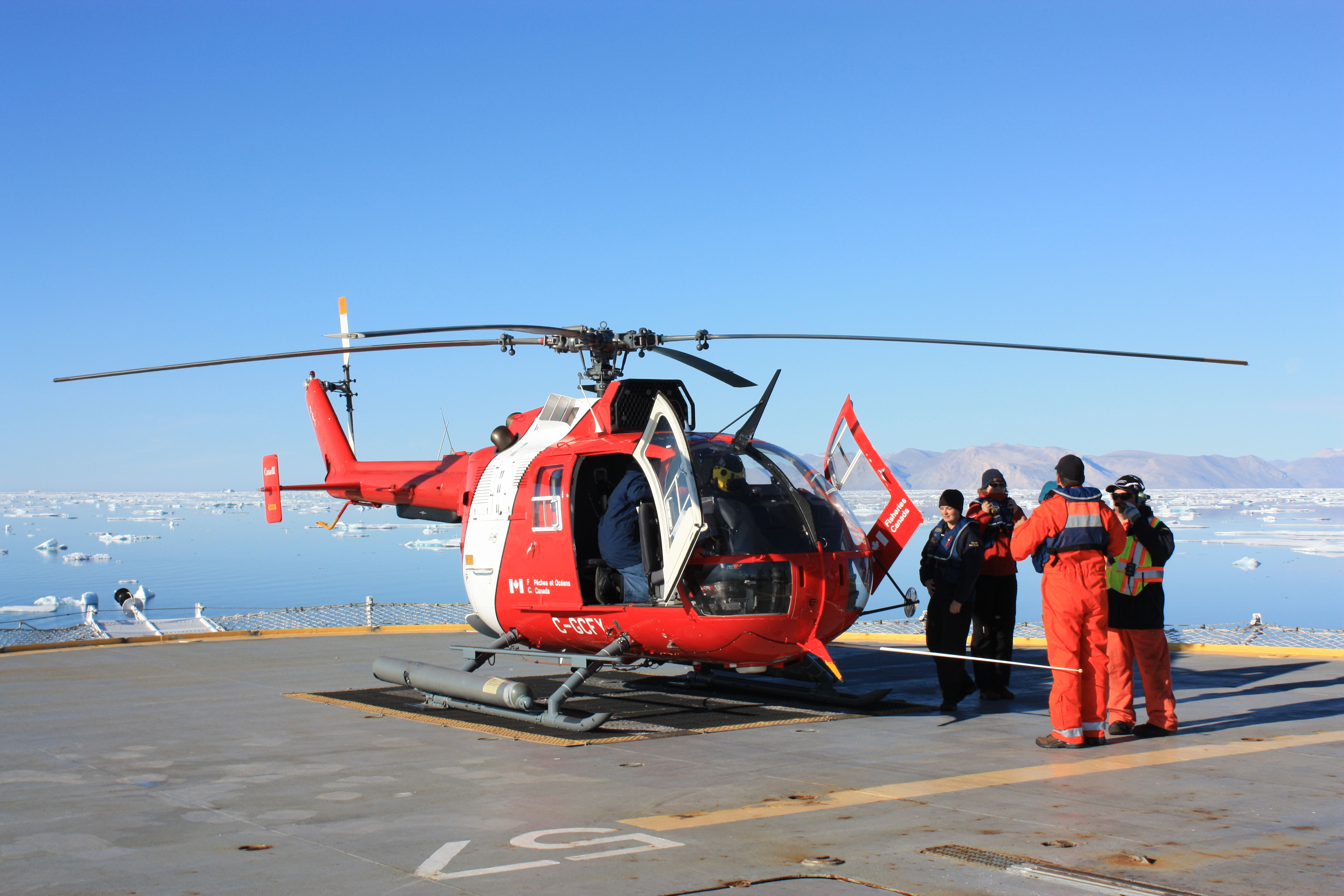
Landing deck of the CCGS Henry Larsen with aircraft preparing for take-off to survey the ice conditions ahead. Shown are Chief Officer Brian Legge (far right) who is in command of the airport and is talking to Pilot Don Dobbin (2nd from right), scientist Renske Gelderloos (3rd from right), Ice Services Specialist Erin Clarke (4th from right), and Helicopter Engineer Pierre Autran performs last checks inside the helicopter. [Photo Credit: Canadian Coast Guard Ship Henry Larsen]

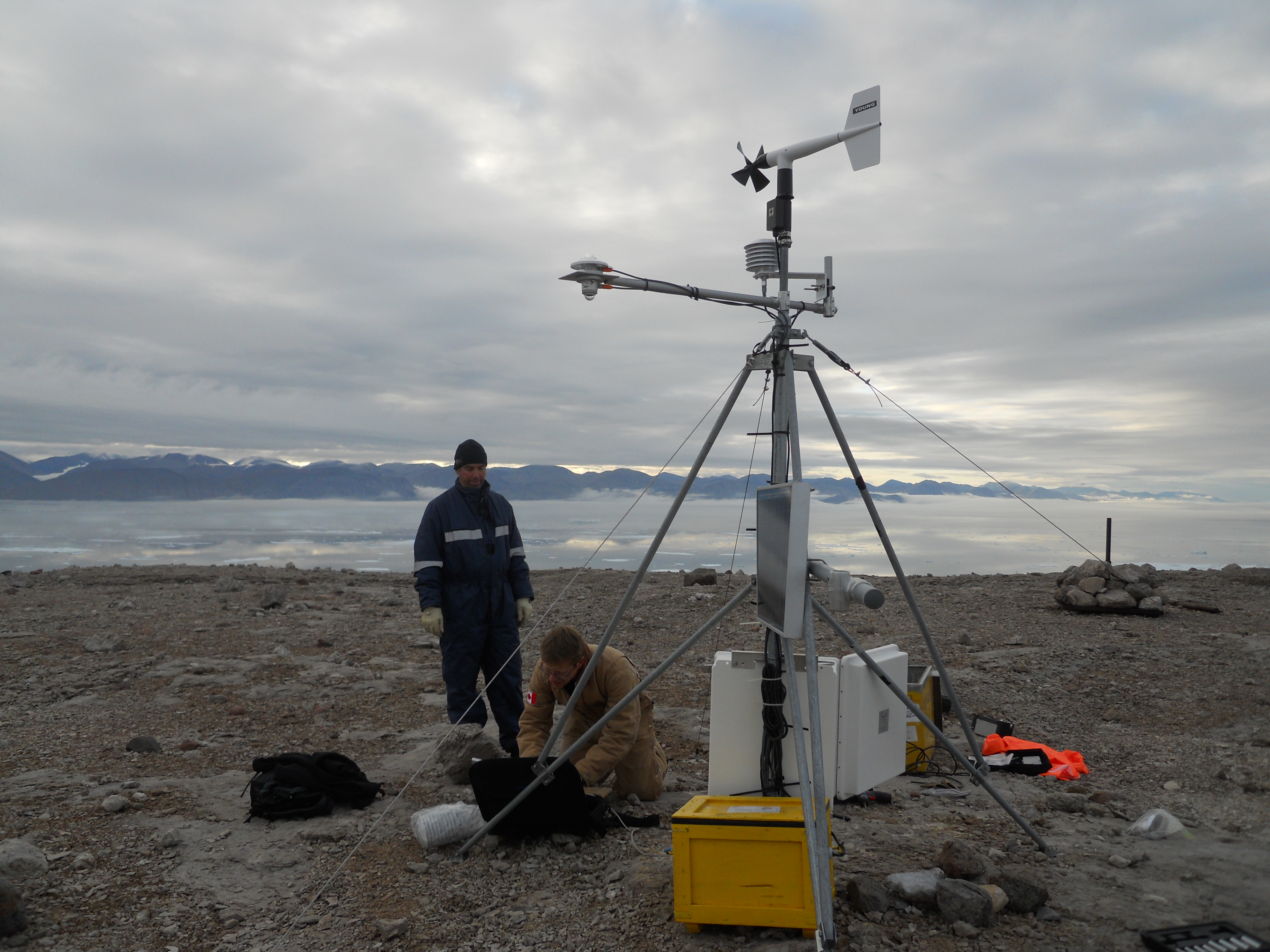
The airport consists of hangar, landing pad, helicopter, traffic control, and fire fighting stations. Don Dobbin was our pilot and Pierre Autran his engineer who was pulled out of retirement for this trip. Incidentally, Pierre and I had sailed together on the same ship in 1993 more than 200 miles north of eastern Siberia. Then all flights were prohibited by Russian aviation authorities: Politics were different 20 years ago, one hopes. No such threat of being shot down existed this year between Greenland and Canada, but for severe ice conditions and poor internet connections, the airport was very busy almost every day for both ice surveys ahead and behind the ship. It also supported landing parties to set up and/or service 4 weather stations.

Helicopter pilot Don Dobbin with scientist Dave Riedel on Hans Island servicing a weather station in the center of Nares Strait. Ellesmere Island in the background. [Photo Credit: Allison Einolf, Minnesota]

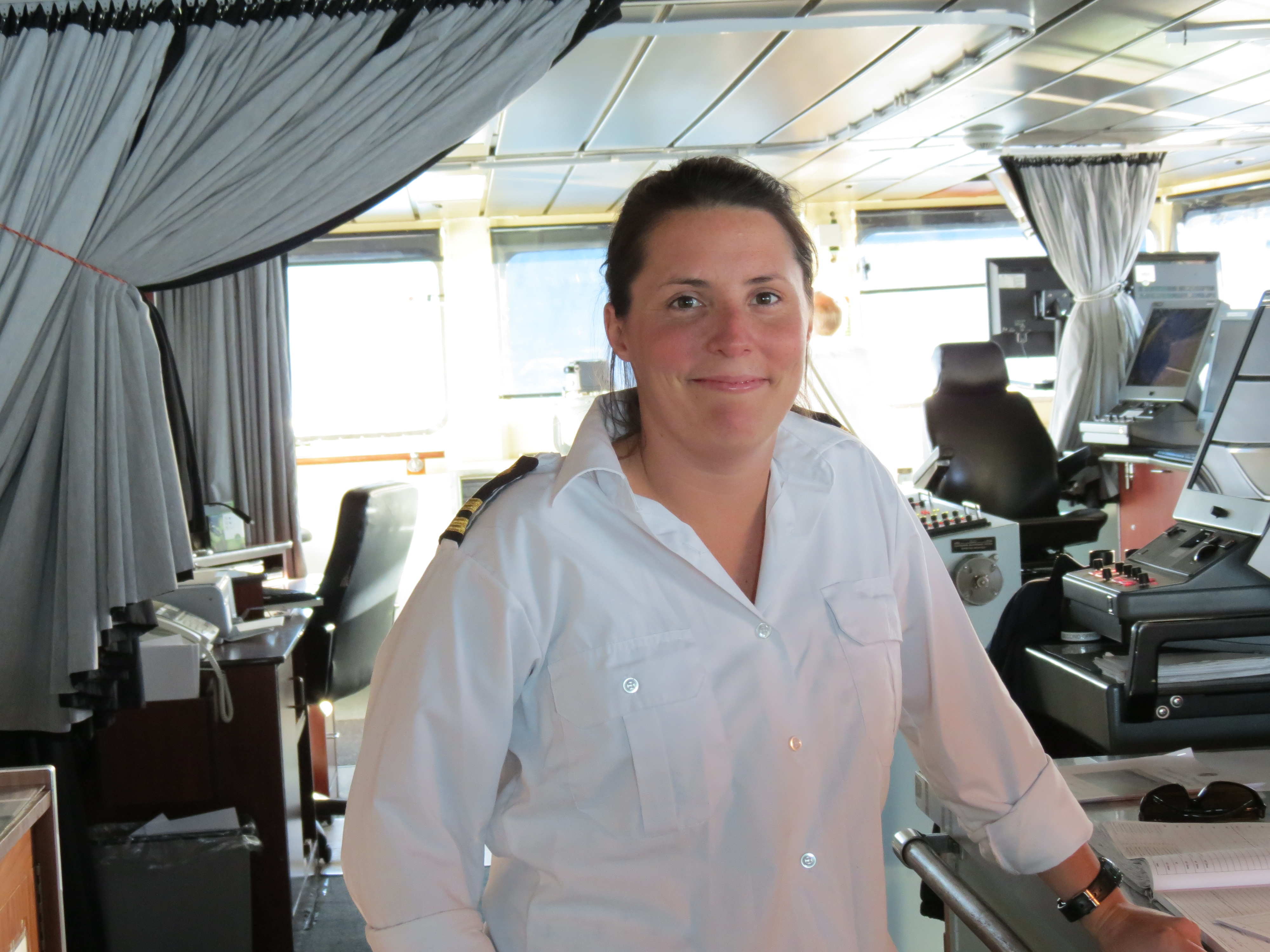
The air traffic control takes place both on the flight deck where Chief Officer Brian Legge is in charge and from the bridge where the officer-of-the-deck is in overall command as either First Officer Chris Steward or Second Officer Rebecca Acton-Bond place the ship, alert the entire ship, and often oversee other science operations as well. All of these are demanding jobs, all these jobs need precision in the concise communication of orders and permissions granted or denied as well as execution of all operations, because helicopter operations are probably one of the most dangerous and critical operations possible on the ship.

Attention to detail, clear communication, and calm execution lower the risk of death and destruction that helicopters can and often do cause. The National Science Foundation sent me to a 4-day course in helicopter safety and what to do if accidents happen over water or on land. It was a sobering course. For this reason, perhaps, Captain Wayne Duffett is almost always on the deck during flight operations, but as all good chief executives, he lets his officers and navigators run the operations but is available for help on consultation should it be needed.
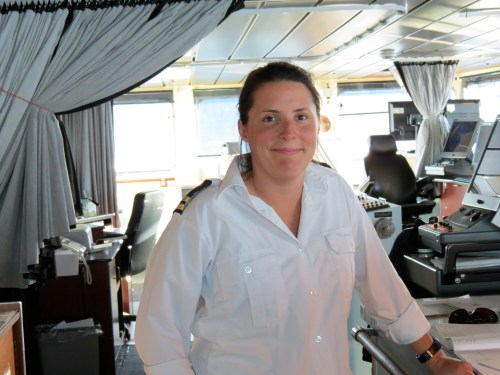
Second Officer and navigator Rebecca Acton-Bond on a sunday on the bridge of the CCGS Henry Larsen in August of 2012 in Nares Strait. [Photo Credit: Canadian Coast Guard, Kirk McNeil, Labrador]
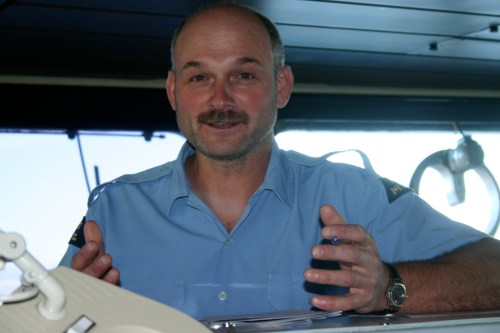
Leading Seaman and helmsman Melvin Cobb on the bridge. [Photo Credit: Canadian Coast Guard Ship Henry Larsen]

The navigator always works with a helmsman or quartermaster who steers the ship following instructions of the officer of the deck, they are on the look-out for ice and bergs to find the best routes. “Best” here refers to the route that requires the least amount of ice breaking. So, if there is one thing that icebreakers like the Larsen are really good at, it is how to avoid ice, because it is a violent and high-energy activity. Fuel is not cheap and less ice is broken, the faster and more efficient the tasks at hand can be accomplished.

And as all people on the ship, everyone has more than one job and this includes the helmsmen and quartermasters like Melvin Cobb or firefighters like Derick Stone, Carl Rose, Paul Gillingham, and Rueben Hillier. They are often members of the deck crew that help landing parties to get ashore and stay save while ashore. This involves the zodiac as well as guns to protect from polar bears:
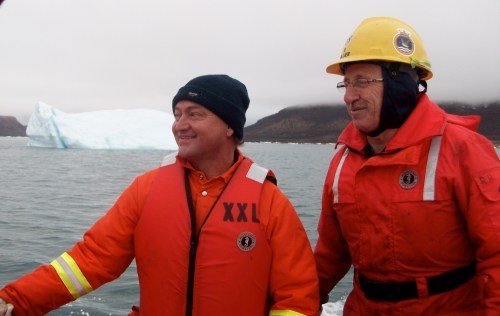
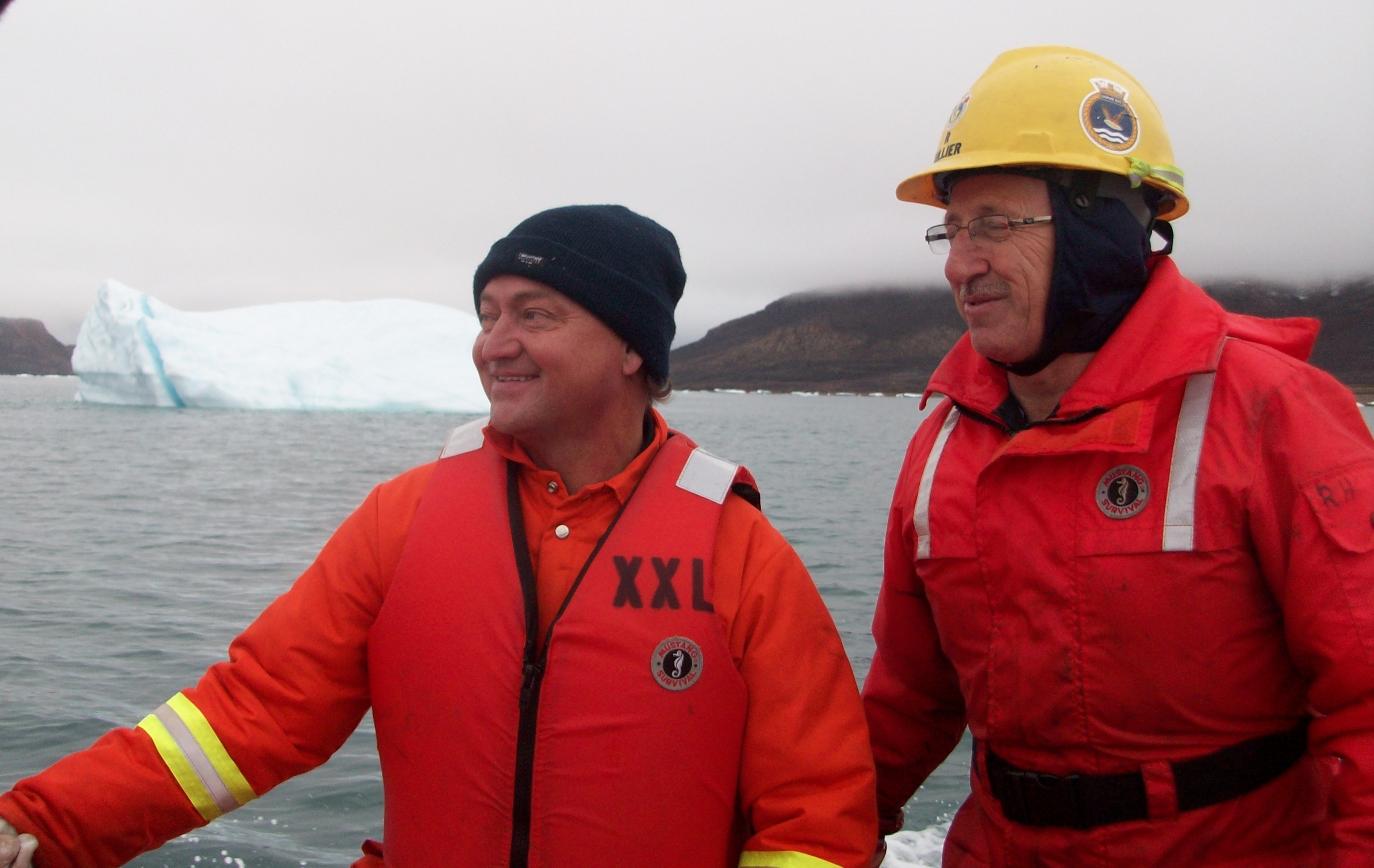
Seamen Paul Gillingham and Rueben Hillier in the zodiac steered by Chief Officer Brian Legge in Alexandra Fjord, Ellesmere Island on Aug.-13, 2012. A tide gauge was recovered and re-deployed near this site. [Photo Credit: Canadian Coast Ship Henry Larsen, Barbara O’Connell]
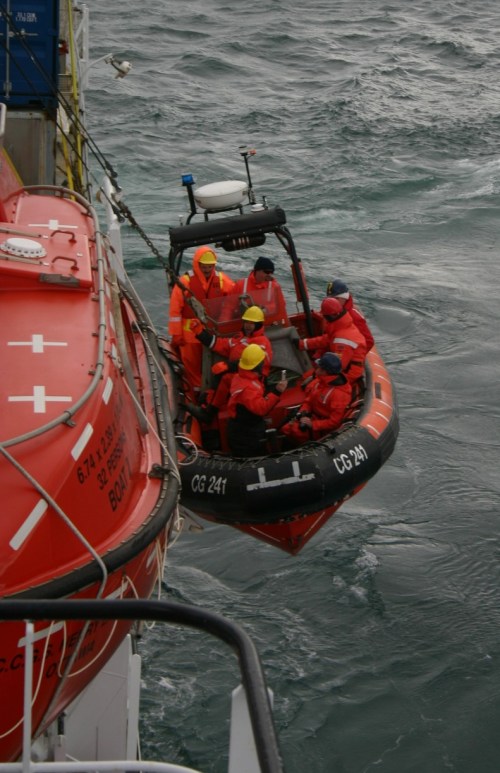
Zodiac launched for a landing part to dismantle a weather station at Cape Baird, Ellesmere Island. Chief Officer Brian Legge at the helm with Melvin Cobb and Derick Stone in the back and center left of the boat filled with scientists Humfrey Melling, David Riedel, Andreas Muenchow, and Renske Geldeloos. [Photo Credit: Canadian Coast Guard Ship Henry Larsen]

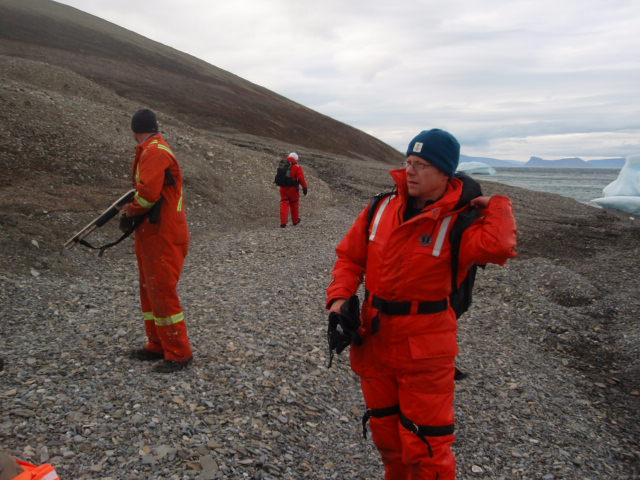
Landing party at Cape Baird, Ellesmere Island to dismantle a weather station. Scientists David Riedel (foreground) and Humfrey Melling (background) are protected by Melvin Cobb (with gun) from polar bears. View is towards the north-west across Lady Franklin Bay to the west of Nares Strait. [Photo Credit: Renske Gelderloos, Oxford University]

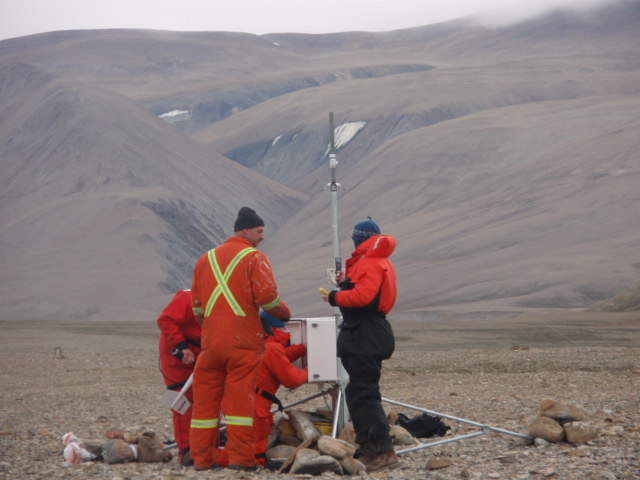
Taking down a weather station on Cape Baird, Ellesmere Island, view is to the south-west. People from right to left, the author, David Riedel (kneeling), Melvin Cobb, and Humfrey Melling (covered). [Photo Credit: Renske Gelderloos, Oxford University]
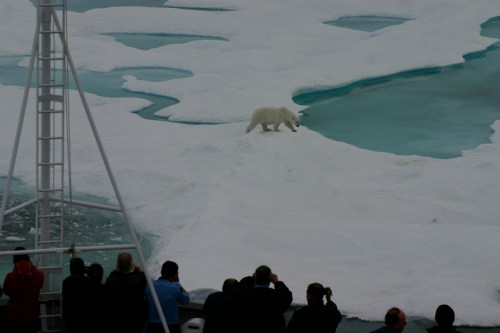
Polar bear on an ice floe in Kennedy Channel as seen from the bridge as the ship was approaching a station a day’s polar bear walk from Cape Baird. [Photo Credit: Canadian Coast Guard Ship Henry Larsen]

There is still more to describe such as the hospital, the restaurant and bar, as well as the superior fishing of sailors and fishermen from Newfoundland to find and hook valuable items such as sensors and computers that some scientists left unattended for 3 or 5 or 9 years at the bottom of the unspoiled seas that border Arctic Greenland and Canada. There will be more … as there are more great people who make great science possible.

Ice Thickness in Nares Strait 2008 and 2009

[Editor’s Note: Undergraduate Julie Jones of the University of Delaware summarizes her work that was supervised by Helga Huntley as part of an NSF-funded summer internship.]

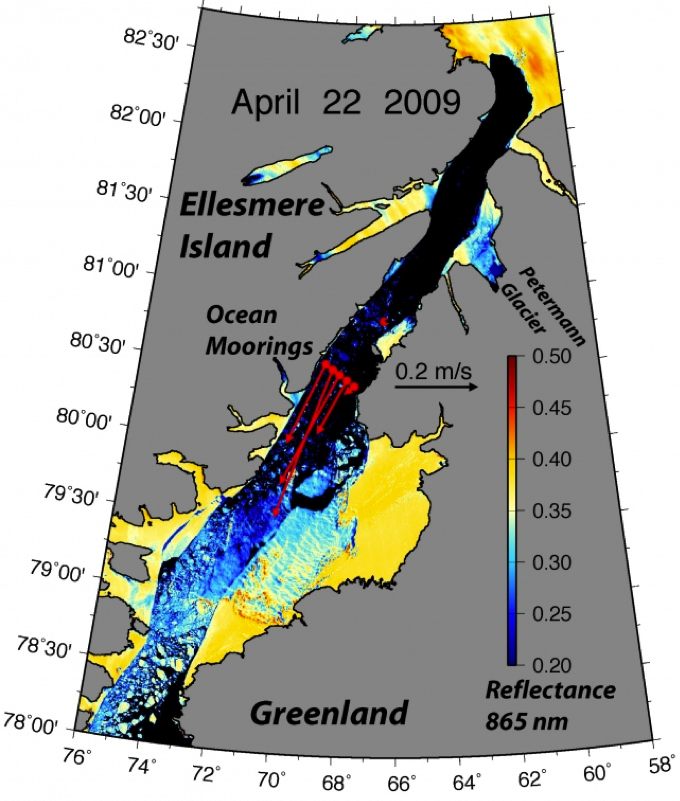
Three years ago in 2009 Andreas Muenchow left from Delaware for Greenland with students Pat Ryan and Berit Rabe to recover instruments that recorded salinity, temperature, current velocities, and ice thickness in Nares Strait since 2007.  This summer, I used those observations to estimate ice thickness for April through June in 2008 and compare them to estimates for the same spring period in 2009.  An ice bridge had formed in 2008 but not in 2009.  Working as a group, we wanted to investigate the effect of ice arches on the ice thickness.  Allison Einolf, another summer intern who focused on ocean currents during the same time periods and Andreas produced these maps that introduce the study area, spatial ice cover, and mean ocean currents:

Image

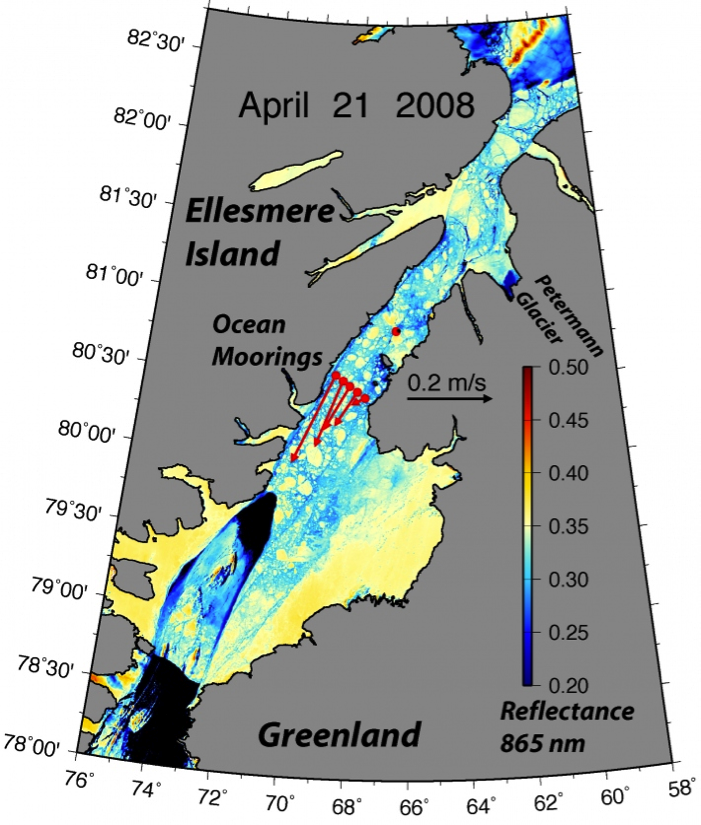
Nares Strait MODIS satellite imagery of the study area and ice arch April 21, 2008. Red dots are instrument locations. Arrows show current velocities.

Image

Nares Strait MODIS satellite imagery of the study area and ice arch April 22, 2009. Red dots are instrument locations. Arrows show current velocities. Note the lack of the southern ice arch, but the presence of one north of the study area.

I used Matlab for most of the data processing, more specifically the Ice Profiling Sonar (IPS) Processing Toolbox for Matlab provided by the manufacturer of the instrument that collected the data: ASL Environmental Sciences, Inc. First I transformed the data from the IPS instrument into a range time series.  I then manually “despiked” the data, taking out any data points that were likely due to bubbles or fish within the acoustic path from the sensor system to the ice above and back.  In a second step I wrote a function using sound speed data from Andreas, atmospheric pressure from Dr. Samelson at Oregon State University, and pressure (depth) data from the IPS instrument to get a time series of the thickness of the ice.  In a third step I applied a Lanczos raised cosine filter that was taught as part of a 2012 Summer Intern Page Workshop. Hence I finally had some nicely filtered data for the periods of the April-June of 2008 and 2009.

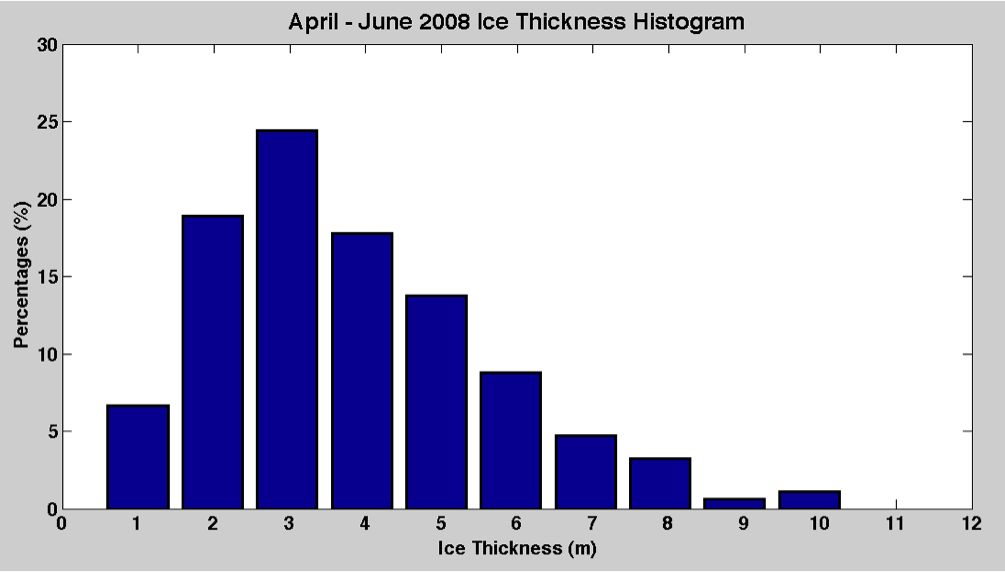
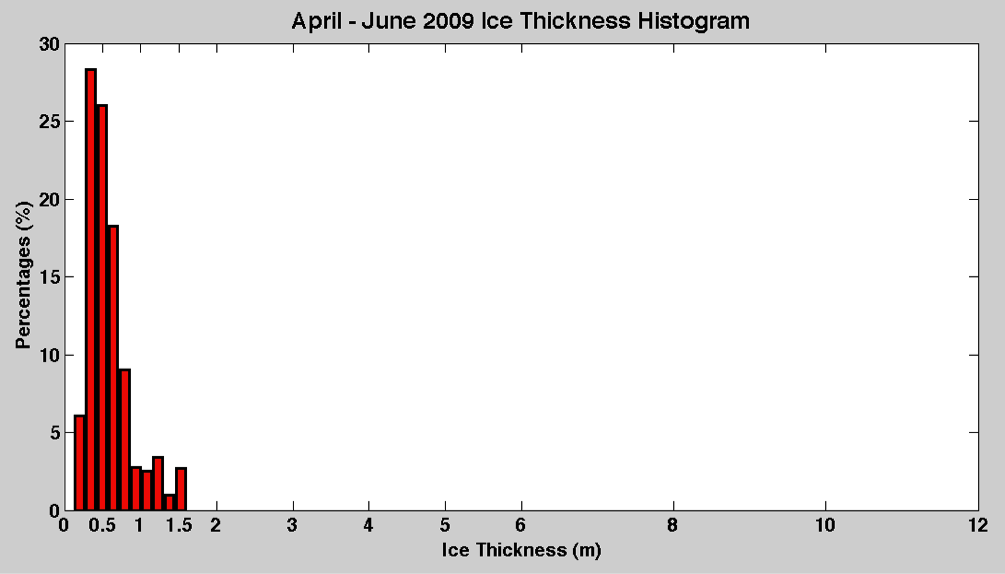
Now the results:  Just as we expected, there was much thicker ice in the 2008 spring with a southern ice arch present than there was in the spring of 2009 when no such ice arch was present:

Histogram for April – June 2008 ice. There is a peak at 3 meters, with almost 25% of the ice that thick.

Histogram for April – June 2009 ice. The ice does not get thicker then 2 meters with most of the ice thinner than one meter.

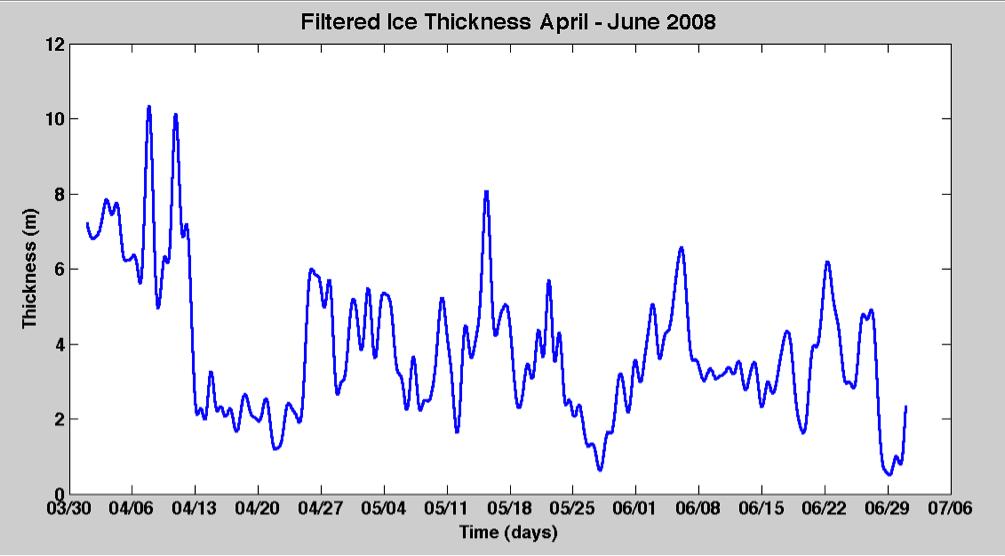
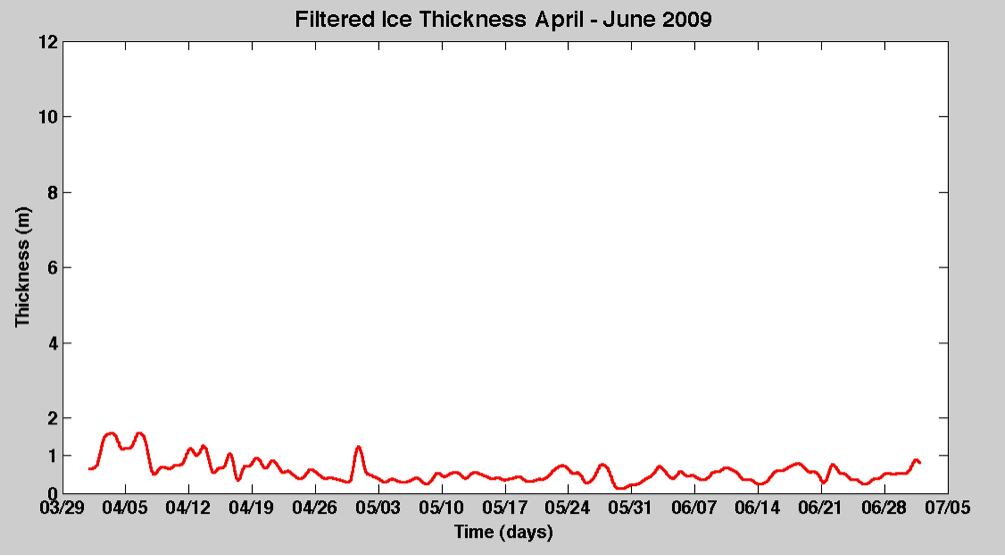
The histograms show thicker ice in 2008, about 2-6 meters on average and with some ice even reaching 10 meters.  In 2009, the ice doesn’t get thicker than 2 meters with most of the ice being thinner than 1 meter.  More specifically, the mean ice thickness for April – June 2008 (2009) is 3.8 (0.58) meters with a standard deviation of 1.8 (0.29) meters.  This further shows that there was thicker ice in 2008 than there was in 2009.  I attributed the cause for the thin 2009 ice to ice flowing freely through Nares Strait all winter and spring as no ice arch in the south blocked such flow.  The ice, thus, did not spend enough time in the high Arctic to thicken.

I noticed something else in my histograms when the 2008 ice bridge collapsed.

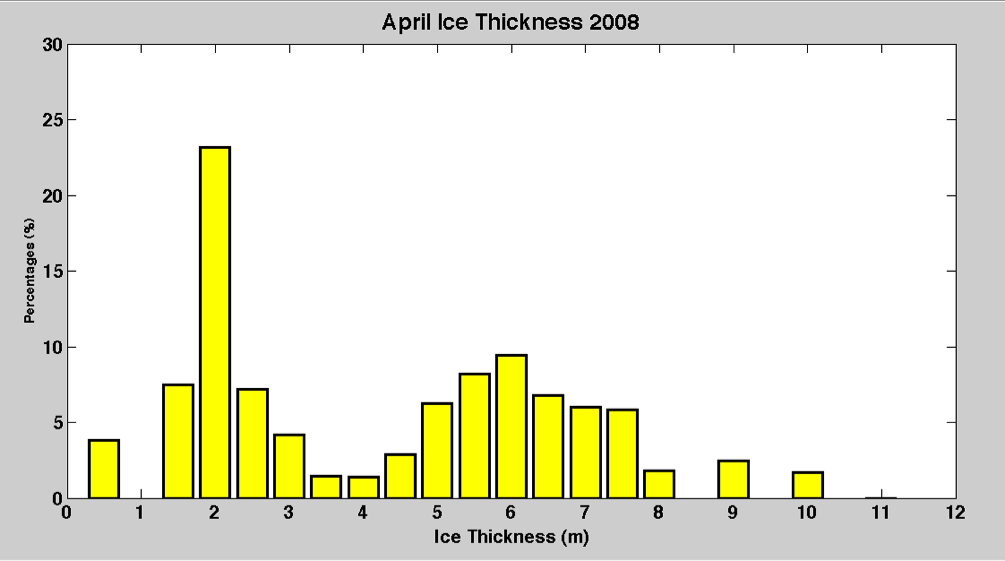
April 2008 ice thickness

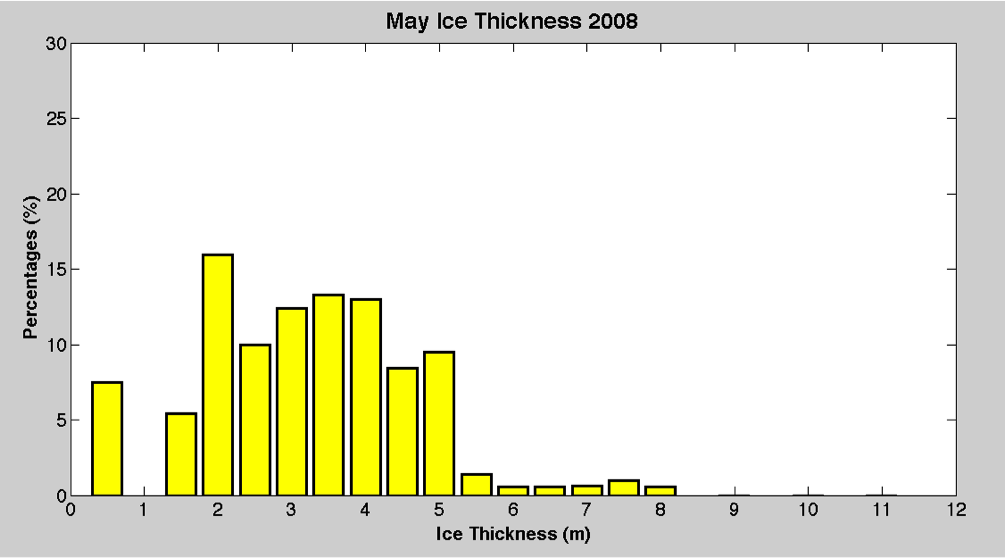
May 2008 ice thickness

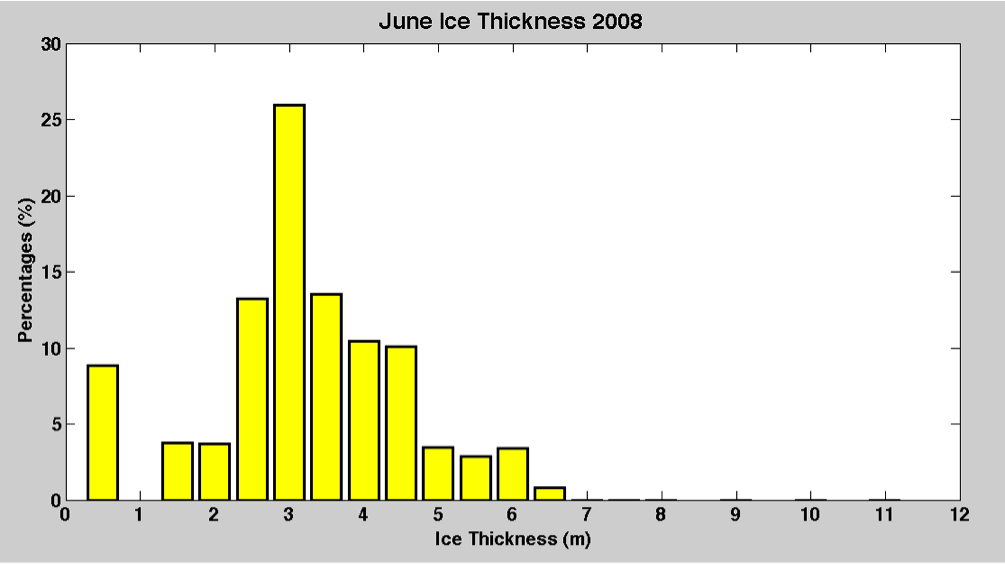
June 2008 Ice Thickness

The monthly histograms show that the ice in April and May is thicker than the ice in June.  We know that the 2008 ice bridge collapsed near June 6th, so it is interesting and it makes a lot of sense that the ice in June would be thinner than the ice two months earlier.

The mean ice thickness for April 2008 was 4.6 meters with a standard deviation of 2.40 meters.  In May 2008 the mean ice thickness was 3.5 meters with a standard deviation of 1.40 meters.  Lastly, in June the mean ice thickness was 3.5 meters with a standard deviation of 1.30 meters.  The ice thickness decreased after April and the variability decreases in June, which helps detect the bridge collapse in the data.

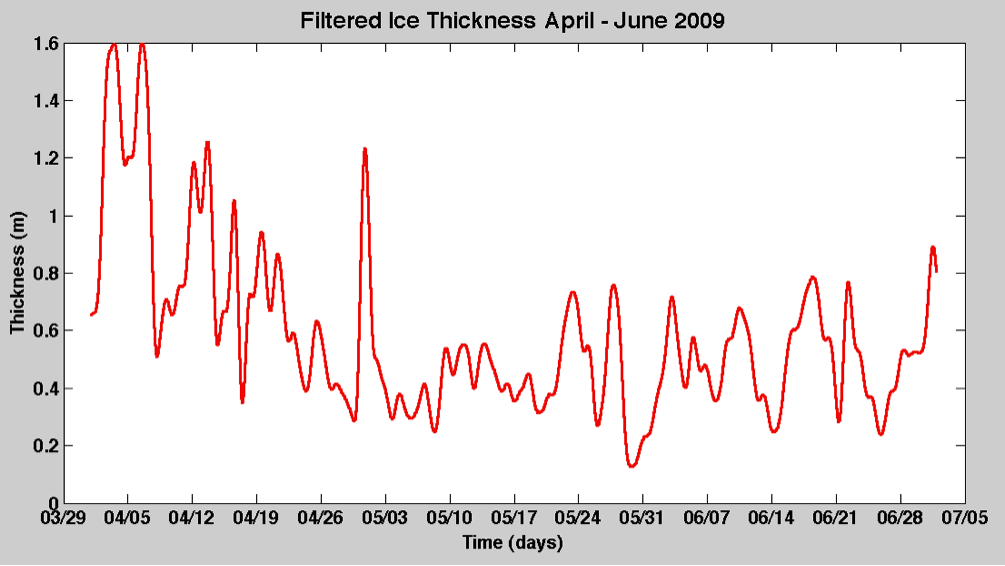
Lastly here are the filtered time series of April – June of 2008 and 2009.

Filtered time series for April – June 2008

Filtered time Series for April – June 2009 with the same scale as 2008 (above figure)

Filtered time series for April – June 2009 with a different scale to see the variability over time more clearly.

Hopefully we can see more interesting and exciting results from the instruments that the Nares Strait team picked up this summer even though they were hit hard by the 2010 Petermann Ice Island!

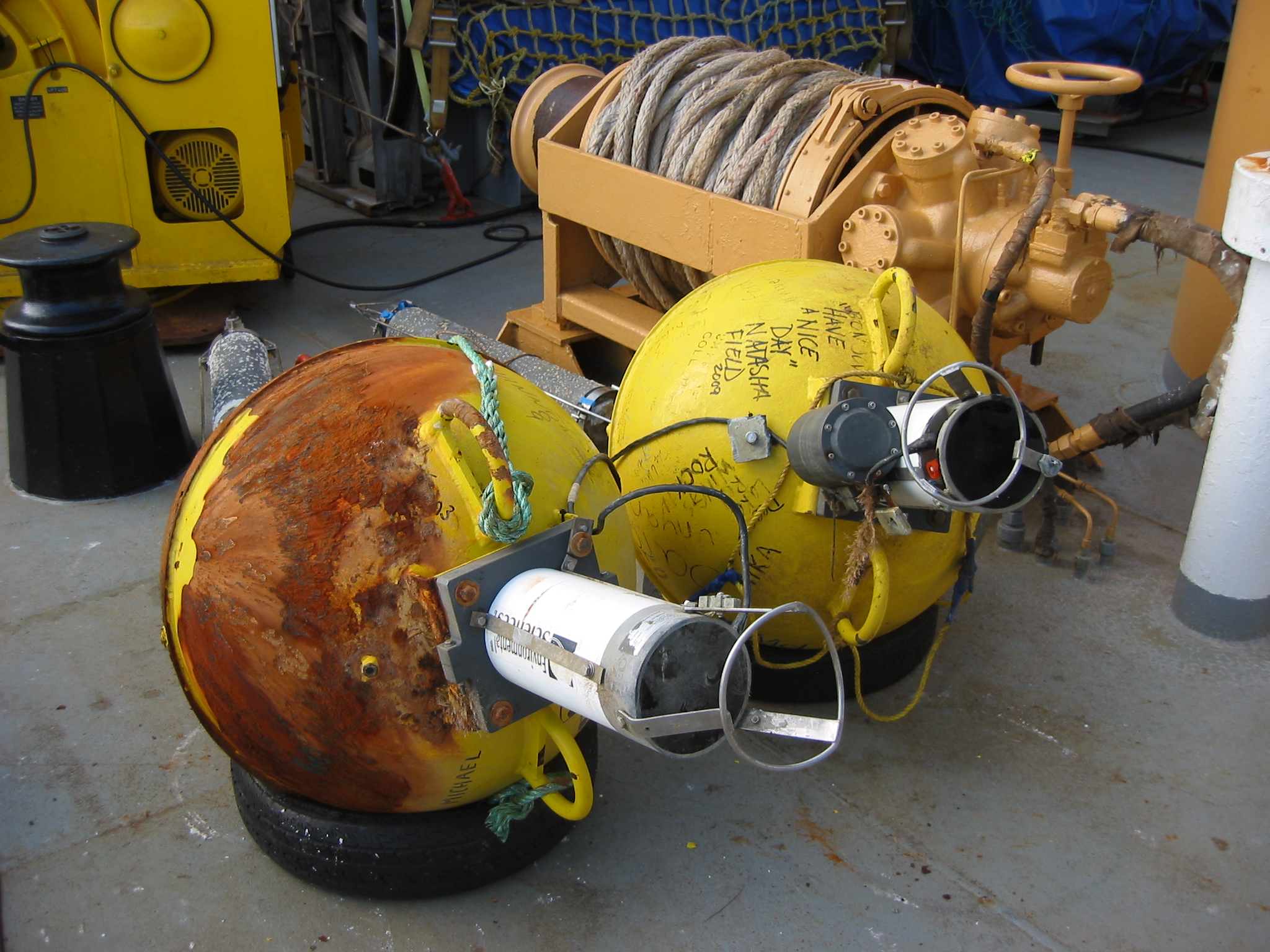
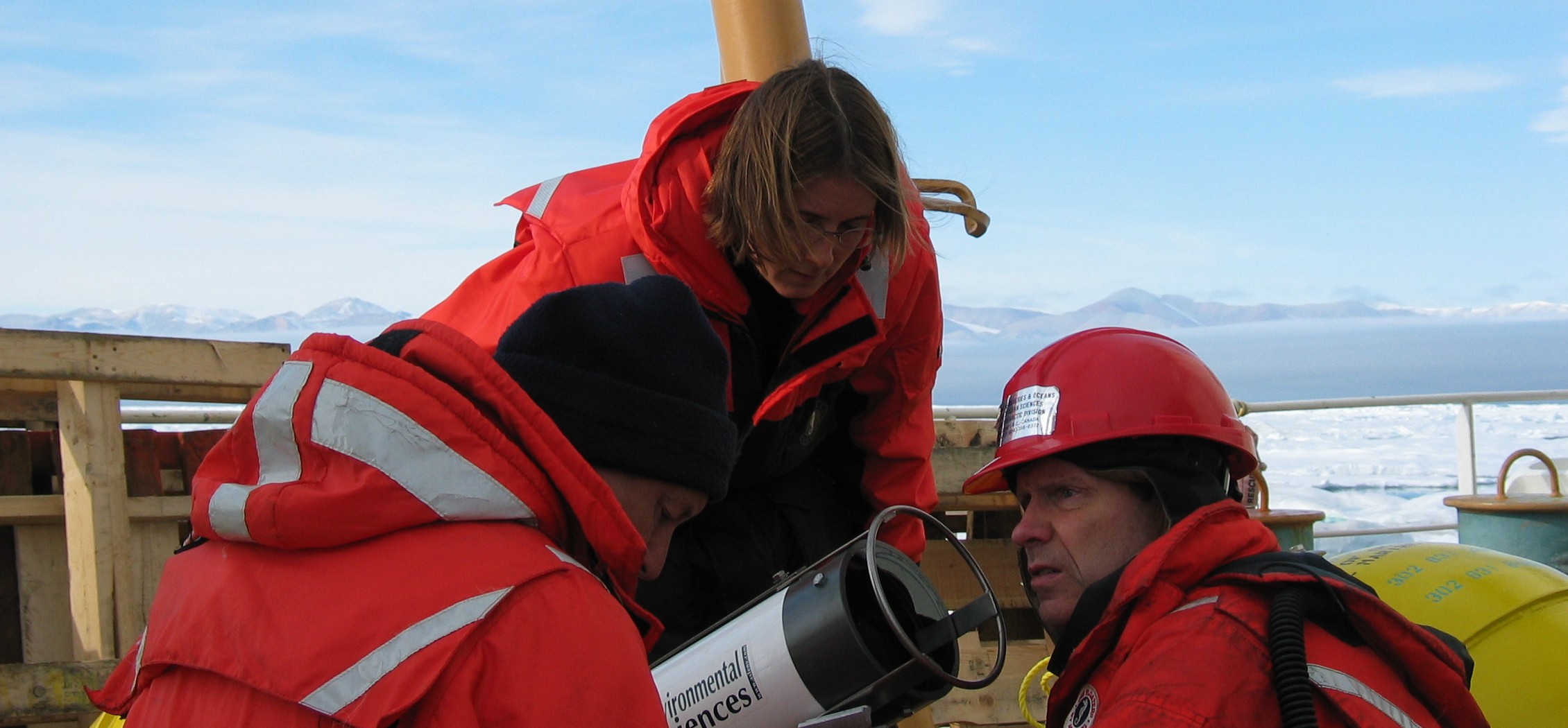
Two Ice Profiling Sonars (IPS) aboard the CCGS Henry Larsen in Aug.-2012. The protective stainless steel frame was bent by the 2010 ice island that hit both instruments in Sept.-2010. [Photo Credit: Andreas Muenchow]

Nares Strait 2012 Ice Arch Collapsing (Updated 6/30)

UPDATE-2 6/30:

June-30, 2012 MODIS-Terra view of the collapsing Nares Strait ice arch. The separation occured at the location where the hairline fracture developed 3 days ago. The collapse is propagating upstream to the north as the buttressing support on the western anchor point near Bache Peninsula and Pim Island was removed.

UPDATE-1 6/29:

June-29, 2012 MODIS-Terra view of the collapsing Nares Strait ice arch. The separation occured at the location where the hairline fracture developed 2 days ago.

The most relevant weather information is from Hans Island near 81 N latitude.

ORIGINAL Post (6/28/2012):
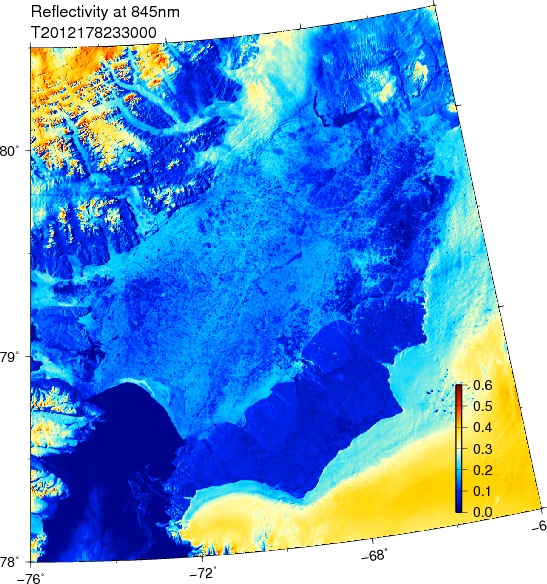
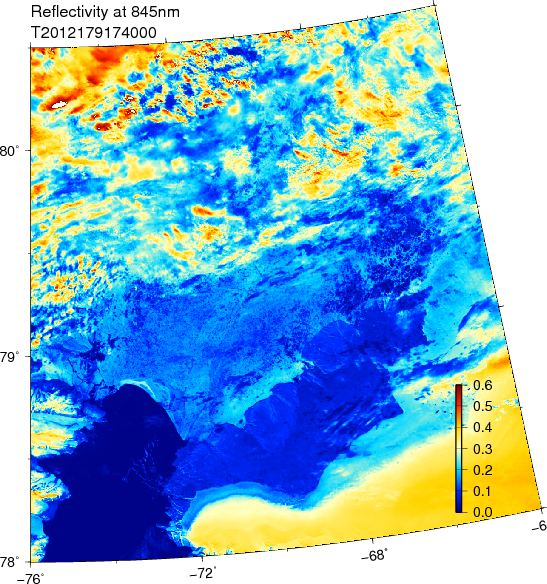
The collapse of the ice-arch in southern Nares Strait began June-27, 2012 with development of a small hairline fracture along the western side of the strait off Ellesmere Island, Canada. The fracture connects an isolated area of open water off Bache Peninsula, Canada at 79 N latitude. The front between land-fast ice in the north and the open water in the south has moved slightly southward. It has also lost a visible larger piece of ice that before anchored the bridge at its western connection to land. This motion will open the hairline fracture more, accelerating the collapse of the ice-arch. The missing support of the ice-arch on its western side will collapse the entire ice-arch and the previously land-fast ice of Nares Strait will stream rapidly to the south, I predict, before this weekend.

Updates (including an animation) will be posted daily at http://muenchow.cms.udel.edu/Nares2012/Kane/.

Ice-bridge at southern Nares Strait June-26, 2012 23:30 UTC from MODIS-Terra. There are no hairline fractures yet along the Ellesmere Island side near 79 N latitude. Greenland is on the right (east), Canada on left (west).

Ice-Bridge at southern Nares Strait on June-27, 2012 17:40 UTC from MODIS-Terra. Notice the crack and hairline fractures in the ice along the Ellesmere Island coast near 79 N latitude and 75 W longitude.

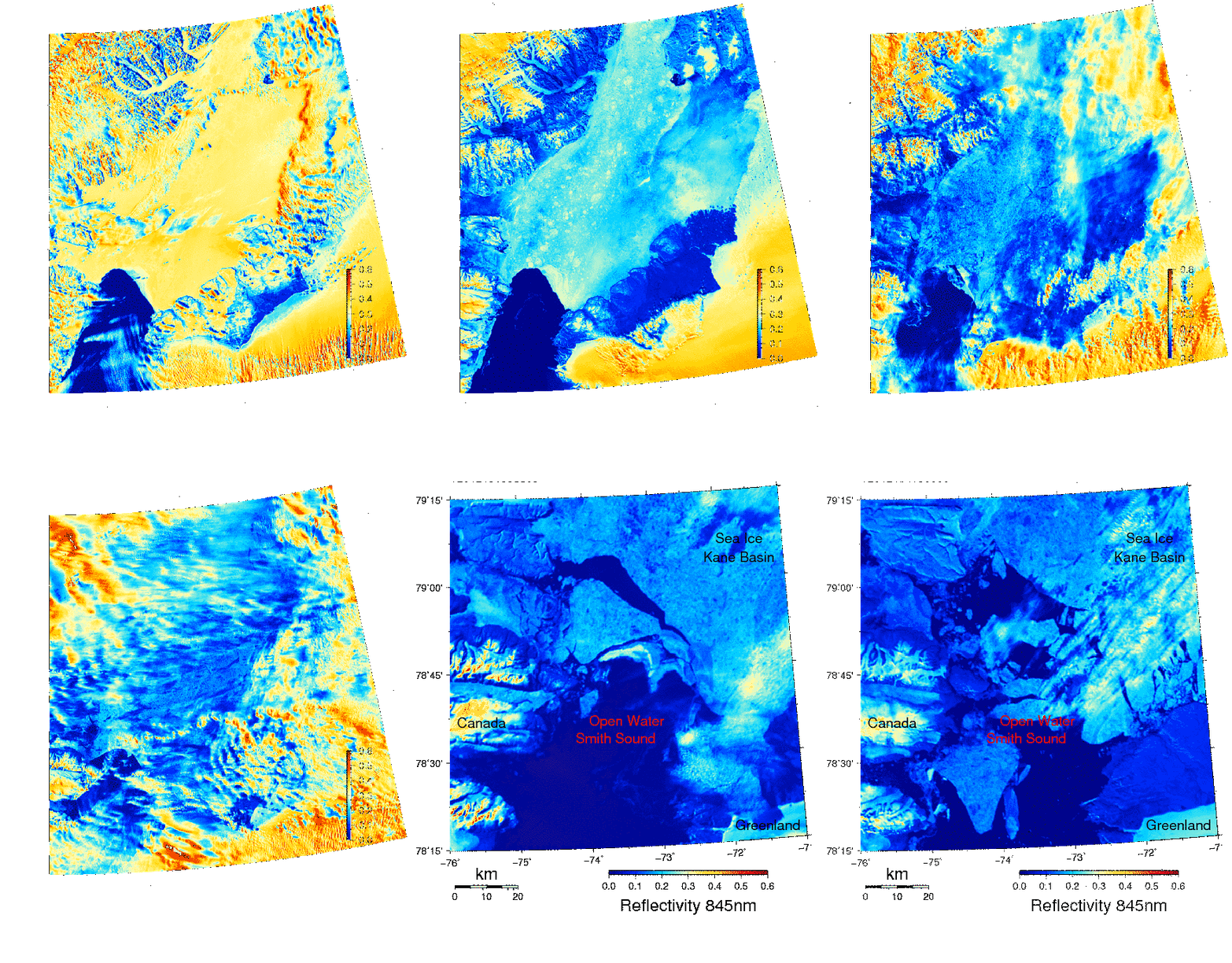
This collapse happens each year in the summer, though the timing varies from April for weak and July for strong arches. The arch in 2012 lasted longer than the one in 2011. No or only weak ice-arches formed at this site in 2007, 2008, and 2009, e.g., http://muenchow.cms.udel.edu/MODIS/.

EDIT-1: Same imagery, same gridding, but more focus and detail

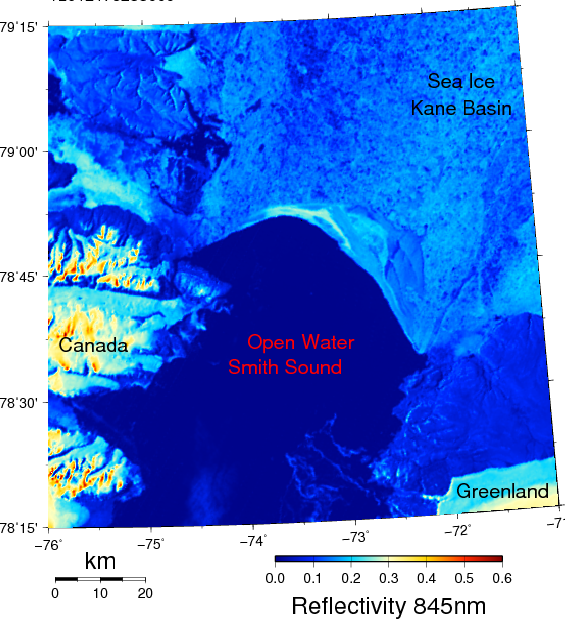
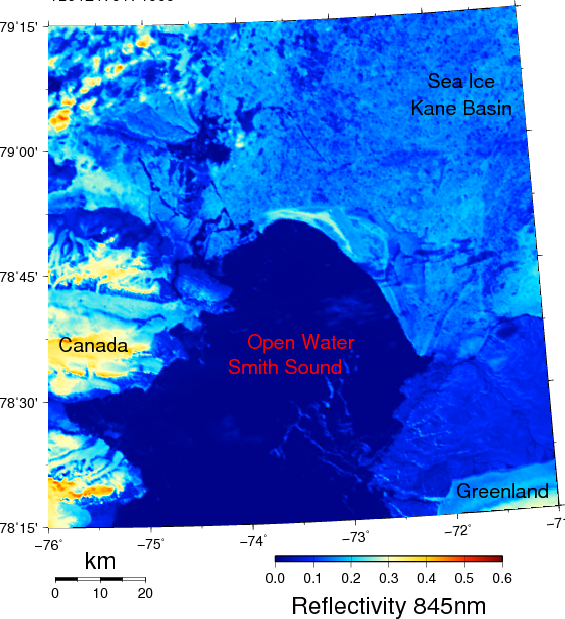
MODIS-Terra June-26, 2012 prior to collapse.

MODIS-Terra June-27, 2012 at the onset of collapse. Note the change near the Canada at 79 N latitude where open waters meets the sea ice.

EDIT-2: The moorings we try to recover this summer are to the north of Kane Basin and to the south where Petermann Fjord enters Nares Strait. This map shows it (also notice how badly the coastline of Greenland is surveyed):

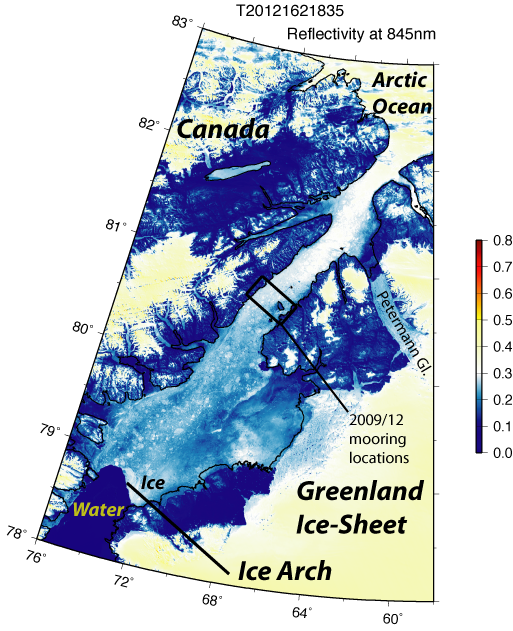
June-10, 2012 MODIS-Terra image showing location of moored array that was deployed in Aug. 2009 to be recovered in Aug. 2012.

Nares Strait Ice Bridge and Arctic Ice Thickness Change

The ice of the Arctic Ocean is rapidly disappearing. This happens every summer, but for the last 30 years there is a little less ice left at the end of each summer than there was the year before. The areas covered by ice are not only shrinking, the ice is also getting thinner, or so many do believe.

To check out such claims, we placed sound systems on the ocean floor of Nares Strait from which to find out how much the thickness of the ice above has changed. We started this in 2003, were told to stop it in 2009, but privately parked our instruments where they would collect data. We must get to check our sound systems and retrieve the private recordings, because otherwise Poseidon will claim our possessions for parking violations. The Canadian Coast Guard Ship Henry Larsen, we hope, will help us to negotiate water and ice to get us deep into Nares Strait as she and her crew did so well in 2006, 2007, and last in 2009.

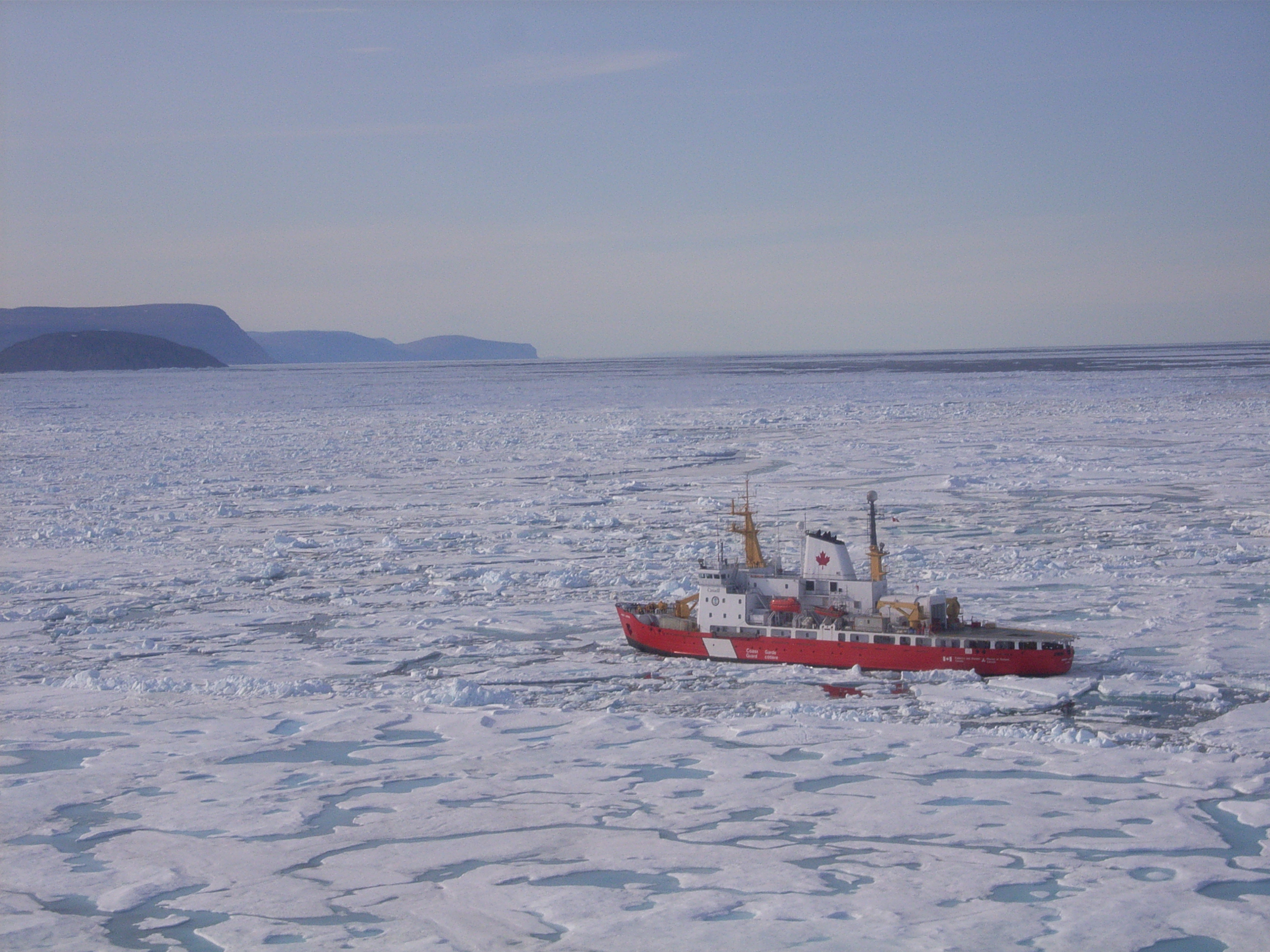
CCGS Henry Larsen in thick and multi-year ice of Nares Strait in August 2009. View is to the south with Greenland in the background. [Photo Credit: Dr. Helen Johnson]

The ice profiling sonar sounds system before its first deployment in Nares Strait in August 2003 from aboard the USCGC Healy. It measure ice thickness many times each seconds for up to 3 years. View is to the north-west with Ellesmere Island, Canada in the background. Listening in are Jay Simpkins (left), Helen Johnson, and Peter Gamble.

Nares Strait to the west of northern Greenland is one of two major gates for the thickest, the hardest, and the oldest ice to leave the Arctic for the Atlantic Ocean [Fram Strait to the east of Greenland is the other.] This gate is closed at the moment by an arching ice bridge that locks all ice in place. No ice can leave the Arctic via Nares Strait as long as these arches hold. The ice arch acts as a dam that holds back the flood of ice that will come streaming south hard once the dam breaks. And break it will, usually between the end of June and July.

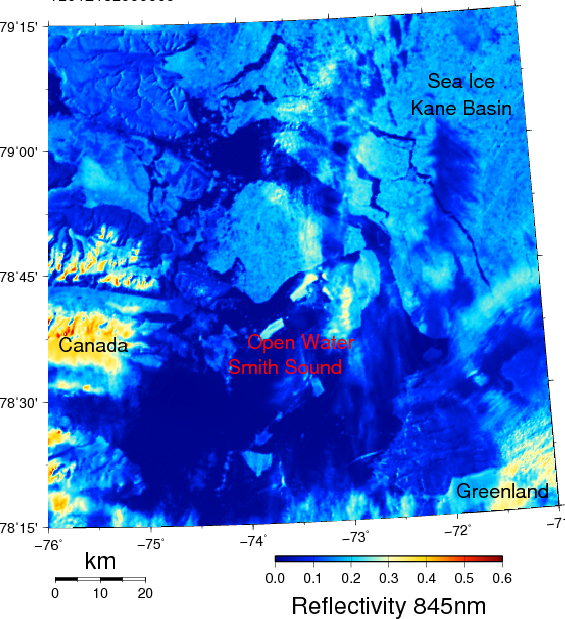
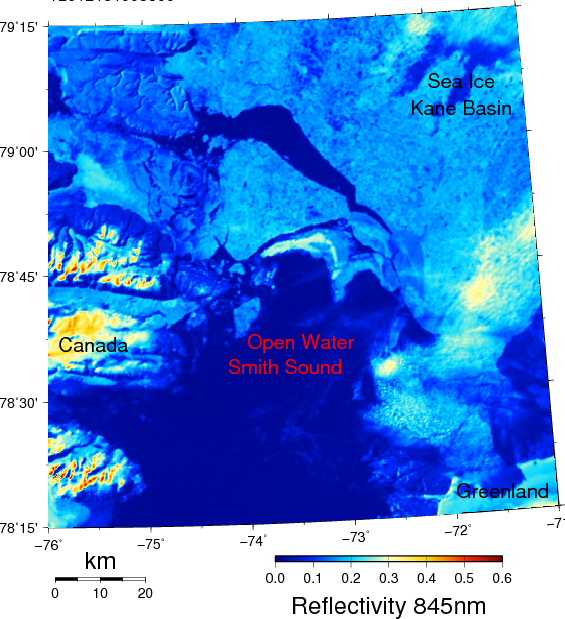
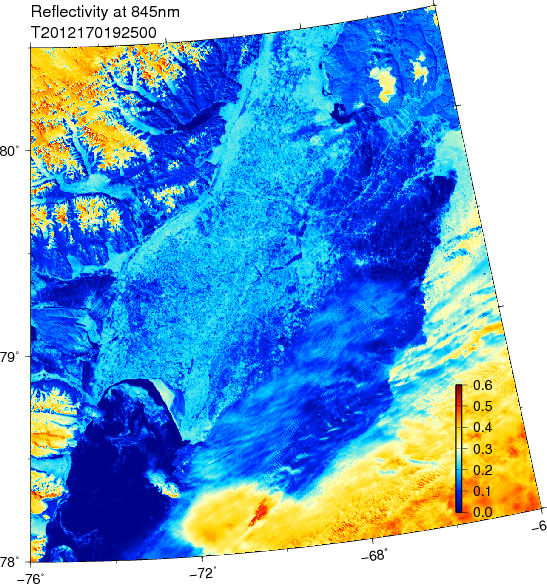
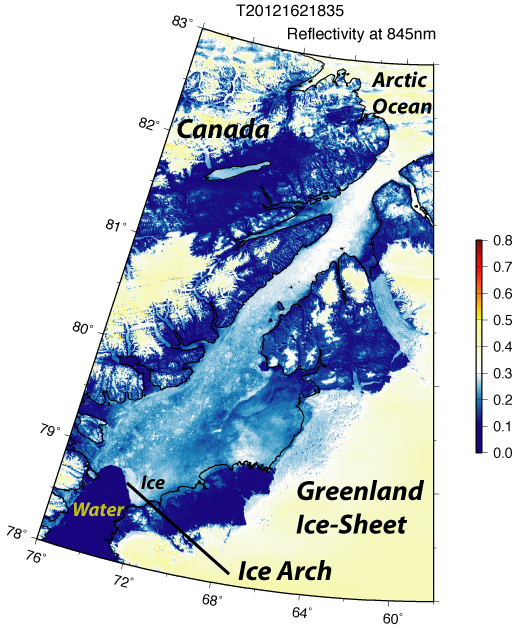
Ice arch in southern Nares Strait as seen by MODIS Terra on June-18, 2012. Greenland is on the right, Canada on the left. The dark blue colors in the bottom-left are open water, yellow are the ice caps of Greenland and Ellesmere Island and lighter shades of blue are warm ice or land. Humboldt Glacier is the on the right-center where Nares Strait is at its widest with Kane Basin at about 80 N latitude.

Nares Strait Jun.-10, 2012 image showing land-fast ice between northern Greenland and Canada as well as the ice arch in the south (bottom left) separating sea ice from open water (North Water). The coastline is indicated as the black line.

The sooner it breaks, the more old ice the Arctic will lose and the better it is for us to get an icebreaker to where must be to recover our instruments and data. The data will tell us if the ice has changed the last 9 years.

I processed and archived maps of Nares Strait satellite images to guide 2003-2012 analyses of how air, water, and ice change from day to day. Ice arches formed as expected during the 2003/04, 2004/05, and 2005/06 winters lasting for about 180-230 days each year. In 2006/07 no ice arch formed, ice streamed freely southward all year, and this certainly contributed to the 2007 record low ice cover. In 2007/08 the arch was in place for only 65 days. In 2009/10, 2010/11, and now 2011/12 ice cover appear normal as the arches formed in December and lasted until July.

We live in exciting times of dramatic change, some to the better and some to the worse. Some of the change is caused by global warming while most is probably not. We do not know for sure, but most of the evidence points towards us people as a major driver of the change we observe in the Arctic and elsewhere. Nevertheless, climate and its change is one grand puzzle that no single scientist, no single discipline, no single country, and no single continent can solve. There are many pieces that all contribute to how and why the Arctic ice changes the way it does. And this includes the ice arches of Nares Strait. There are many mysteries and unresolved physics in what makes these ice arches tick and what makes them blow to bits, but blow they will … watch it, it’s fun, and perfectly natural.

EDIT: This movie shows just how stable the ice arch is at the moment.