Tag Archives: glaciers

Pine Island Glacier Ice Island 2012 Shoving Off

NASA published a stunningly crisp image of Pine Island Glacier (PIG), Antarctica yesterday that is already out of date, because the PIG is on the move. Glaciers change rapidly these days and the speed of the PIG is anything but glacial. The image below from Nov.-13, 2011 shows a massive crack that will develop into an ice island about 3-4 times larger than the one formed from Petermann Glacier, Greenland in 2010. While the image indicates that the part seaward of the crack is still attached, I am convinced that it is already moving independently of the glacier.
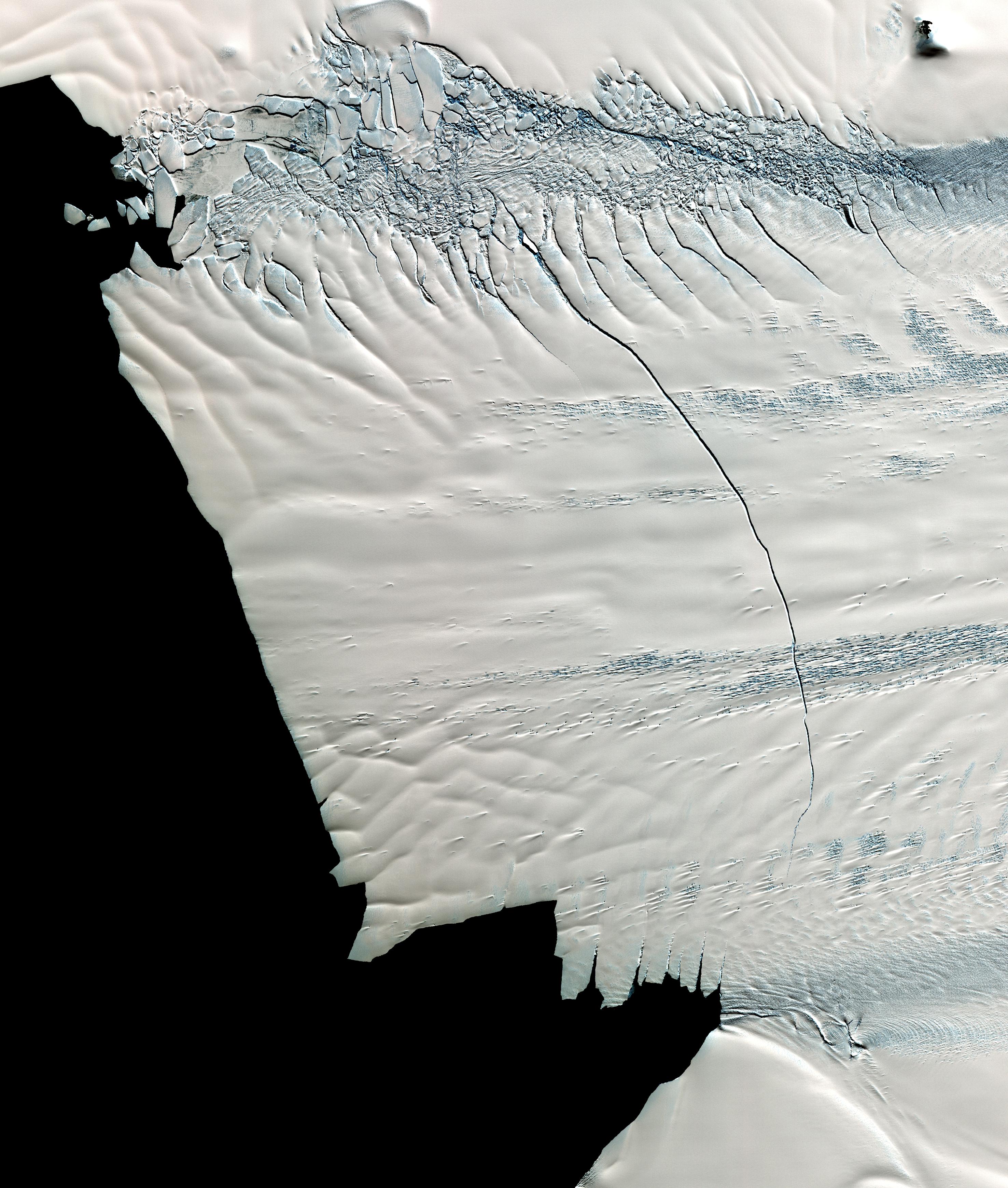
Nov.-13, 2011 image of Pine Island Glacier, Antarctica from the Advanced Spaceborne Thermal Emission and Reflection Radiometer (ASTER) instrument. Area shown cover 27 by 32 miles or 44 by 52 kilometers. Image Credit: NASA/GSFC/METI/ERSDAC/JAROS, and U.S./Japan ASTER Science Team.

The same Terra space craft that provides the very crisp and high-resolution ASTER image also has sensors that image a larger area at slightly coarser 250 meter resolution. And monday was again an exceptionally clear day over Pine Island Glacier that revealed this (false color) image of radiation received at a “color” that is out of range of our eyes, the near infrared (865 nanometers):
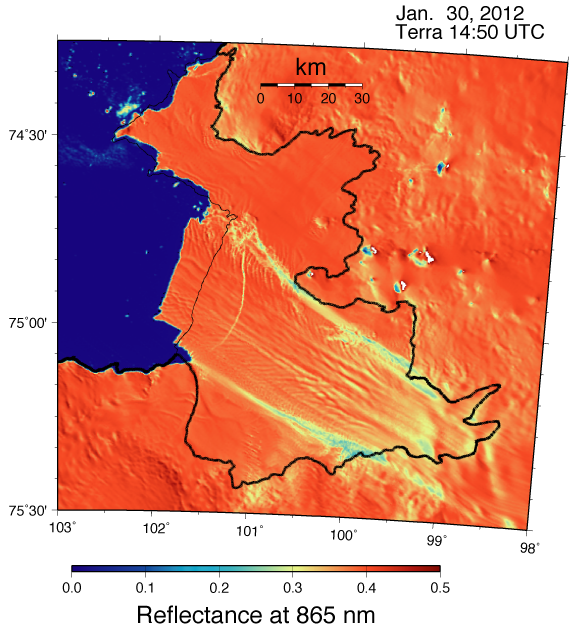
Pine Island Glacier, Antarctica as seen Jan.-30, 2012 from MODIS sensors on Terra spacecraft. The crack is visible as the white line. For reference I am also showing where the front of the glacier was seven years ago with a thin black line. The thick black line shows where the glacier is grounded to the bedrock more than 1000 meters deep (grounding line).

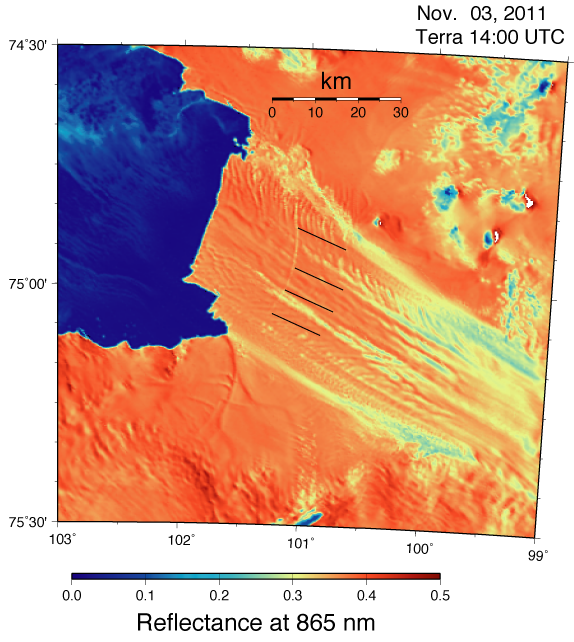
The glacier has advanced a fair amount, the crack breaking off is a perfectly normal event. This is what tidewater glaciers do, they move out to sea and break off icebergs and ice islands. Subtracting the January-30, 2012 image from a Nov.-3, 2011, I think that the thick red line below shows how far and fast the new ice island has moved the last 3 months. Its speed is at least ten times that of the glacier behind the crack:
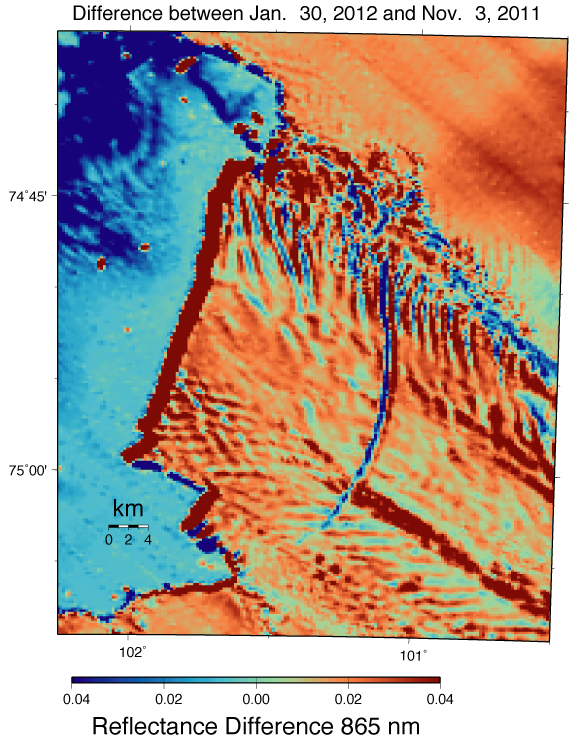
Difference of two MODIS images, thick red line on left (seaward edge of glacier) shows the area that the new ice island had moved into on Jan.-30, 2012 that was water on Nov.-3, 2011.

Lets leave the boring crack alone, nothing to worry there. What is important at Pine Island Glacier is the retreat of the grounding line, the location where ice, ocean, and bedrock meet. All ice located seaward of the grounding line is floating and does not add to rising global sea level. [Actually, it does raise sea level a tiny amount on account of subtle nonlinearity on how volume of water and ice are influenced by temperature, salinity, and pressure, but lets neglect this detail for now as everyone else does for a good reason).

It is the ice landward of the grounding line that will raise sea level as it passes the grounding line and becomes floating ice. And the thickness of this part of the glacier is decreasing at a rapid and alarming rate, because the glacier is melting from below by the ocean and much of the bedrock landward is below sea level, thus allowing the PIG to become “unhinged.”

The problem with this process is that we cannot see it as easy from space, as we can see changes at the surface. The ocean melting does not give the stunning images that portray drama, concern, and excitement the same way that new ice islands do. Yet, for most large glaciers like Pine Island, Antarctic and Petermann, Greenland, the oceans are eroding and melting these glaciers from below. It is the physics on how this works that we scientists do not yet know and understand very well. It is one thing to have a theory and perhaps a model, but only hard data from the ice and the ocean will give us the confidence and understanding to make smart decisions that balance our energy use contributing to global warming with the need to economically develop. Smart development allows us to live better lives and cope with calamities, some of which may be caused by global warming and the sea level rise it brings.
Pine Island Glacier on the Move

Pine Island Glacier, Antarctica, is the focus of a large observational effort to better understand how glaciers and floating ice shelves interact with the ocean.

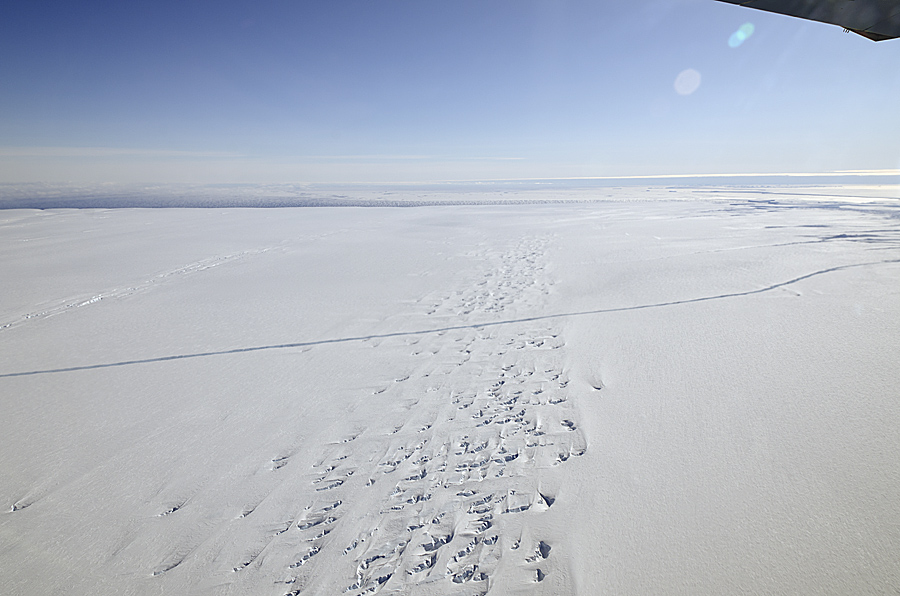
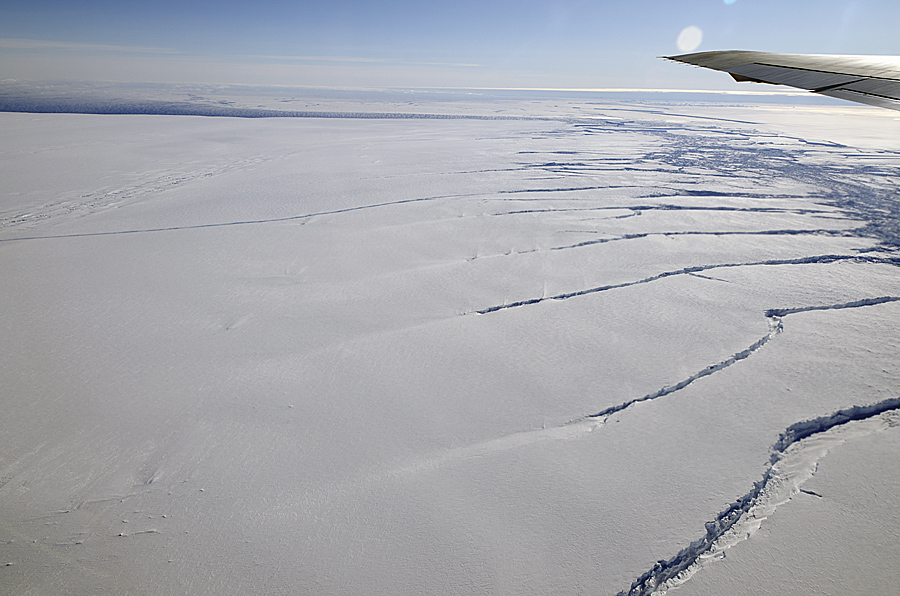
Pine Island Glacier (view is to the north, ocean in the top left) with crevasses and large crack extending from the east (right) to the west (left) as seen from aboard NASA's DC-8 research aircraft in October 2011. Credit: Michael Studinger/NASA

Scientists, pilots, technicians, and students working with NASA’s IceBridge and NSF’s Antarctic programmes tried hard for several years now to reach this glacier, set up a base, and drill through the 400-600 m thick ice shelf to reach the ocean. The data from these gargantuan efforts will reveal physics of ice-ocean interactions. This process is poorly represented in the climate models that are used to project past and present climates into the future. Harsh and hostile conditions cut these efforts short today, again, as reported by OurAmazingPlanet.

The expedition leader, NASA’s Dr. Bindschadler wrote today, that

A decision had been made by NSF the day we left McMurdo that if the helos were not able to be flown to PIG by Saturday, January 7, this year’s field work would be cancelled … We worked through our cargo—some had not been seen for two years when we tested our equipment at Windless Bight—preparing for either helos or the Twin Otter to start moving us onto the ice shelf. Neither came. Weather worsened.

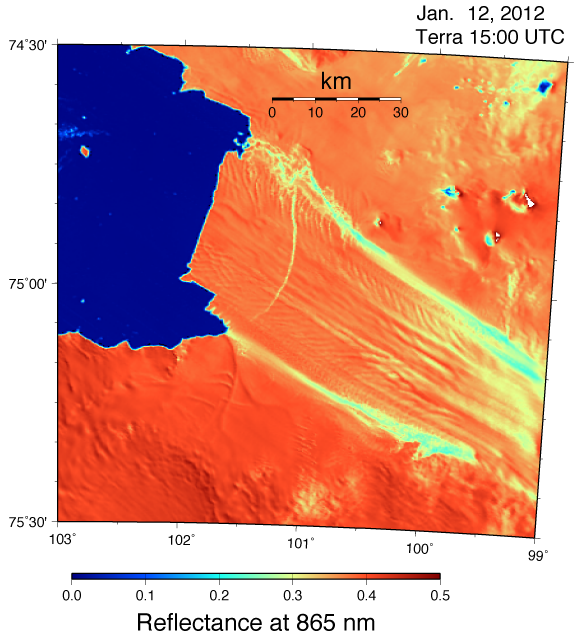
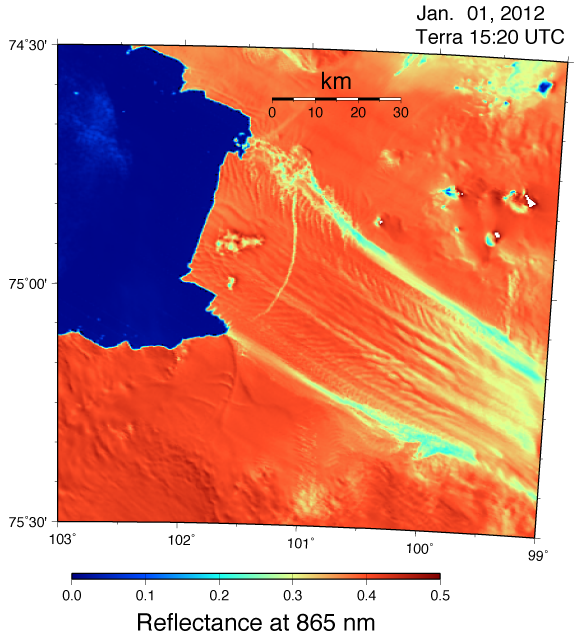
Despite this dramatic turn of events, skies were clear over Pine Island Glacier today as they on New Year Jan.1, 2012. Two MODIS images show detailed features at 250-m resolution. I here show the near infra-“red” signals that the satellite receives (865 nm). The dark ocean reflects little of red (low reflectance) as it is all absorbed while the bright snow and ice reflects lots of red (high reflectance). Recall that the color “white” looks white, because it reflects all colors into our eyes including red, while “black” absorbs all colors, so none are left to reach our eyes.

Pine Island Glacier and Bay, Antarctica on Jan.-1, 2012 as seen by MODIS Terra, notice the whitish crack near the center of the image.

I show lots of the near infra-“red” as, well, red, and I color little red as blue. I chose the colors of the “crayons” to do the coloring. The technical term for this is contouring. Formally, I am depicting a function f=f(x,y) where f is the amount of red and x and y are locations east and north, respectively.

Pine Island Glacier and Bay, Antarctica on Jan.-12, 2012 as seen by MODIS Terra, notice the whitish crack near the center of the image.

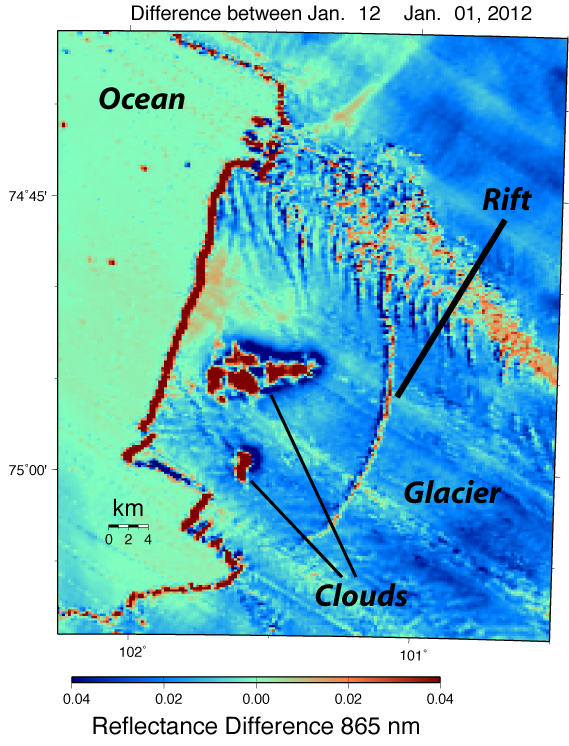
They almost look the same, don’t they? If they were identical, then the difference would get zero. Except, glaciers move, especially this one. It is also about to spawn a large ice island. A crack was first reported in Oct.-2011 by scientists aboard a DC-8 of a NASA Icebridge flight. This crack is also widening as, I speculate, the front moves faster seaward of the crack than it does landward. My question is if I can see movements in these easily accessible public MODIS images. And my first answer, to be refined later, is 80 meters per day plus or minus 50%:

Difference of reflectance by subtracting Jan.-1 reflectances from those on Jan.-12, 2012. Very dark red colors show large positive numbers, meaning that the ice occupies a place on Jan.-12 that was water on Jan.1.

I am neither a glaciologist nor a remote sensing person, so I may be running a few red lights differencing two images and assign meaning to it. For example, I estimate the speed at which the front of the glacier moves by dividing the width of the very dark thick red line (about 1 km wide) by 12 days to get 80 meters per day or 3.5 meters per hour. The error here is at least 2 pixels (500-m), about half the estimated speed. My assumption here is that the high reflectance on Jan.-12 at a location with a low reflectance on Jan.1 means that the “bright” glacier has moved to a place that was “dark” ocean before. There is more to this, but I have to start somewhere.

Incidentally, Dr. Bindschadler, the leader of the current Pine Island field project who had to leave the base camp near Pine Island Glacier today, is the very person who wrote a wonderful peer-reviewed paper in 2010 with the title “Ice Sheet Change Detection by Satellite Image Differencing.” I will need to study it more closely … along with the vagarities of field work in polar regions.

It is difficult to get data from the field as opposed to data from remote sensing or modeling. This is especially true for remote and hostile locations the ice and the oceans interact. It is frustrating to be sent home early because of inclement weather and the very narrow window of opportunity when the few available helicopters and planes can fly or the ships can sail near Antarctica and Greenland.

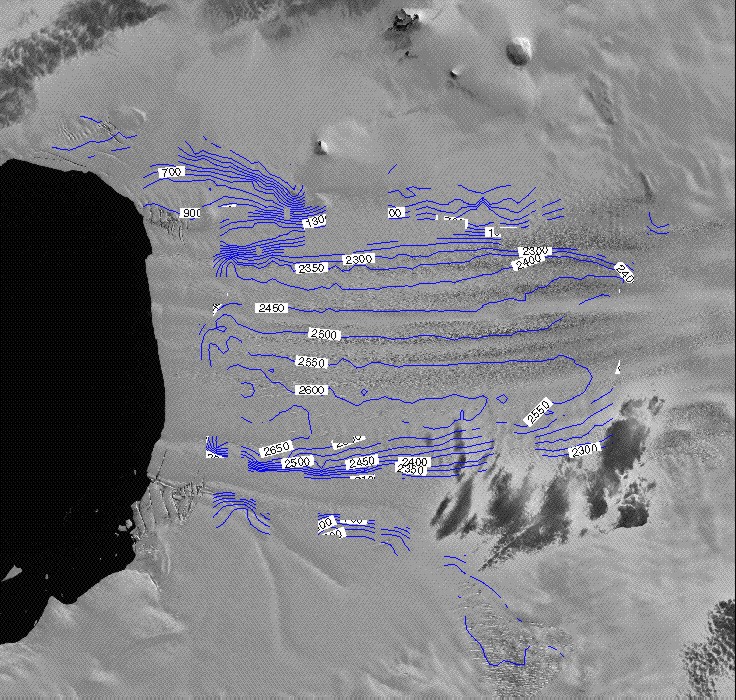
EDIT Jan.-13: The National Snow and Ice Center estimated speeds of Pine Island Glacier as determined from two LandSat images from 1986 and 1988:

Contours of glacier speeds in meter per year of Pine Island Glacier from 1986 and 1988 LandSat Imagery, National Snow and Ice Center

These speeds are very different, 2-3 km per year versus 1 km in 12 days. The former estimate is made from 2 carefully geolocated images 2 years apart without a crack across the floating glacier, while my estimate yesterday is more noisy, but it is for a segment of the glacier that is barely connected to it. Perhaps we should consider the segment seaward fo the crack a separate ice island that is moving with the ocean rather than the glacier?

New Ice Island Forming at Pine Island Glacier, Antarctica

A new ice island is about to form as spring and summer arrive in Antarctica. NASA researchers working on Pine Island Glacier (PIG) as part of the IceBridge Mission discovered a 30 km wide rift some 25 km from the ocean during overflights in a DC-8 research aircraft.The rift will eventually will break off into a tabular iceberg about 10 times the size of Manhattan. The rift is wide enough to be visible in optical satellite imagery that has a spatial resolution of 250 meters. A BBC report credits NASA scientist stating that this large calving of an ice island is part of a natural, roughly decadal cycle.

Pine Island Glacier from MODIS/Terra with crack visible at 250-m spatial resolution.

A crack runs across the floating ice shelf of Pine Island Glacier in Antarctica, seen from NASA's DC-8 on Oct. 14, 2011. Credit: Michael Studinger/NASA

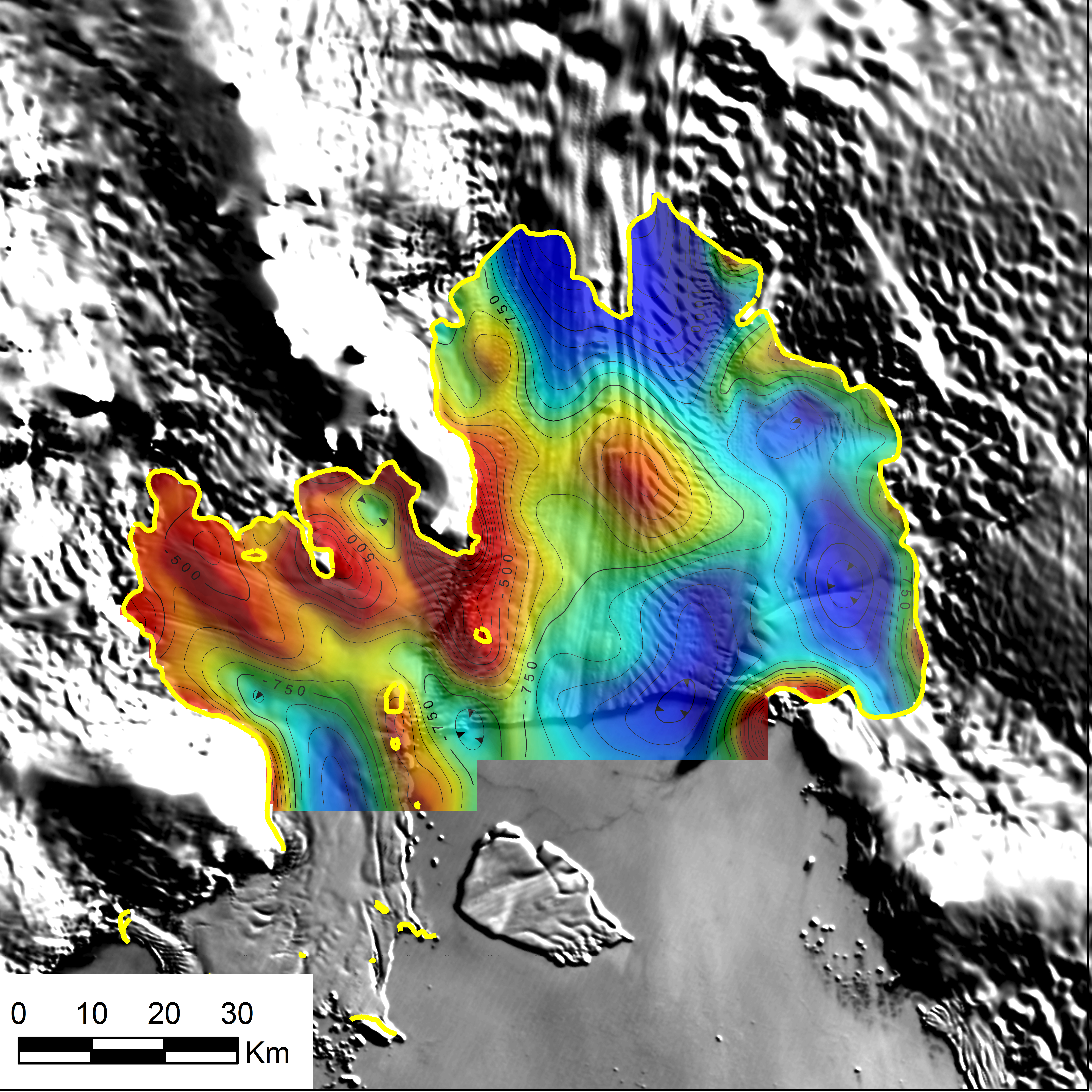
Antarctic massive ice sheets contain 70% of all freshwater and 90% of all ice on earth. Most of this is contained within the stable East Antarctic ice sheet where temperatures have increased little. In contrast, the West Antarctic ice sheet has seen warming by about 0.2 degrees Celsius and a net loss of ice to raise global sea level by perhaps 2-3 inches in 100 years. The grounding line Pine Island Glacier (where ocean, bedrock, and ice meet) has retreated for several decades as warmer ocean waters near the bottom cross a sill and plunge into a landward depression of the bedrock. This leads to enhanced melting of the floating ice-sheet and a potential instability that could lead to a collapse of the ice-shelf and much enhanced discharge of the Pine Island Glacier to draw down a large fraction of the West Antarctic Ice Sheet.

Bottom topography under Pine Island Glacier and grounding line. Blue colors show greater depths and its connection to the open ocean (bottom, north). (credit: NASA)

A similar physical process, albeit at a smaller scale, is potentially working at Petermann Glacier off Greenland where the grounding line is at a local maximum of bedrock elevation. Petermann’s grounding line has probably not moved substantially the last 100 years or so.

More detail on the evolving Pine Island Glacier, Antarctica event can be found at a NASA media briefing.

Why Petermann Glacier and Fjord?

The National Science Foundation (NSF) declined to fund a Physical-Ocean-Ice-Shelf-Experiment (POISE) at Petermann Fjord in northern Greenland this year. The reviews by three anonymous peers, a panel of eight scientists, and two sympathetic program managers were all very good, but not without criticism.

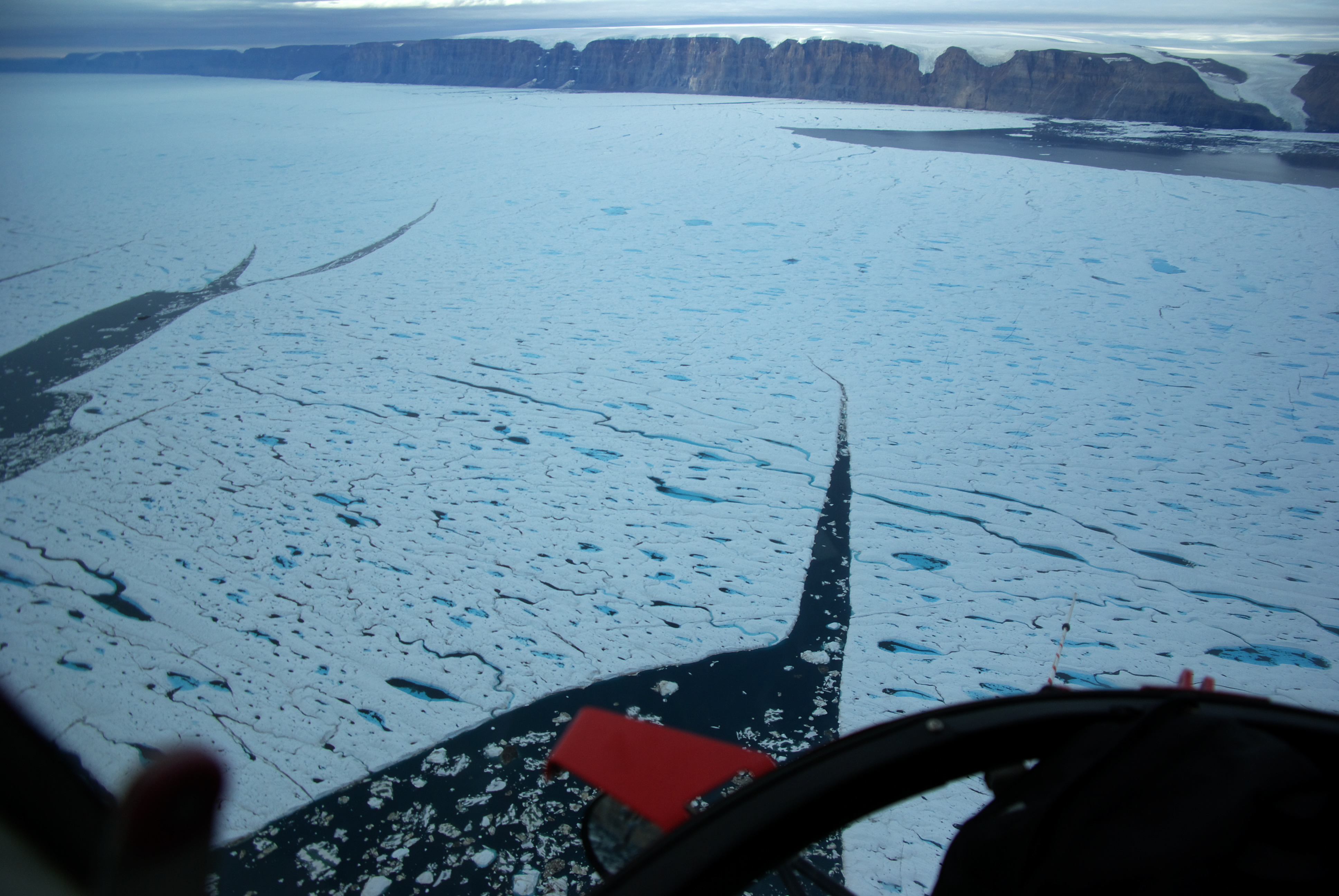
Floating ice shelf of Petermann Glacier in August 2009 as seen from a helicopter of the Canadian Coast Guard Ship Henry Larsen. View is to the south-east with the glacier to the left and the ocean to the right. Photo by David Riedel, British Columbia.

Our admittedly expensive 4-year proposal was rejected along with at least five competing proposals in the same general subject area, because we did not show why a study of ice-ocean interaction of glaciers and ice-sheets has to take place at Petermann Glacier, a remote location less than 800 miles from the North Pole. Claiming this glacier to be unique, we made a fatal mistake, because NSF cares little about each glacier, but cares much about the underlying physical problem, that is, how do tidewater glaciers with floating ice shelves interact with the ocean they float on.

There are several glaciers in Greenland that have extensive ice shelves. To the best of my knowledge, they are all in northern Greenland. Nioghalvfjerdsfjorden and Petermann Fjord contain the largest floating areas exposed to the oceans on the east and west coasts of Greenland, respectively. Both these glaciers have seen preliminary studies during the last 15 years including radar measurements that describe the geometry of the ice shelves, the bedrock below, as well as the ice streams to connect the glaciers to the inland ice. Smaller and less studied glaciers with past or present ice shelves are Steensby, Ryder, and C.F. Ostenfeldt in the north-west as well as Academy and Marie-Sophie glaciers in the north-east (Weidick, 1995).

The most extensive ice shelves are located around Antarctica, however, and one thus may wonder, what uniform physics can and should be studied in northern Greenland that also applies to the ice sheets in the south? I would need some scaling law or normalization scheme that connects many glaciers into an organizational scheme. In physical oceanography the near-balance of a density-driven (internal) pressure gradient and the effects of a rotating earth provides a dynamical scale that connects river discharges off Delaware, with ice patterns off Eastern Greenland, and algae bloom patters off northern Norway, among many other phenomena. What dynamical metric connects the ice sheets of Greenland to each other and to those off Antarctica?

Ice Islands, Oil Fields, and Sea Level

A piece of ice, the size of four Manhattans, is heading our way. It broke free from northern Greenland last summer and has become home to seals and sea life off Labrador and Newfoundland, Canada. Ocean currents continue to propel it towards Hibernia oil fields and the rich fishery grounds of the Grand Banks. It is a tourist attraction as well.

Ice Island off Labrador 20 km from the coast in water 100-200 m deep (from Terra/MODIS).

This largest break-up from Greenland for at least 80-years has raised fears, that a warming climate will raise global sea level. While melting all of Greenland’s ice sheet would increase sea level in Delaware and Bangladesh by over 20 feet, this is unlikely to happen for the next 500 years. But how much does Greenland melt now? How much will our local sea level change the next few years as a result? Will it be inches or feet by the end of this century?

In order to answer these questions, we need to understand how the melting of Greenland’s ice works, if it melts all the time, if it melts everywhere, and if its melting is accelerating. We all know that glaciers grow when snow accumulates atop and shrink when icebergs break off. As big as the ice island from Petermann was, it contributes only a seventh to Petermann’s normal overall loss. Ocean warming and circulation cause most of the rest. During both the cold darkness of winter and bright coolness of summer, the ocean melts the most ice below the surface where it is thickest.

Furthermore, this melting can accelerate ice streams discharging ice hundreds of miles inland when thrown off-balance. Presently, these ice streams are held in place by a delicate balance of forces at the point where ocean, glacier, and the bottom meet. If this triple intersection of water, ice, and rock retreats into an existing landward cavity, then ocean water will rush in, enhance ice-ocean contact, increase the rate of melting, collapse the ice shelf, and thus raise global sea level. That’s bad for Delaware and Bangladesh, because it increases coastal erosion, flooding, and loss of wetlands that are nurseries for fish, crab, and shrimp.

Ice islands breaking off Greenland are visible and dramatic, but the cost of them breaking oil rigs off Newfoundland are small compared with the costs of rising sea level due to accelerating ice streams and disintegrating ice shelves. These sucker punches will be costly for us in Delaware and Bangladesh. An ice island or two … pocket change.