Tag Archives: climate

Melting Mountain Glaciers: Changing Planet Video

A short video clip explains in stunning clarity how mountain glaciers change. The example is Mount Kilimanjaro in Tanzania, Africa. The video is produced professionally by NBC and NSF and contains actor Gregory Peck, writer Ernest Hemingway, as well glaciologists Lonnie Thompson and Douglas Hardy.

Lonnie Thompson has perhaps traveled the world for ice cores and published its science implications more extensively than anyone else. At a recent meeting in San Francisco I heart him deliver an engaging and fun presentation. His writing is most accessible in terms of clarity and context.

Thompson, L. (2002). Kilimanjaro Ice Core Records: Evidence of Holocene Climate Change in Tropical Africa Science, 298 (5593), 589-593 DOI: 10.1126/science.1073198

Rising Seas, Storms, and Flooding

Ocean waters are rising and flooding inland waters in Delaware and elsewhere. Some of this is perfectly regular and normal such as the up and down of the tides. Some of it is irregular and normal such as caused by storms, river discharges, waves, and weather. And some is caused by global warming as we continue to burn coal and oil to power our economies. Lets have a quick look at what all this looks like and try to put this into some perspective, but Sandy’s 5.3 feet surge last monday was second to the 5.5 feet surge that hit Lewes in 1962.

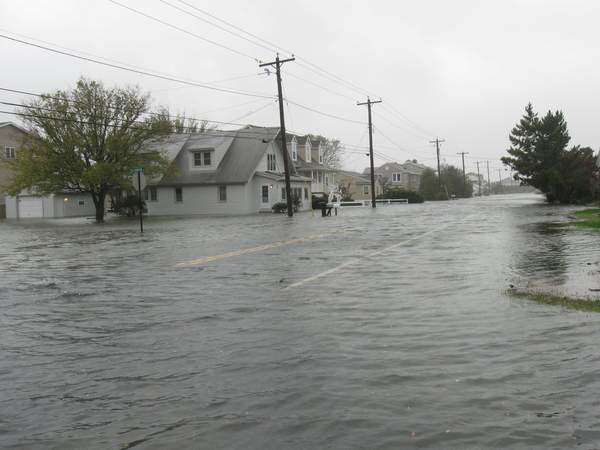
Cedar Street in Lewes flooded on Monday, October 29. (Photo by: Don Bland), as published by Cape Gazette.

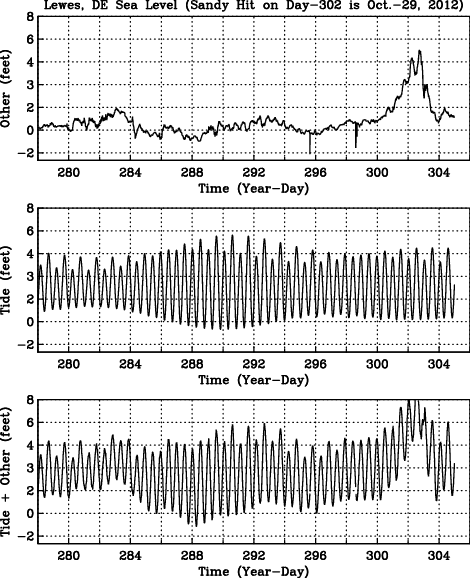
The up and down of the tides each day is about 3 feet in Lewes, Delaware. This large change in sea level is so regular, normal, and predictable, that I remove it from all further discussion, because I want to know how extreme an event this week’s storm Sandy was. For this purpose I downloaded all the hourly tide gauge data from Lewes, Delaware from NOAA. The record starts in 1957 and is ongoing. Here is how the record looks for the last 4 weeks including the surge caused by Sandy last monday:

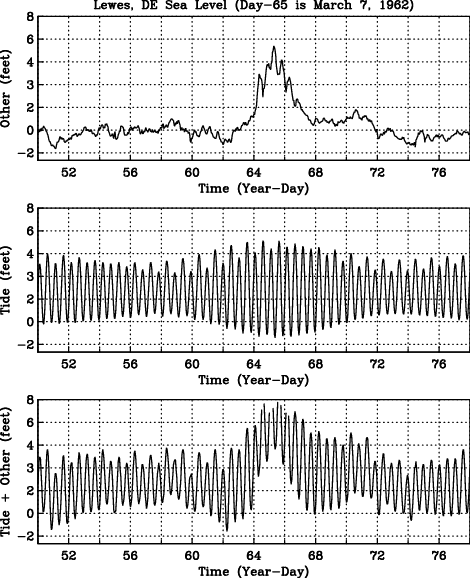
Sandy’s storm surge added 5.3 feet to the regular tide which is second-largest surge in the historical record. The largest surge at Lewes, DE was caused by the 1962 Ash Wednesday Storm that added 5.5 feet to the regular sea level:

So while Sandy was a very large surge, it was neither unprecedented nor a once in a century event. Furthermore, and this is where I come back to global warming, the 5.3 feet 2012 surge of Sandy includes the last 50 years of steady sea level rise which comes to about an inch every 10-15 years or about half a foot in the ~50 years between 1962 and 2012. So, a repeat of the 1962 storm system would cause a 6.0 feet and not the 5.5 feet surge that took place in 1962.

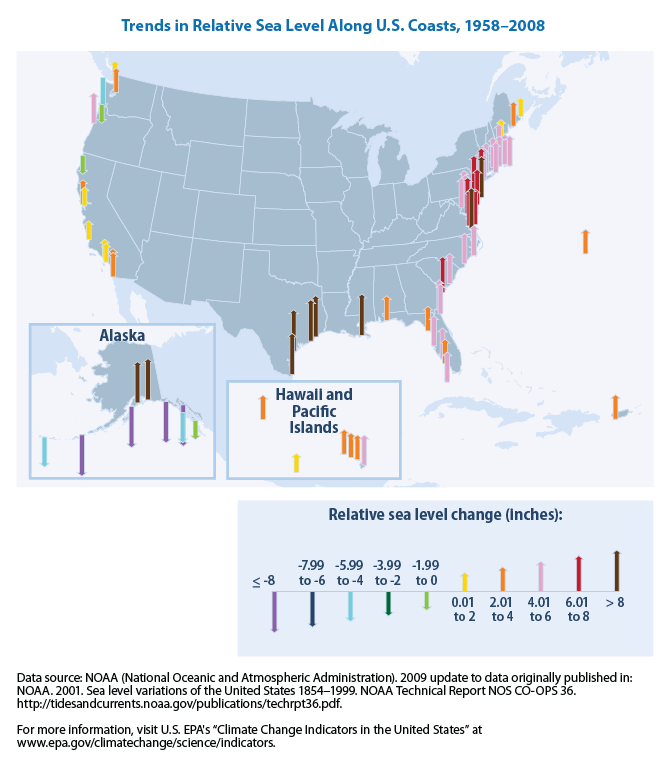
Furthermore, while the real size of the surge depends on where the center of the storm makes land-fall or where you are relative to the storm, the rising seas caused by global warming are much more uniform, that is, they are little different in Boston, New York, Lewes, Norfolk, or even San Francisco:

So, global warming and the rising seas it causes are both real and here to stay. Global warming provides the upward creeping background sea level to which larger tides, waves, and surges add. The combined effect of all these cause the coastal flooding. So 50 years from now, a rare, but perhaps perfectly natural freak storm like Sandy will cause a storm surge of 5.8 instead 5.3 feet on account of global warming. About 1/3 of this added sea level is caused by the oceans expanding as they warm, another 1/3 is caused by melting glaciers and ice sheets in Greenland and Antarctica, and the last 1/3 is caused by other processes. So, what happens on Greenland or China does not stay there, it impacts present and future sea level in Lewes, DE.

Arctic Ice Cover and Petermann Fjord, Glacier, and Ice Island Video Footage

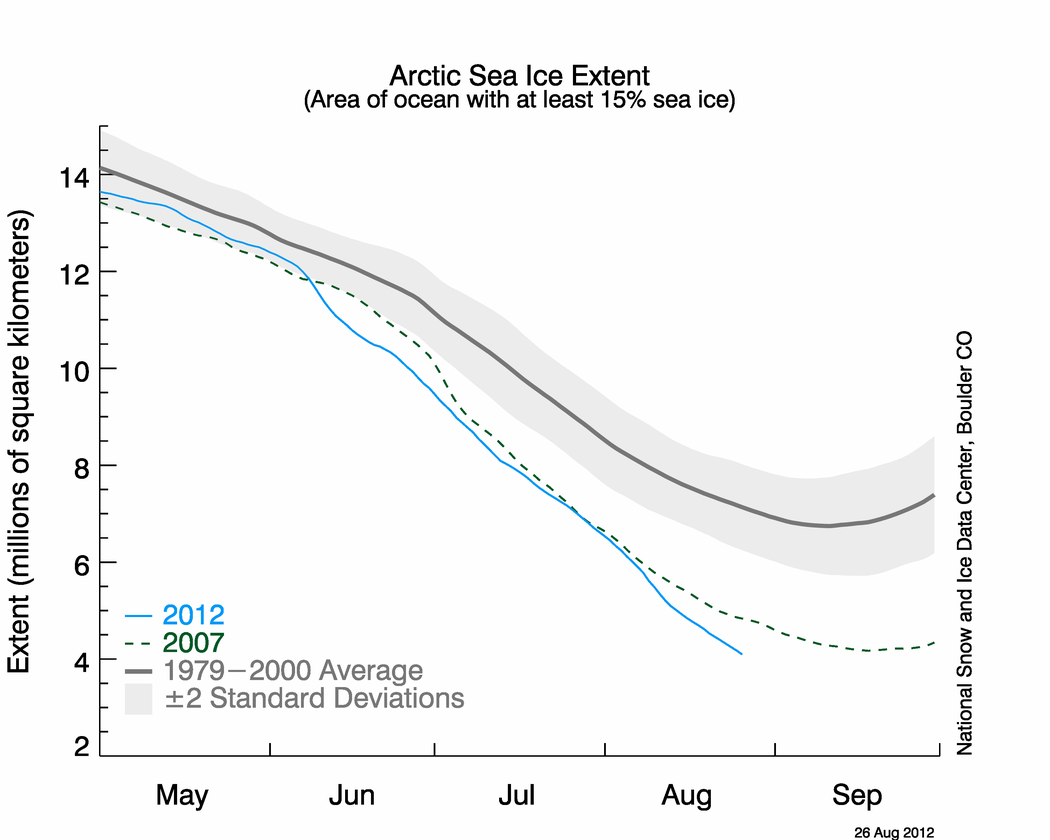
The National Snow and Ice Data Center announced today, that the Arctic Ice Area Extent has reached an absolute minimum breaking the record minimum of 2007 with still several weeks of potential melting and retreat to go. This has been anticipated for many weeks now with perhaps the most extensive coverage and intelligent discussions over at Neven’s Arctic Sea Ice Blog.

The graph above shows Arctic sea ice extent as of August 26, 2012, along with daily ice extent data for 2007, the previous record low year, and 1980, the record high year. 2012 is shown in blue, 2007 in green, and 1980 in orange. The 1979 to 2000 average is in dark gray. The gray area around this average line shows the two standard deviation range of the data. The 1981 to 2010 average is in sky blue. Sea Ice Index data. [Credit: National Snow and Ice Data Center]

This is as big a deal, because an ice-covered ocean reflects much more sunlight back into space in summer than a black ocean does that absorbs more heat: a positive feedback. This is why people in hot climates wear white, not black clothes, they like to stay cool. Furthermore, this decline has been ongoing for the last 30 years and the climate models that policy makers rely on did not predict this level of ice cover to occur for another 20-30 years. So, the warming climate and the changes it caused are on an accelerated schedule with regard to the Arctic Sea Ice cover. Also, the remaining ice cover is thinner than it used to be, because the multi-year ice keeps leaving the Arctic faster than it can be formed inside the Arctic. Both the Fram Strait to the east of Greenland and Nares Strait to the west of Greenland export this old, hard, and thick ice that ultimately melts further south. The ice that is left in the Arctic Ocean has become both thinner, younger, and softer, making it easier to melt the next summer.

On somewhat related news from the University of Delaware (UDel), we put two videos together that show a tiny, if spectacular example of a different area that has never been ice-free for at least 150 years when people were looking: Petermann Fjord. On August 10/11, 2012 the Captain and crew of the Canadian Coast Ship Henry Larsen gave us unfettered 18 hours access to the newly ice-free waters of this large glacier that discharges about 6% of the Greenland ice sheet. The UDel press release has the video that is also posted at youtube. As a less professionally assembled version is my first introductory iMovie project, e.g.,

Nares Strait 2012: Weather Stations and Polar Bears

Weather stations offer basic information that relate to the motion of air, ice, and water. As part of our Nares Strait experiments and expeditions that started in 2003, a group of Canadian, Danish, English, Scottish, and US scientists began installations of a small network of such stations. The first and perhaps most prominent was placed on Hans Island which was a joint Danish and Canadian operation with the data hosted in real-time by the Scottish Association of Marine Science (SAMS, they also host data from Littleton Island on Greenland). This station was refurbished about 10 days ago from the Canadian Coast Guard Henry Larsen:

Dave Riedel (kneeling) and Don Dobbin (standing) on Hans Island during routine maintenance of the weather station. View is across Nares Strait with Ellesmere Island, Canada is towards the north-west. [Photo Credit: Allison Einolf, University of Delaware summer undergraduate intern from Macalaster College.]

Another weather station was placed last week by Dave Riedel and Ron Lindsay with the helicopter pilot Don Dobbin on Brevoort Island, Canada. Dave, who is shown above at the Hans Island weather station just posted his account and close encounters with two polar bears at the University of Oxford’s Arctic Ocean Research page. As a teaser I show the island as seen from the helicopter. Can you find and see the two polar bear in this photograph?

Bears on Brevoort Island, Ellesmere Island during the installation of an automated weather station on Aug.-13, 2012. Photo credit: Dave Riedel, British Columbia as posted at University of Oxford’s Arctic Ocean Research.

The data from the two “new” weather stations at Brevoort Island, Canada at the entrance to Alexandra Fjord and Joe Island, Greenland at the entrance to Petermann Fjord have real-time satellite data download capabilities, but these will need to be turned on from British Columbia by David Riedel and Canadian colleagues. I am not sure if they made it home when we parted yesterday night at Ottawa International Airport when they still had to make 2 or 3 connections to get home after being in the air or in transit for 3 days. More on the fun and adventure of traveling in the far north is reported by Dr. Renske Gelderloos in her blog post today at the Oxford site also. I suspect, that she wrote while being stranded somewhere between Ottawa and London.

Greenland’s Warming, Melting, and Sliding to Sea

Greenland is warming, Greenland’s warming is melting its ice, and Greenland melting ice is raising global sea level. All true, but it all has happened before during the last 100 years or so. Our technology to extract small signals buried deep in noise from both our backyard and remote Greenland is unprecedented. This skill should not fool us, that the large changes that we see in Greenland and elsewhere have not happened before. They have, but memory is a fickle thing, as “new” is exciting, while “old” is often forgotten and considered unimportant. Those who live in the past are doomed to miss the present, those who ignore the past, are doomed to repeat it. We need to learn from the past, live in the present, and prepare for the future.

Preparing for an expedition to Nares Strait between northern Greenland and Canada in about 5 weeks, I am exploring temperature data from land, satellites, and ocean sensors to get a feel for what has changed. I started with data from weather stations such as the U.S. Air Force Base Thule , Canada’s former spy station Alert, and Denmark’s Station Nord about 700-1000 miles from the North Pole. So, it is cold up there:
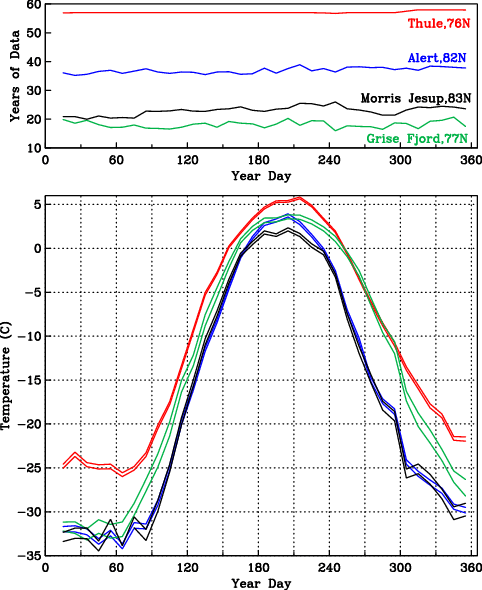
Annual cycle of air temperature (bottom panel) from south to north at Thule (red), Grise Fjord (green), Alert (blue), and Cap Morris Jesup. Data years (top panel) for each year day are degrees of freedom. For each place two temperature curves indicate upper and lower limits of the climatological mean temperature for that day at 95\% confidence.

Well, we knew that, but the real question is: Has anything changed? Has Global Warming reached Greenland? The plot above does not tell, but this one does:
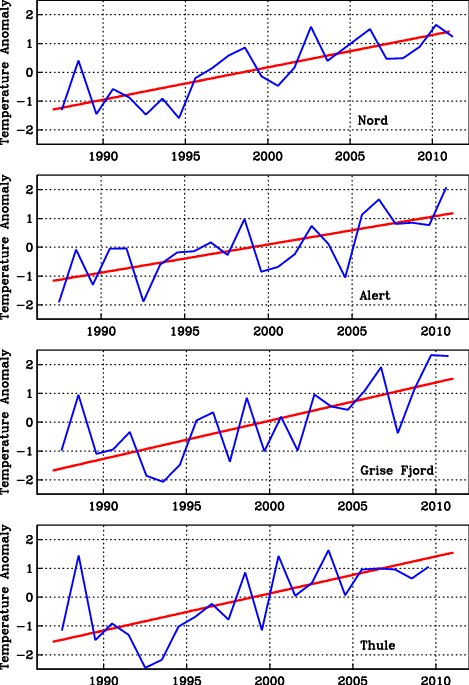
Annual averages and trends of air temperature anomalies for the 1987-2010 period for (top to bottom) Station Nord (Greenland), Alert (Canada), Grise Fjord (Canada), and Thule (Greenland). Scales are identical. The trends are fitted to daily, not annual data. The annual averages are shown for display purposes only.

To some it screams: “Warming, melting, Greenland is surging to sea.” [It is, but it did so before.]

There is lots of fancy signal processing that goes into this (see Tamino or a class I teach) to make a firm statement:

The air around northern Greenland and Ellesmere Island has warmed by about 0.11 +/- 0.025 degrees Celsius per year since 1987. North-west Greenland and north-east Canada are warming more than five times faster than the rest of the world.

This must be huge (yes, it is), it must have an effect on the Greenland ice sheet (yes, it does), and this must raise sea level (yes, perhaps 10 cm or 3 inches in 100 years, Moon et al., 2012).

Now where is the catch?

The catch is that my records all start in 1987, because that is the period for which I have actual measurements from all those stations. My satellite record is even shorter: it starts in 2000, but with lots of work can be extended back to 1978. And my ocean record is shorter yet: it starts in 2003. There just are no other hard data available from north-west Greenland.

So, does this mean we are stuck with the gloom and doom of a short record?

No, but we have to leave the comforts of hard, modern data with which to do solid science. People have to stick out their necks a little by making larger scale interferences. Based on the 1987-2010 results shown above, I can now say that trends and year-to-year variations are all similar in Alert, Thule, Kap Morris Jesup, etc., etc., so I will use the 60 year Thule record to make statements that somewhat represent all of Nares Strait. I could also start looking for softer and older data. With soft data I mean sketchy ship logs kept by whalers, tense expedition reports of starving explorers (Lauge Koch, Knud Rasmussen, Peter Freuchen), and imperial expeditions (George Nares, Adolphus Greely).

Further south there are a few ports where government or trading authorities started records early. The current capital of Greenland, Nuuk (formerly Godthab) is such a place. The Nuuk record starts 1881. And what I find is that the current warming in Greenland has happened just as dramatic as it does now in the 1920ies and 1930ies [well, except for the 2010 spike, but that story is still ongoing]:
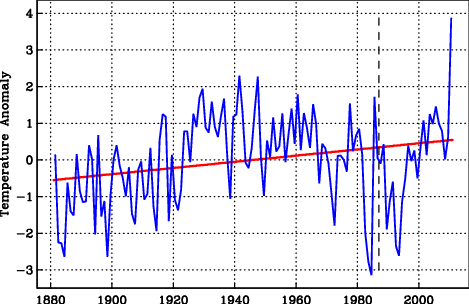
Data from Nuuk, southern Greenland, where the temperature record goes back to 1881 (monthly data from NASA/GISS). The dashed line indicates 1987.

The trend is statistically significant, about 0.008 +/- 0.03 degrees centigrade per year or about 10 times smaller than what it is for northern Greenland starting in 1987. So the devil of Greenland warming, melting, and sliding to sea is in the details or records that are too short. The Global Warming signal is in there, but how much, we do not know and perhaps cannot know. Furthermore, most of the globe of “Global Warming” is covered by water and the ocean warming we know little about. Recall, my ocean record off northern Greenland only starts in 2003 and ends in 2009 or 2012, if we recover computers, sensors, and data from the bottom of Nares Strait this summer.

Greenland’s data and physics of ice, ocean, and air are exciting and all show dramatic change. To me, this is a big and fun puzzle, but one has to be careful and humble to avoid making silly statements for political purposes that are not supported by data. Do I think Global Warming is happening? Absolutely, yes. Do I think it is man-made? Probably. What do I do about it? I ride my bicycle to and from work every day. And that’s what I do next … bicycle home.