Tag Archives: Arctic Ocean

Nares Strait Ice Bridge and Arctic Ice Thickness Change

The ice of the Arctic Ocean is rapidly disappearing. This happens every summer, but for the last 30 years there is a little less ice left at the end of each summer than there was the year before. The areas covered by ice are not only shrinking, the ice is also getting thinner, or so many do believe.

To check out such claims, we placed sound systems on the ocean floor of Nares Strait from which to find out how much the thickness of the ice above has changed. We started this in 2003, were told to stop it in 2009, but privately parked our instruments where they would collect data. We must get to check our sound systems and retrieve the private recordings, because otherwise Poseidon will claim our possessions for parking violations. The Canadian Coast Guard Ship Henry Larsen, we hope, will help us to negotiate water and ice to get us deep into Nares Strait as she and her crew did so well in 2006, 2007, and last in 2009.
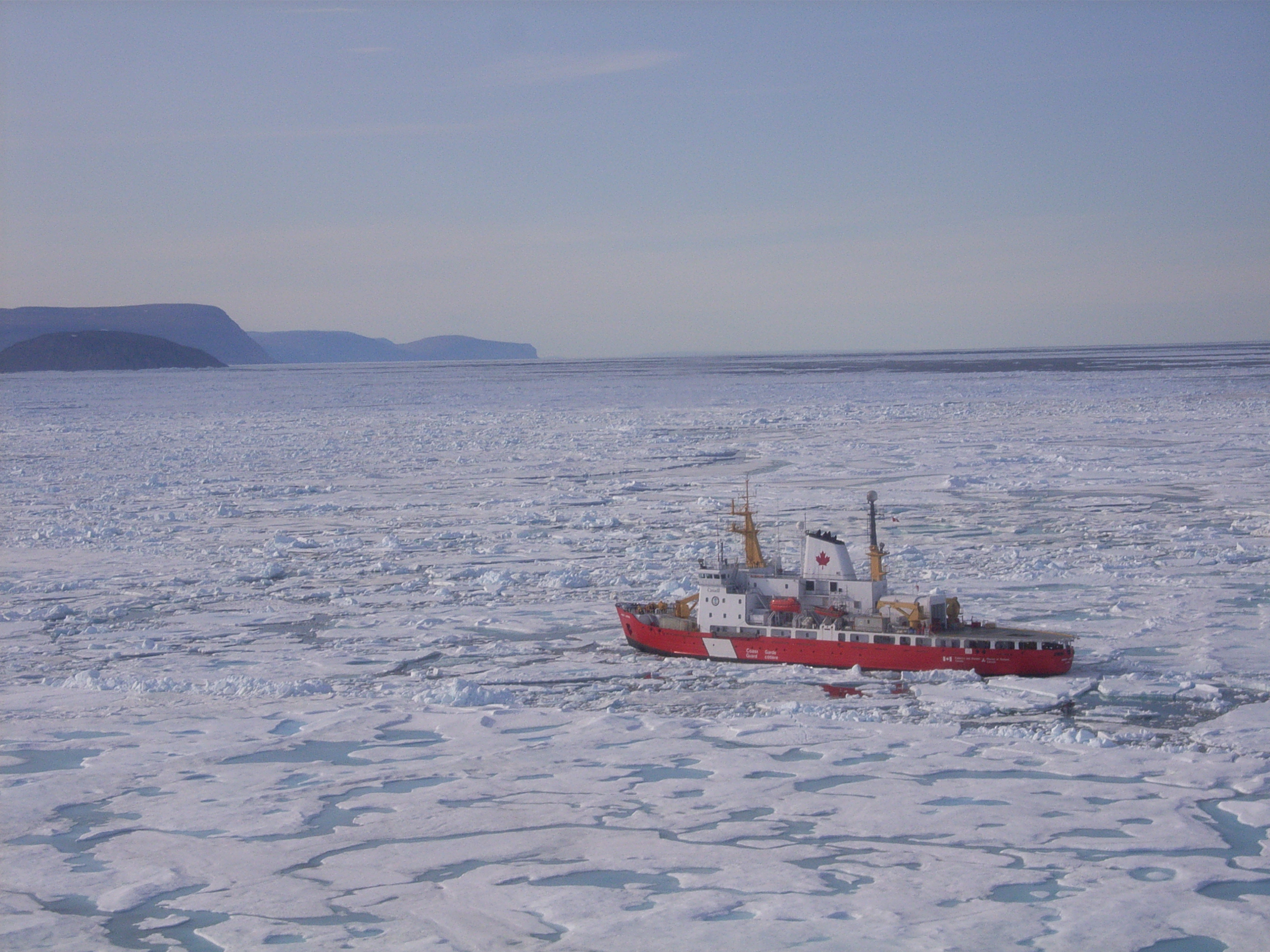
CCGS Henry Larsen in thick and multi-year ice of Nares Strait in August 2009. View is to the south with Greenland in the background. [Photo Credit: Dr. Helen Johnson]
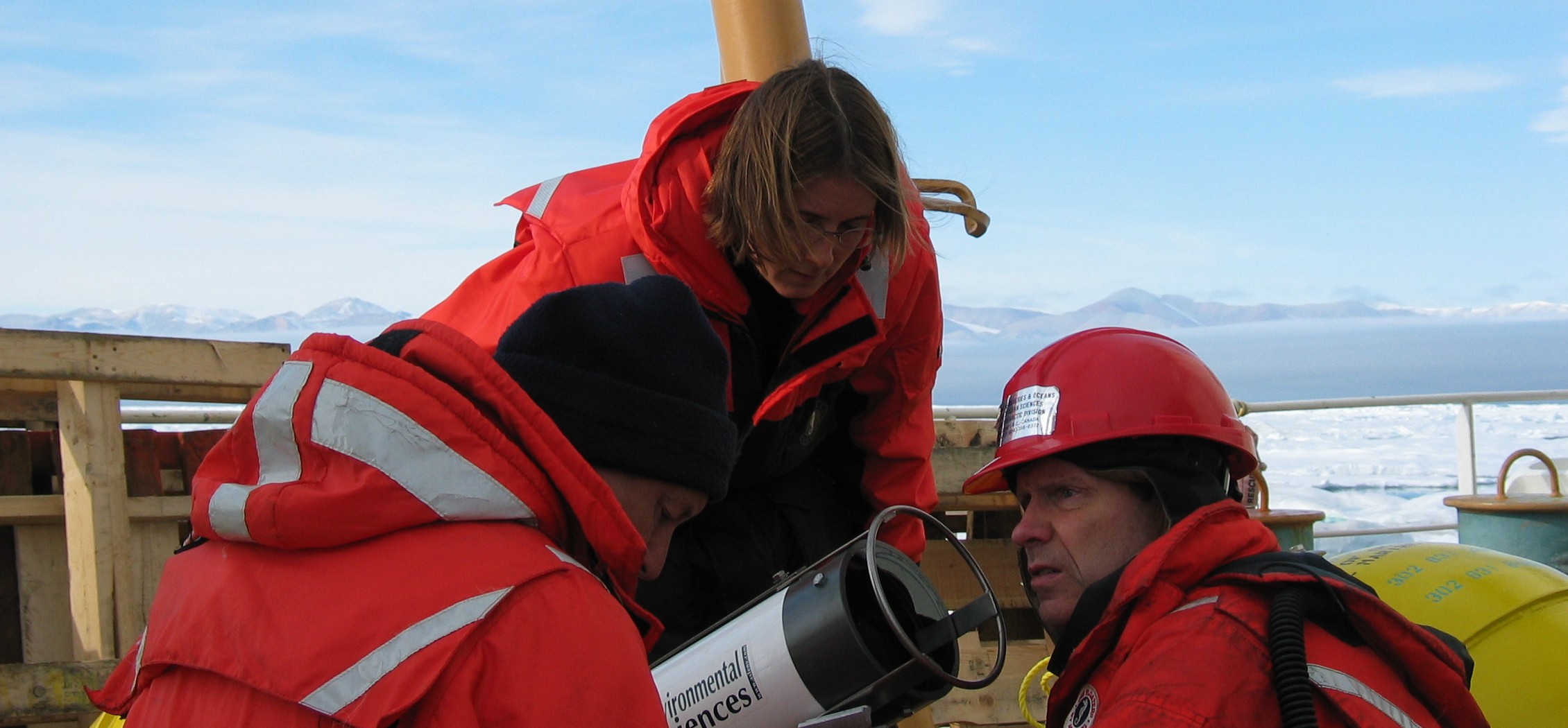
The ice profiling sonar sounds system before its first deployment in Nares Strait in August 2003 from aboard the USCGC Healy. It measure ice thickness many times each seconds for up to 3 years. View is to the north-west with Ellesmere Island, Canada in the background. Listening in are Jay Simpkins (left), Helen Johnson, and Peter Gamble.

Nares Strait to the west of northern Greenland is one of two major gates for the thickest, the hardest, and the oldest ice to leave the Arctic for the Atlantic Ocean [Fram Strait to the east of Greenland is the other.] This gate is closed at the moment by an arching ice bridge that locks all ice in place. No ice can leave the Arctic via Nares Strait as long as these arches hold. The ice arch acts as a dam that holds back the flood of ice that will come streaming south hard once the dam breaks. And break it will, usually between the end of June and July.
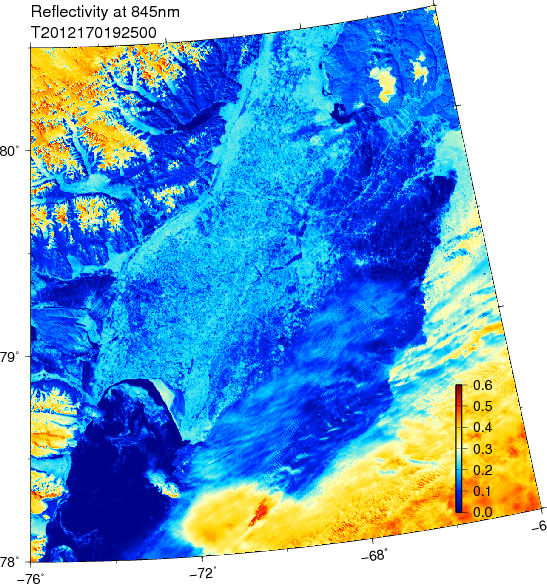
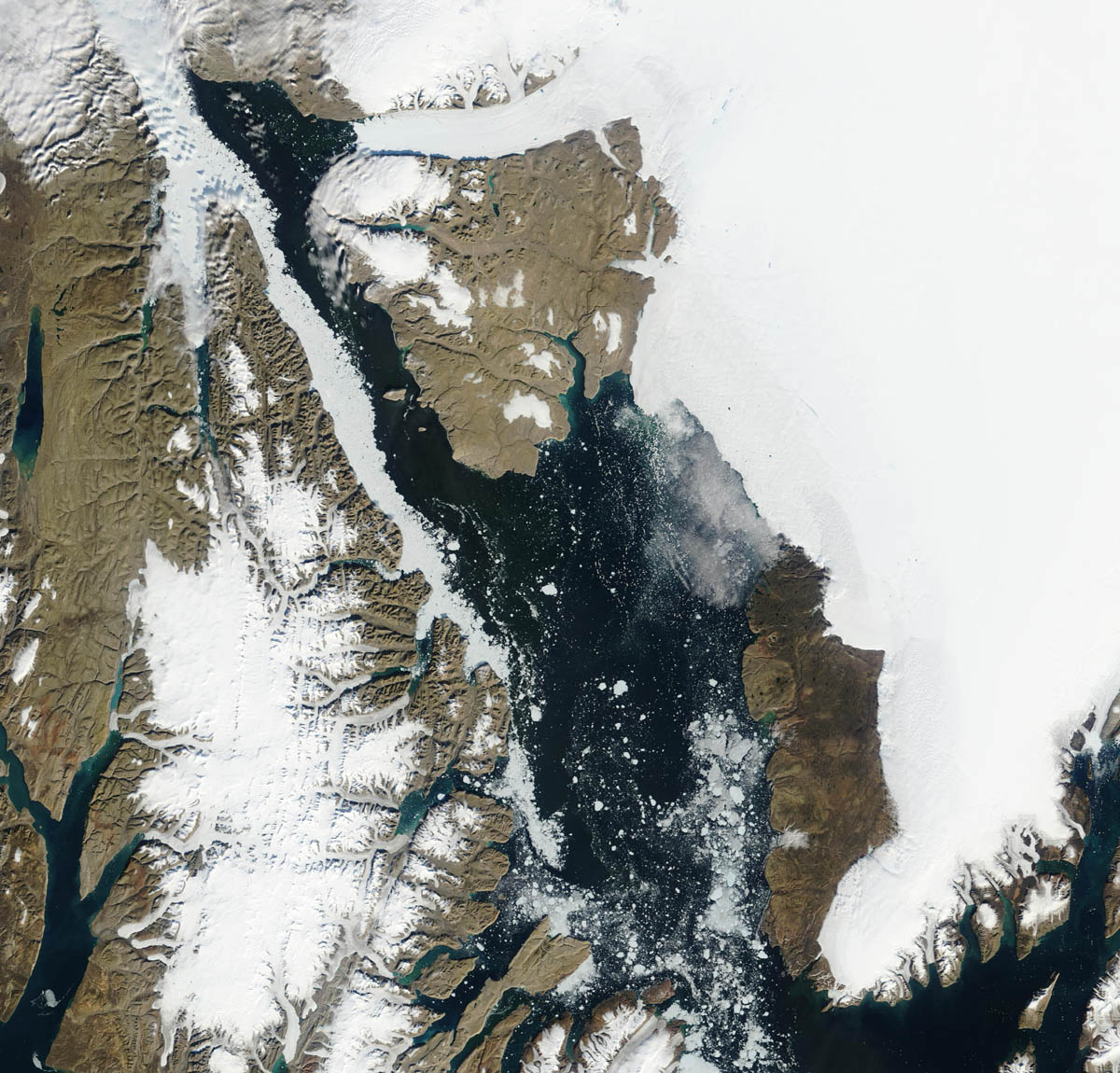
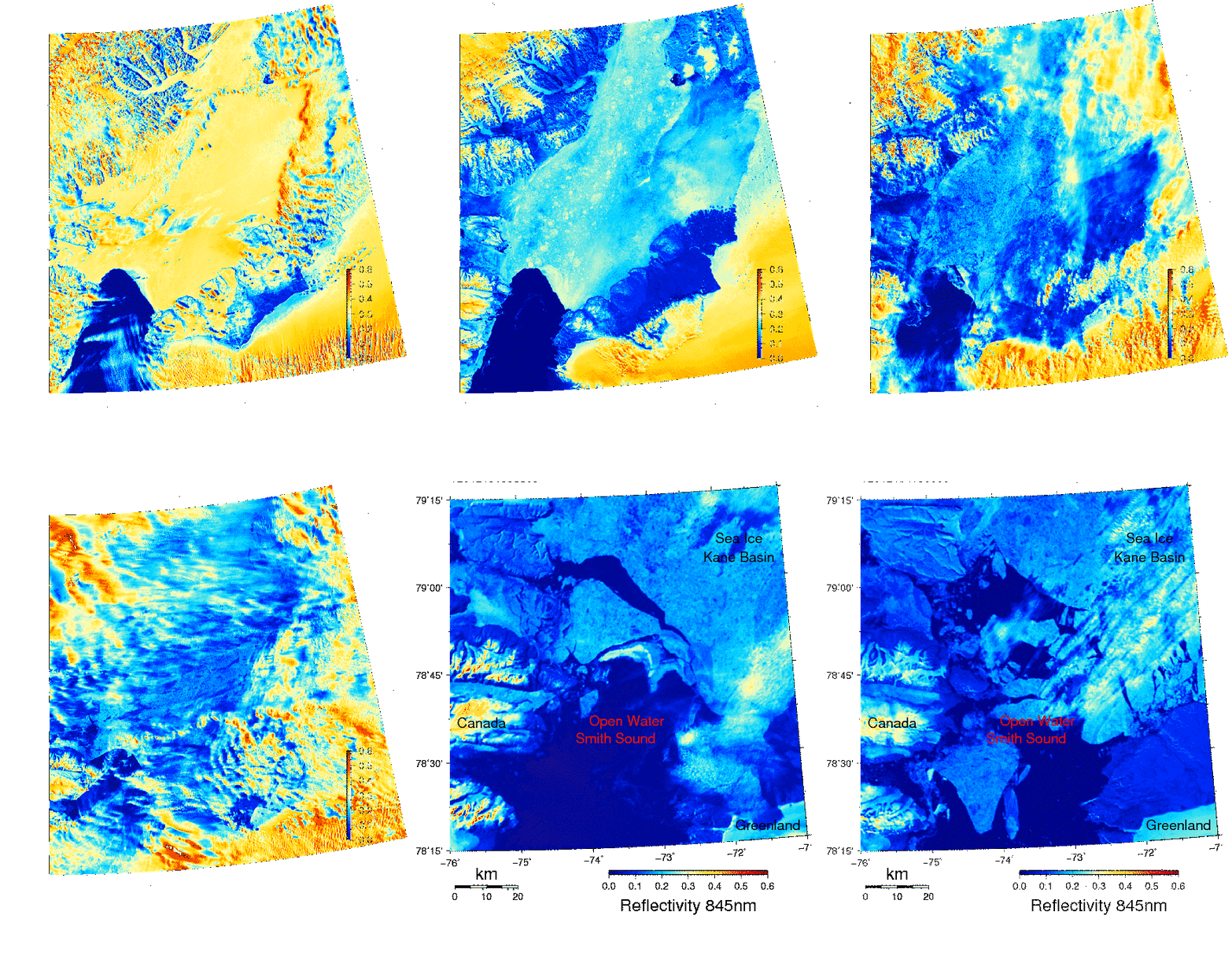
Ice arch in southern Nares Strait as seen by MODIS Terra on June-18, 2012. Greenland is on the right, Canada on the left. The dark blue colors in the bottom-left are open water, yellow are the ice caps of Greenland and Ellesmere Island and lighter shades of blue are warm ice or land. Humboldt Glacier is the on the right-center where Nares Strait is at its widest with Kane Basin at about 80 N latitude.
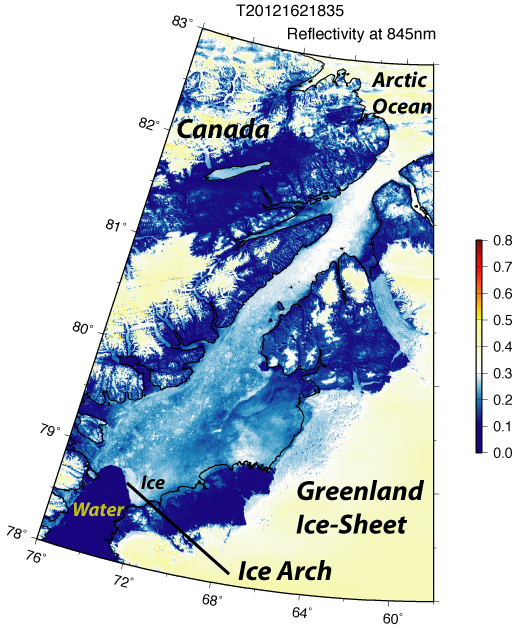
Nares Strait Jun.-10, 2012 image showing land-fast ice between northern Greenland and Canada as well as the ice arch in the south (bottom left) separating sea ice from open water (North Water). The coastline is indicated as the black line.

The sooner it breaks, the more old ice the Arctic will lose and the better it is for us to get an icebreaker to where must be to recover our instruments and data. The data will tell us if the ice has changed the last 9 years.

I processed and archived maps of Nares Strait satellite images to guide 2003-2012 analyses of how air, water, and ice change from day to day. Ice arches formed as expected during the 2003/04, 2004/05, and 2005/06 winters lasting for about 180-230 days each year. In 2006/07 no ice arch formed, ice streamed freely southward all year, and this certainly contributed to the 2007 record low ice cover. In 2007/08 the arch was in place for only 65 days. In 2009/10, 2010/11, and now 2011/12 ice cover appear normal as the arches formed in December and lasted until July.

We live in exciting times of dramatic change, some to the better and some to the worse. Some of the change is caused by global warming while most is probably not. We do not know for sure, but most of the evidence points towards us people as a major driver of the change we observe in the Arctic and elsewhere. Nevertheless, climate and its change is one grand puzzle that no single scientist, no single discipline, no single country, and no single continent can solve. There are many pieces that all contribute to how and why the Arctic ice changes the way it does. And this includes the ice arches of Nares Strait. There are many mysteries and unresolved physics in what makes these ice arches tick and what makes them blow to bits, but blow they will … watch it, it’s fun, and perfectly natural.

EDIT: This movie shows just how stable the ice arch is at the moment.

Moira Dunbar, Arctic Exploration, and Women in Science

Throughout history, the ocean has been the domain of sea monsters, Neptune and men. The women found in nautical history are portrayed as distractions or a sailor’s connection to land.  Robert Louis Stevenson only wrote one female character in Treasure Island, Jim Hawkins’ mother, who only briefly graces the pages with her presence.  Pirates and sailors alike did not tolerate women on ships except for a captain’s wife, mistress, or daughter.

This attitude towards women in sailing continued even after American women were given the right to vote in 1920. Born 2 years earlier in Scotland, Moira Dunbar was an extraordinary woman fighting for her right to go to sea in the name of science.

Originally from Edinburgh, Dunbar emigrated to Canada in 1947, where she studied ice movement for the Joint Intelligence Bureau of Canada. She later moved to the Defense Research Board in 1952, where she fought notions that a woman couldn’t go to the Arctic on reconnaissance planes of the Royal Canadian Air Force. She co-authored Arctic Canada From the Air with Keith R. Greenaway in 1956. She logged over 600 flight hours and became the first woman to sail as part of a science crew on board a Royal Canadian Navy icebreaker.

The M/V Calanus as seen August 2007 in Iqualuit (formerly Frobisher Bay) on Baffin Island. Moira Dunbar published hydrographic data collected off Baffin Island from this ship in 1958.[Photo Credit: Andreas Muenchow]

Moira Dunbar persisted in breaking through barriers traditionally placed on her gender, blazing a trail for women in science and research. She wasn’t satisfied with standing by idle while her male colleagues went to the Arctic to study, in person, what she was researching, so she made her own way.

Since Dunbar’s entrance into the world of polar science, women have faced fewer challenges entering scientific fields, but are still underrepresented. Men occupied 74% of science and engineering jobs in the United States in 2006 according to a 2011 National Science Foundation (NSF) study. Within the sciences, even fewer women are in physical sciences and engineering.

Even though these statistics may appear daunting to a woman entering the sciences, there is good news: the number of women in science and engineering has been increasing steadily for a long time. From 1979 to 2008, the number of women and minorities as a percentage of full-time, full professors with science and engineering doctorates has more than quadrupled.

Every year, more women enter the sciences and my experience reflects this: entering Macalester College, St. Paul, MN in 2009 as a first-year female physics major, I found not a single woman in the graduating class. In contrast, I can now name at least 5 beside myself. And in such a small major (only 15-20 students), 5 is quite a large number. Women are heading out into the world of science, just as Moira Dunbar did more than 60 years ago. I know many women working on ships in both the Pacific and Atlantic Oceans as skippers, scientists, cooks, and engineers, and I am looking forward to boarding a Canadian Coast Guard Vessel later this summer for some Arctic research myself.

Last Image of Nares Strait from Europe’s Environmental Satellite

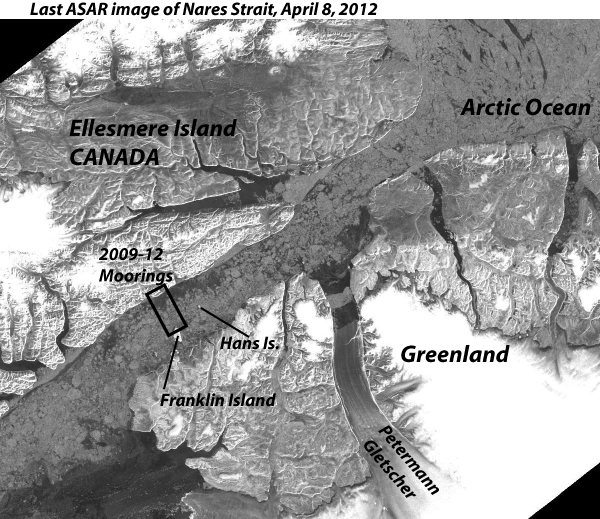
The European Space Agency announced today that one of its primary environmental satellites died. For over a months now engineers could neither receive data nor send commands to the 10-year old veteran of earth science research whose design life was 5 years. The last image received for my study area between northern Greenland and Canada shows Petermann Gletscher and ice-covered Nares Strait:

The rectangle between Franklin Island, Greenland and Ellesmere Island, Canada shows the site where in August 2012 we hopefully will recover data from an array of ice and ocean sensing equipment that we put there in 2009.

It was during this 2009 International Polar Year expedition to Nares Strait that I discovered satellite remote sensing in a new way, that is, accessing the raw digits sent down to earth from the NASA’s Aqua and Terra satellites that contain Moderate Resolution Imaging Spectroradiometer (MODIS) sensors. These two sensors are as old or older than its European companion. MODIS are now the only optical sensors at better than daily resolution which check the land, ocean, and ice now that the European satellite is not talking with us anymore.

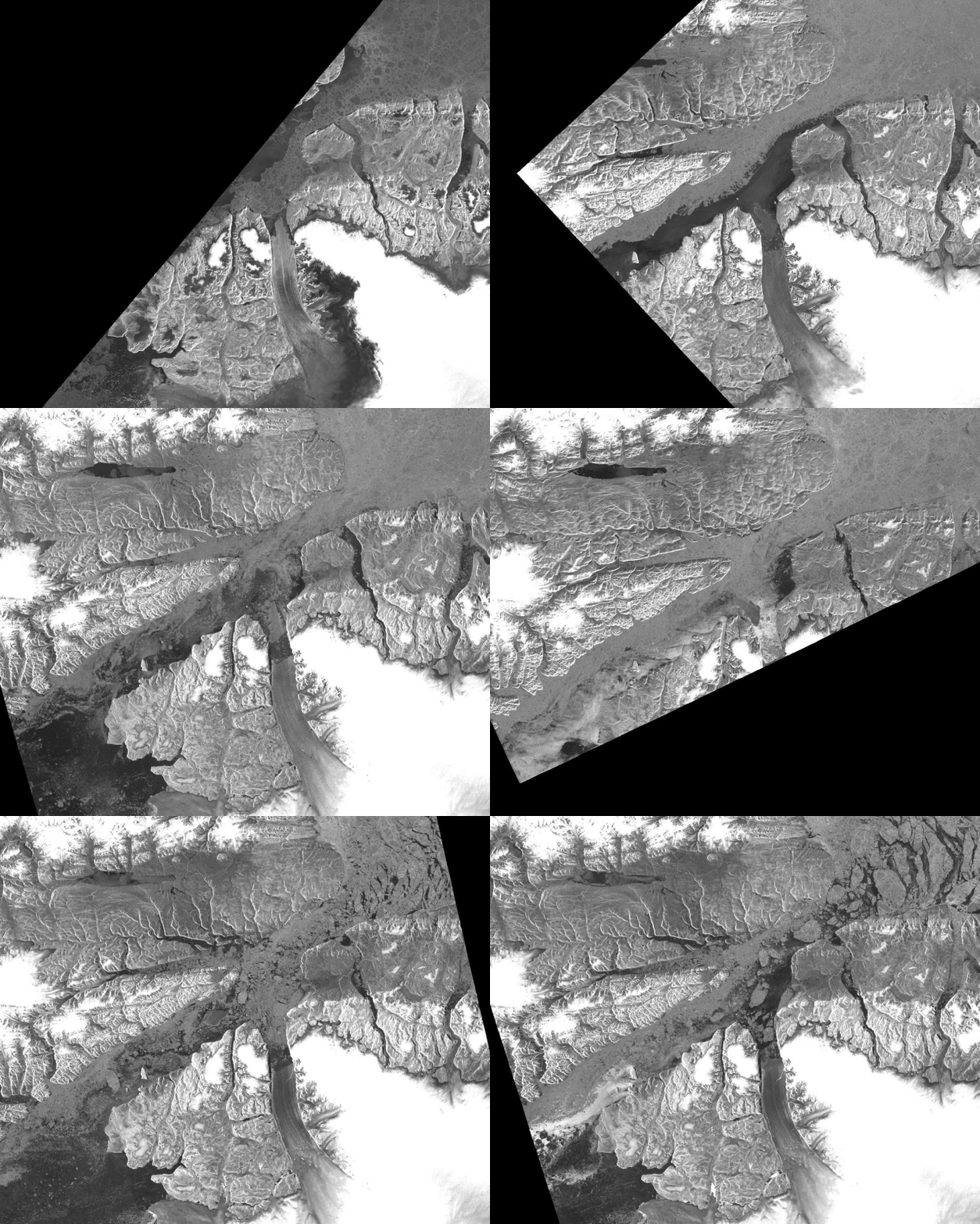
For me, the most spectacular use of Europe’s EnviSat was its ability to document how the 2010 Petermann Ice Island wiggled its way out of its constraining fjord into Nares Strait. A movie of daily radar images is attached:

Petermann Ice Island 2010 slow movement through Petermann Fjord, break-up on Joe Island, and swift movement southward in Nares Strait. Click on image to start movie.

Unlike its Canadian counterpart, RadarSat, the imagery from the European radar (ASAR) was distributed widely, free of charge, and became useful to research communities and a wider public. The Danish Meteorological Institute provides an archive of imagery from both US and European satellites for all of coastal Greenland that just lost its European imagery (http://ocean.dmi.dk/arctic/modis.uk.php). Unlike the now defunct EnviSat, RadarSat is a for-profit commercial enterprise unaffordable to scientists or a public. The Canadian government funded development, launch, and initial data processing before giving it away to a private corporation. Ironically, the largest paying customer for its expensive products is the Canadian Government, but the data are rarely used for public education or research. They may as well be secret.

So, the demise of EnviSat is sad news. It removes a semi-public eye in the sky. Lets hope, that its replacement by the European Space Agency receives the urgent attention that it deserves.

Heat Sensing Eyes “See” Arctic Ice Thickness

The Arctic sea ice is disappearing before our eyes as we extended them into space in the form of satellites. Every summer for the last few years the area covered by ice is shrinking during the summer when 24 hours of sunlight give us plenty of crisp images. But what about winter? What about now? And does a picture from space tell us how thick the ice is?

Nares Strait between northern Greenland and Canada on Aug.-13, 2005 with Petermann and Humboldt Glaciers at top and center right from MODIS imagery using red, blue, and green channels.

It is dark in the winter near the north pole as the sun is below the horizon 24 hours each day, but there are many ways to “see” in the dark as flying bats aptly show. They send out sound that bounce off objects from which bats reconstruct objects around them. We use radar from space to do to the same with radio waves to “see” different types of ice at night from satellites. We can also use tiny amounts of heat stored in water, ice, snow, and land to “see” at night. Someone breathing down your neck at a cold dark corner will make our heart beat faster as we “see” the heat not with our eyes, but with our skin. I digress, as I really want to talk about icy Arctic seas and how we can perhaps “see” how thick it is with our eyes in the sky.

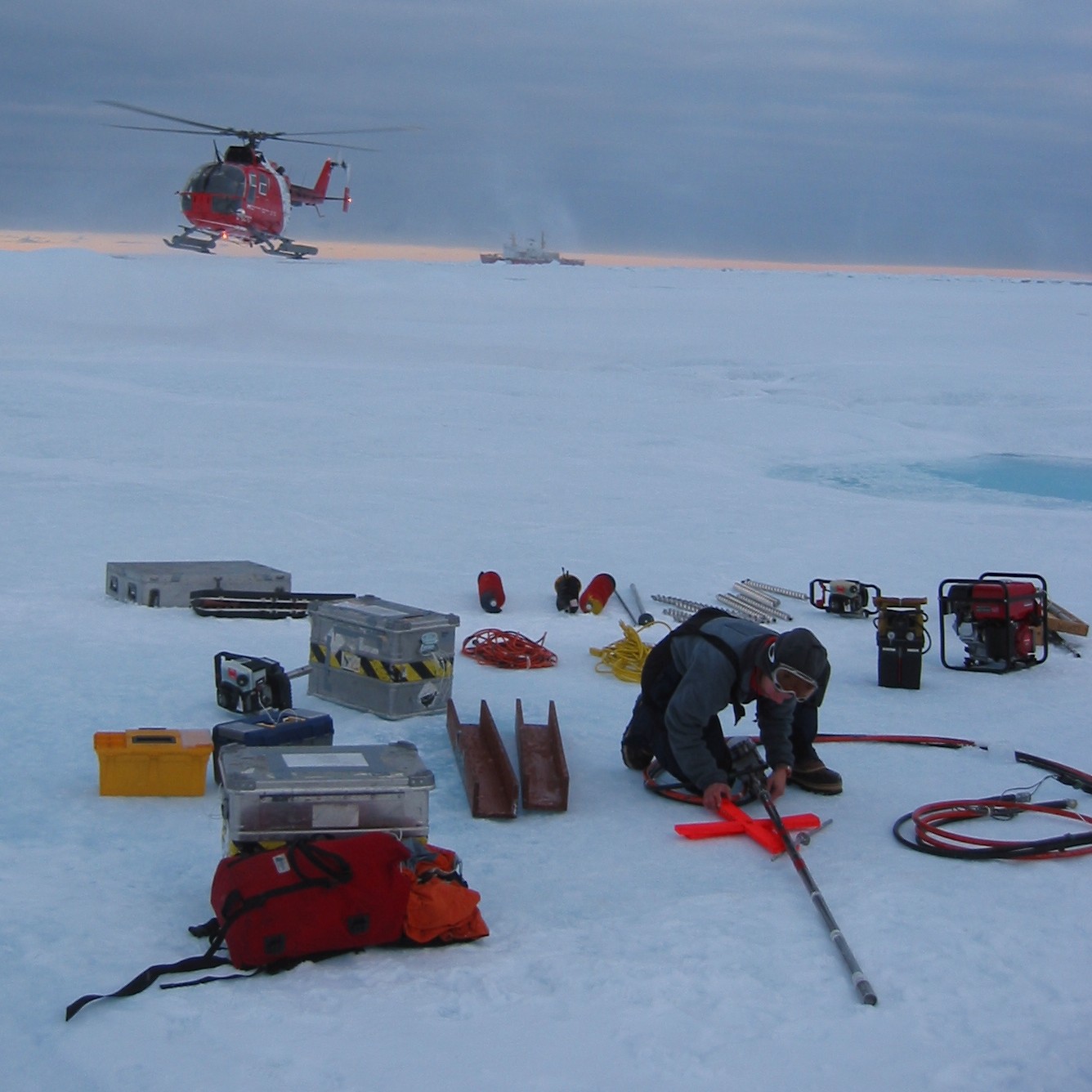
The most accurate and pain-staking way to measure ice thickness is drill holes through it. This is back-breaking, manual labor away from the comforts of a ship or a camp. One person watches with a shot-gun for polar bear searching for food, not our food, we are the food. The scientist who does this sweaty, dangerous work on our Nares Strait expeditions is Dr. Michelle Johnston of Canada’s National Research Council. She is a petite, attractive, and smart woman who is calm, competent, and comfortable when she leads men like her bear-like helper Richard Lanthier into the drilling battles with the ice. She gets dirty, cold, and wet when on her hands and knees setting up, drilling, cutting, measuring:

Dr. Michelle Johnston assembling ice drilling gear in Nares Strait with Greenland on the horizon. The Canadian Coast Guard Ship Henry Larsen in the background with its helicopter hovering.

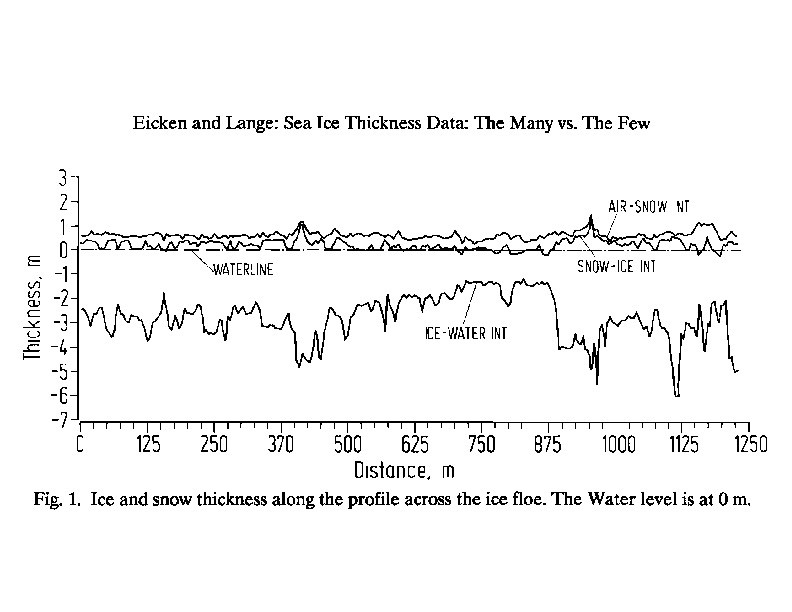
She measures temperatures within the ice and tries to crush it to find out how strong it is. All of this information guides ship operators on what dangers they face operating in icy seas. Drilling over 250 such holes across a small floe on the other (eastern) side of Greenland, Dr. Hajo Eicken showed how one large ice floe changes from less 1 meter to more than 5 meters in thickness. He also discovered that the percentage of thick and thin ice of his single 1 mile wide ice chunk is similar to the percentages measured by a submarine along a track longer than 1000 miles.

This was a surprising result in 1989 and we use it to estimate ice thickness more leisurely sipping coffee in our office. From the same satellite that gives us crisp true color images in summer as shown above, we get false color images of temperature as shown below.

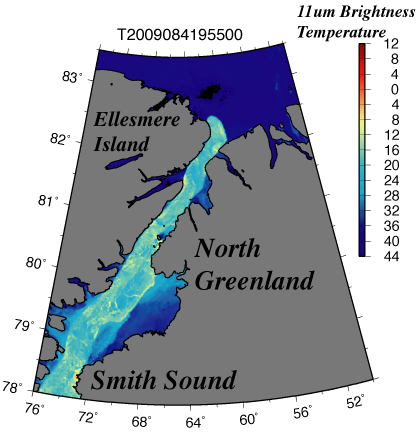
Map of Nares Strait, north-west Greenland on March-25, 2009 showing heat emitted during the polar night from the ocean through the ice, and sensed by MODIS satellite.

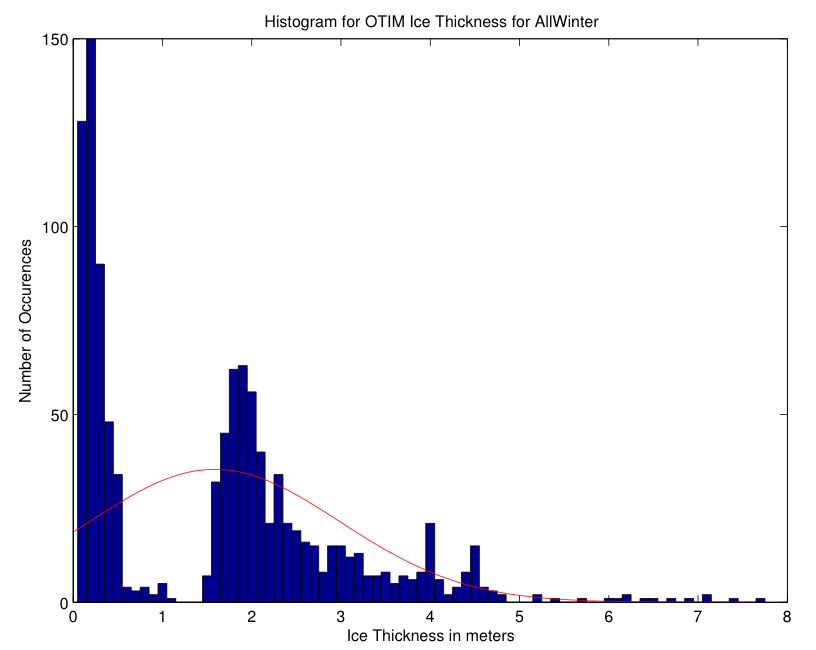
A graduate student of mine, Claire Macdonald, is trying to convert these temperature readings into ice thickness for Nares Strait. She showed me the first promising results today. The plot below shows the distribution of “thermal” ice thickness for a small square in Nares Strait Dec.-1, 2008 through Mar.-1, 2009 when no clouds were in the area. Note the two distinct and separate clusters with thicknesses below 1 meter and above 2 meters. They represent thin ice formed in 2009 after an upstream ice arch blocked all flow of thicker ice from the Arctic Ocean to Nares Strait. The thicker ice passed the study area at times when the thick, hard multi-year Arctic ice entered Nares Strait freely from the Arctic Ocean.

Distribution of "thermal" ice thickness from satellite for Nares Strait Dec.-1, 2008 through Mar.-1, 2009. (Credit: Claire Macdonald, Jan.-26, 2012)

Much work remains to be done: Claire is comparing the “thermal” ice thickness with “acoustic” ice thickness measured by sonars moored in the water below the ice. It then will be exciting to explore “thermal” thicknesses for all of Nares Strait. Winds and ocean currents will pile ice up in some areas making it thicker while they spread ice out making it thinner. Claire and I have worked with such wind and ocean data. Science is never finished as each question answered raises a host of new ones.

Ice Arch off North-West Greenland Locks Ice Motion in Nares Strait

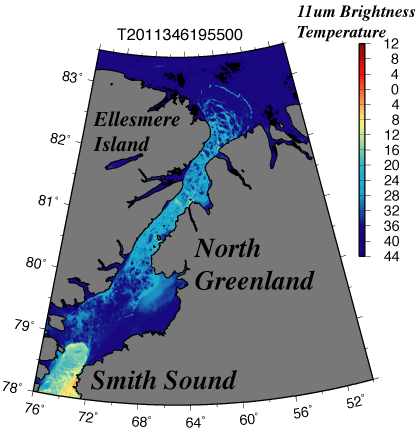
Winter has come to north-west Greenland as the sea ice of Nares Strait has locked itself to land and stopped movement of all ice from the Arctic Ocean in the north to Baffin Bay and the Atlantic Ocean in the south. While there is no sunlight for several more months now during the polar night, the warm ocean beneath the ice emits heat through the ice which becomes visible to heat-sensing satellites. The light yellow and reddish colors show thin ice while the darker bluish colors show thicker ice today:

Dec.-13, 2011 surface brightness temperature of Nares Strait showing an ice arch in Smith Sound separating thin and moving ice (reddish, yellow) from thick land-fast ice (blue).

The prior 2010/11 winter was the first in several years that these normal conditions have returned. The ice arch in Smith Sound did not form in 2009/10, 2008/09, and 2007/08 winters while a weak arch in 2007/08 fell apart after only a few days. Conditions in 2009 were spectacular, as only a northern ice arch formed. Since the ocean moves from north to south at a fast and steady clip, it kept Nares Strait pretty clear of ice for most of the winter as no Arctic ice could enter these waters and all locally formed new “first-year ice” is promptly swept downstream:

March-25, 2009 map Nares Strait, north-west Greenland showing heat emitted during the polar night from the ocean and sensed by MODIS satellite.

The very thin and mobile ice in Nares Strait of 2009 exposed the ocean to direct atmospheric forcing for the entire year. I reported substantial warming of ocean bottom temperatures here during this period. This new 2011/12 ice arch formed the last few days. If it consolidates during the next weeks, then it is very likely to stay in place until June or July of 2012. It decouples the ocean from the atmosphere and, perhaps more importantly, prevents the Arctic Ocean from losing more of its oldest, thickest, and hardest sea ice. This is very good news for the Arctic which has lost much ice the last few years.

For more daily thermal MODIS imagery take a peek at http://muenchow.cms.udel.edu/Nares2011/Band31/ for 2011. Replace Nares2011 with Nares2003 or any other year, and an annual sequence appears. Furthermore, my PhD student Patricia Ryan just sent me a complete list of files that I need to process until 2017. Fun times.