Category Archives: Wild Life

Travels by Mind to the Glaciers and Oceans off North-East Greenland

Our minds travel easier than the body. My eyes have never seen East Greenland, but I moved across its white Continue reading

Camels in Arctic Canada, Nature Reports

Camels roamed freely the boreal forests of Arctic Canada ages ago. Today, Natalia Rybczynski of the Canadian Museum of Nature in Ottawa published such findings in Nature Communications with Canadian and British scientists. Margaret Munro has the full story.

Illustration of the High Arctic camel on Ellesmere Island during the Pliocene warm period, about three and a half million years ago. [Credit: Julius Csotonyi/Canadian Museum of Nature]

Illustration of the High Arctic camel on Ellesmere Island during the Pliocene warm period, about three and a half million years ago. [Credit: Julius Csotonyi/Canadian Museum of Nature]

My first impression was that of hoax, but here is what the original science article says in the abstract:

Moreover, we report that these deposits have yielded the first evidence of a High Arctic camel, identified using collagen fingerprinting of a fragmentary fossil limb bone. Camels originated in North America and dispersed to Eurasia via the Bering Isthmus, an ephemeral land bridge linking Alaska and Russia. The results suggest that the evolutionary history of modern camels can be traced back to a lineage of giant camels that was well established in a forested Arctic.

Now, the camel is dead for 3.5 million years. It lived at a time when the earth’s climes, oceans, glaciers, and mountains were all different from what they are today with many ice ages that came and went. Bone fragments of this ancient camel were preserved by ice ages long past and today’s cold and dry desert climate of Ellesmere Island.

Good stuff comes out of Canada, and this includes Rick Mercer’s rant about Scientists in Canada 2013.

Rybczynski, N., Gosse, J., Richard Harington, C., Wogelius, R., Hidy, A., & Buckley, M. (2013). Mid-Pliocene warm-period deposits in the High Arctic yield insight into camel evolution Nature Communications, 4 DOI: 10.1038/ncomms2516

Did I ever see a Polar Bear?

When people hear that I have worked as a physical oceanographer in the Arctic for almost 20 years, their first question is often: “Did you ever see a Polar Bear?” The answer is a yes, but when we see bears, it is usually as a tiny moving speck of yellowish white near the white, icy, and hazy horizon. Only twice was it different. The first time was in October 2003 to the north-west off Arctic Alaska when a young bear swam towards and around the U.S. Coast Guard Cutter Healy doing station work:

Polar Bear seen Oct.-10, 2003 from aboard the USCGS Healy to the north-east of Alaska [Credit: Andreas Muenchow, University of Delawarel]

Polar Bear seen Oct.-10, 2003 from aboard the USCGC Healy to the north-east of Alaska [Credit: Andreas Muenchow, University of Delaware]

The second close encounter was last year as the Canadian Coast Guard Ship Henry Larsen was about to leave Nares Strait on Aug.-12. Out of the 100+ pictures snapped of this bear, the ship’s Steward Kirk McNeil of Labrador probably took the best shot:

Polar bear as seen in Kennedy Channel on Aug.-12, 2012. [Photo Credit: Kirk McNeil, Labrador from aboard the Canadian Coast Guard Ship Henry Larsen]

Polar bear as seen in Kennedy Channel on Aug.-12, 2012. [Photo Credit: Kirk McNeil, Labrador from aboard the Canadian Coast Guard Ship Henry Larsen]

This bear approached the drifting ship leisurely over a 10 minutes period from a large piece of ice that also drifted with the tides and currents. My PhD student Pat Ryan captured the last 2 minutes of this visit with her iPhone. The voice is hers (I also discern the voice of Ice Specialist Erin Clarke). Greenland is in the background to the east:

ADDENDUM Feb.-13, 2013: I just found this map of the spatial distribution of polar bears from a Dec.-23, 2012 article in the Washington Post by Juliet Eilperin entitled “Polar bear trade, hunting spark controversy.” Writing for the Wall Street Journal Feb.9, 2013, Zac Unger commented with the question “Are polar bears really disappearing?”

Polar bear population and their trends. [Source: Polar Bear Specialist Group. Laris Karklis/The Washington Post. Published on December 23, 2012, 5:24 p.m.]

Polar bear population and their trends. [Source: Polar Bear Specialist Group. Laris Karklis/The Washington Post. Published on December 23, 2012, 5:24 p.m.]

Addendum Feb.-25, 2013: A very funny bear commercial.

Nares Strait 2012: Weather Stations and Polar Bears

Weather stations offer basic information that relate to the motion of air, ice, and water. As part of our Nares Strait experiments and expeditions that started in 2003, a group of Canadian, Danish, English, Scottish, and US scientists began installations of a small network of such stations. The first and perhaps most prominent was placed on Hans Island which was a joint Danish and Canadian operation with the data hosted in real-time by the Scottish Association of Marine Science (SAMS, they also host data from Littleton Island on Greenland). This station was refurbished about 10 days ago from the Canadian Coast Guard Henry Larsen:

Dave Riedel (kneeling) and Don Dobbin (standing) on Hans Island during routine maintenance of the weather station. View is across Nares Strait with Ellesmere Island, Canada is towards the north-west. [Photo Credit: Allison Einolf, University of Delaware summer undergraduate intern from Macalaster College.]

Another weather station was placed last week by Dave Riedel and Ron Lindsay with the helicopter pilot Don Dobbin on Brevoort Island, Canada. Dave, who is shown above at the Hans Island weather station just posted his account and close encounters with two polar bears at the University of Oxford’s Arctic Ocean Research page. As a teaser I show the island as seen from the helicopter. Can you find and see the two polar bear in this photograph?

Bears on Brevoort Island, Ellesmere Island during the installation of an automated weather station on Aug.-13, 2012. Photo credit: Dave Riedel, British Columbia as posted at University of Oxford’s Arctic Ocean Research.

The data from the two “new” weather stations at Brevoort Island, Canada at the entrance to Alexandra Fjord and Joe Island, Greenland at the entrance to Petermann Fjord have real-time satellite data download capabilities, but these will need to be turned on from British Columbia by David Riedel and Canadian colleagues. I am not sure if they made it home when we parted yesterday night at Ottawa International Airport when they still had to make 2 or 3 connections to get home after being in the air or in transit for 3 days. More on the fun and adventure of traveling in the far north is reported by Dr. Renske Gelderloos in her blog post today at the Oxford site also. I suspect, that she wrote while being stranded somewhere between Ottawa and London.

Nares Strait 2012: Of Walrus, Polar Bears, Narwhales, and Nibbles

Andreas Muenchow, Aug.-13, 2012 off Pim Island 78:50N 74:21W

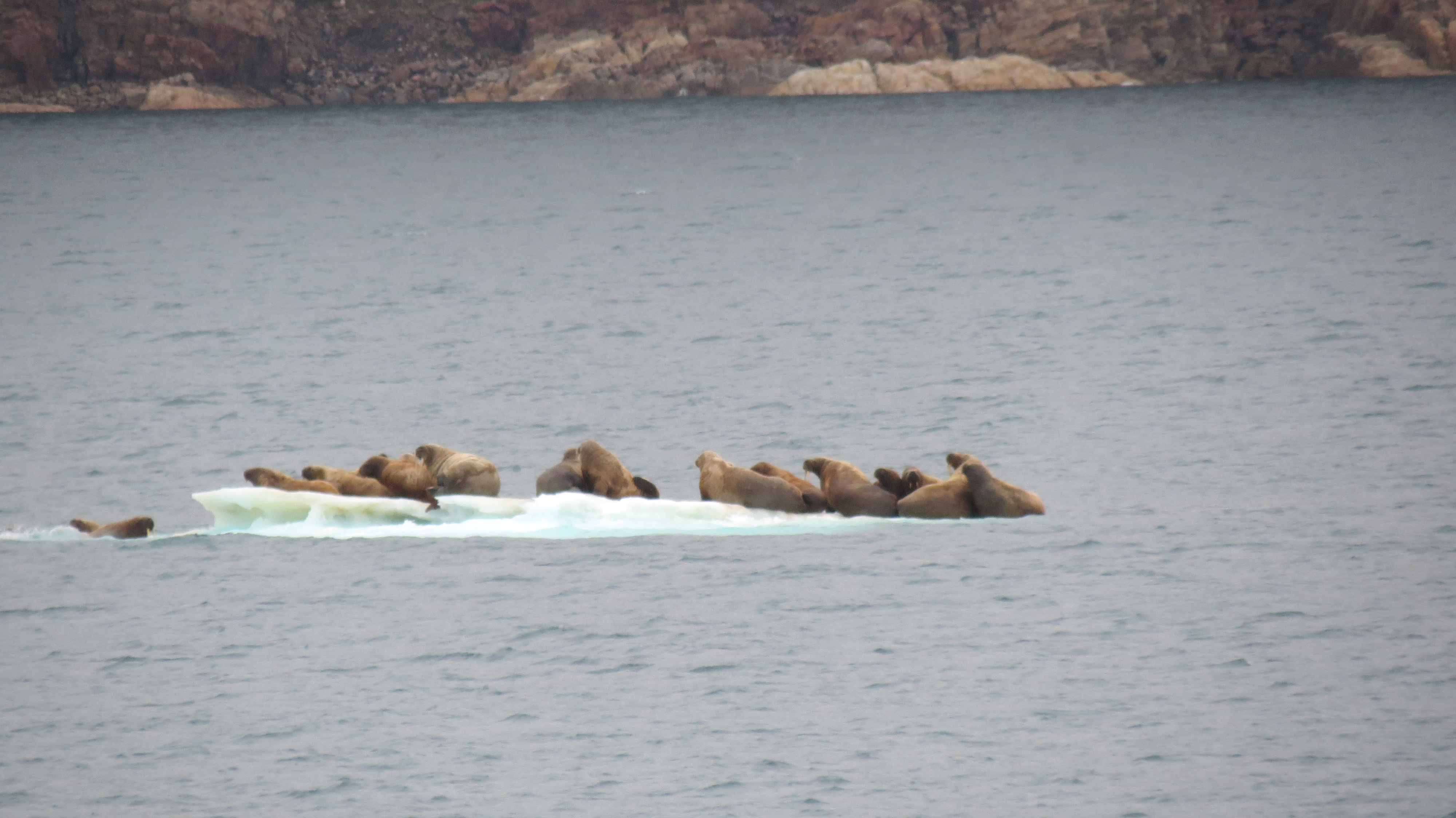
Steaming out of Alexandra Fjord after another successful mooring recovery, we are heading south to service two automated weather stations at the southern entrance to Nares Strait. During the last 3 days we have seen schools of narwhales in Petermann Fjord, a polar bear on an ice floe in Kennedy Channel just off Hans Island, and now several schools of walrus in Alexandra Fjord. I do not recall this much wild life during prior trips to Nares Strait.
Walrus on an ice floe in Alexandra Fjord on Aug.-13, 2012. [Photo Credit: Kirk McNeil, Labrador, Canadian Coast Guard Ship Henry Larsen]

Most wildlife is first seen on the bridge of the CCGS Henry Larsen. An announcement is usually made via the ship’s loudspeakers that often pipe music or the report of the day. It is a funny sight to see 10 scientists and 10-20 crew scrambles for cameras and a good viewing position. The officer in charge aboard the bridge is also in charge of the ship’s camera whose pictures are placed on a public computer for all aboard to access. I also placed several videos from Petermann Fjord and glacier on the same public access point. It is remarkable how freely everyone aboard shares photos, videos, as well as data, experiences, and skills. It makes for a most pleasant atmosphere working and living together for the 2-3 weeks we scientists are aboard.
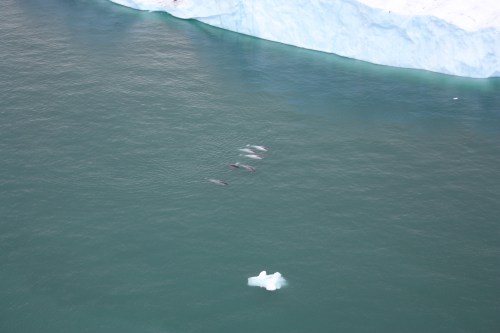
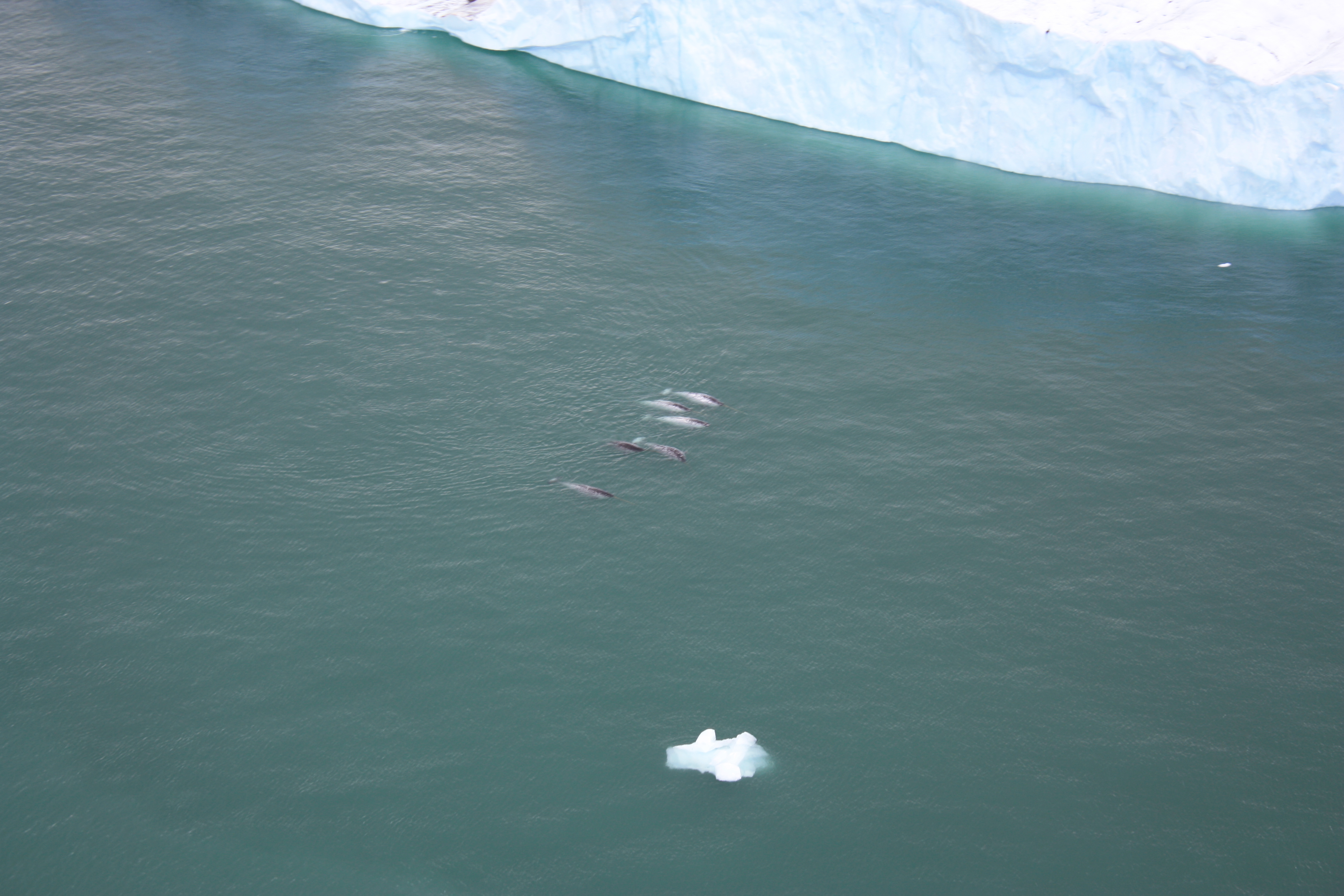
Narwhales at the seaward front of Petermann Gletscher on Aug.-10, 2012. [Photo Credit: Canadian Coast Guard Ship Henry Larsen, Jo Poole, British Columbia]

As for the narwhales of Petermann Fjord, our sadly absent colleague Dr. Helen Johnson of the University of Oxford was the first person to ever report these bottom-feeding mammals deep inside Petermann Fjord from a helicopter flight in 2009. She also conducted the zodiac survey along the edge of the floating glacier that broke off in 2010 and some more in 2012. Narwhales have been observed to dive down to over 1000 meters depth to feed via tiny pressure and temperature profilers attached their thick skins. The data were transmitted via satellite when the whales surfaced for breathing.
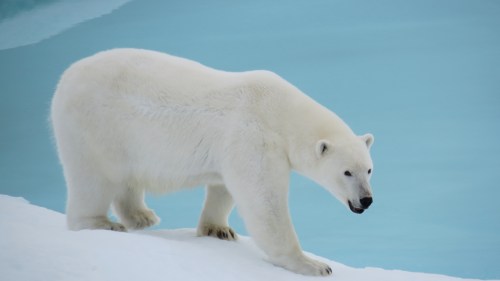
Polar bear as seen in Kennedy Channel on Aug.-12, 2012. [Photo Credit: Kirk McNeil, Labrador from aboard the Canadian Coast Guard Ship Henry Larsen]

The polar bear knows no fear and approaches every moving object, including a red icebreaker without fear, but lots of curiosity and investigates. Our polar bear perhaps thought that the big red moving ship was a wounded, blood-soaked food item. Everything is food for polar bears; some have been successful to tear down automated weather stations. Two polar bears were sighted from the ship’s helicopter today while landing a party of three to install a new weather station with an Iridium link for real-time data display. Everyone tried to finish the job as quickly as possible to get off the small island without encountering the bears.

Which brings me to the last item of this post: I have been struggling for 2 days with “nibbles” while trying to extract information on how battery voltage changed over time on some of our moorings in order to track down and diagnose a potential malfunction in one of our instruments. And the problem was that some information within a he binary data stream was separated by nibbles. It is a beautiful new word that I learnt 2 days ago from our Chief Scientist Dr. Humfrey Melling. Lots of the many data streams we are dealing with from our moored instruments, our survey instruments, our weather stations, our e-mails, etc., etc. are digital data that are stored as binary (composed of “0” and “1”) or hexadecimal numbers (composed of 1,2,3,4,5,6,7,8,9,A,B,C,D,E,F) where our decimal number 255, for example is coded as 11111111 in binary or FF in hexadecimal. The number 255 is represented as 8 bits, which equals 1 byte, which equals 2 nibbles. So a “nibble” is half a byte and the F of a hexadecimal number represents the information content of 1 nibble. To get my voltage recordings, I had to separate a single byte into its two nibbles to allocate one (along with another byte) battery voltage while the other was allocated to a second independent battery voltage.

If this sounds “geek,” it is. In order to watch the narwhales, walrus, and polar bears for a short moment of being an intermittent tourist, more advanced skills and a wicked sense of humor and hard work are absolutely essential to be a scientist a research expedition such as the one we are about to conclude. We just finished our last CTD cast at 1:30 am local time to measure temperatures and salinities within one nautical mile off Greenland near 78.5 North and 72.5 West. Rain turned to snow … winter is upon us at 2am on Aug.-14 already.

Addendum: Added photos on Sept.-13, 2012.