
Dr. Renske Gelderloos, from Oxford University, has posted more accounts of data collection from the CCGS Larsen (including a description of rosette operations by our own Pat Ryan). Read her copied posts below, or follow her accounts at her blog directly (where there are additional photos from the area, taken in 2009).
CTD sections…
7/8 August 2012:
Two days of CTD sections. We actually need to work on the weather stations as well: there is a weather station on Cape Baird that needs to be dismantled and relocated to Joe Island on the other side of Nares Strait. Access to a weather station, however, requires a helicopter and the weather has changed from its lovely sunny side to a cloudy and windy variety. There is either far too much wind for the helicopter to fly, or it is foggy and then we can’t fly either. The main activities are therefore centered around taking CTD profiles, which, by the lack of other activities and the need for a deck crew for the rosette system, is now a daytime activity. We take one section just south of Petermann Fjord, and one further north in Robeson Channel. The latter section is extra nice because this part of Nares Strait was often too much ice covered to access for taking measurements in previous years.
In the late afternoon of 8 August the FRC (the small boat) is sent out into Discovery Bay to try and recover a tide gauge pressure mooring that had been there since 2003. In that year, a diver from the American ship ‘Healy’ installed this mooring. In 2006, when the first next ship for scientific purposes came up here, the bay could not be reached because of heavy ice conditions. In 2007, during the expedition thereafter, the science crew flew to the bay by helicopter and successfully talked to the mooring and released it, but it has never come to the surface. In 2009, on the third expedition after deployment, heavy ice conditions again inhibited access to the bay. Now, in 2012, we decided to take the absolute longest of long shots in trying and recover this mooring (if the bay would not be frozen over) using a sinking line and try and ‘catch’ the mooring. As we knew the exact location, it was at least worth trying. So, the FRC was sent into Discovery Bay and came back later that evening, to everyone’s astonishment, with the mooring on board that had been happily recording data for the full nine years it had been there in the water! (In an attempt to be creative I naively inquired whether it would be an option to land the FRC on the beach below Cape Baird and walk to the weather station. Given the steep slope and significant height of the plateau, this idea was quickly discarded.) The success with the Discovery Bay mooring was later celebrated at the bar.
…and water sample collection
During some of the CTD profiles we also take water samples. As I am in the ‘CTD command centre’ almost full time during the sections, I asked Pat Ryan to write something about the water sampling. Here is her story:
Water Sample Collection, by Pat Ryan, University of Delaware
One of the ways oceanographers study the sea is through the collection of water samples. Chemical oceanographers evaluate the characteristics of water to provide information on the source of the water, contaminants and conditions of the sea to sustain life among other things.
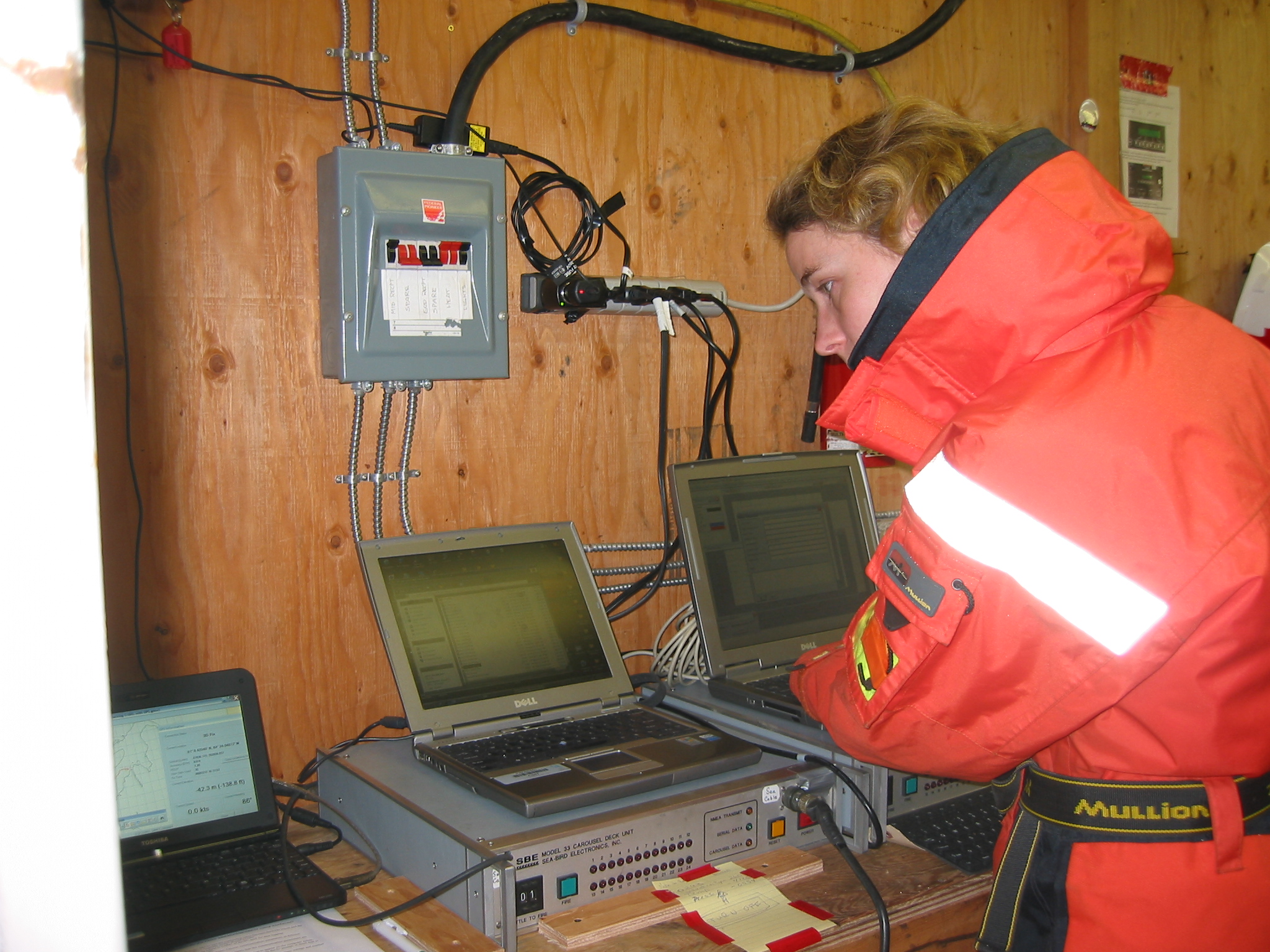
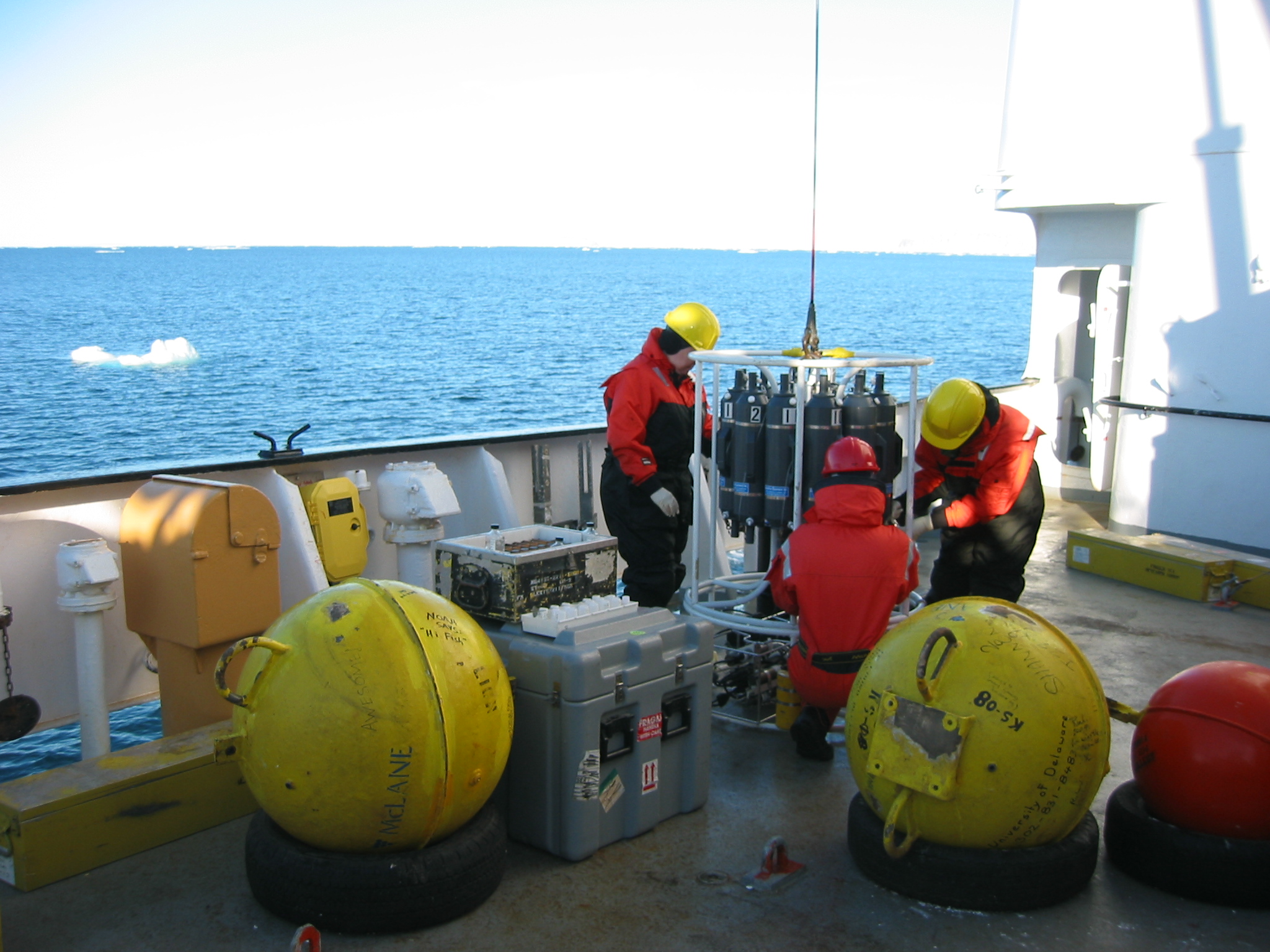
The collection of water aboard the Larsen is done in a contraption we call a rosette. It’s comprised of a number of Niskin bottles (large cylindrical plastic bottles), in our case 12, held upright in a large round metal frame. Our rosette is about as tall as I am (170 cm). As the device is lowered into the ocean, all of the bottles are open at both the top and the bottom so that there are more cylinders than bottles. As the rosette is lowered, water flows freely through the open bottles as if they were pipes… stoppers at each end are connected to a tension-based triggering device that can close both ends instantaneously – thereby capturing the seawater residing at the depth of the rosette at the time of firing. On the deck, connected via wire to the rosette, is a computer that sends a signal to each of the bottles when the operator wants to capture water.
Our rosette is typically lowered at a controlled rate to the bottom of Nares Strait collecting samples on its descent and then quickly brought back up. Attached to the rosette is also a CTD device that continuously provides salinity, temperature and depth information to the operator. Physical oceanographers use these data to analyze aspects of the sea and for the water collection purpose this information is vital to collect samples (that is to trigger the closure of bottles) at specific depths.
All of the heavy work of wrangling the rosette off and then back onto the deck of the ship is done by the deck crew of the Henry Larsen. Garbed in bright orange jumpsuits and hard hats, the crew pilot the heavy and cumbersome rosette to a gentle landing after each cast. They are a great group of guys who regale us with tales of the sea, and places back home (Newfoundland for most of them) and make us laugh to the point that we sometimes even forget how cold our hands are!
While the deck crew is managing the heavy work of the rosette, one of the science team members, Jo, mans the winch, hoisting, lowering and then raising the rosette up as directed by another member of our team, Renske. She operates the computer, carefully monitoring the graphics which tell her where the rosette is at all times. It’s Renske who determines when each of the bottles fire.
As soon as the rosette is safely back aboard, the piddlers get to work. We are members of the science crew assigned to get the samples from each Niskin bottle into the pre-labeled sample bottles. First, we check that the bottles have fired properly and that there are no signs of leaks that would indicate a sample was compromised. Then a group of us (3 is a nice number – as it speeds up the process and is not so many that there are traffic jams on the deck) set about the task of filling various glass and plastic vials with very cold ocean water, these will be shipped to a lab for analysis when we port. The label in each bottle indicates the location and depth at which the sample was collected as well as which type of analysis is to be performed. On this trip we are sampling for O-18, Barium, Salinity and Nutrients. Protocols to insure the integrity of the sample for each analysis are followed – some of the samples must be immediately frozen and kept at very cold temperatures. Others require specialized gaskets to prevent oxygen transfer. Duplication of some samples provides for quality control check performance. Every time the rosette is deployed, we typically fill about 50 bottles. Each of the bottles is rinsed with the sample several times prior to being filled – as we dump this rinse water onto the deck, this process can lead to wet shoes and socks when the wind is blowing hard as it was yesterday. In the Arctic, this water piddling as it is “affectionately” dubbed can be chilly, wet work. Your hands can feel like you might not get sensation back for days and on a windy day (as we had yesterday) the water can be blowing in sheets to soak you.
That being said, it can also be an enjoyable group endeavor. Our lead scientist often joins us filling bottles and Renske will lend a hand as time permits. There is a frenzy of activity when the rosette alights upon the deck that feels like work but the camaraderie of the piddlers and the tendency to easy laughter among the group actually makes it some of the fondest (if perhaps coldest) memories of my Arctic experience.
An Arctic Hike
9 August 2012
When I woke up this morning, the wind had not settled down. Quite the opposite to be honest: For the first time since we left Thule the boat was significantly moving in other directions than forward. Taking the helicopter to Cape Baird was absolutely out of the question, and the usual 8-o’clock science meeting was cancelled because it did not seem we would be able to do anything in this weather.
I took a cup of coffee to my cabin and wrote a bit on this blog. After finishing I decided to go up to the bridge to get the latest info on the state of affairs. At the bridge it turned out that the idea to take the FRC to shore and climb up the cliff was being considered more seriously. Apparently, something that is considered impossible one day is suddenly not such a bad idea the next one out here. I was asked to come along and immediately agreed! I knew it would be a tough climb and a windy exercise on the plateau, but this unique opportunity to walk up a glacial outlet and be part of this, admittedly, somewhat absurd plan, I did not want to miss for the world. The carefully-put-together list of absolute essentials to dismantle a weather station was, figuratively speaking, thrown overboard and replaced by a light-weights-only list, as we would have to carry everything up the hill. The magnitude of the team was now determined by the number of people required to carry tools up the hill and tools and a dismantled weather station down the hill. The science team was therefore expanded to four (Humfrey, Dave, Andreas and me) and a crew member with a shotgun (Melvin) was added to the team in case of a polar bear attack. Chief officer Brian, aided by seaman Derick, skillfully maneuvered the FRC from the ship to the beach below the cliffs (while making sure we all got absolutely soaked were it not for our waterproof floater suits), where we jumped out of the boat onto the beach with our backpacks.
From the beach the least steep route (but still steep) to the plateau where the weather station was situated was through a dry glacial valley. The ground was covered in loose gravel and stones, which made the climb up not an easy hike. In some less covered spots small mosses and tiny plants had been able to find a habitat to flourish, really amazing! I am not a biologist and know little about plants, but this surely is not an easy environment for most life I know. Humfrey later explained that some of the plants we had seen were actually even tiny trees. While sliding backwards we made progress upwards (being Dutch I am not really used to steep slopes anyway) and finally the weather station came into sight. The wind conditions up here were far from ideal to do anything at all! Wind gusts down at the ship reached well over 30 knots, up here they were a lot more severe. We had to strongly lean into the wind and secure everything we laid on the ground with heavy rocks to prevent them from being blown away. Some of the dismantling had already been done for us by local animals (one of the damaged items was definitely the work of a polar bear; cut wires could have been done by other animals). We wrapped the sensors in bubble wrap and put them in my backpack. The tools went back into other backpacks and the battery box and the solar panel had to be carried down while holding them in our hands. Humfrey decided we would take the short way back, which meant sliding down the steep side of the hill straight to the beach. Being only a little over sixty kilos, and very aware of the insanely expensive equipment on my back, the combination of this route and the wind made me go down very slowly. We all made it down to the beach safely, and quickly afterwards Brian and Derick came to pick us up. With a tail wind the ride back to the ship was a lot more comfortable than the way out. Time for a shower and some laundry…
First sight of the Petermann ice island
9 August
Ever since a large piece of the glacier tongue of Petermann Glacier broke off on the 22nd of July (now commonly referred to as ‘the ice island’), we have been anxiously monitoring the movement of this island. The event gives us both opportunities and threats: We are studying the ocean circulation (and its effect on glacial melting) in this fjord. This piece of the glacier breaking off may give us the opportunity to take measurements in a previously covered and therefore inaccessible area. The last time a ship went here to take measurements was in 2009, and incidentally two large calving events have taken place since then (the first one being in August 2010), so really a large part of the fjord that was previously covered under ice is now accessible by ship. On the other hand, the island can block the entrance to the fjord altogether and we may not be able to get in at all.
We are close to the ice island now and are very curious to see it. The news of the piece breaking off made the TV news all over the world, but we are probably the first people to see the island in real life. The captain announces this long awaited moment by: “All ship personnel, all ship personnel; there is a little piece of ice next to the ship if you’re interested”. The bow quickly crowded with people with cameras taking lots of pictures. By the time this ice island will reach the more inhabited part of the world (say Newfoundland) it will have been broken into smaller pieces and not be so gigantic anymore.
This ice island breaking off of the ice tongue of Petermann Glacier is not necessarily a dramatic and life changing event. This glacier tongue loses 80 to 90% of its ice through melting from below, because the ocean water is relatively very warm (don’t get too excited now, it is only about 0.2 degrees Celsius so not particularly hot-tub temperatures). Calving of ice from the edge is only responsible for a tiny fraction of the total ice loss. That being said, if the glacier continues to calve off ice, this may be different in the future.
After the ice-island sight-seeing moment it was time for dinner (or ‘supper’ as it is called on the ship). Supper time is quite early, from 16.30 h to 17.30 h. Chief scientist Humfrey decided on a night-time CTD section (up to about midnight) in the alongside direction of the fjord, away from the ice island and away from the fjord. Tomorrow we will see whether we can go into the fjord and do the rest of this section and another one. Things don’t look good though: the ice island is completely blocking the northeast side of the entrance, while the southwest side is stuffed with thick multi-year ice. But first to bed, and we will see what happens in the morning.
Data collection in Petermann Fjord
10 August 2012
After a short night I woke up this morning for regular breakfast hours between 7 and 8 am. It became clear that we would not be taking measurements in at least the next few hours, so I took the opportunity to catch up on some sleep. After about two hours I was woken up in a not-so-gently manner by the ship’s crushing the thick multi-year ice in the southwestern part of the Petermann Fjord entrance. After an ice reconnaissance flight by helicopter the captain had decided that it was safe to go into the fjord, provided the ice flights were repeated every hour to make sure the ice island did not rotate southwards and close off the whole entrance. This was the first time I saw the boat in action as a real ice breaker: breaking ice. Quite an experience I must say! Thick floes of ice were crushed by the ship’s bow and pushed sideward. The landscape around us is breathtaking: steep cliffs on both sides of the fjords, on top of the cliffs theGreenland ice sheet, large ice bergs that have calved off from Petermann Glacier in the ocean around us, smaller glaciers flowing into the fjord, and the rest of the ocean around us covered in thick ice floes. The wideness and calmness is amazing. The passengers on the helicopter flights today get a real treat. Apart from the amazing landscape a large group of narwhals (whales with long pointy noses) is spotted. I stay on deck for a long time just to admire in silence.
It takes to halfway the afternoon for the boat to break its way through the ice to the vicinity of the edge of the glacier tongue, where we start a CTD/rosette section across the fjord. I asked Humfrey to add some stations to the schedule, even it would only be the top few hundred meters, to better resolve possible finer structures in the fjord. He agreed and added a ‘shallow’ station in between every planned station, warning us though that the whole operation would then take up to 1 or 2 o’clock in the morning. As I really wanted this data I was willing to stay up that late. Apart from the CTDs and rosettes, which tell us something about the water properties and currents in the fjord, we also want to know what the underwater topography (known as bathymetry) looks like. The only information we have is from previous ships in this area, and that information is extremely limited. We basically don’t know more than that the fjord is at least over 1100m deep and that around the entrance the deep part is separated from Nares Strait by a shallow sill, probably no deeper than 450m deep. Therefore we zigzag from station to station, while recording the depth soundings from the ships. The ship’s echo sounder sends a sound signal out to the bottom and waits till this signal returns. From the time it takes to go to the bottom and back, combined with the speed of sound through the water, the depth of the water under the ship is calculated. So, while covering as much ground as we can, we basically map the bathymetry of Petermann Fjord. Knowledge about the bathymetry is of vital importance to be able to make reliable computer models of the ocean circulation in the fjord.
The zigzagging had one minor disadvantage: it took almost an hour to get from one station to the next. Most of the science team had gone off to bed or for a drink at the bar around 10 o’clock in the evening, while Andreas handled the winch and I monitored the CTD-recordings on the computer screen. Humfrey was also still dedicated to the science being done, but after being satisfied that the depth recordings of the bridge went well around 3 am, he went to bed as well. Although the deep stations were a bit boring to perform (looking at a wire unrolling for 20 min, and then rolling up for 20 min), the data was very exciting and we spent the time in between stations plotting the data, discussing, and going back and forth between the processed data and the rough profiles to see what features were real and which ones may be an artificial side effect of the plotting procedure used. When the last station was finally completed and we finished moving equipment into the container, it was 5 o’clock in the morning (slightly later than the scheduled end time). I decided skipping breakfast in the morning would be an excellent idea and went to bed for a good morning of sleep.

 Icy Seas