Author Archives: Andreas Muenchow

Ice Island Flotilla From Petermann Glacier Continue Southward Flow

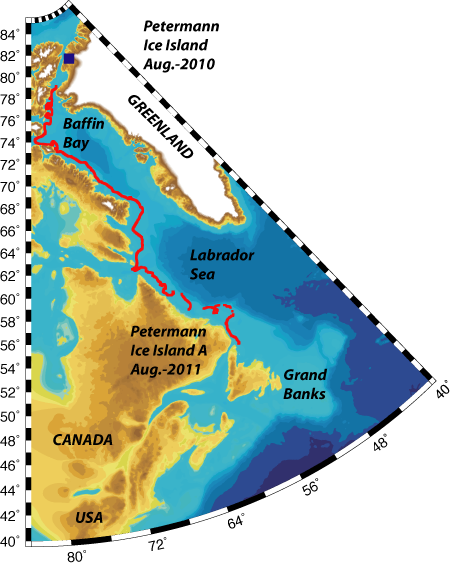
More icebergs and ice island from Greenland are heading south along northern North-America this year. Petermann Glacier’s first piece arrived last year off Newfoundland causing a local tourist sensation for a stunning display of ice along its shores. There are many more pieces from Petermann to come for a few more years.

Track of Petermann Ice Island from Aug.-2010 through Aug.-2011 traveling in shallow water from northern Greenland along Baffin Island and Labrador to Newfoundland.

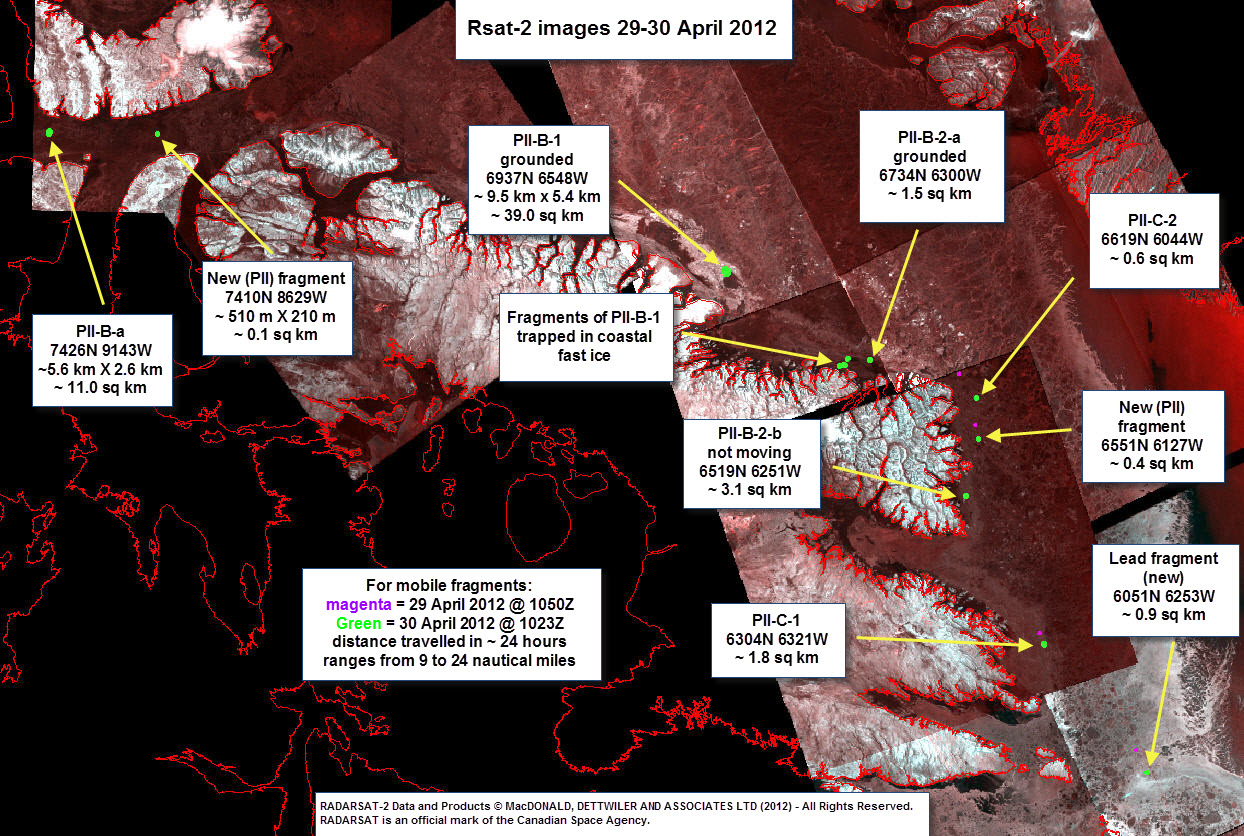
April 29/30, 2012 locations of Petermann Ice Island 2010 on their way south along northern North America. [Credit: Luc Desjardins, Canadian Ice Service]

Yet, how come that these arrivals are both so predictable in their pattern, but are almost impossible to pin down for an exact location and time? The answer involves mystical and fake forces, stunningly beautiful experiments, elegant mathematical equations, and, most important of all: spin.

The earth spins rapidly around its axis and neither ocean nor glaciers leave the planet for outer space. The obvious answer that gravity holds all the pieces in place is neither the correct nor the full answer. A subtle balance of several other forces makes Planet Earth the perfect place to keep us supplied with water to drink and air to breath. Additional forces besides gravity relate to the difference in pressure between the top and the bottom of the ocean as well as the rotational force that forces our car off the road if we speed too fast around a curve. The net effect of these is that earth fatter at the equator than at the North Pole. There appears to be more of gravity pulling us in at the North Pole than there is at the equator. Put another way, a scale measuring our own weight dips almost a pound more in Arctic Greenland than it does in the tropical forests of Borneo even if we do it naked in both places. Lose a pound of your weight instantly, travel to the far north. (GRACE)

This makes no sense intuitively, but common sense and intuition help little when it comes to how the ocean’s water and the atmosphere’s air move on a rotating planet. For example, we all know intuitively that a down-pour of rain flows down a slope into the ditch. It requires work to bring water up to the top of a hill or into the water towers to make sure that water flows when we open the faucet. Not true for the ocean at scales that relate to climate, weather, and changes of both. Here all water flows along, not down the hill. Better yet, it requires no work at all to keep it moving that way for all times. This is why Greenland’s ice keeps coming our way as soon as pieces break off. The earth’s spin makes it go around the hill, to speak loosely of pressure differences. Winds and friction have little effect. The ocean’s natural and usually stable state is in geostrophic balance. Geostrophy is a fancy word for saying that the ocean’s water flows along, not down a hill, because it is balanced by a fake and mystical Coriolis force that I will not explain. I teach a graduate class on Geophysical Fluid Dynamics for that.

In technical language, most of the oceans tend to flow along not down a pressure gradient. A kettle of boiling water discharges water from high pressure inside the kettle to the lower pressure in the kitchen. Yet the steam dissolved in the atmosphere moves around high or low-pressure systems. That’s how we read weather maps: Clockwise winds around high-pressure over Europe, North-America, and Asia to the north of the equator, counter-clockwise winds around low-pressure systems. If I apply this spin-law to Baffin Bay containing all the icebergs and ice islands, the spin rule states that these large and deep pieces flow along lines where the earth’s local rate of rotation, lets call it planetary spin f, divided by the local water depth, lets call it H, is a constant. So, to a first approximation, the icebergs and ice islands flow along a path where f/H is constant. If the planetary spin is constant, then the ice island follow lines of constant water depth H. There is more to the story, much more, such as the effects of waters of different densities residing next to each other, but I better continue this later, as I got a dinner date with a sweetheart and “Thermal Wind” can wait 😉

Pine Island Glacier Ice Island 2012 Shoving Off

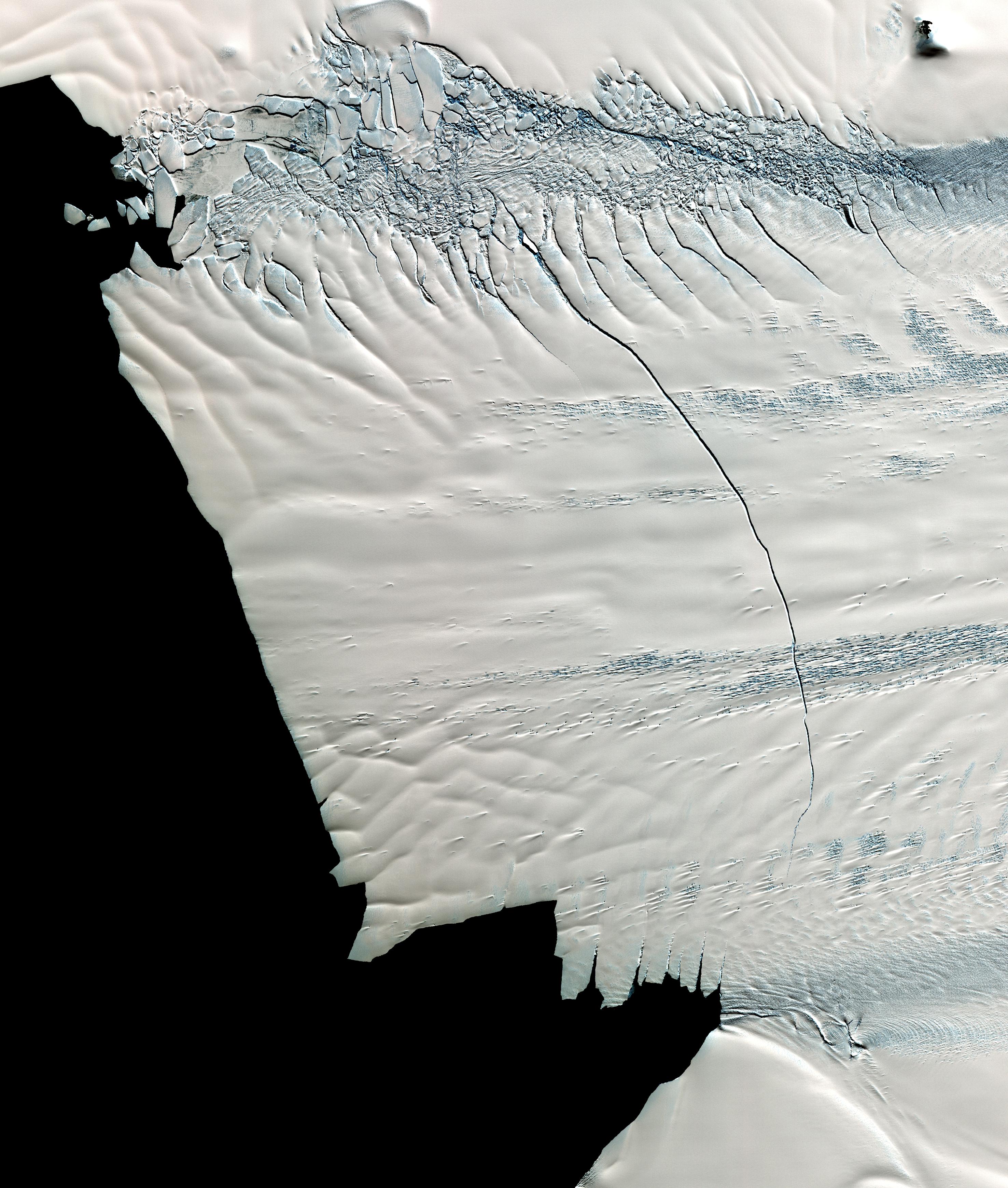
NASA published a stunningly crisp image of Pine Island Glacier (PIG), Antarctica yesterday that is already out of date, because the PIG is on the move. Glaciers change rapidly these days and the speed of the PIG is anything but glacial. The image below from Nov.-13, 2011 shows a massive crack that will develop into an ice island about 3-4 times larger than the one formed from Petermann Glacier, Greenland in 2010. While the image indicates that the part seaward of the crack is still attached, I am convinced that it is already moving independently of the glacier.

Nov.-13, 2011 image of Pine Island Glacier, Antarctica from the Advanced Spaceborne Thermal Emission and Reflection Radiometer (ASTER) instrument. Area shown cover 27 by 32 miles or 44 by 52 kilometers. Image Credit: NASA/GSFC/METI/ERSDAC/JAROS, and U.S./Japan ASTER Science Team.

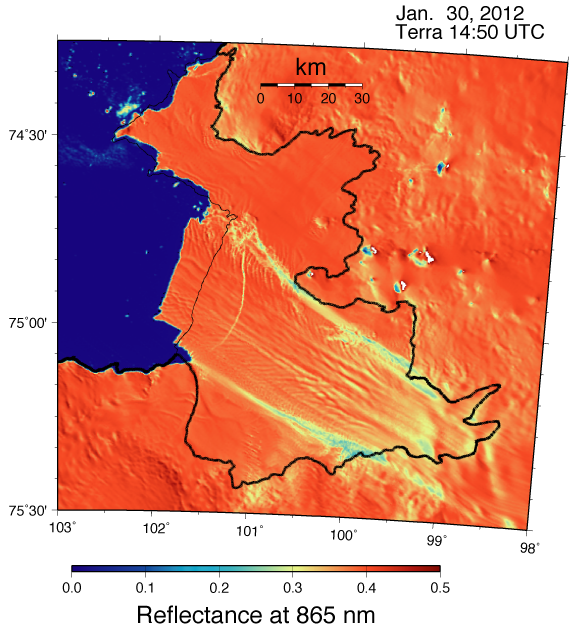
The same Terra space craft that provides the very crisp and high-resolution ASTER image also has sensors that image a larger area at slightly coarser 250 meter resolution. And monday was again an exceptionally clear day over Pine Island Glacier that revealed this (false color) image of radiation received at a “color” that is out of range of our eyes, the near infrared (865 nanometers):

Pine Island Glacier, Antarctica as seen Jan.-30, 2012 from MODIS sensors on Terra spacecraft. The crack is visible as the white line. For reference I am also showing where the front of the glacier was seven years ago with a thin black line. The thick black line shows where the glacier is grounded to the bedrock more than 1000 meters deep (grounding line).

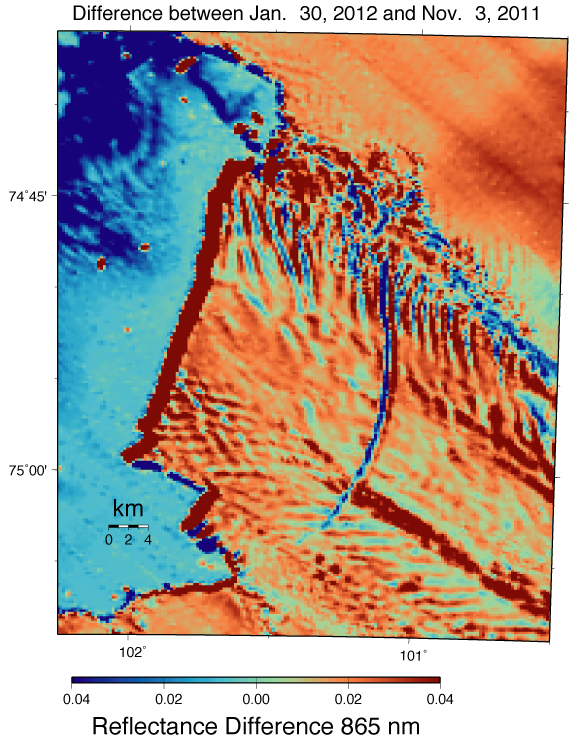
The glacier has advanced a fair amount, the crack breaking off is a perfectly normal event. This is what tidewater glaciers do, they move out to sea and break off icebergs and ice islands. Subtracting the January-30, 2012 image from a Nov.-3, 2011, I think that the thick red line below shows how far and fast the new ice island has moved the last 3 months. Its speed is at least ten times that of the glacier behind the crack:

Difference of two MODIS images, thick red line on left (seaward edge of glacier) shows the area that the new ice island had moved into on Jan.-30, 2012 that was water on Nov.-3, 2011.

Lets leave the boring crack alone, nothing to worry there. What is important at Pine Island Glacier is the retreat of the grounding line, the location where ice, ocean, and bedrock meet. All ice located seaward of the grounding line is floating and does not add to rising global sea level. [Actually, it does raise sea level a tiny amount on account of subtle nonlinearity on how volume of water and ice are influenced by temperature, salinity, and pressure, but lets neglect this detail for now as everyone else does for a good reason).

It is the ice landward of the grounding line that will raise sea level as it passes the grounding line and becomes floating ice. And the thickness of this part of the glacier is decreasing at a rapid and alarming rate, because the glacier is melting from below by the ocean and much of the bedrock landward is below sea level, thus allowing the PIG to become “unhinged.”

The problem with this process is that we cannot see it as easy from space, as we can see changes at the surface. The ocean melting does not give the stunning images that portray drama, concern, and excitement the same way that new ice islands do. Yet, for most large glaciers like Pine Island, Antarctic and Petermann, Greenland, the oceans are eroding and melting these glaciers from below. It is the physics on how this works that we scientists do not yet know and understand very well. It is one thing to have a theory and perhaps a model, but only hard data from the ice and the ocean will give us the confidence and understanding to make smart decisions that balance our energy use contributing to global warming with the need to economically develop. Smart development allows us to live better lives and cope with calamities, some of which may be caused by global warming and the sea level rise it brings.

Heat Sensing Eyes “See” Arctic Ice Thickness

The Arctic sea ice is disappearing before our eyes as we extended them into space in the form of satellites. Every summer for the last few years the area covered by ice is shrinking during the summer when 24 hours of sunlight give us plenty of crisp images. But what about winter? What about now? And does a picture from space tell us how thick the ice is?

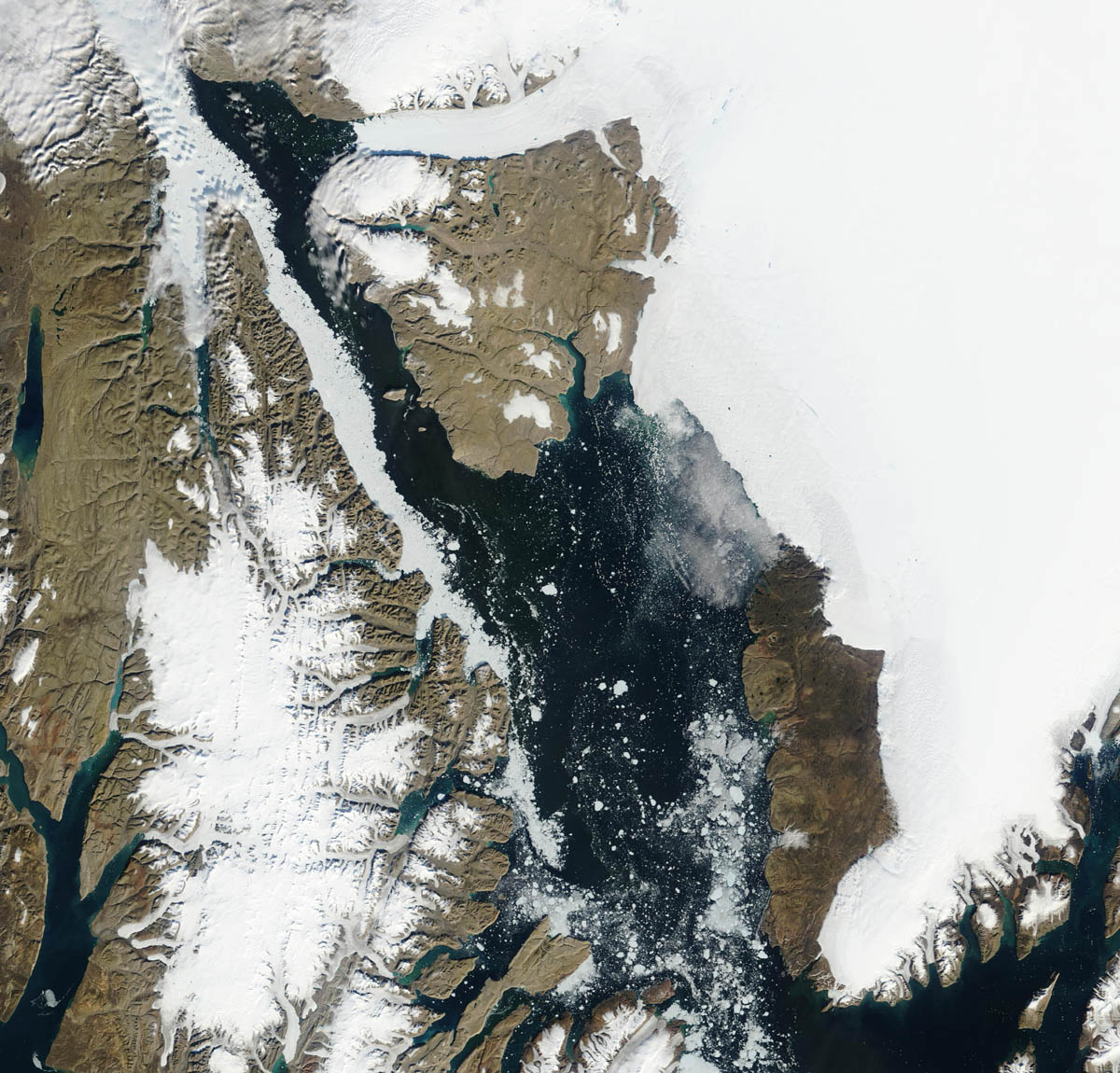
Nares Strait between northern Greenland and Canada on Aug.-13, 2005 with Petermann and Humboldt Glaciers at top and center right from MODIS imagery using red, blue, and green channels.

It is dark in the winter near the north pole as the sun is below the horizon 24 hours each day, but there are many ways to “see” in the dark as flying bats aptly show. They send out sound that bounce off objects from which bats reconstruct objects around them. We use radar from space to do to the same with radio waves to “see” different types of ice at night from satellites. We can also use tiny amounts of heat stored in water, ice, snow, and land to “see” at night. Someone breathing down your neck at a cold dark corner will make our heart beat faster as we “see” the heat not with our eyes, but with our skin. I digress, as I really want to talk about icy Arctic seas and how we can perhaps “see” how thick it is with our eyes in the sky.

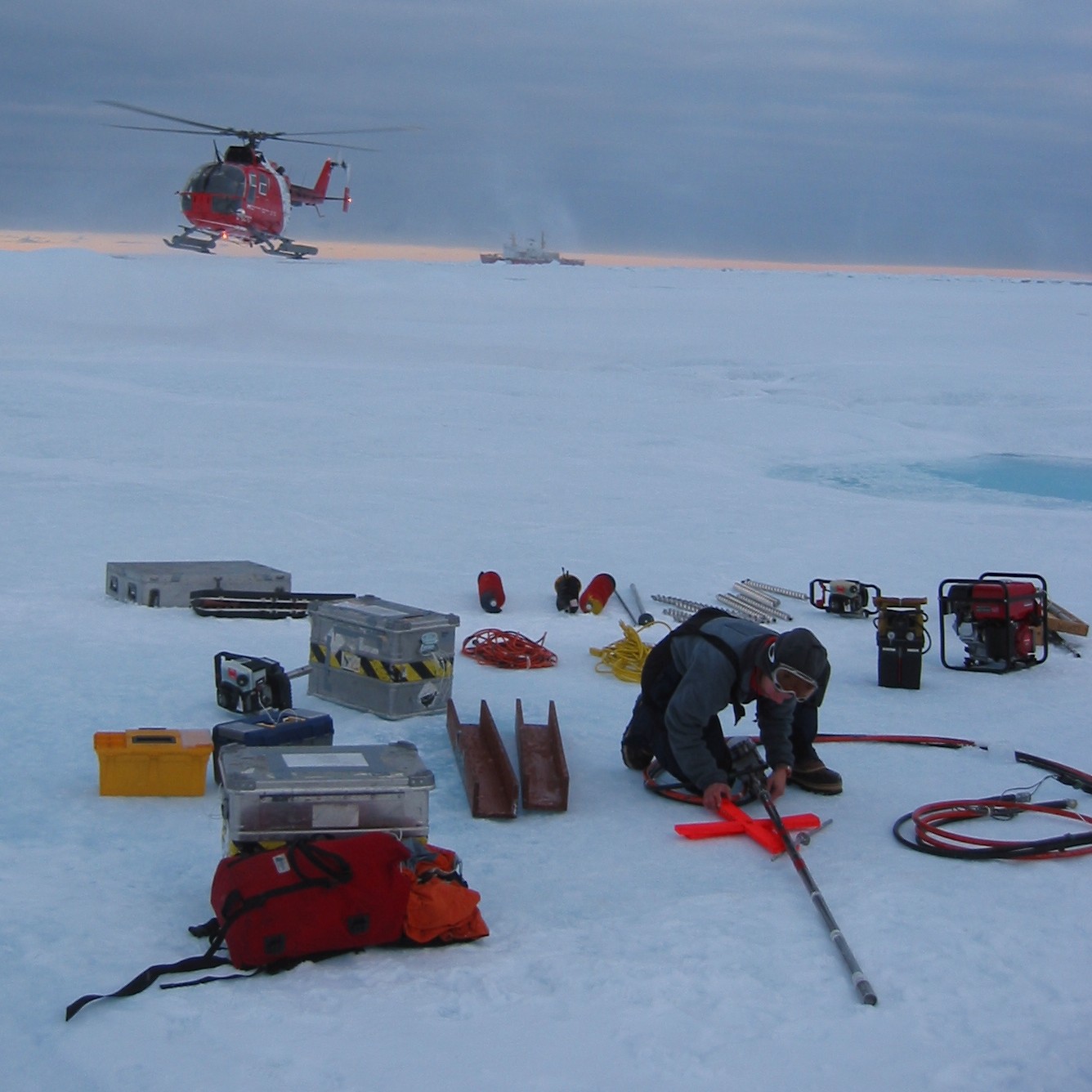
The most accurate and pain-staking way to measure ice thickness is drill holes through it. This is back-breaking, manual labor away from the comforts of a ship or a camp. One person watches with a shot-gun for polar bear searching for food, not our food, we are the food. The scientist who does this sweaty, dangerous work on our Nares Strait expeditions is Dr. Michelle Johnston of Canada’s National Research Council. She is a petite, attractive, and smart woman who is calm, competent, and comfortable when she leads men like her bear-like helper Richard Lanthier into the drilling battles with the ice. She gets dirty, cold, and wet when on her hands and knees setting up, drilling, cutting, measuring:

Dr. Michelle Johnston assembling ice drilling gear in Nares Strait with Greenland on the horizon. The Canadian Coast Guard Ship Henry Larsen in the background with its helicopter hovering.

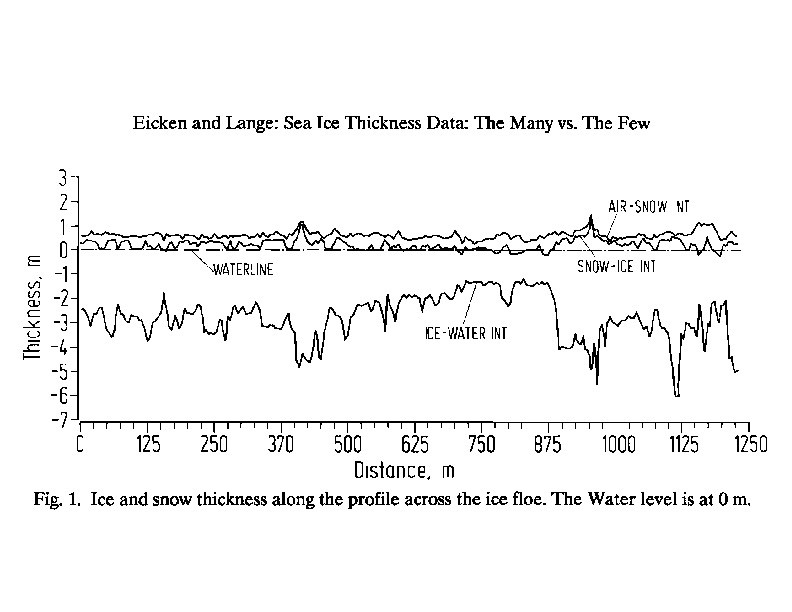
She measures temperatures within the ice and tries to crush it to find out how strong it is. All of this information guides ship operators on what dangers they face operating in icy seas. Drilling over 250 such holes across a small floe on the other (eastern) side of Greenland, Dr. Hajo Eicken showed how one large ice floe changes from less 1 meter to more than 5 meters in thickness. He also discovered that the percentage of thick and thin ice of his single 1 mile wide ice chunk is similar to the percentages measured by a submarine along a track longer than 1000 miles.

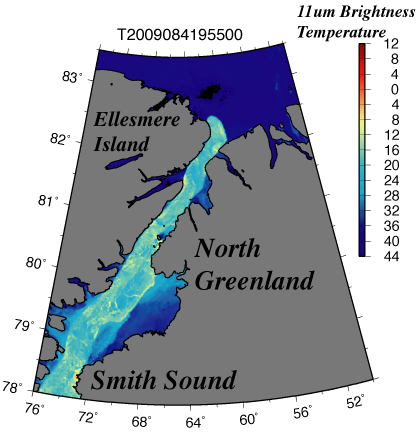
This was a surprising result in 1989 and we use it to estimate ice thickness more leisurely sipping coffee in our office. From the same satellite that gives us crisp true color images in summer as shown above, we get false color images of temperature as shown below.

Map of Nares Strait, north-west Greenland on March-25, 2009 showing heat emitted during the polar night from the ocean through the ice, and sensed by MODIS satellite.

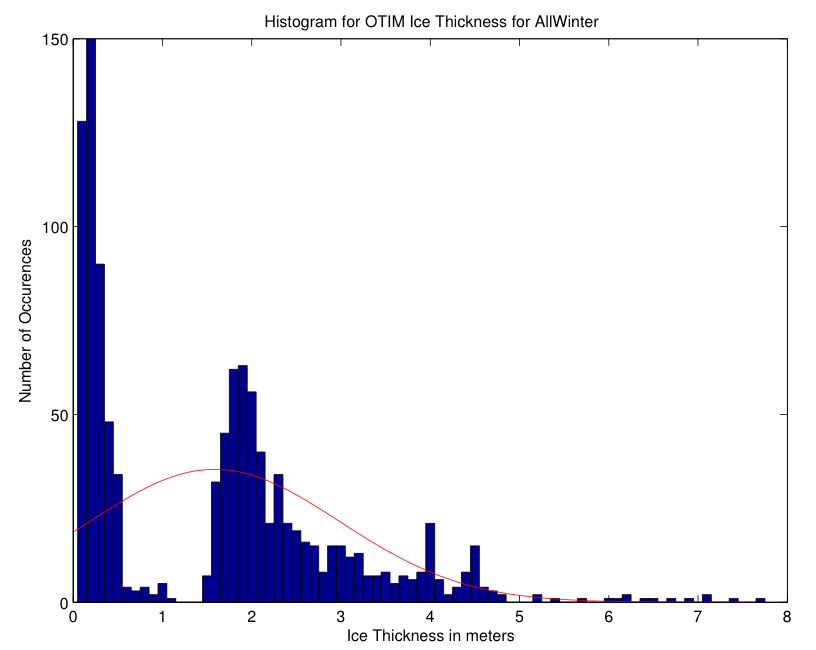
A graduate student of mine, Claire Macdonald, is trying to convert these temperature readings into ice thickness for Nares Strait. She showed me the first promising results today. The plot below shows the distribution of “thermal” ice thickness for a small square in Nares Strait Dec.-1, 2008 through Mar.-1, 2009 when no clouds were in the area. Note the two distinct and separate clusters with thicknesses below 1 meter and above 2 meters. They represent thin ice formed in 2009 after an upstream ice arch blocked all flow of thicker ice from the Arctic Ocean to Nares Strait. The thicker ice passed the study area at times when the thick, hard multi-year Arctic ice entered Nares Strait freely from the Arctic Ocean.

Distribution of "thermal" ice thickness from satellite for Nares Strait Dec.-1, 2008 through Mar.-1, 2009. (Credit: Claire Macdonald, Jan.-26, 2012)

Much work remains to be done: Claire is comparing the “thermal” ice thickness with “acoustic” ice thickness measured by sonars moored in the water below the ice. It then will be exciting to explore “thermal” thicknesses for all of Nares Strait. Winds and ocean currents will pile ice up in some areas making it thicker while they spread ice out making it thinner. Claire and I have worked with such wind and ocean data. Science is never finished as each question answered raises a host of new ones.

Physics and Engineering of Breaking Dams, Glaciers, and Tides

The title “Bombing Hitler’s Dams” fascinated me when I saw it featured on my TiVo last night. The story told was that of a group led by a smart, creative, and somewhat crazy Cambridge University engineer Dr. Hugh Hunt trying to recreate all the engineering elements needed to blow up a dam with a bomb that skips along the surface of the water the same way that a flat stone skips over a calm pond. While we all know intuitively how to throw a flat stone at the right speed at the correct angle, imagine to do it from an aircraft dropping a bomb to skip a few hundred yards over the surface of a reservoir, kiss the dam, sink, then blow it up via a depth charge. After many elaborate tests starting with 3 foot baby’s pool 5 inches deep, the show concluded with the real blowing up of real dam in northern Canada by a much enlarged group of engineers, construction workers, students, pilots, contractors, etc.

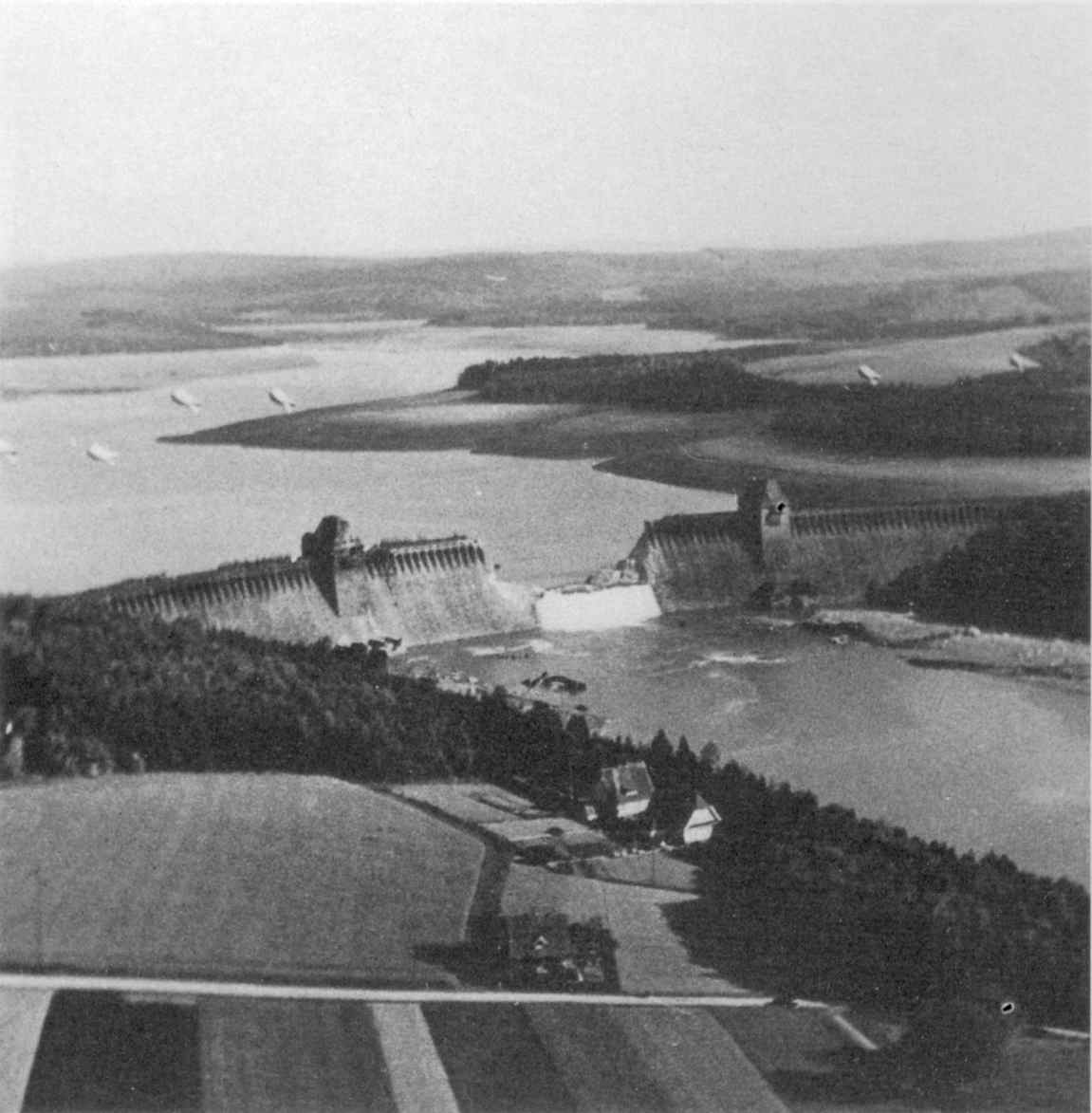
Photograph of the breached Möhne Dam taken by Flying Officer Jerry Fray of No. 542 Squadron from his Spitfire PR IX, six Barrage balloons are above the dam

If you think this is hard to do, it is. On May 16/17, 1943 a British bombing raid called “Operation Chastise” deployed cylindrical drums filled with explosives like skipping stones to hop over torpedo nets meant to protect the dams from subsurface mines. Two of three targeted dams were blown up, 53 airmen perished, German heavy industry in the Rhine-Ruhr valley was disrupted for 4 months, and over 1500 civilians drowned in the flood wave created by the breaking dams:

The story reminds my of my adviser, Dr. Richard Garvine (an aeronautical engineer by training) whom I met in 1986 while a physics student from Germany studying physical oceanography for a year in Bangor, Wales. Rather than returning to Germany, I went to the United States for graduate school where I met my sweetheart. One of my first graduate assignment was to study the “breaking dam” problem (Stoker, 1948: “The Formation of Breakers and Bores”, Communications of Pure and Applied Mathematics, 1, 1-87). The “breaking dam” problem is now a classical problem in fluid dynamics that relates to breaking waves, tsunamis, tides, as well as the discharge of fresh water from cooling plants, estuaries, and glaciers. I applied it to tides in the Conway Estuary in North-Wales for my MS thesis that the Swedish Royal Society saw fit to publish as my first contribution to science.

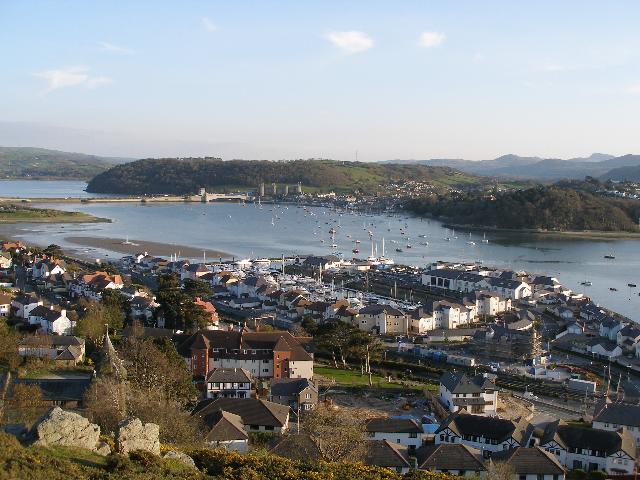
Conwy Estuary at its mouth near high tide.

I stole the above photo of the Conway Estuary, North Wales from a set of beautiful travelogues of an area where I camped for 6 weeks to guard instruments that measured currents along the 50 km tidal reach of this beautiful estuary. The tides rush in like the waves of a breaking dam, yet, they do not break (no bore forms, why?). To model the physics, I needed to study the work done by American, British, and French engineers who labored hard to defeat Nazi Germany by blowing up actual dams developing new and applying old ideas in physics and engineering along the way. Studying their work, I got my answer, too.

Addendum: A review of the aftermath and devastation of the 1943 flood wave from a German perspective is posted here with original photos from both British and German sources.

Pine Island Glacier Grounding and Unhinging

I can’t get Pine Island Glacier, Antarctica out of my mind. Checking my e-mail over breakfast, I was alerted to the forum post of Dr. King, a geophysicist working at the University of Newcastle in northern England. His post provided a hint and link to data on where all glaciers around Antarctica are grounded. The file at the National Snow and Ice Data Center was too slow to download at home, so I quickly bicycled to work, got the data, wrote a little script , and plotted Pine Island Glacier’s grounding and “coastline”:

Pine Island Glacier, Antarctica as seen Jan.-12, 2012 from MODIS Terra. The blue colors top-left are ocean, red-yellow are ice. Thick black line shows where the glacier is grounded to the bedrock below sea level, that is, all "red" areas to the left (west) of this line are floating on the ocean. The thin black line is the "coastline." Grounding and coastlines are from National Snow and Ice Data Center'. North is to the top.

The image indicates a problem in a rapidly changing world: Both the “coastline” and the “grounding line” change with time, rapidly so. The black lines shown above come from hundreds of cloud-free satellite images from the 2004/05 summer in Antarctica. Dr. Scambos, Lead Scientist for the National Snow and Ice Data Center painstakingly analyzed these data and assembled them into the “Mosaic of Antarctica.” The derived coastline for the Pine Island region suggests, that the glacier advanced over 10 km in 7 years. The crack behind it identifies the next ice island that, I speculate, has already separates from the glacier, as its front is moving 10 times faster than the glacier itself. The grounding line looks different from one that I have seen before, too, e.g.,

Bottom topography under Pine Island Glacier and grounding line. North is to the bottom. (NASA)

Trying to resolve this issue, I google searched “Pine Island Grounding Line” only to find a number of excellent science essays and publications on the impacts that Pine Island Glacier and its streaming ice have on climate change and global sea level rise:

Good science essays hide in strange places: “West-Antarctic Ice: Slip-sliding Away” by Dr. Bruce E. Johansen of the University of Nebraska makes reference to a 2010 publication in the Proceedings of the Royal Society of Dr. Katz, University of Oxford. This theoretical fluid dynamicist modeled “Stability of ice-sheet grounding lines” . It is a very theoretical paper whose results are summarized in The New Scientist. This is where I am now, hoping on my bicycle to visit my BrewHaHa coffee shop to read the paper away from my desk over lunch.

Oh, I also stumbled into a NASA animation of how Pine Island and adjacent ice streams accelerate and become thinner very far inland as a result. The graphics are stunning, the data are free, and the message is scary, yet, the science is exciting and I feel very lucky to be able to study this. Watch it, get hooked on science, and have fun.