Author Archives: Andreas Muenchow

Arctic Ice Cover and Petermann Fjord, Glacier, and Ice Island Video Footage

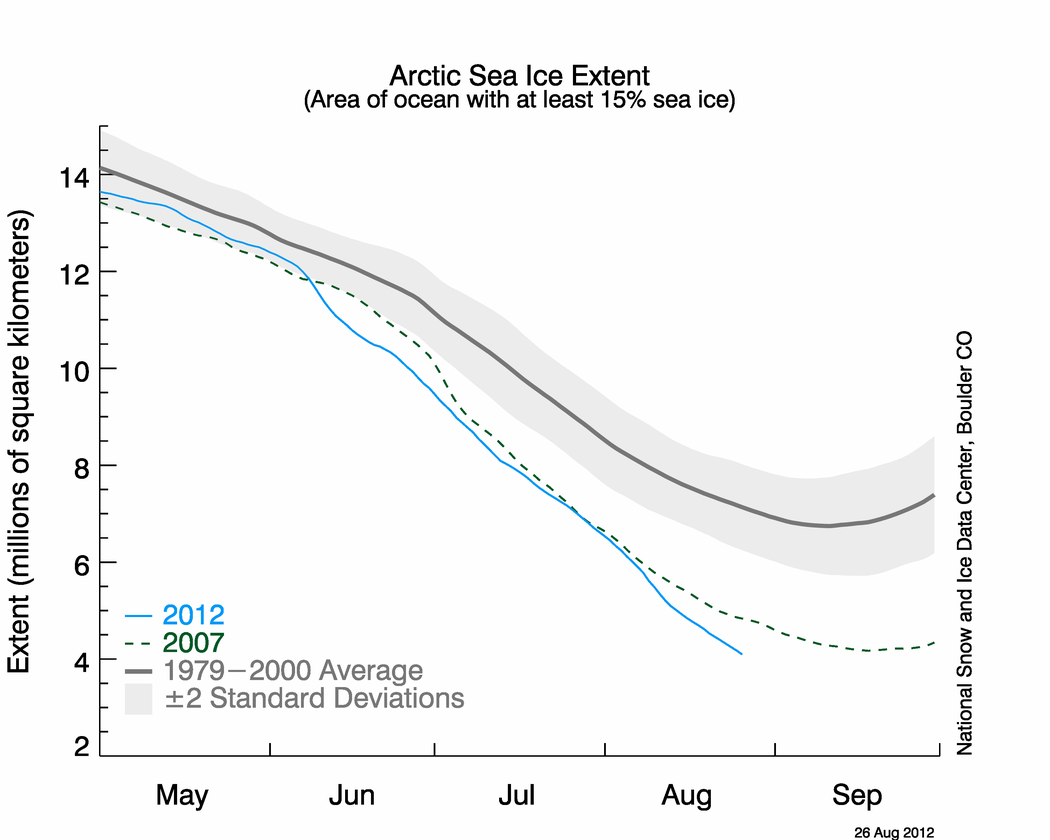
The National Snow and Ice Data Center announced today, that the Arctic Ice Area Extent has reached an absolute minimum breaking the record minimum of 2007 with still several weeks of potential melting and retreat to go. This has been anticipated for many weeks now with perhaps the most extensive coverage and intelligent discussions over at Neven’s Arctic Sea Ice Blog.

The graph above shows Arctic sea ice extent as of August 26, 2012, along with daily ice extent data for 2007, the previous record low year, and 1980, the record high year. 2012 is shown in blue, 2007 in green, and 1980 in orange. The 1979 to 2000 average is in dark gray. The gray area around this average line shows the two standard deviation range of the data. The 1981 to 2010 average is in sky blue. Sea Ice Index data. [Credit: National Snow and Ice Data Center]

This is as big a deal, because an ice-covered ocean reflects much more sunlight back into space in summer than a black ocean does that absorbs more heat: a positive feedback. This is why people in hot climates wear white, not black clothes, they like to stay cool. Furthermore, this decline has been ongoing for the last 30 years and the climate models that policy makers rely on did not predict this level of ice cover to occur for another 20-30 years. So, the warming climate and the changes it caused are on an accelerated schedule with regard to the Arctic Sea Ice cover. Also, the remaining ice cover is thinner than it used to be, because the multi-year ice keeps leaving the Arctic faster than it can be formed inside the Arctic. Both the Fram Strait to the east of Greenland and Nares Strait to the west of Greenland export this old, hard, and thick ice that ultimately melts further south. The ice that is left in the Arctic Ocean has become both thinner, younger, and softer, making it easier to melt the next summer.

On somewhat related news from the University of Delaware (UDel), we put two videos together that show a tiny, if spectacular example of a different area that has never been ice-free for at least 150 years when people were looking: Petermann Fjord. On August 10/11, 2012 the Captain and crew of the Canadian Coast Ship Henry Larsen gave us unfettered 18 hours access to the newly ice-free waters of this large glacier that discharges about 6% of the Greenland ice sheet. The UDel press release has the video that is also posted at youtube. As a less professionally assembled version is my first introductory iMovie project, e.g.,

Steensby Gletscher Sheds 10 km^2 Ice Island

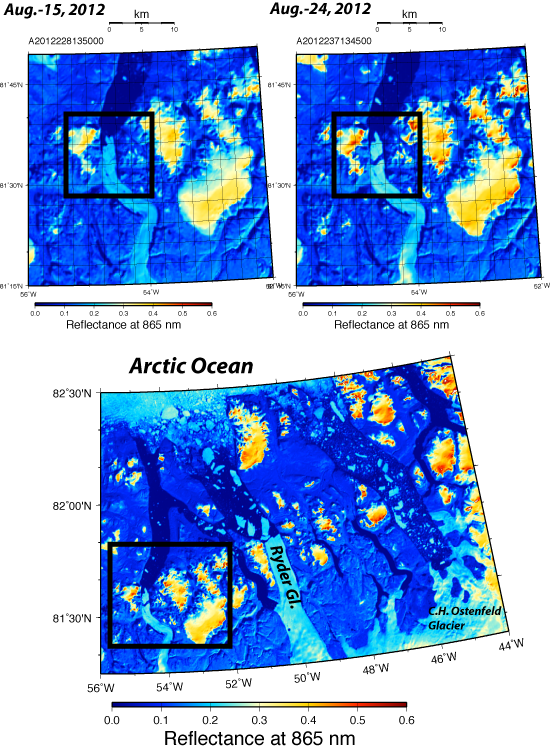
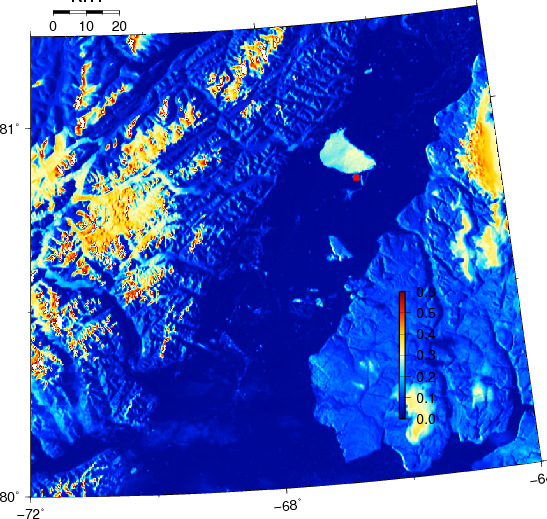
Following the rapid southward motion of Petermann’s 2012 Ice Island (PII-2012) via MODIS satellite imagery, I noticed a larger piece of Steensby Gletscher nearby breaking off. Steensby discharges into Sankt George Fjord whose upper reaches are narrower than Petermann’s (4.5 km vs. 15.5 km wide). The new ice island is smaller than the Manhattan-sized ice islands from Petermann, but it is still about three times the size of Manhattan’s Central Park (~ 10 km^2).

Steensby Gletscher and Sankt George Fjord on Aug.-15 and Aug.-24, 2012 (top) and fjords and glaciers of north-west Greenland facing the Arctic Ocean as seen by MODIS-Aqua on Aug.-24, 2012 13:45 UTC (bottom). All data are shown at 250-m spatial resolution. Note the segment of Steensby Gletscher which is separating from the glacier to form a new ice island.

The floating ice shelf of Steensby Gletscher is also two to three times thicker, but it moves more slowly. It appears, that a lateral crack or rift broke off sometime between Aug.-21 and Aug.-22, 2012 to form the ice island, this one about 1/10 the size of PII-2012. This latest calving is about 7 years of steady advance of this glacier. Comparing the front of the glacier with that observed in 1947, 1953, and 1971, I find its current site well within the earlier bounds reported by Dr. Anthony Higgins of the Geological Survey of Greenland. The same cannot be said for Petermann Gletscher about 40 nautical miles to the south-west. Unlike Petermann’s Ice Islands, Steensby’s are likely to linger and stay inside its fjord for several years as many of those calving from neighboring Ryder and C.H. Ostenfeld Gletschers do.

Michael Studinger of NASA’s IceBridge project provides stunning aerial photography of Steensby Gletscher when he flew over North-West Greenland in May of 2011.

Addendum 8-25: Mauri Pelto posted equally stunning high-resolution Landsat imagery and provides more context, analyses, and references.

Higgins, A.K., 1990: North Greenland glacier velocities and calf ice production. Polarforschung, 60, 1-23.

New Ocean Observations in Petermann Fjord

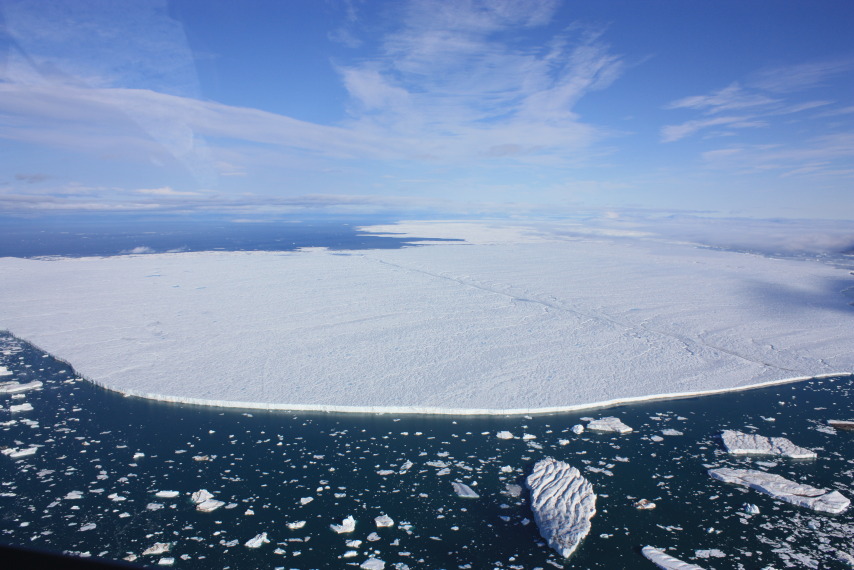
A new ice island separated from Petermann Glacier on July 16, 2012 as reported here first. Less than 4 weeks later, the Canadian Coast Guard Ship Henry Larsen reconnoitered the ice island on Aug.-9 when it blocked the northern half of the entrance of the fjord.

Petermann Ice Island 2012 (PII-2012) as seen Aug.-11, 2012 at the entrance of Petermann Fjord. The view is to the north-west. [Photo Credit: Canadian Coast Guard Ship Henry Larsen.]

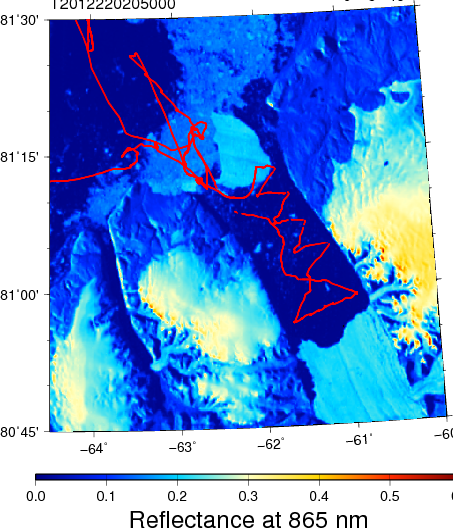
I was aboard this ship when Captain Wayne Duffett decide to break into the largely ice-free fjord behind the ice-island after consultations with Ice Services Specialist Erin Clarke. The ice observer had just returned from her second helicopter survey in 2 days with pilot Don Dobbin to assess both ice cover and its time rate of change. From the time the ship entered the fjord behind the ice island, hourly flights to a fixed point at the south-western corner of the ice island ensured that its movement would not cut off the ship’s exit. This approach worked and it gave the science crew of 8 aboard about 18 hours to conduct the very first survey of a previously ice-covered ocean:

Petermann Glacier, Fjord, and Ice Island as seen by MODIS at 865 nm on Aug. 07, 2012 overlaid with survey lines of CCGS Henry Larsen on Aug.-9/10/11, 2012 in red.

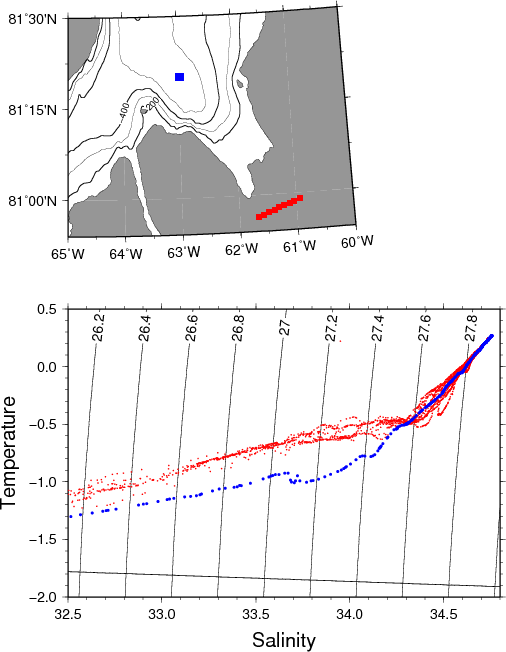
We were not funded to do enter the fjord, but our main mission to recover an array of ocean moorings with 3-year long data records covering the 2009-12 period about 100 km to the south in Nares Strait has already been accomplished. So, what does a physical oceanographer do when in uncharted and unknown territory? He drops a number of CTDs, that is, measuring conductivity (C), temperature (T), and depth (D, pressure, really) as the instrument (the CTD) is lowered at a constant rate from the surface to the bottom of the ocean at a number of stations. The results from such work next to the present front of Petermann Glacier was a surprise for which we do not yet have a satisfactory explanation: The waters inside the fjord are much warmer at salinities 32.5-34.25 than they are outside the fjord:

Temperature as a function of salinity from 9 stations across Petermann Fjord next to the current seaward edge of Petermann Glacier on Aug.-10, 2012 in red. For comparison I show in blue a station done outside the fjord on Aug.-9, 2012. Note that temperatures increase with increasing salinity which is expected for waters that are a mixture of cold and fresh polar and saltier and warmer Atlantic waters. Density deviations from 1000 kg/m^3 are shown as solid contours along with the freezing temperature that decreases with increasing salinity.

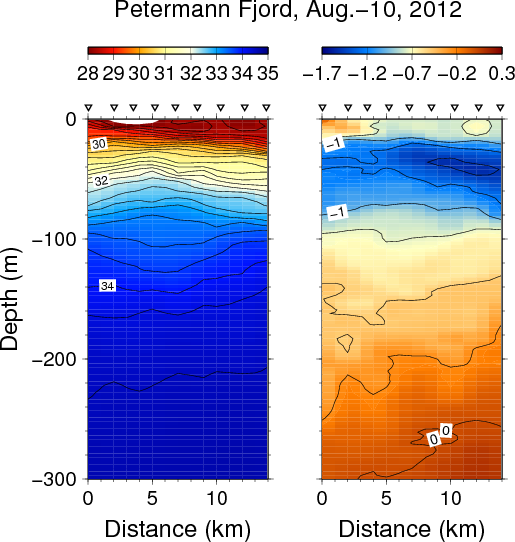
Another way to show the same data is to actually plot the section, that is, the distribution of temperature and salinity in physical space across the fjord as a function of depth:

Section across the seaward edge Petermann Glacier on Aug.-10, 2012 for salinity (left panel) and temperature (right panel). Symbols indicate station locations from which color contours are drawn. Note that the display is cropped to the top 300 meters while real recordings extend to the bottom which exceeds 1000 meters. The view is eastward towards the glacier with north to the left.

Note the doming salinity contours which to classically trained oceanographers suggest a flow out of the page on the right and into the page on left with maximum at about 90 meter depth relative to no flow at, say, 500 meter depth. Another way to view this distinct property distribution is that the flow above 90 meters is clockwise (outflow on left, inflow on right) relative to the more counter-clockwise flow below this depth. This feature, too, comes as a surprise and requires more thought and analyses to explain.

There is much more work to be done to figure out what all this means. I feel like scratching the surface of a large iceberg half-blind. The data from below 300 meter depth, too, contain clues on how some this glacier interacts with the ocean. As for the purpose of this post, I merely wanted to report that the ice island is presently having a hitting or scratching tiny Hans Island. The latter is unlikely to move, but Petermann’s Ice Island will slow on impact, swivel counter-clockwise, bump into Ellesmere, and pretend nothing has happened on its merry way south. This is the latest image I have:

Petermann Ice Island 2012 on Aug.-22, 2012 as seen by MODIS Terra at 21:45 UTC. The tiny red dot marks Hans Island, the location of a weather station in the Kennedy Channel section of Nares Strait. Petermann Fjord is towards the top right out of view.

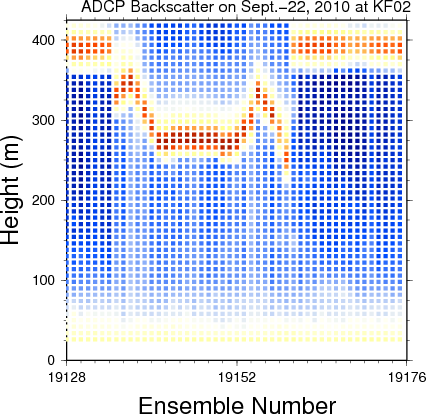
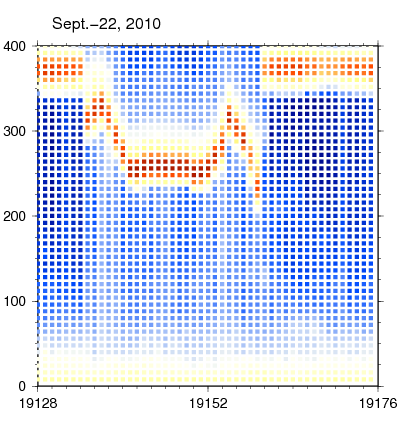
ADDENDUM Sept.-1, 2012: PII-2010B had a maximum thickness of at least 144 meters as it passed over a mooring that measures ocean currents from the Doppler shift of acoustic backscatter that is shown here for one of four beams:

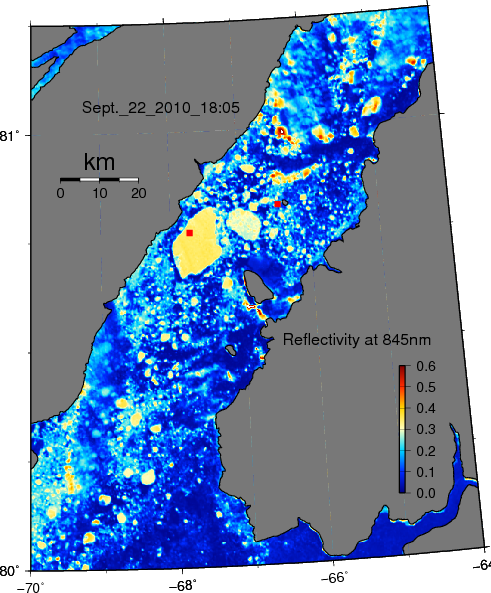
Time-depth series of acoustic scatter from a bottom-mounted acoustic Doppler current profiler for 24 hours starting Sept-22, 2010 9:30 UTC. Red colors indicate high backscatter from a “hard” surface like ice. The vertical axis depth in meters above the transducers while the horizontal is ensemble number into the record (0.5 hours between ensembles). The 2010 ice island from Petermann Glacier (PII-2010B) passed over the mooring. When PII-2010B was attached to the glacier it was adjacent to the segment that became PII-2012 this year.

Nares Strait 2012: Weather Stations and Polar Bears

Weather stations offer basic information that relate to the motion of air, ice, and water. As part of our Nares Strait experiments and expeditions that started in 2003, a group of Canadian, Danish, English, Scottish, and US scientists began installations of a small network of such stations. The first and perhaps most prominent was placed on Hans Island which was a joint Danish and Canadian operation with the data hosted in real-time by the Scottish Association of Marine Science (SAMS, they also host data from Littleton Island on Greenland). This station was refurbished about 10 days ago from the Canadian Coast Guard Henry Larsen:

Dave Riedel (kneeling) and Don Dobbin (standing) on Hans Island during routine maintenance of the weather station. View is across Nares Strait with Ellesmere Island, Canada is towards the north-west. [Photo Credit: Allison Einolf, University of Delaware summer undergraduate intern from Macalaster College.]

Another weather station was placed last week by Dave Riedel and Ron Lindsay with the helicopter pilot Don Dobbin on Brevoort Island, Canada. Dave, who is shown above at the Hans Island weather station just posted his account and close encounters with two polar bears at the University of Oxford’s Arctic Ocean Research page. As a teaser I show the island as seen from the helicopter. Can you find and see the two polar bear in this photograph?

Bears on Brevoort Island, Ellesmere Island during the installation of an automated weather station on Aug.-13, 2012. Photo credit: Dave Riedel, British Columbia as posted at University of Oxford’s Arctic Ocean Research.

The data from the two “new” weather stations at Brevoort Island, Canada at the entrance to Alexandra Fjord and Joe Island, Greenland at the entrance to Petermann Fjord have real-time satellite data download capabilities, but these will need to be turned on from British Columbia by David Riedel and Canadian colleagues. I am not sure if they made it home when we parted yesterday night at Ottawa International Airport when they still had to make 2 or 3 connections to get home after being in the air or in transit for 3 days. More on the fun and adventure of traveling in the far north is reported by Dr. Renske Gelderloos in her blog post today at the Oxford site also. I suspect, that she wrote while being stranded somewhere between Ottawa and London.

Nares Strait 2012: First Petermann Ice Island Photos

The CCGS Henry Larsen dropped its science party of nine at Resolute on Cornwallis Island near the center of Lancaster Sound. We are staying at the “Polar Continental Shelf Project” which is a Government Canada base for science and logistics people working all over the Canadian High Arctic. Over dinner we met a group of graduate students, botanists, whom we had met 4 days ago at Alexandra Fjord where they were living since June. I had missed the rendezvous on the water then, because I freakishly tried to refurbish a tide gauge that we recovered in the morning and re-deployed in the afternoon. One of the students, Anne, told Renske and me, that they saw narwhales at Alexandra Fjord for the first time in at least 4 summers that she lived there. I wonder, if those were the same narwhales that we Petermann Fjord.

North-eastern portion of Petermann Glacier on Aug.-11, 2012, the meandering river is the centerline, view is almost due east. [Photo Credit: Canadian Coast Guard Ship Henry Larsen.]

Which brings me to the purpose of this quick blog entry: The Internet on land, while not much faster than on the ship, is more stable. This allowed me to download the first photos of both the ice island at the entrances of Petermann Fjord and the new front of the glacier far into the fjord. The pictures were taken from the helicopter checking on the ice island last Friday as we worked sections deep inside the fjord. It was a frantic day of data collection in stunned scenery. It was challenging to stay focused on keeping sensors, computers, and winches running smoothly with so much natural beauty in all directions. I will post more photos in higher resolution as soon as we are getting home late sunday night. As a first teaser, however, here the first of many photos and videos. The two photos below I degraded from 4-6 MB to 0.1-0.2 MB to allow for limited bandwidth up north.

Petermann Ice Island 2012 (PII-2012) as seen Aug.-11, 2012 at the entrance of Petermann Fjord. The view is to the north-west. [Photo Credit: Canadian Coast Guard Ship Henry Larsen.]

Addendum: Last night I uploaded the 4.6 MB version of the image. Photo credit should again be given to Canadian Coast Guard Ship Henry Larsen, it was Jo Poole of British Columbia who took the picture using the official ship’s camera. Leaving for Iqualuit in 3 hours.