Author Archives: Andreas Muenchow

Shades of White as the Sun Rises over Nares Strait

After four months of total darkness the sun is back up in Nares Strait. It transforms the polar night into thousand shades of white as mountains, glaciers, and ice take in and throw back the new light. Our satellites receive some of the throw-away light as the landscape reflects it back into space. During the long dark winter months these satellites could only “see” heat, but this will change rapidly as Alert atop of Arctic Canada receives 30 minutes more sun with each passing day.
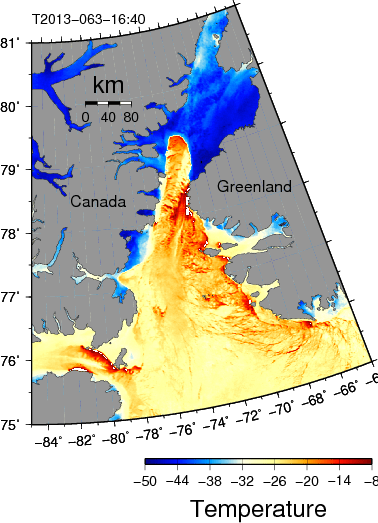
Surface temperature in degrees centigrade over northern Baffin Bay on March-4, 2013 16:20 UTC from MODIS Terra.

Surface temperature in degrees centigrade over northern Baffin Bay on March-4, 2013 16:20 UTC from MODIS Terra. Warm colors (reds) show thin and/or ice while cold colors (blues) suggest thick ice stuck in place.

A very strong ice arch at the southern entrance to Nares Strait separates thick (and cold) ice to north from thin (and warm) ice to the south. The thick and cold ice is not moving, it is stuck to land, but the ocean under the ice is moving fast from north to south. The ocean currents thus sweep the newly formed thin ice away to the south. This ice arch formed way back in early November just after the sun set for winter over Nares Strait.

Now that the sun is up, we can also “see” more structures in the ice by the amount of light reflected back to space. A very white surface reflects lots while a darker surface reflects less. We are looking at the many shades of white here … even though I color them in reds and blues:

Surface reflectance at 865 nm in northern Baffin Bay on March-4, 2013 16:20 UTC from MODIS Terra.

Surface reflectance at 865 nm in northern Baffin Bay on March-4, 2013 16:20 UTC from MODIS Terra. A true color image (which this is not) would show only white everywhere. Hence I show the very bright white as red and the less bright white as blue. This artificial enhancement makes patterns and structures more visible to the eye.

Zooming into the area where the ice arch separates thick ice to the north that is not moving from thin ice in the south that is swept away by ocean currents, I show this image at the highest possible resolution:
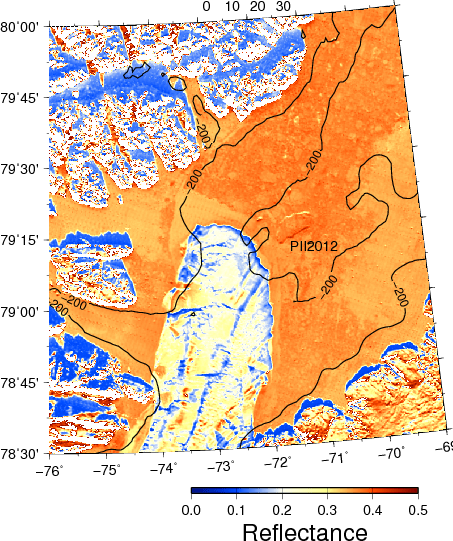
Surface reflectance at 865 nm at the southern entrance to Nares Strait on March-4, 2013. Contours are 200-m bottom depth showing PII2012 grounded at the north-eastern sector of the ice arch.

Surface reflectance at 865 nm at the southern entrance to Nares Strait on March-4, 2013. Contours are 200-m bottom depth showing PII2012 grounded at the north-eastern sector of the ice arch.

Note, however, that the sun is far to south and barely peeking over the horizon. This low sun angle shows up as shadows cast by mountains. And since the sun is still far to the south, the shadows cast are to the north. This “shadow” makes visible the ice island from Petermann Gletscher that anchors this ice arch as it is grounded. I labeled it PII2012 in the picture.

From laser measurements we know that the ice islands stands about 20 meter (or 60 feet) above the rest of the ice field. This height is enough to cast a visible shadow towards the north (slightly darker = less red) as well as a direct reflection off its vertical wall facing south (brighter = more red) towards the sun. At its thickest point, PII2012 is about 200 meters (~600 feet) thick. For this reason, I also show the 200-m bottom contour that moves largely from north to south along both Ellesmere Island, Canada on the left and Greenland on the right.

The sun brings great joy to all, especially those hardy souls who live in the far north. The sun’s rise also shows the delicate interplay of light and shadows that we can use to solve puzzles on how ice, oceans, and glaciers work. At the entrance of Nares Strait the playful delights of the sea ice, ocean currents, and ice islands gives us a large area of thin ice. The thin ice will soon melt and perhaps has already started to set into motion a spring bloom of ocean plants. Ocean critters will feed on these to start another cycle of life. Whales, seals, and polar bears all depend on it for 1000s of years now.

Sketch of the biological pieces that a large area of open water near a fixed ice edge like that of a polynya may support. [From Northern Journal>/a>]

Sketch of the biological pieces that a large area of open water near a fixed ice edge like that of a polynya may support. [From Northern Journal]

Book Review: Terra Incognita by Sara Wheeler

Ms. Wheeler is not the touchy-feely kind when she describes scientists and technicians in Antarctica during the 7-month that she spent with them in science camps. She turns awes and wonders into a refreshing set of stories about people and places. At a fast clip she surprises with delightful encounters describing a different breed of people in a different land. “Terra Incognita” is not all ice, mountains, deserts, and hardship, but it is about the people who live and work there. As a scientist I felt at times described like a caged animal on display in her writing. She pokes fun of subjects and self that the feeble may not always like. Her book made me laugh and smile often. It still does.

terra-incognita-by-sara-wheeler

The people in Ms. Wheeler’s book reminded me of many companions that I lived with in close quarters working on Arctic research vessels and out of remote field camps. She succeeds to show the essence of men and women who live science. With humor and gripping commentary she depicts the human side of science well. This is travel writing at its very best, ever since Bruce Chatwin stopped writing. Along with Ms. Wheeler’s first book “Travels in a Thin country” that is Chile, “Terra Incognita” reflects a healthy thirst for life, people, and wanderlust.

I just came across these beautiful words and imagery of “A young lady venturing Far North”

The Fourth Continent's avatarThe Fourth Continent

According to Inuit culture in Greenland, a person possesses six or seven souls. The souls take the form of tiny people scattered throughout the body.

By Annie Dillard.

I don’t know much about this yet, but the idea of six or seven souls sounds almost overbearing. With just one soul, you can feel enough love, and in times of sorrow, too much pain. Just a thought.

I do love this carving of an Inuit Soul in the picture below. It has a fluidity to it. It is as if after rough waves had crashed onto the stone countless times, a soul had woken up from all the noise and pushed its face out for the world to see.

View original post

Did I ever see a Polar Bear?

When people hear that I have worked as a physical oceanographer in the Arctic for almost 20 years, their first question is often: “Did you ever see a Polar Bear?” The answer is a yes, but when we see bears, it is usually as a tiny moving speck of yellowish white near the white, icy, and hazy horizon. Only twice was it different. The first time was in October 2003 to the north-west off Arctic Alaska when a young bear swam towards and around the U.S. Coast Guard Cutter Healy doing station work:

Polar Bear seen Oct.-10, 2003 from aboard the USCGS Healy to the north-east of Alaska [Credit: Andreas Muenchow, University of Delawarel]

Polar Bear seen Oct.-10, 2003 from aboard the USCGC Healy to the north-east of Alaska [Credit: Andreas Muenchow, University of Delaware]

The second close encounter was last year as the Canadian Coast Guard Ship Henry Larsen was about to leave Nares Strait on Aug.-12. Out of the 100+ pictures snapped of this bear, the ship’s Steward Kirk McNeil of Labrador probably took the best shot:

Polar bear as seen in Kennedy Channel on Aug.-12, 2012. [Photo Credit: Kirk McNeil, Labrador from aboard the Canadian Coast Guard Ship Henry Larsen]

Polar bear as seen in Kennedy Channel on Aug.-12, 2012. [Photo Credit: Kirk McNeil, Labrador from aboard the Canadian Coast Guard Ship Henry Larsen]

This bear approached the drifting ship leisurely over a 10 minutes period from a large piece of ice that also drifted with the tides and currents. My PhD student Pat Ryan captured the last 2 minutes of this visit with her iPhone. The voice is hers (I also discern the voice of Ice Specialist Erin Clarke). Greenland is in the background to the east:

ADDENDUM Feb.-13, 2013: I just found this map of the spatial distribution of polar bears from a Dec.-23, 2012 article in the Washington Post by Juliet Eilperin entitled “Polar bear trade, hunting spark controversy.” Writing for the Wall Street Journal Feb.9, 2013, Zac Unger commented with the question “Are polar bears really disappearing?”

Polar bear population and their trends. [Source: Polar Bear Specialist Group. Laris Karklis/The Washington Post. Published on December 23, 2012, 5:24 p.m.]

Polar bear population and their trends. [Source: Polar Bear Specialist Group. Laris Karklis/The Washington Post. Published on December 23, 2012, 5:24 p.m.]

Addendum Feb.-25, 2013: A very funny bear commercial.

Antarctic Plane Crash Kills 3 Canadians

Polar research requires ships, planes, and helicopters to supply bases and move people, instruments, fuel, and food to places where instruments need to placed, recovered, or serviced. While these activities are fairly routine and safe where most of us live, they are neither routine nor safe in extreme cold, extreme winds, or extremely remote places such as Arctic Canada, Greenland, or Antarctica.

I just learnt from an NSF Press Release that a Kenn Borek Twin Otter crashed into Mount Elizabeth in the Queen Alexandra Range of the Transantarctic Mountains at an elevation of about 3,900 m or 11,000 feet less than 2 weeks ago. All three Canadian crew aboard were killed. The plane was in transit from a research station at the South Pole to the Italian station at Terra Nova Bay to support Italian field work.

A memorial ceremony for the aircrew at NSF's Amundsen-Scott South Pole Station [Photo Credit: Blaise Kuo Tiong, NSF]

A memorial ceremony for the aircrew at NSF’s Amundsen-Scott South Pole Station [Photo Credit: Blaise Kuo Tiong, NSF]

Here are the words of Dr. Kelly Falkner, Director of NSF’s Polar Division (source):

January 28, 2013
On behalf of the U.S. National Science Foundation and all in the U. S. Antarctic Program, I wish to extend our profound sympathies to the families, friends, and colleagues of the three Kenn Borek Twin Otter crew, whose deaths in Antarctica while en route to support the Italian national Antarctic science program have recently been confirmed.

We have been privileged to experience first-hand their professionalism, skill, and dedication to the arduous task of supporting science in an extremely remote and inhospitable environment. In many ways, their contributions make possible hard won but vital advances in scientific knowledge that serve all of mankind. Although everyone associated with the pursuit of science in Antarctica makes personal sacrifices to do so, very infrequently and sadly, some make the ultimate sacrifice.

While it may come as little consolation at this very sorrowful time, the families, friends, and colleagues of the crew members should know that the thoughts of everyone in the U.S. Antarctic Program were with them through the long ordeal of the past few days and remain so now.

To the families and friends of the crew, I commend your loved ones for their commitment and dedication to their profession and offer our condolences. The sense of loss is keenly felt throughout the U.S. program and no doubt throughout the international Antarctic community.

-NSF-

I am also thinking of Marty Bergmann, a Canadian Polar scientist turned administrator. He perished 2 summers ago in a plane crash outside Resolute, Nunavut in the Canadian High Arctic working his Government Canada job to tirelessly help others in their Arctic research. Unlike the photo below, I remember him with a massive ear-to-ear grin on his face and a twinkle in his eye.

The Royal Canadian Geographic Society will recognize Martin Bergmann, the director of the Polar Continental Shelf Program who died in a plane crash in Resolute last year, by creating a medal for excellence in Arctic leadership, science and exploration. [Credit: CBC News]

Martin Bergmann, Director of the Polar Continental Shelf Program who died in a plane crash in Resolute Aug.-20, 2011. [Credit: CBC News]