Tag Archives: weather

Arctic Sea Ice Cover and Extreme Weather Explained

Addendum Sept.-24, 2012: A New Climate State, Arctic Sea Ice 2012 (video by Peter Sinclair).

I just discovered an outstanding interview that Dr. Jennifer Francis of Rutgers University gave to a non-profit community radio station out of Vancouver, British Columbia.

Jennifer Francis Interview 20120910

She connects and explains global warming, its much amplified signal in the Arctic, the extreme record minimal Arctic sea ice cover this summer, and how the warming Arctic and its disappearing sea ice impacts our weather in the northern hemisphere by slowing down the atmospheric jet stream separating polar from mid-latitude air masses. She explains all of this in non-technical language without loss of accuracy.

Dr. Jennifer Francis, Rutgers University [Photo Credit: ARCUS]

If this program piques your interest and you want to read more, Andrew Revkin of the New York time has led an informed discussion at his New York Times blog Dot Earth. And finally, Climate Central presented and illustrated Dr. Francis’ observations and ideas rather well with graphics and videos.

Nares Strait 2012: Weather Stations and Polar Bears

Weather stations offer basic information that relate to the motion of air, ice, and water. As part of our Nares Strait experiments and expeditions that started in 2003, a group of Canadian, Danish, English, Scottish, and US scientists began installations of a small network of such stations. The first and perhaps most prominent was placed on Hans Island which was a joint Danish and Canadian operation with the data hosted in real-time by the Scottish Association of Marine Science (SAMS, they also host data from Littleton Island on Greenland). This station was refurbished about 10 days ago from the Canadian Coast Guard Henry Larsen:

Dave Riedel (kneeling) and Don Dobbin (standing) on Hans Island during routine maintenance of the weather station. View is across Nares Strait with Ellesmere Island, Canada is towards the north-west. [Photo Credit: Allison Einolf, University of Delaware summer undergraduate intern from Macalaster College.]

Another weather station was placed last week by Dave Riedel and Ron Lindsay with the helicopter pilot Don Dobbin on Brevoort Island, Canada. Dave, who is shown above at the Hans Island weather station just posted his account and close encounters with two polar bears at the University of Oxford’s Arctic Ocean Research page. As a teaser I show the island as seen from the helicopter. Can you find and see the two polar bear in this photograph?

Bears on Brevoort Island, Ellesmere Island during the installation of an automated weather station on Aug.-13, 2012. Photo credit: Dave Riedel, British Columbia as posted at University of Oxford’s Arctic Ocean Research.

The data from the two “new” weather stations at Brevoort Island, Canada at the entrance to Alexandra Fjord and Joe Island, Greenland at the entrance to Petermann Fjord have real-time satellite data download capabilities, but these will need to be turned on from British Columbia by David Riedel and Canadian colleagues. I am not sure if they made it home when we parted yesterday night at Ottawa International Airport when they still had to make 2 or 3 connections to get home after being in the air or in transit for 3 days. More on the fun and adventure of traveling in the far north is reported by Dr. Renske Gelderloos in her blog post today at the Oxford site also. I suspect, that she wrote while being stranded somewhere between Ottawa and London.

Nares Strait 2012: A Bird’s Eye View of Nares Strait

Allison Einolf, Aug.-7, 2012

I know next to nothing about helicopters. They’ve always seemed exciting, but I couldn’t tell you anything about make or model or what makes one helicopter better than the next. As it turns out, helicopters are just as exciting as they seem on television.

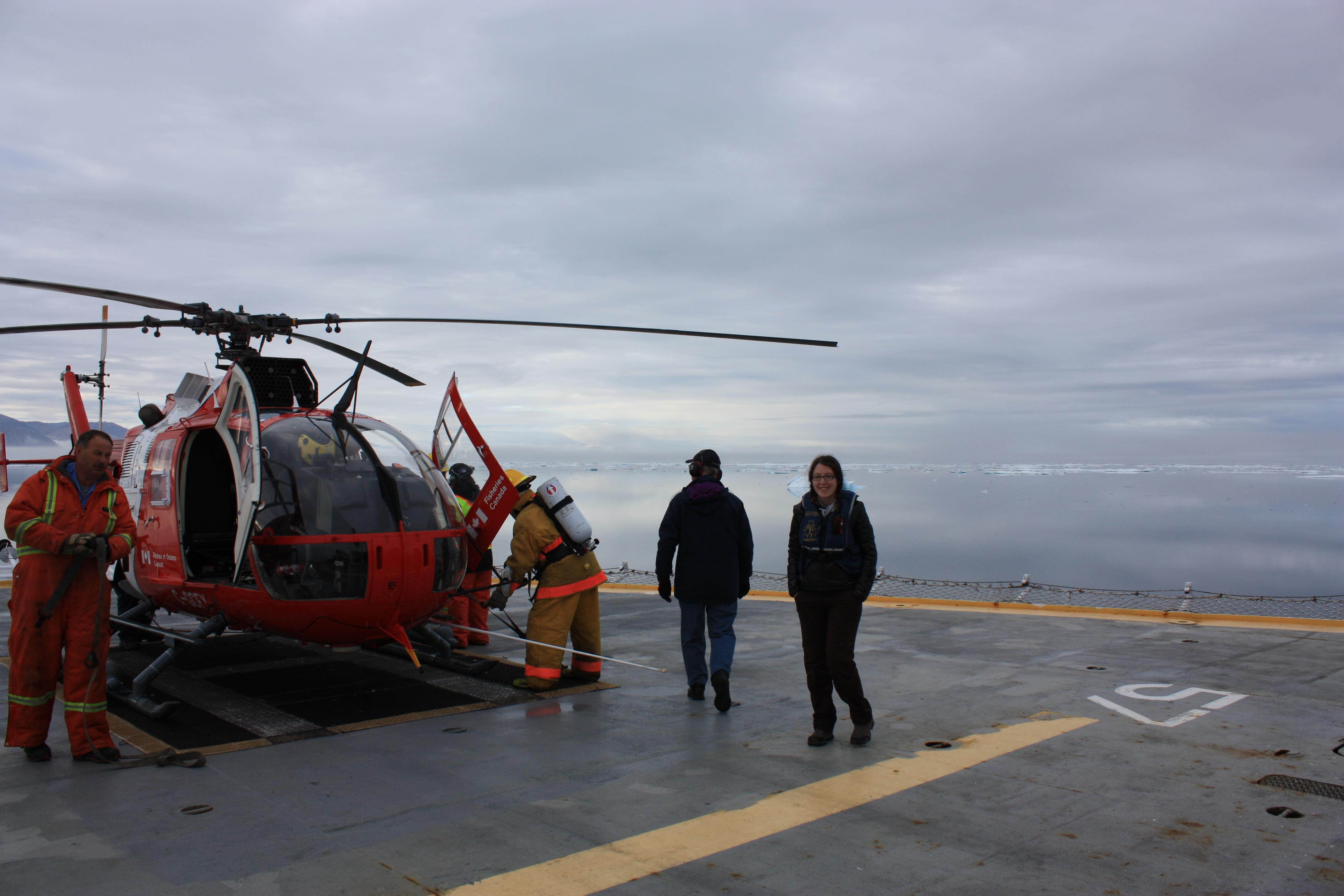
Sunday morning, as our group of eight scientists met to discuss the plan for the day, Brian, the Chief Officer, interrupted to ask if anyone wanted to tag along on the first helicopter ride of the trip. Renske’s hand immediately shot up into the air, and I volunteered a little more slowly. We quickly wrapped up our meeting, and Renske and I layered on jackets and headed up to the flight deck.
Allison Einolf getting ready for an ice recon flight on the flight deck of the CCGS Henry Larsen. [Photo Credit: Jo Poole, British COlumbia]

The purpose of the flight was to give the Ice Services Specialist, Erin, a chance to look ahead at the ice cover up to Hans Island, where we were headed. She was going to make a chart of the ice to help guide the ship through the path of least resistance, and maybe do a little sightseeing. An air of excitement filled the helicopter because neither she nor the pilot, Don, had ever been up here in Nares Strait either.

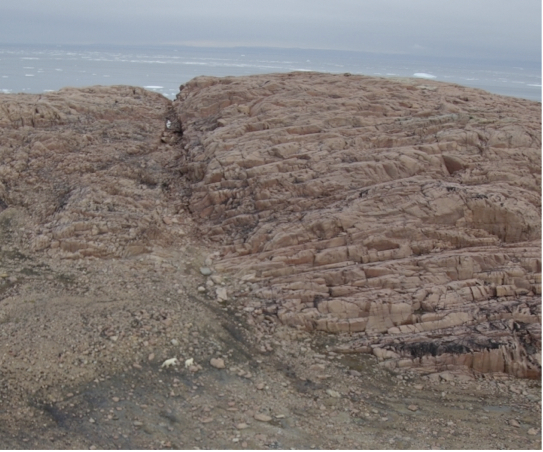
Once the first bit of work was done, we flew over to Ellesmere Island to see the amazing folded ranges. The colors there are amazing – bright reds and yellows in layers, crunched up in beautiful synclines and anticlines. The hills are scored with avalanche chutes and based with alluvial fans. There are glaciers nested in the folds of the mountains, and it is simply breathtaking.

There is a stark contrast between Greenland and Ellesmere Island on either side of the Kennedy Channel. I was awestruck by Greenland while we were in Thule, but Ellesmere Island makes the Greenland side of the strait look dull and gray in comparison. It’s one of the first things you notice up here, and many members of the crew point it out on sunny days. The contrast brings up all sorts of questions about the rocks even for the casual observer.

A few theories have come up over the years as to what made the sides of the channel so different. Some think that the channel lies along some sort of fault or plate boundary, and some argue that plate tectonics has nothing to do with it. No matter how I look at it, something has to have been vastly different on each side of the strait because the Greenland side has all of these horizontal layers in a much grayer rock, and the Ellesmere side is more than just colorful layers – they bend and contort in violent and beautiful ways that seem much more active than the Greenland layers.

Both sides of the Nares Strait are beautiful in their own ways, and the view from a helicopter was spectacular. We were able to land on Hans Island, which is a great example of the carbonate rock of Greenland, and is apparently rife with marine fossils. We also flew over Franklin Island and farther south to Rawlings Bay and Jolliffe Glacier. It was the first time I had seen a large glacier close up, and it was amazing to see the ridges in the ice, and I was surprised by how much a glacier seems to look and act like a very slow moving river.
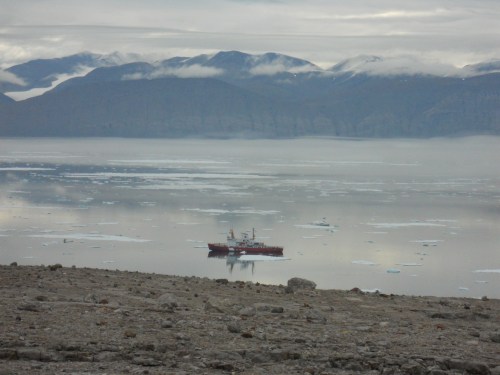
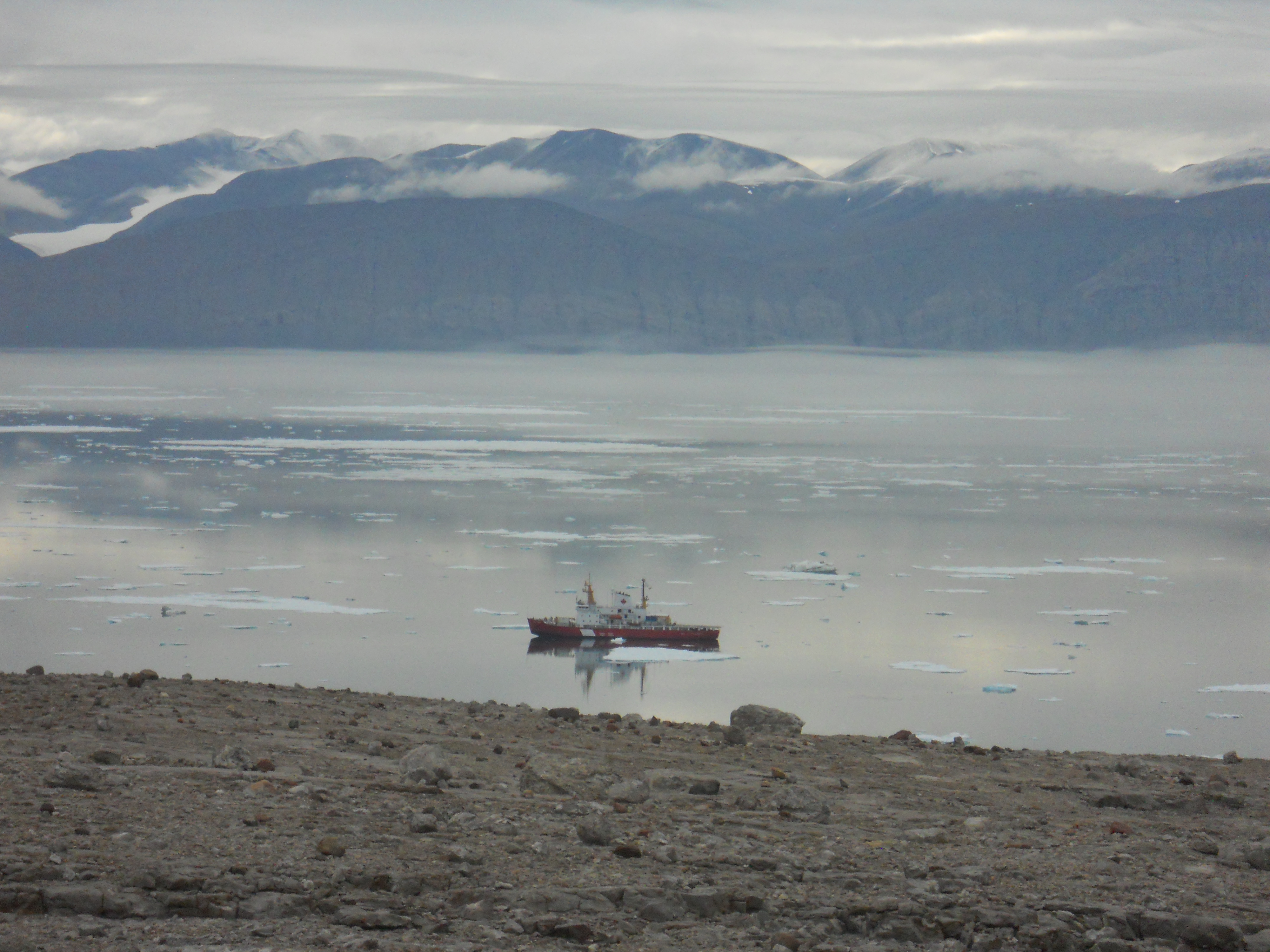
CCGS Henry Larsen as seen from atop Hans Island. The view is to the west with Ellesmere Island in the background. [Photo Credit: Allison Einolf, University of Delaware undergraduate intern]

As we flew into the fjord, I was continually amazed by how nearly vertical some of the layers of the rock were, and by the bright reds and yellows of the rock. Flying back to the ship we flew over the mountains and I was amazed by the way the rock beneath us dropped away completely as we flew into Nares Strait. The geology, the ice, and the experience of being in a helicopter were all so incredible.


Record Warming and Melting of Greenland

These are admittedly daily data, and yes, it is warm in summer everywhere, and yes, when it is warm, snow and ice melt at the surface. Here is the latest image of Greenland’s warming and melting that I lifted (figure and caption) straight from today’s NASA release:

Extent of surface melt over Greenland’s ice sheet on July 8, 2012 (left) and July 12, 2012 (right). Measurements from three satellites showed that on July 8, about 40 percent of the ice sheet had undergone thawing at or near the surface. In just a few days, the melting had dramatically accelerated and an estimated 97 percent of the ice sheet surface had thawed by July 12. In the image, the areas classified as “probable melt” (light pink) correspond to those sites where at least one satellite detected surface melting. The areas classified as “melt” (dark pink) correspond to sites where two or three satellites detected surface melting. Image credit: Jesse Allen, NASA Earth Observatory and Nicolo E. DiGirolamo, SSAI and Cryospheric Sciences Laboratory


Continue reading

Uncertainty in the Physics and Philosophy of Climate Change

I wrote this post last year for the National Journal, but it also relates to the way I think about Petermann Glacier’s ice islands. There are now at least 4 larger ice islands that formed from last year’s single calving: one is the tourist attraction off Labrador and Newfoundland, a second has left Petermann Fjord last week, a third was grounded off Ellesmere Island for much of the year and is now where #1 was Nov.-2010, while the fourth … I do not know. Last I heart, it was grounded off central Baffin Island. With this much variation of where pieces of the ice island went, how can we possibly claim any skill in predicting anything?


Neither climate nor weather is linear, but this neither makes them unpredictable nor chaotic. The simple harmonic pendulum is the essence of a linear system with clear cause and effect relations. Oscillations are predictable as long as the initial forcing is small. Furthermore, a linear trend will show the pendulum to slow down due to friction. Corrections are straightforward.

Unfortunately, climate is not a simple, harmonic, or linear system. While this does not make it unpredictable or chaotic, it means that our “common sense” and loose talk of “totality of events” can easily fool us. We know that CO2 emissions for the last 150 years changed global temperatures. We also know that our current climate system has been very stable over the last 10,000 years. What we do not yet know is how small or how large a perturbations the last 150 years have been. If the pendulum is forced too much, if the spring is stretched too far, the system will find another stable state by breaking. Climate dynamics can find an adjustment less tuned to the areas where people presently live. This is what “tipping points” are about. Only numerical experimentation with the best physics and models will suggest how close to a different stable climate state we are. The IPCC process is one way to do so.

Ice cores from Greenland contain air bubbles 100,000 years old, which clearly demonstrate that our present climate state is the “anomaly of quiet” in terms of temperature fluctuations. The absence of large fluctuations for about 10,000 years made agriculture and advanced civilizations possible. The ice cores show that abrupt climate change has happened and may happen again, not this election cycle, but it is one possibility perhaps as likely as the possibility that climate change is mundane, linear, and follows trends that we can easily correct or mitigate later. Both are excellent hypotheses.

For scientists, these are exciting times as we conduct a massive, global experiment to see how much CO2 we can add to the atmosphere to perhaps find a different climate state. Dr. Terry Joyce, Senior Scientist at Woods Hole Oceanographic Institution once said: “I’m in the dark as to how close to an edge or transition to a new ocean and climate regime we might be. But I know which way we are walking. We are walking toward the cliff.” I agree with this sentiment, but add that we do not know if this cliff is a 1000 feet fall or a 2 feet step. Can we affort to wait until we know for sure? As a scientist I do not care. As a citizen, however, I think the time to act responsibly is now.