
Tag Archives: moorings

Ice Thickness in Nares Strait 2008 and 2009

[Editor’s Note: Undergraduate Julie Jones of the University of Delaware summarizes her work that was supervised by Helga Huntley as part of an NSF-funded summer internship.]

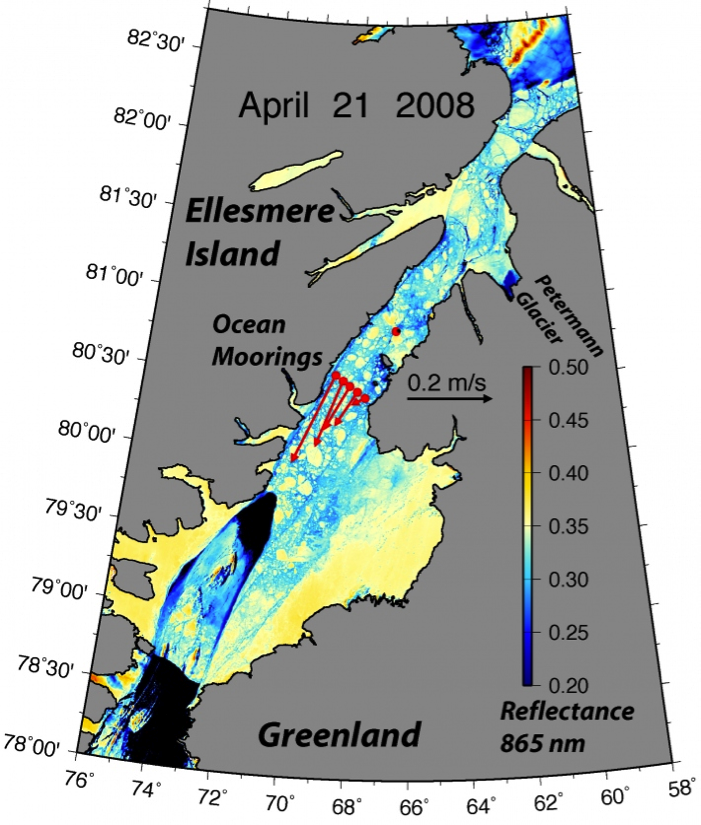
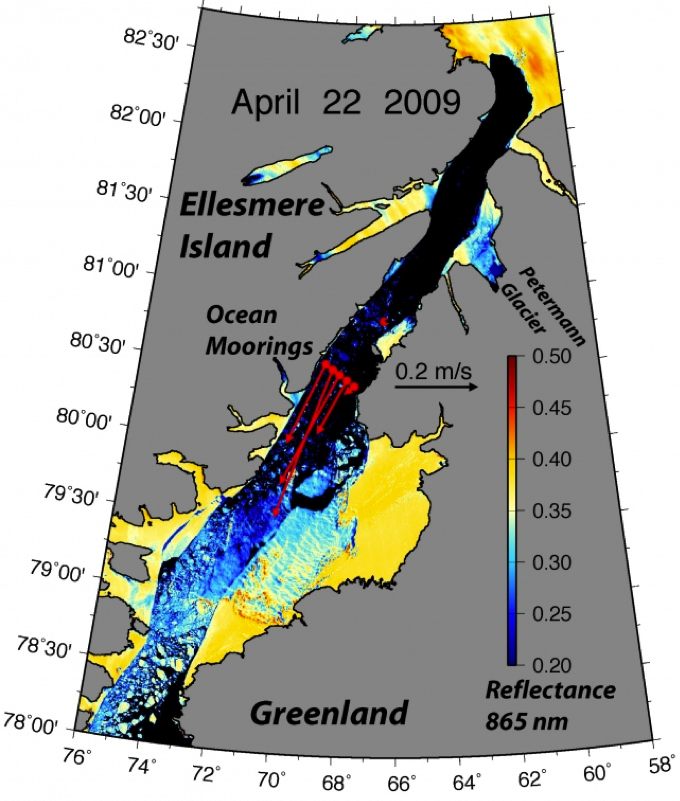
Three years ago in 2009 Andreas Muenchow left from Delaware for Greenland with students Pat Ryan and Berit Rabe to recover instruments that recorded salinity, temperature, current velocities, and ice thickness in Nares Strait since 2007.  This summer, I used those observations to estimate ice thickness for April through June in 2008 and compare them to estimates for the same spring period in 2009.  An ice bridge had formed in 2008 but not in 2009.  Working as a group, we wanted to investigate the effect of ice arches on the ice thickness.  Allison Einolf, another summer intern who focused on ocean currents during the same time periods and Andreas produced these maps that introduce the study area, spatial ice cover, and mean ocean currents:
Image

Nares Strait MODIS satellite imagery of the study area and ice arch April 21, 2008. Red dots are instrument locations. Arrows show current velocities.
Image

Nares Strait MODIS satellite imagery of the study area and ice arch April 22, 2009. Red dots are instrument locations. Arrows show current velocities. Note the lack of the southern ice arch, but the presence of one north of the study area.

I used Matlab for most of the data processing, more specifically the Ice Profiling Sonar (IPS) Processing Toolbox for Matlab provided by the manufacturer of the instrument that collected the data: ASL Environmental Sciences, Inc. First I transformed the data from the IPS instrument into a range time series.  I then manually “despiked” the data, taking out any data points that were likely due to bubbles or fish within the acoustic path from the sensor system to the ice above and back.  In a second step I wrote a function using sound speed data from Andreas, atmospheric pressure from Dr. Samelson at Oregon State University, and pressure (depth) data from the IPS instrument to get a time series of the thickness of the ice.  In a third step I applied a Lanczos raised cosine filter that was taught as part of a 2012 Summer Intern Page Workshop. Hence I finally had some nicely filtered data for the periods of the April-June of 2008 and 2009.

Now the results:  Just as we expected, there was much thicker ice in the 2008 spring with a southern ice arch present than there was in the spring of 2009 when no such ice arch was present:
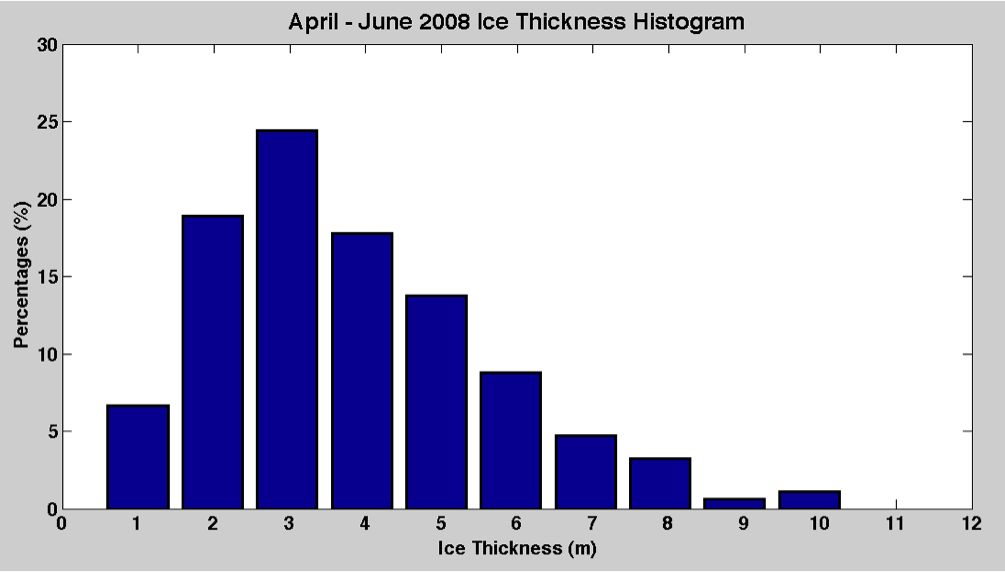
Histogram for April – June 2008 ice. There is a peak at 3 meters, with almost 25% of the ice that thick.
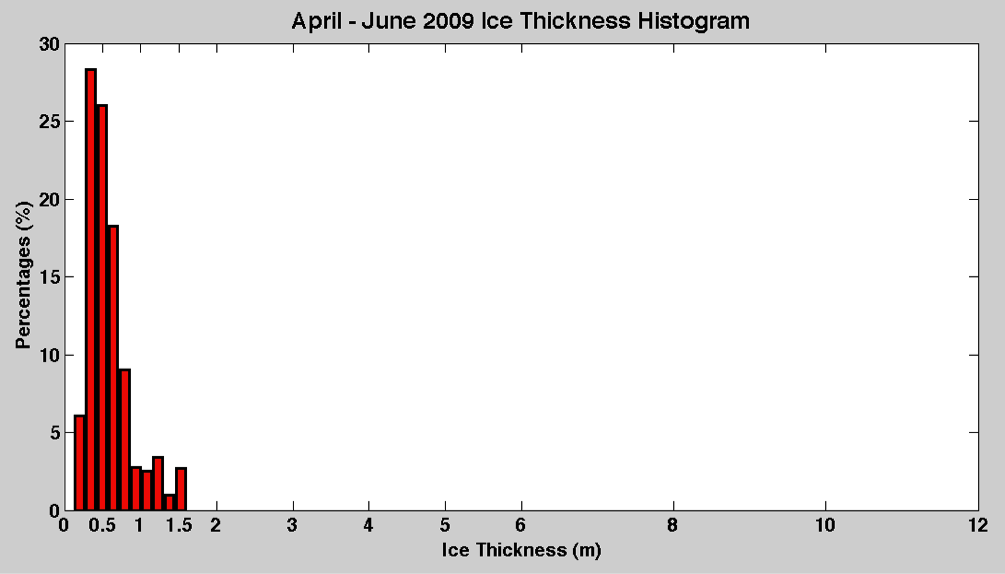
Histogram for April – June 2009 ice. The ice does not get thicker then 2 meters with most of the ice thinner than one meter.

The histograms show thicker ice in 2008, about 2-6 meters on average and with some ice even reaching 10 meters.  In 2009, the ice doesn’t get thicker than 2 meters with most of the ice being thinner than 1 meter.  More specifically, the mean ice thickness for April – June 2008 (2009) is 3.8 (0.58) meters with a standard deviation of 1.8 (0.29) meters.  This further shows that there was thicker ice in 2008 than there was in 2009.  I attributed the cause for the thin 2009 ice to ice flowing freely through Nares Strait all winter and spring as no ice arch in the south blocked such flow.  The ice, thus, did not spend enough time in the high Arctic to thicken.

I noticed something else in my histograms when the 2008 ice bridge collapsed.
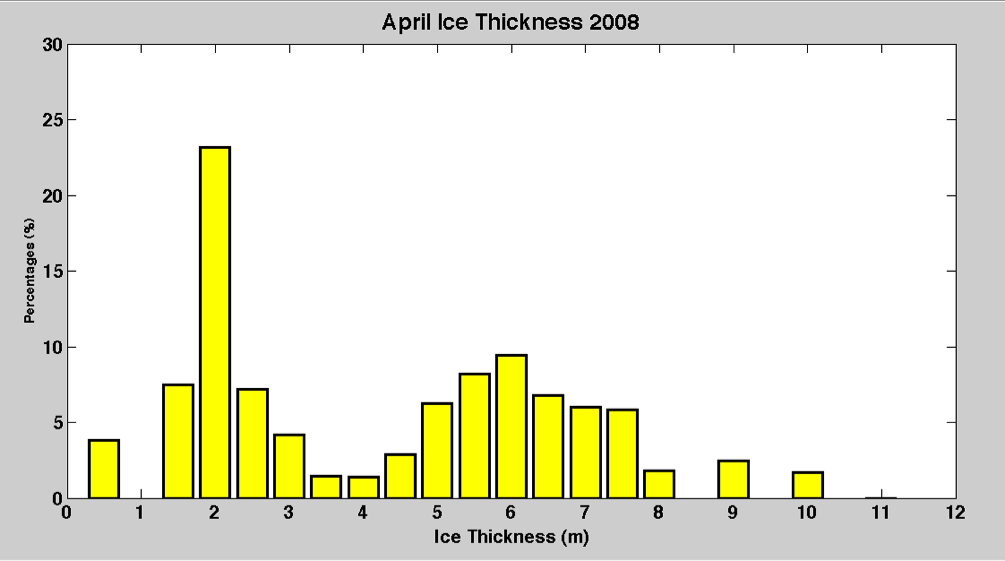
April 2008 ice thickness
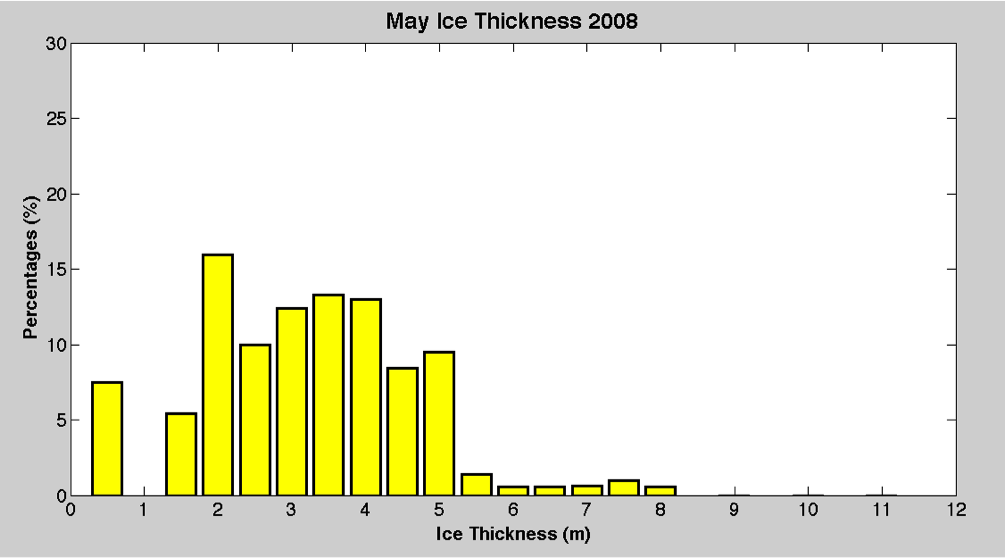
May 2008 ice thickness
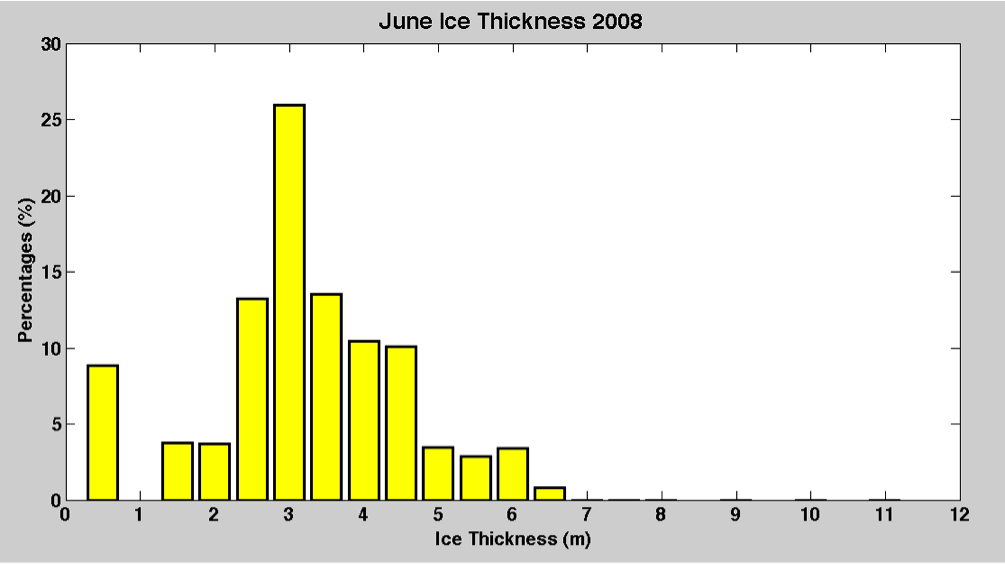
June 2008 Ice Thickness

The monthly histograms show that the ice in April and May is thicker than the ice in June.  We know that the 2008 ice bridge collapsed near June 6th, so it is interesting and it makes a lot of sense that the ice in June would be thinner than the ice two months earlier.

The mean ice thickness for April 2008 was 4.6 meters with a standard deviation of 2.40 meters.  In May 2008 the mean ice thickness was 3.5 meters with a standard deviation of 1.40 meters.  Lastly, in June the mean ice thickness was 3.5 meters with a standard deviation of 1.30 meters.  The ice thickness decreased after April and the variability decreases in June, which helps detect the bridge collapse in the data.

Lastly here are the filtered time series of April – June of 2008 and 2009.
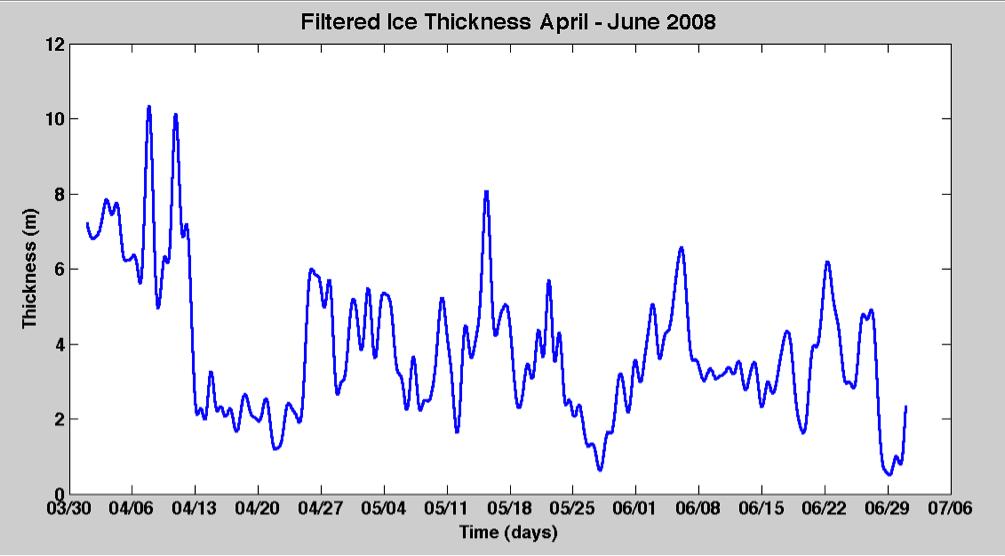
Filtered time series for April – June 2008
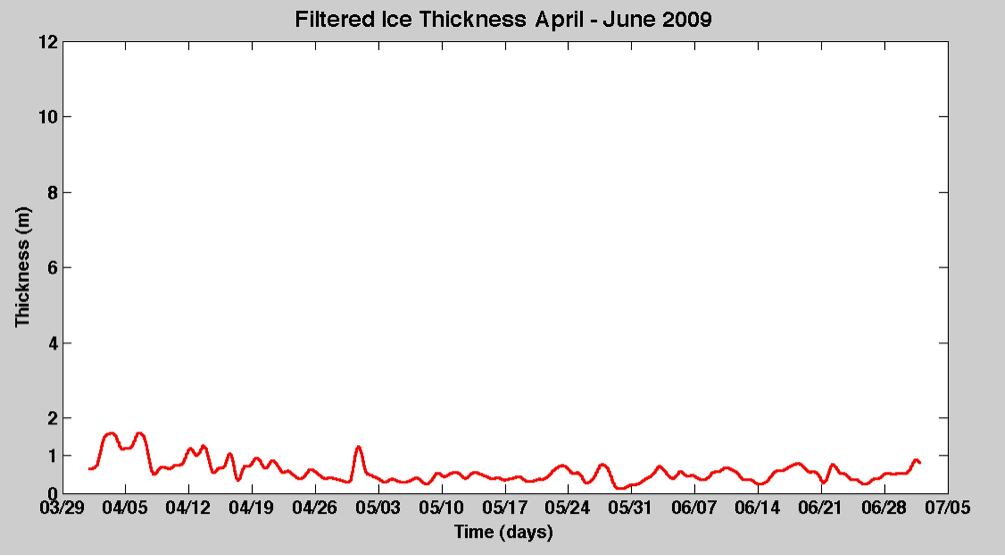
Filtered time Series for April – June 2009 with the same scale as 2008 (above figure)
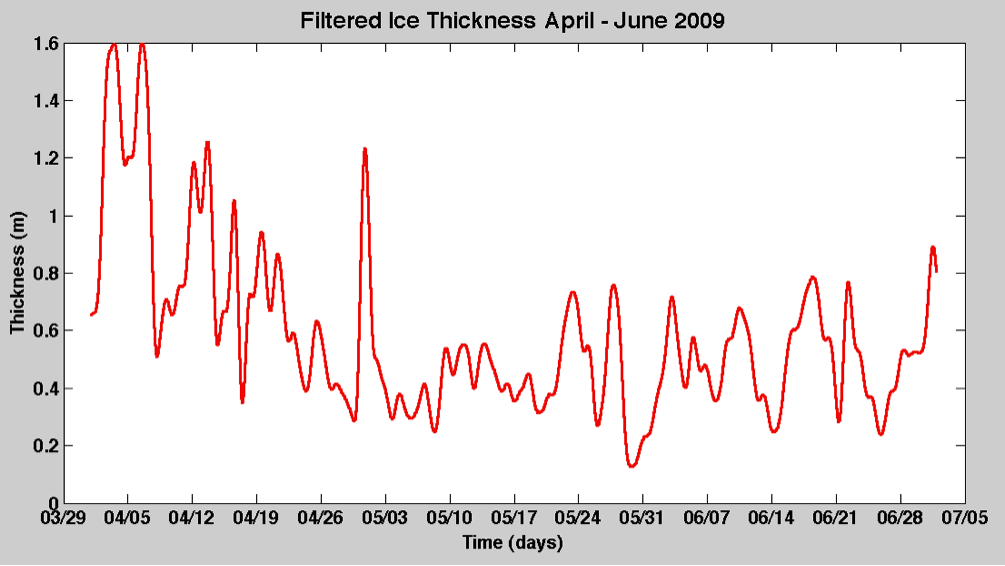
Filtered time series for April – June 2009 with a different scale to see the variability over time more clearly.

Hopefully we can see more interesting and exciting results from the instruments that the Nares Strait team picked up this summer even though they were hit hard by the 2010 Petermann Ice Island!
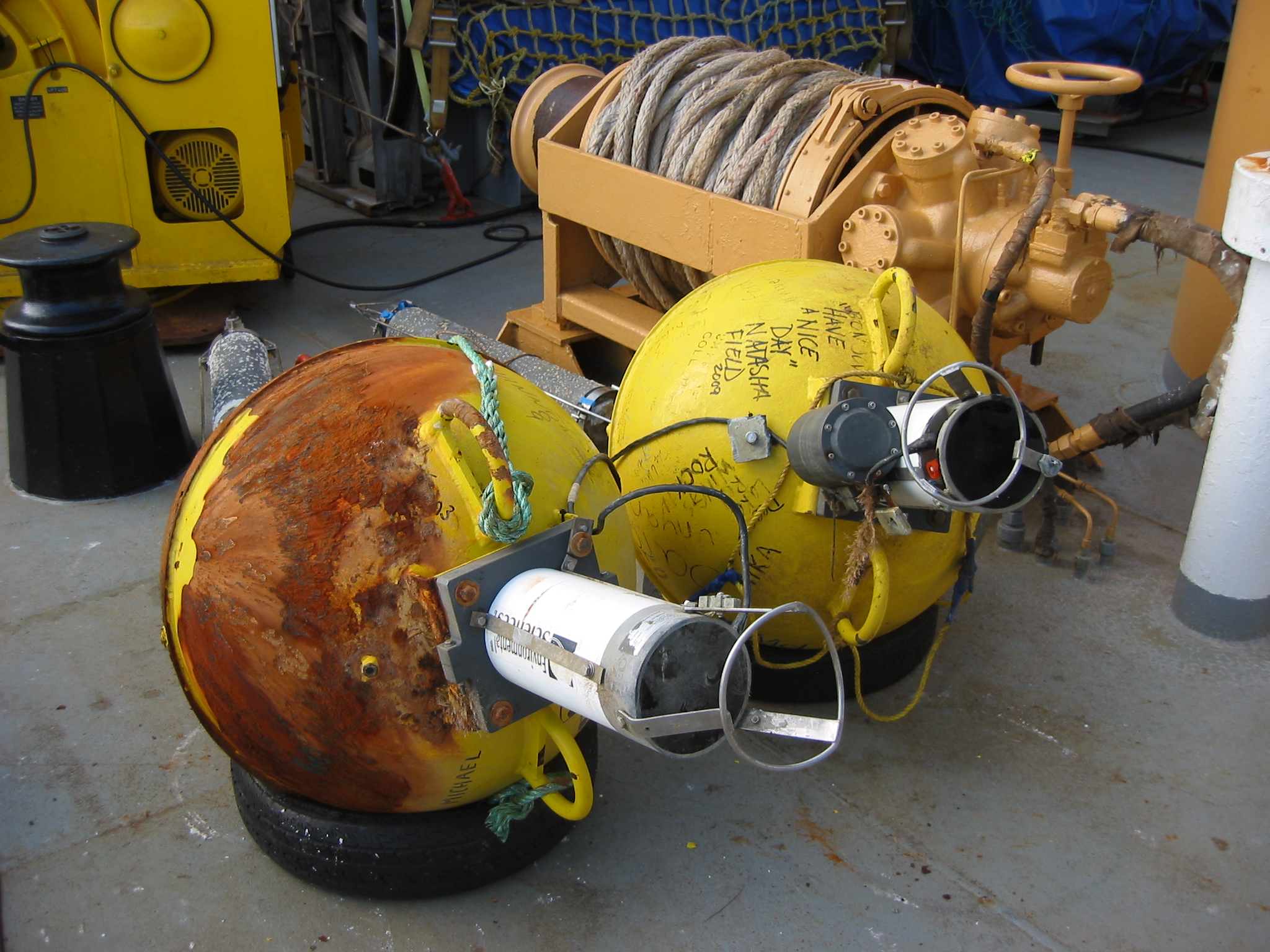
Two Ice Profiling Sonars (IPS) aboard the CCGS Henry Larsen in Aug.-2012. The protective stainless steel frame was bent by the 2010 ice island that hit both instruments in Sept.-2010. [Photo Credit: Andreas Muenchow]

Nares Strait 2012: Renske’s Take on Mooring Recovery

This is a wonderful description by Dr. Renske Gelderloos of Oxford University of what mooring recoveries are all about, taken from her blog.

Mooring Day!

6 August

Today is mooring day! My function on board has officially been changed from scientist to full-time photographer for the day. We want as many photos as we can get from the equipment as it comes out of the water, so that we can always go back later and see if something happened before, during or after the recovery. And it is a beautiful sunny day; very photogenic!

Recovering the moorings is really our number-one priority on this field trip, so everyone is both excited and anxious whether we will be able to recover all of the seven moorings in this section. Ron has already contacted three of them yesterday evening, so that is a very good start. Contacting a mooring works as follows: Ron sends out a signal to the mooring at a given frequency. If the mooring receives this signal it will respond with another signal. Because these moorings are in the water for a very long time (three years in this case), the release switches are programmed to be asleep two thirds of the time and awake only one third of the time to save battery. The mooring only responds if it is awake, so it may take a few minutes to get a response. Once the mooring has confirmed that it is still in the position where it was left three years ago and awake, we go towards the mooring and check that there is no ice overlaying the site (or if there is a little and it is not too thick, ‘just push it away a little bit’ with our icebreaker). Then Ron sends out another signal to lure the mooring to the surface. This signal opens the acoustic release that holds the mooring down to its anchor. The floatation devices that are attached to the mooring line rush upwards to the surface. At this point everyone stares over the railing to try and be the first one to spot it. Today the weather was so calm that we could actually hear them come up, so it was easy. When the mooring is spotted, the FRC is launched with two crew members, who tow the mooring to the boat and attach the heavy things one by one to the crane. Then the crane tows them up to the deck.

Recovering an Acoustic Doppler Current Profiler (ADCP) mooring in 2009.
 

The first four moorings were recovered before lunch (which is from 11.30 to 12.30 here) and it looked like we were going to set a new record today. The fifth mooring after lunch also came in according to plan, but then our luck had run out. The sixth mooring refused to respond, no matter how long we tried. After a while we decided to try and contact the seventh mooring, but again without success. We steamed to the location of the seventh mooring in the hope of getting a response, still with no success. Then suddenly the sixth mooring decided it was willing to communicate after all. Apparently it had just been having some puberty issues refusing to wake up, but now it responded to our mating call. Quickly we steamed back to the site of the sixth mooring, opened the released and successfully recovered the mooring. We tried to get into contact with the last mooring, but unfortunately it was all in vain. We will probably try again on the way back, but we may need to accept that the mooring is just not there anymore.

The scientific successes and endavours of this day were celebrated at the bar that night with a drink. It was a long, eventful and in the end scientifically successful day.

Nares Strait 2012: Tide Gauge Recovered after 9 Years

Andreas Muenchow, Aug.-8, 2012, off Cape Baird

In 2003 we deployed a tide gauge that was recovered today after attempts in 3 different years to do so failed. Discovery Harbor near Fort Conger was the most northern location at 81 42’ North and 64 1’ West of a large moored array placed in 2003. It was at Fort Conger, that Lt. Greeley of the U.S. Army waited in vain for a supply ship that never arrived, but this sad story is for another day and I like to write about happier news: Our 2003 tide gauge lay in wait for 9 years and 1 day precisely. A 2006 attempt to reach this northern location by ship failed on account of heavy ice cover, a 2007 attempt by helicopter succeeded to establish acoustic communications, but failed to recover the sensor package, and a 2009 attempt by ship failed again because of difficult ice conditions.

The odds of a recovery were slim, but 4 hours ago a crew of five found the tide gauge the same way that skilled fishermen of Newfoundland recover lost traps and fish for halibut: with a line of hooks operating small ships smartly. Chief Officer Brian Legge, Seamen Derick Stone and Carl Rose, as well as scientists Ron Lindsay and Jonathon Poole found the proverbial needle (read tide gauge) in the hey stack (read Arctic Ocean). The entrance to Discovery Harbor was guarded by yet another ship-sized piece of Petermann Glacier ice, this one grounded, as well as several large and small sea ice floes, all moving rapidly with the tides and currents. Even navigating the zodiac through this maze to a fixed location was a major accomplishment.

The long-lost tide gauge is a 2 feet cylinder filled with electronics, but 9 years moored to the floor at 20 meter depth turned it into a complex biology habitat attracting wild life much like the artificial reefs created along Delaware by sunken New York City’s discarded subway trains. Mollusks, seaweed, clams, barnacle, algae, and bacterial slime all attached themselves to every surface. Arctic shrimp perhaps feeding on algae or slime were captured along with the gauge. Seaman Derick Stone, who has never seen an Arctic shrimp (neither have I), quickly brushed it away and back into the ocean muttering something about  “Scorpions in the Arctic.” A second specimen was captured alive and returned to the ocean after a brief inspection. It was agreed, that there was no enough meat on this 2-inch long and skinny shrimp

As a sign of respect to the gods of the icy seas a majority of PhDs aboard solemnly swore to give the long lost sensor 3 days of rest before stripping it bare to reveal its guts, check health and status and retrieve recordings. Pranksters aboard this ship, at least one with a PhD, already alerted me to schemes of hostile capture and ransom requests; I suspect ransom to be paid in treasures, valuable certificates, and screech. Little do these pranksters know of web streaming, local area networks, advanced image processing, and other counter-intelligence operations … to be continued.

P.S.: Oh, we also completed section work (temperature, salinity, water samples) in Robeson Channel to the north of Petermann Fjord where a few segments of Petermann Glaciers former ice shelf are both grounded and moving off the coast of Greenland. Presently off Cape Baird to perhaps recover an automated weather station to be placed instead at Joe Island at the southern entrance to Petermann Fjord, weather permitting. We got 40 kts winds from the south, braking waves, as well as balmy air temperatures of 4 degrees Celsius or so.

Nares Strait 2012: Long Hours Recovering Moorings

Andreas Muenchow, Aug.-7, 2012, 12:22 am

Everyone can throw instruments into the ocean, but only few can recover the same instruments 3 years later. And fewer people yet can recover instruments that were hit hard by Petermann’s Ice Island of 2010 (PII-2010). Today, we did exactly that:

Starting at 8am sharp yesterday, we recovered six of seven moorings from the 300-400 m deep ocean floor. Only one is still left. The attention to detail three years ago, when we deployed the moorings, paid off.

We are now parked next to a massive multi-year ice floe for a night without darkness at 80:43.0 North latitude and 67:17.9 West longitude. For the last 3 hours our group celebrated today’s success at the only bar within 300 miles while downloading an incredible amount of data from instruments to laptops. Among the three of us from Delaware we got 5 computers. The groups from British Columbia, Canada and Oxford, England are no different. Science is both a social and an individual activity, as oceanographer Henry Stommel said with true wisdom. There is lots and lots of scientific computing taking place right now, well past mid-night, when most aboard are sleeping.

The recovery of a sensor package begins with sending acoustic signals to an acoustic receiver attached to a tiny motor at the bottom of the ocean. After waking up said receiver near the bottom of the ocean, we send a command through the water with sound waves to turn a motor that separates a hook from a heavy anchor. Buoys attached above the acoustic release raise the entire sensor package to the surface. A zodiac with Chief Officer Brian Legge and a Leading Seaman aboard heads out to grapple the surfaced instrument package that is then hauled aboard the ship by a crew led most competently by bosun Don Barnable. Once aboard the ship a flock of scientists, engineers, technicians, and students crowd over all the elements of the sensor package to document, detach, secure, and move all the many pieces of the mooring.

The ice-profiling sonars originally designed and developed by our Chief Scientist Dr. Humfrey Melling was abused by PII-2010 the most. Two instruments moored 8 km apart were hit in almost identical fashion with ¾ inch thick protective stainless steel attached to the vibrating ceramic plates was bent into strange shapes by more than 80 meters thick ice. Data are downloaded right now to pin point the timing of the impact, but I am pretty sure it was PII-2010 in September of that year.

In addition to the two ice profiling sonars that measured ice thickness overhead from 2009 through 2012 at better than half hourly periods, we also recovered two acoustic Doppler current profilers that measure ocean currents in 40 different layers from the bottom to the surface. Furthermore, two moorings each measure ocean temperature, salinity, and pressure (CT/D) every fifteen minutes for the same 3 years complement the available data. The survival of the CT/D is remarkable for the mooring string contains instruments at 30 meters below the surface. Since our ice-profiling sonar at 80 meters depth was hit by PII-2010, these much shallower CT/D moorings were also hit by PII-2010. Their slick and smart design to slip through cracks and hooks on the underside of the ice made them survive the certain strikes by ice and ice islands.

This was a long and eventful day when we perhaps accomplished 80% of the tasks we set out to accomplish in the 8 days we have in Nares Strait. Our design decisions made 3 years ago paid off as we recovered almost all equipment hopefully holding 3 years of data. These 3 years of data include both the 2010 and 2012 calving events from Petermann Glacier, but they also contain data on the physical context within which these dramatic events took place. Our work has only just begun … as we are preparing to encounter Petermann’s 2012 ice island … I stop here at 1:11 am local time, cloudy skies and lots of ice around.

[Images will be placed when we return, as internet access aboard the ship is limited to text only.]

Nares Strait 2012: First Mooring Recovered

We have received word back from the intrepid Arctic explorers of some early success.  Here is Andreas Muenchow’s latest report:
“Recovered first mooring at 80.7 N and 67.7 W. Ice profiling sonar was hit by ice 100-m below surface, light damage on guard rail, but transducers look ok. Clear skies, light winds from the south, and air temperatures of 1.9 Celsius provided optimal condition. Never before did we recover a mooring this quickly: acoustic interrogation was less than 5 minutes, another 2 minutes after release command the mooring popped up in open water 300 feet from the ship, zodiak lassoed mooring, and 20 minutes later all was aboard. It does not get better than this … attention to detail by Dr. Melling’s mooring group (Joe, Ron, Dave, and Dave) in 2009 paid off.
Petermann Ice Island edged another 1 km towards Nares Strait. I saw at least 3 much smaller segments of likely Petermann Glacier pieces yesterday, all tiny, about the size of our ship. We are now also within helicopter range of Petermann Fjord, but we have 6 more moorings to go. Good start.”
by Andreas Muenchow, Aug.-6, 2012, 12:41UTC