Tag Archives: climate change

Petermann Glacier, Ice Islands, and Changing Climate

Petermann Glacier is a tidewater glacier in the remote north-west of Greenland. The glacier is grounded at about 600-m below sea level. It has calved two large ice islands, a 4-Manhattan sized island in 2010 and a 2-Manhattan sized one in 2012. These losses cover much of the area shown in this 2009 photo:

Eastern wall of Petermann Fjord as seen from CCGS Henry Larsen’s helicopter in August 2009 with the floating ice shelf. Most of the visible ice shelf has been lost during the 2010 and 2012 calving events. [Photo Credit: David Riedel, British Columbia.]

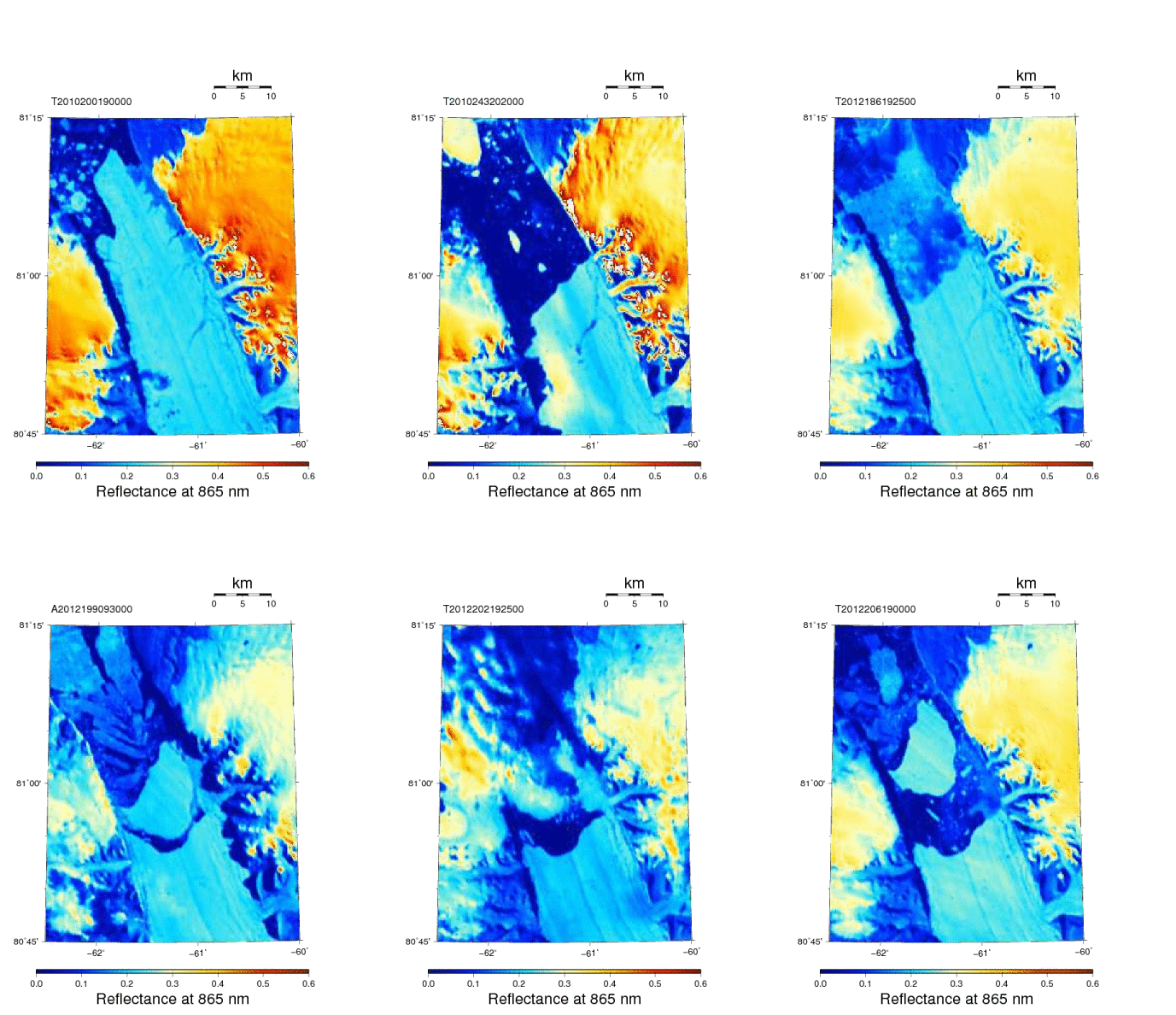
From selected imagery, I created a short movie (0.7 MB) which shows (a) the 2010 calving, (b) the advance of the new front in 2011 and early 2012, and (c) the 2012 calving. The glacier has moved at a rate of about Continue reading

Greenland’s Warming, Melting, and Sliding to Sea

Greenland is warming, Greenland’s warming is melting its ice, and Greenland melting ice is raising global sea level. All true, but it all has happened before during the last 100 years or so. Our technology to extract small signals buried deep in noise from both our backyard and remote Greenland is unprecedented. This skill should not fool us, that the large changes that we see in Greenland and elsewhere have not happened before. They have, but memory is a fickle thing, as “new” is exciting, while “old” is often forgotten and considered unimportant. Those who live in the past are doomed to miss the present, those who ignore the past, are doomed to repeat it. We need to learn from the past, live in the present, and prepare for the future.

Preparing for an expedition to Nares Strait between northern Greenland and Canada in about 5 weeks, I am exploring temperature data from land, satellites, and ocean sensors to get a feel for what has changed. I started with data from weather stations such as the U.S. Air Force Base Thule , Canada’s former spy station Alert, and Denmark’s Station Nord about 700-1000 miles from the North Pole. So, it is cold up there:
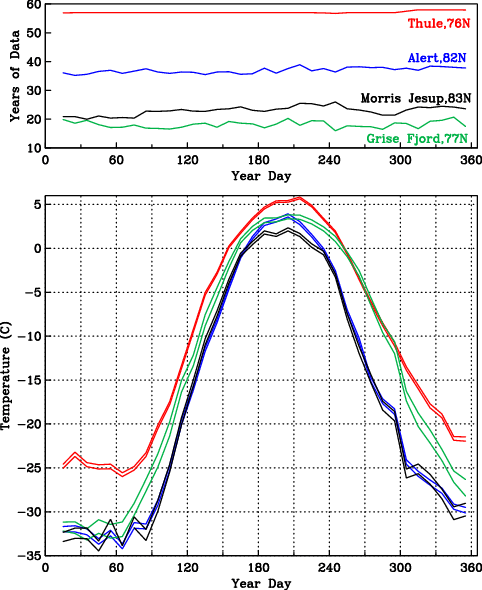
Annual cycle of air temperature (bottom panel) from south to north at Thule (red), Grise Fjord (green), Alert (blue), and Cap Morris Jesup. Data years (top panel) for each year day are degrees of freedom. For each place two temperature curves indicate upper and lower limits of the climatological mean temperature for that day at 95\% confidence.

Well, we knew that, but the real question is: Has anything changed? Has Global Warming reached Greenland? The plot above does not tell, but this one does:
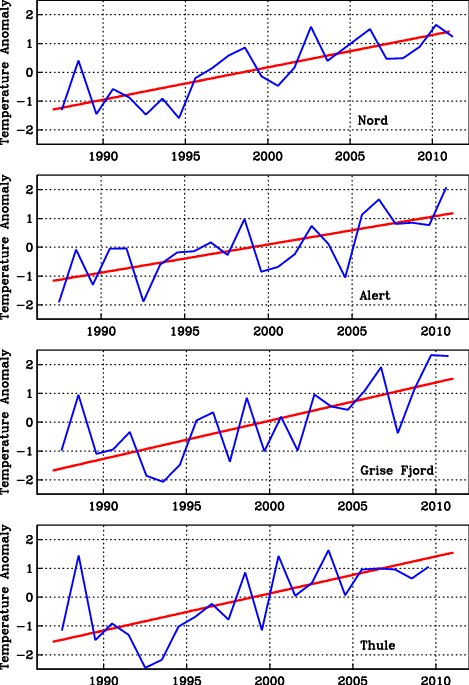
Annual averages and trends of air temperature anomalies for the 1987-2010 period for (top to bottom) Station Nord (Greenland), Alert (Canada), Grise Fjord (Canada), and Thule (Greenland). Scales are identical. The trends are fitted to daily, not annual data. The annual averages are shown for display purposes only.

To some it screams: “Warming, melting, Greenland is surging to sea.” [It is, but it did so before.]

There is lots of fancy signal processing that goes into this (see Tamino or a class I teach) to make a firm statement:

The air around northern Greenland and Ellesmere Island has warmed by about 0.11 +/- 0.025 degrees Celsius per year since 1987. North-west Greenland and north-east Canada are warming more than five times faster than the rest of the world.

This must be huge (yes, it is), it must have an effect on the Greenland ice sheet (yes, it does), and this must raise sea level (yes, perhaps 10 cm or 3 inches in 100 years, Moon et al., 2012).

Now where is the catch?

The catch is that my records all start in 1987, because that is the period for which I have actual measurements from all those stations. My satellite record is even shorter: it starts in 2000, but with lots of work can be extended back to 1978. And my ocean record is shorter yet: it starts in 2003. There just are no other hard data available from north-west Greenland.

So, does this mean we are stuck with the gloom and doom of a short record?

No, but we have to leave the comforts of hard, modern data with which to do solid science. People have to stick out their necks a little by making larger scale interferences. Based on the 1987-2010 results shown above, I can now say that trends and year-to-year variations are all similar in Alert, Thule, Kap Morris Jesup, etc., etc., so I will use the 60 year Thule record to make statements that somewhat represent all of Nares Strait. I could also start looking for softer and older data. With soft data I mean sketchy ship logs kept by whalers, tense expedition reports of starving explorers (Lauge Koch, Knud Rasmussen, Peter Freuchen), and imperial expeditions (George Nares, Adolphus Greely).

Further south there are a few ports where government or trading authorities started records early. The current capital of Greenland, Nuuk (formerly Godthab) is such a place. The Nuuk record starts 1881. And what I find is that the current warming in Greenland has happened just as dramatic as it does now in the 1920ies and 1930ies [well, except for the 2010 spike, but that story is still ongoing]:
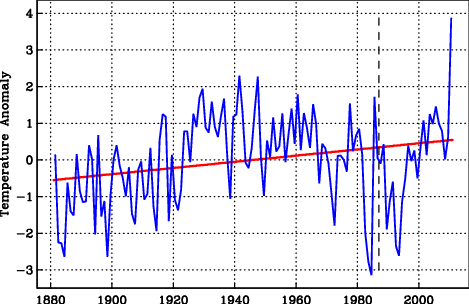
Data from Nuuk, southern Greenland, where the temperature record goes back to 1881 (monthly data from NASA/GISS). The dashed line indicates 1987.

The trend is statistically significant, about 0.008 +/- 0.03 degrees centigrade per year or about 10 times smaller than what it is for northern Greenland starting in 1987. So the devil of Greenland warming, melting, and sliding to sea is in the details or records that are too short. The Global Warming signal is in there, but how much, we do not know and perhaps cannot know. Furthermore, most of the globe of “Global Warming” is covered by water and the ocean warming we know little about. Recall, my ocean record off northern Greenland only starts in 2003 and ends in 2009 or 2012, if we recover computers, sensors, and data from the bottom of Nares Strait this summer.

Greenland’s data and physics of ice, ocean, and air are exciting and all show dramatic change. To me, this is a big and fun puzzle, but one has to be careful and humble to avoid making silly statements for political purposes that are not supported by data. Do I think Global Warming is happening? Absolutely, yes. Do I think it is man-made? Probably. What do I do about it? I ride my bicycle to and from work every day. And that’s what I do next … bicycle home.

Nares Strait Ice Bridge and Arctic Ice Thickness Change

The ice of the Arctic Ocean is rapidly disappearing. This happens every summer, but for the last 30 years there is a little less ice left at the end of each summer than there was the year before. The areas covered by ice are not only shrinking, the ice is also getting thinner, or so many do believe.

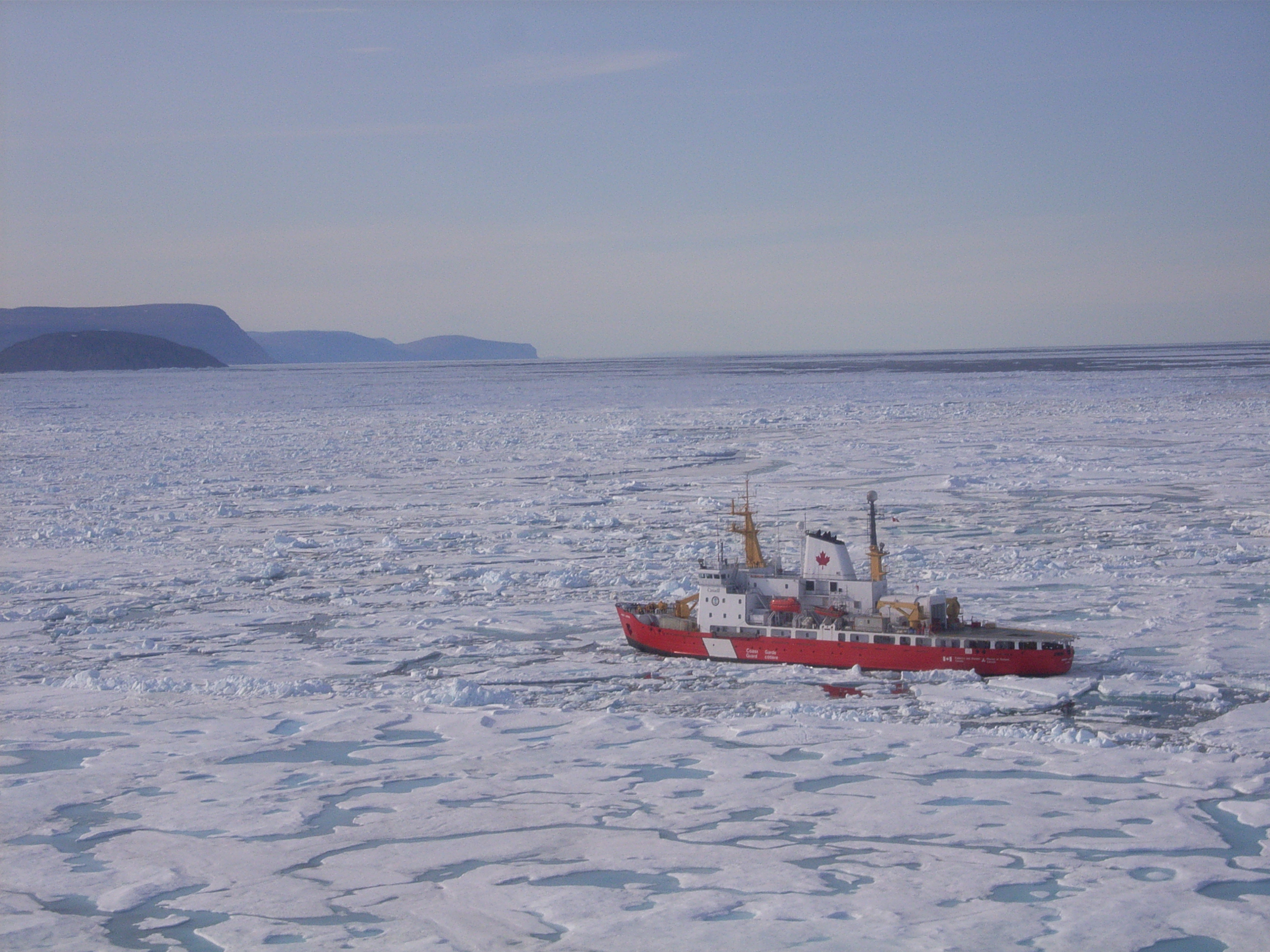
To check out such claims, we placed sound systems on the ocean floor of Nares Strait from which to find out how much the thickness of the ice above has changed. We started this in 2003, were told to stop it in 2009, but privately parked our instruments where they would collect data. We must get to check our sound systems and retrieve the private recordings, because otherwise Poseidon will claim our possessions for parking violations. The Canadian Coast Guard Ship Henry Larsen, we hope, will help us to negotiate water and ice to get us deep into Nares Strait as she and her crew did so well in 2006, 2007, and last in 2009.

CCGS Henry Larsen in thick and multi-year ice of Nares Strait in August 2009. View is to the south with Greenland in the background. [Photo Credit: Dr. Helen Johnson]

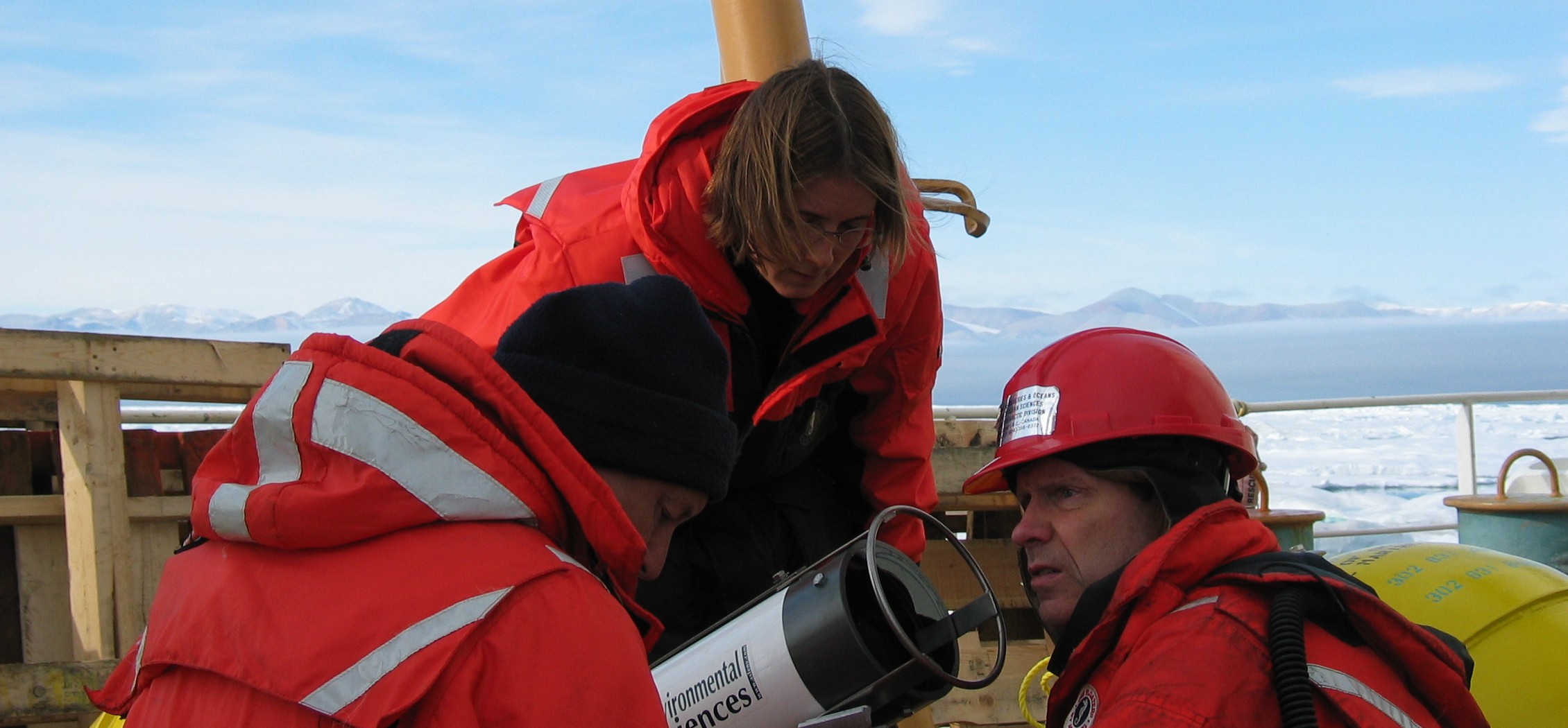
The ice profiling sonar sounds system before its first deployment in Nares Strait in August 2003 from aboard the USCGC Healy. It measure ice thickness many times each seconds for up to 3 years. View is to the north-west with Ellesmere Island, Canada in the background. Listening in are Jay Simpkins (left), Helen Johnson, and Peter Gamble.

Nares Strait to the west of northern Greenland is one of two major gates for the thickest, the hardest, and the oldest ice to leave the Arctic for the Atlantic Ocean [Fram Strait to the east of Greenland is the other.] This gate is closed at the moment by an arching ice bridge that locks all ice in place. No ice can leave the Arctic via Nares Strait as long as these arches hold. The ice arch acts as a dam that holds back the flood of ice that will come streaming south hard once the dam breaks. And break it will, usually between the end of June and July.

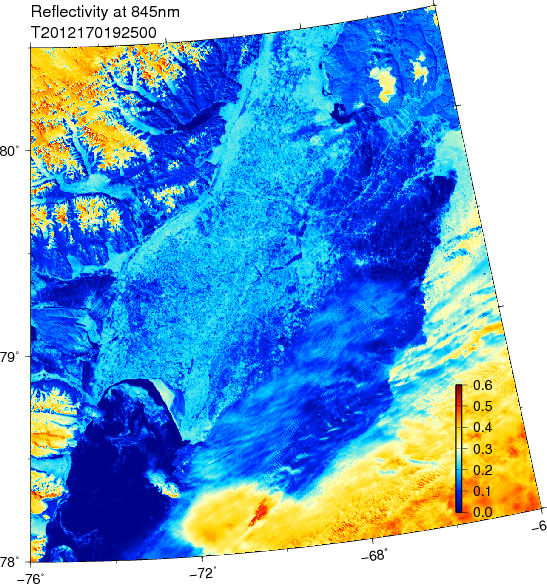
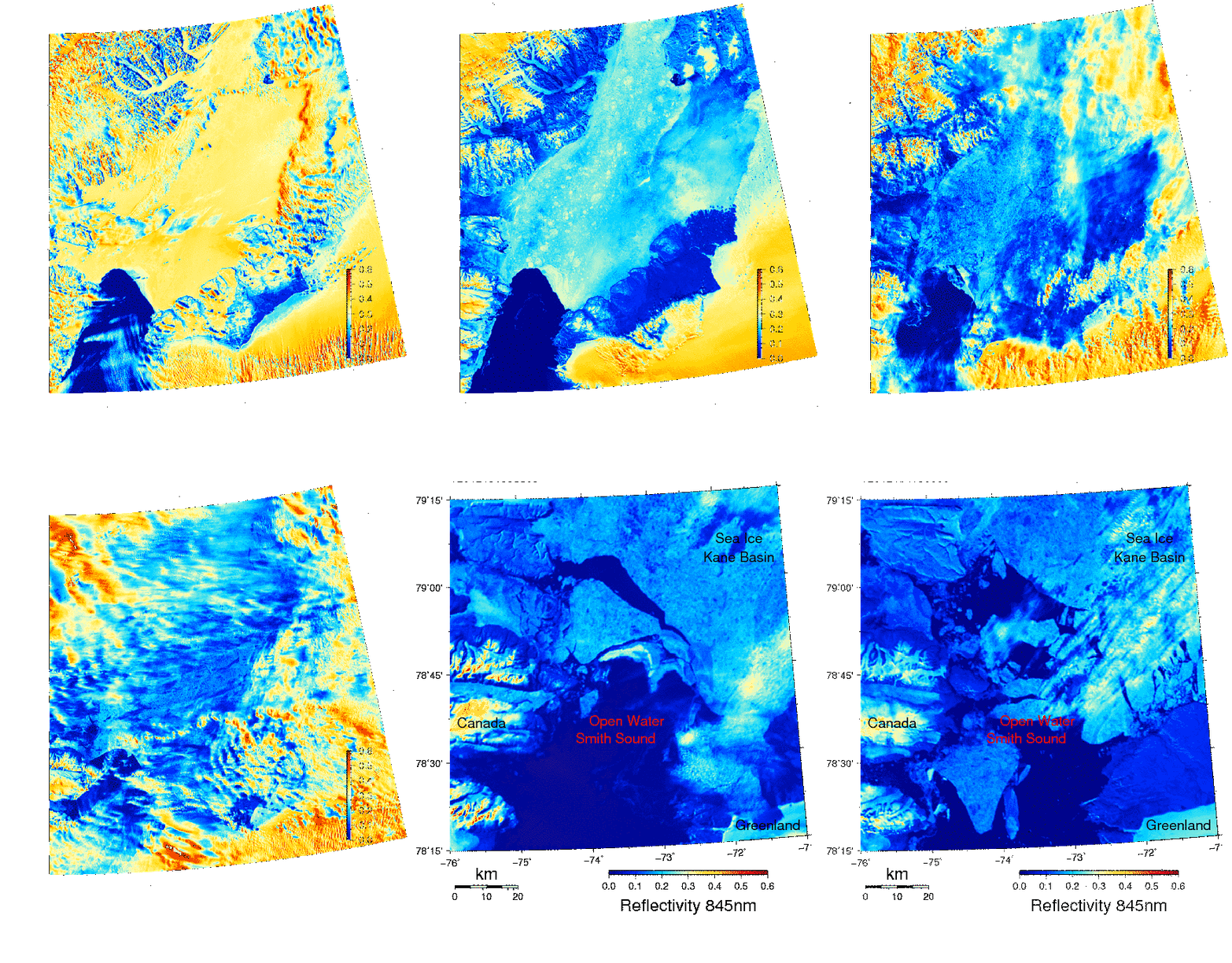
Ice arch in southern Nares Strait as seen by MODIS Terra on June-18, 2012. Greenland is on the right, Canada on the left. The dark blue colors in the bottom-left are open water, yellow are the ice caps of Greenland and Ellesmere Island and lighter shades of blue are warm ice or land. Humboldt Glacier is the on the right-center where Nares Strait is at its widest with Kane Basin at about 80 N latitude.

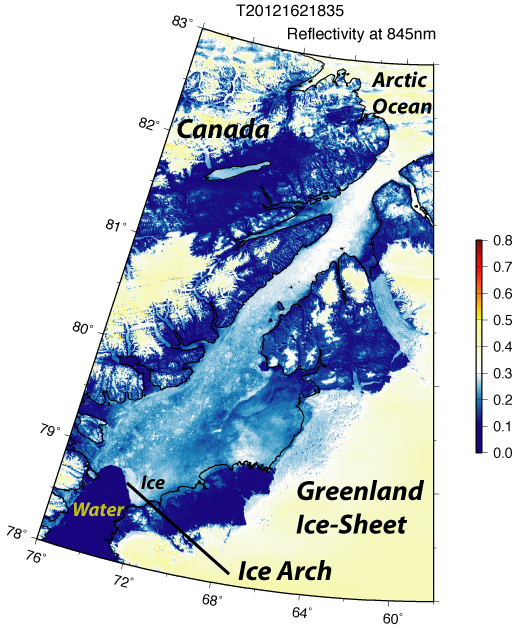
Nares Strait Jun.-10, 2012 image showing land-fast ice between northern Greenland and Canada as well as the ice arch in the south (bottom left) separating sea ice from open water (North Water). The coastline is indicated as the black line.

The sooner it breaks, the more old ice the Arctic will lose and the better it is for us to get an icebreaker to where must be to recover our instruments and data. The data will tell us if the ice has changed the last 9 years.

I processed and archived maps of Nares Strait satellite images to guide 2003-2012 analyses of how air, water, and ice change from day to day. Ice arches formed as expected during the 2003/04, 2004/05, and 2005/06 winters lasting for about 180-230 days each year. In 2006/07 no ice arch formed, ice streamed freely southward all year, and this certainly contributed to the 2007 record low ice cover. In 2007/08 the arch was in place for only 65 days. In 2009/10, 2010/11, and now 2011/12 ice cover appear normal as the arches formed in December and lasted until July.

We live in exciting times of dramatic change, some to the better and some to the worse. Some of the change is caused by global warming while most is probably not. We do not know for sure, but most of the evidence points towards us people as a major driver of the change we observe in the Arctic and elsewhere. Nevertheless, climate and its change is one grand puzzle that no single scientist, no single discipline, no single country, and no single continent can solve. There are many pieces that all contribute to how and why the Arctic ice changes the way it does. And this includes the ice arches of Nares Strait. There are many mysteries and unresolved physics in what makes these ice arches tick and what makes them blow to bits, but blow they will … watch it, it’s fun, and perfectly natural.

EDIT: This movie shows just how stable the ice arch is at the moment.

Greenland’s Glaciers, Science, Sea-Level, and Teachers

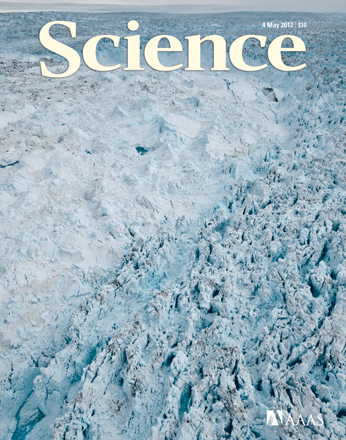
Science Magazine hit climate change hard today. They cover how Greenland’s glaciers and ice sheets change as they interact with the ocean and contribute to sea-level rise feature in 3 related stories. The reality check of these three stories puts a damper on the usual doomsday scenarios of those whose skill is limited to grabbing public attention to move a political agenda. Real science works differently:

May-4, 2012 Science Magazine Cover: A jumble of icebergs forms in front of the heavily crevassed calving front of Jakobshavn Isbræ, one of the fastest outlet glaciers draining the Greenland Ice Sheet. The ~5-kilometer-wide ice front rises ~80 meters out of the water and extends more than 600 meters underwater. Recent research shows that the speeds of Greenland glaciers are increasing. See page 576. [Photo Credit: Ian Joughin, APL/UW]

The solid new research is that of Twila Moon, a graduate student at the University of Washington whose dissertation work relates to the evolution of Greenland’s outlet glaciers over the last 10 years. She uses data from Canadian, German, and Japanese radars flown on satellites. She applies fancy mathematics to the data and feds data and mathematics into modern computer codes. And with all that, she cracks the puzzle on how fast more than 200 of Greenland’s largest glaciers go to town, eh, I mean, to sea. Furthermore, she shows how this flow has changed over the last 10 years.

Twila Moon, graduate student and scientist at the University of Washington and first author of “21st-Century Evolution of Greenland Outlet Glacier velocities” that appeared in Science Magazine on May-4, 2012. [Photo Credit: APL/UW website]

Back in the days of 2008, crude, but simple back-on-the-envelope calculation suggested that Greenland contributes 0.8-2.0 meters to global sea-level rise by 2100. In stark contrast, the 2000-2010 data now reveals, that even the low-end estimate is too high by a factor of 10. A glacier here or there may accelerate at a large rate to give the 0.8-2.0 m, but these rates do not occur at the same time at all glaciers. Ms. Moon’s more comprehensive and careful analyses of accelerating glaciers bring down Greenland’s contributions to sea-level rise to below 0.1 m by 2100, that comes to about 1 mm/year or an inch in 30 years.

A commentary written by Professor Richard Alley relates to the ice-sheets that feed these glaciers. Dr. Alley is famous for his work on Greenland’s ice sheet as he participated in 2-Mile Time Machine, a project that revolutionized the way that we view climate and its variability the last 100,000 years. The title refers to the 2-mile long ice-core from Greenland’s ice-sheet that trapped and stored air and stuff from the last 100,000 years. Dr. Alley is also featured in Andrew Revkin’s dot-earth blog of the New York Times as the Singing Climatologist. His comment on “Modeling Ice-Sheet Flow” references Ms. Moon’s observations as evidence that ice sheets change quickly. It also contains the sentence that “The lack of a firm understanding of ice-sheet-ocean interaction, constrained by reliable ocean data, remains a critical obstacle to understanding future changes.” I could not agree more with this sentiment, these data are darn hard to come by … not as hard as getting to the bottom of the 2-mile time machine, though.

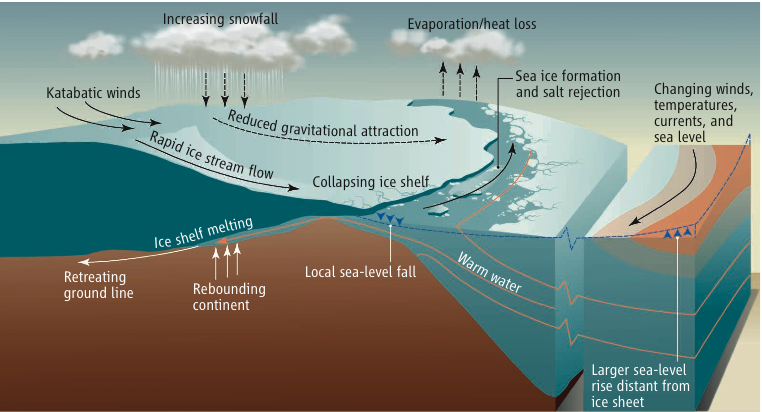
While Ms. Moon addressed changes in Greenland’s glaciers, Dr. Alley addressed the ice-sheets feeding those glaciers, another comment by physical oceanographer Dr. Josh Willis of NASA’s Jet Propulsion Laboratory relates to the sea-level changes caused by accelerating glaciers to make “Regional Sea-Level Projections.” He works mostly on massive computer models which devour massive amounts of data to get climate right. Sometimes this works, sometimes is does not, but he does comment that these earth system models give sea-level projections that are a factor 2 smaller than those derived from statistical relations and semi-empirical models using surface temperature and radiative forcing to extrapolate past trends into the future. The difference probably relates to smaller and more regional processes that involve the physics of ocean circulation and its interaction with ice-shelves off Antarctic and Greenland.

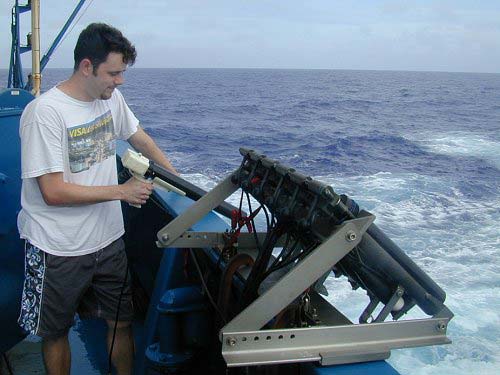
Dr. Josh Willis conducting an oceanographic experiment studying sea temperatures between New Zealand and Hawaii. [Credit: JPL/NASA]

My great oceanography hero, Henry Stommel of Woods Hole oceanographic Institution once wrote in his “View of the Sea,” that “Science is both an individual and a social activity.” I am sure that graduate student Ms. Moon, NASA researcher Dr. Willis, and veteran professor and science communicator Prof. Alley all work hard and lonely at night some nights … and party hard while discussing science and adventures over a beer, dinner, coffee in some city, remote field, or on a ship. The one group of people missing in this picture are … the science teachers, that is, those dedicated, over-worked, and under-paid professionals who encourage, motivate, and helped us to become scientists before we went to college.

The editorial of this week’s Science Magazine is entitled “Empowering Science Teachers.” It compares the social and professional status of pre-college science teachers in Finland and the USA. I will only say in the words of Anne Baffert, chemistry teacher at Salpointe Catholic High School in Tucson, Arizona, that too many science “… teachers work in a command-and-control environment, managed by those who lack any real understanding of how to improve the system.” The editorial suggests on how scientists can improve science teaching, such as “… active involvement in science through structured collaborations with scientists …” Apparently, Finland succeeds while we in the USA are challenged to get our graduate students into a pre-college class room teaching. More stuff for me to munch on here …

Pine Island Glacier Ice Island 2012 Shoving Off

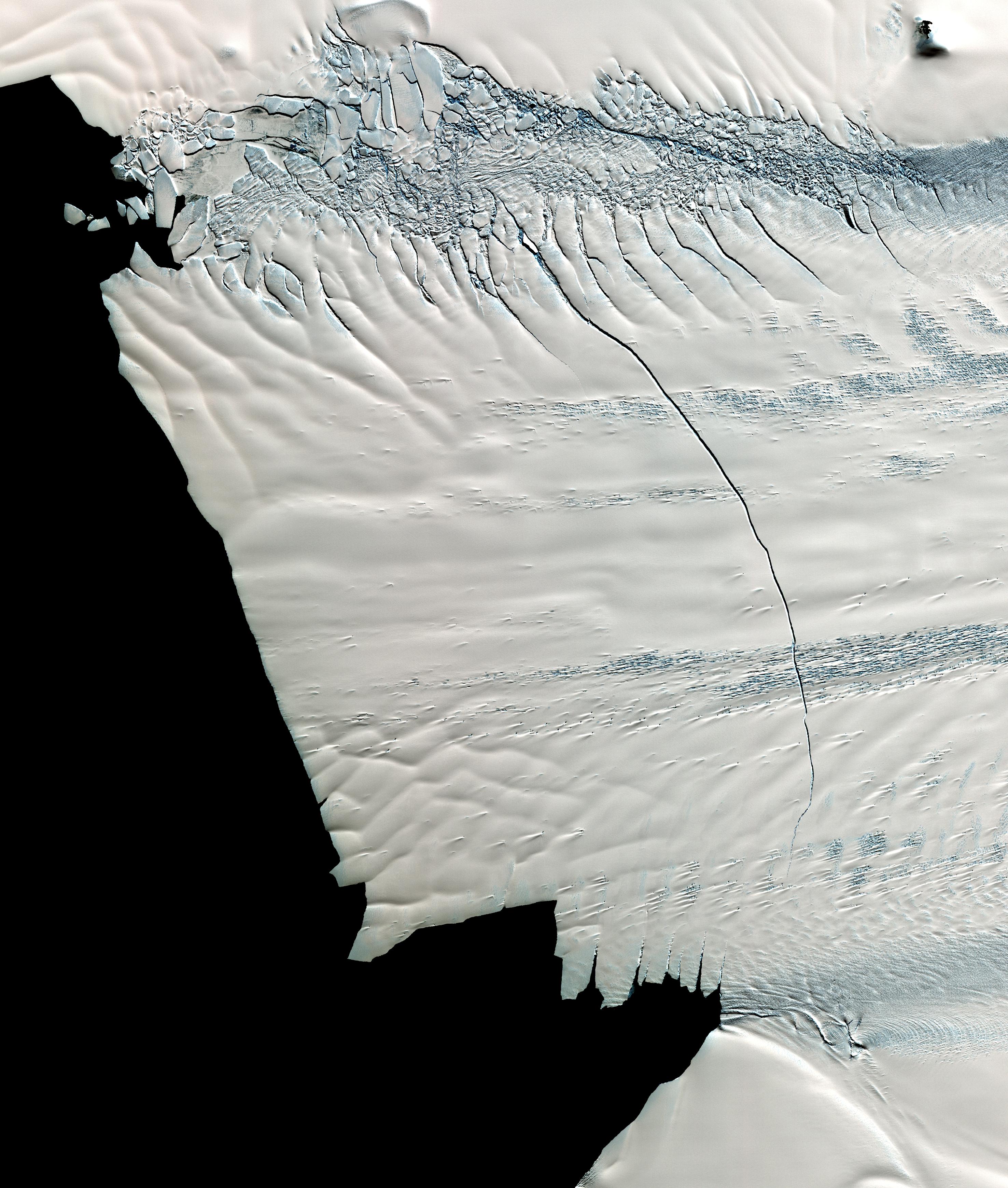
NASA published a stunningly crisp image of Pine Island Glacier (PIG), Antarctica yesterday that is already out of date, because the PIG is on the move. Glaciers change rapidly these days and the speed of the PIG is anything but glacial. The image below from Nov.-13, 2011 shows a massive crack that will develop into an ice island about 3-4 times larger than the one formed from Petermann Glacier, Greenland in 2010. While the image indicates that the part seaward of the crack is still attached, I am convinced that it is already moving independently of the glacier.

Nov.-13, 2011 image of Pine Island Glacier, Antarctica from the Advanced Spaceborne Thermal Emission and Reflection Radiometer (ASTER) instrument. Area shown cover 27 by 32 miles or 44 by 52 kilometers. Image Credit: NASA/GSFC/METI/ERSDAC/JAROS, and U.S./Japan ASTER Science Team.

The same Terra space craft that provides the very crisp and high-resolution ASTER image also has sensors that image a larger area at slightly coarser 250 meter resolution. And monday was again an exceptionally clear day over Pine Island Glacier that revealed this (false color) image of radiation received at a “color” that is out of range of our eyes, the near infrared (865 nanometers):

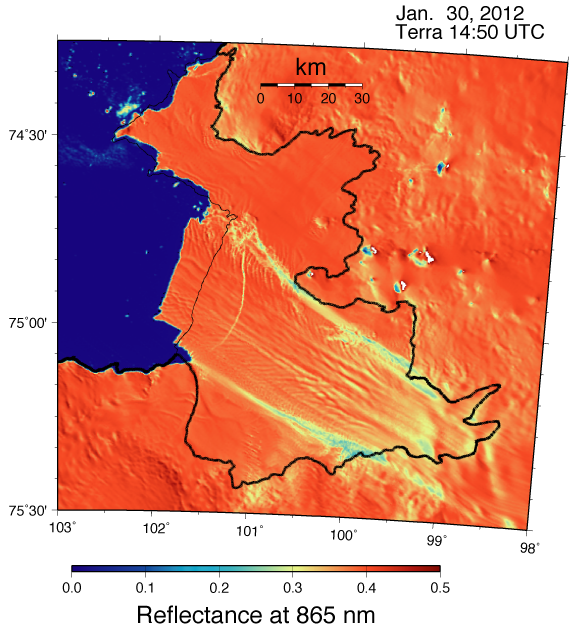
Pine Island Glacier, Antarctica as seen Jan.-30, 2012 from MODIS sensors on Terra spacecraft. The crack is visible as the white line. For reference I am also showing where the front of the glacier was seven years ago with a thin black line. The thick black line shows where the glacier is grounded to the bedrock more than 1000 meters deep (grounding line).

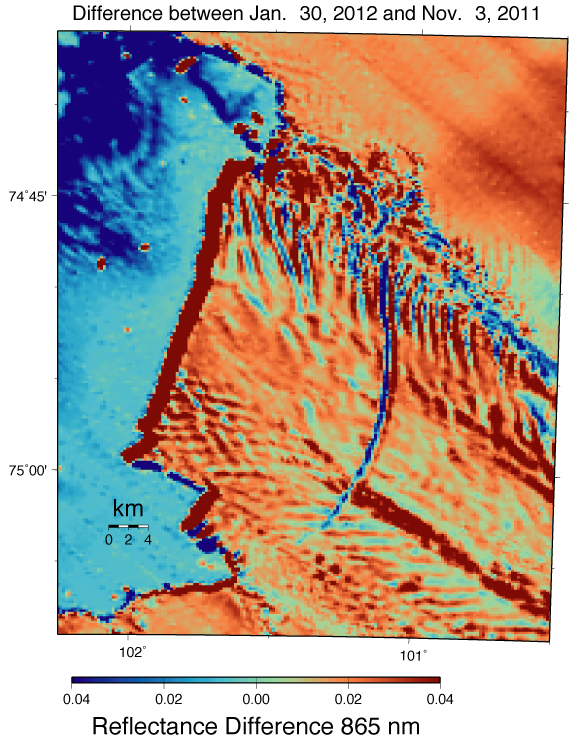
The glacier has advanced a fair amount, the crack breaking off is a perfectly normal event. This is what tidewater glaciers do, they move out to sea and break off icebergs and ice islands. Subtracting the January-30, 2012 image from a Nov.-3, 2011, I think that the thick red line below shows how far and fast the new ice island has moved the last 3 months. Its speed is at least ten times that of the glacier behind the crack:

Difference of two MODIS images, thick red line on left (seaward edge of glacier) shows the area that the new ice island had moved into on Jan.-30, 2012 that was water on Nov.-3, 2011.

Lets leave the boring crack alone, nothing to worry there. What is important at Pine Island Glacier is the retreat of the grounding line, the location where ice, ocean, and bedrock meet. All ice located seaward of the grounding line is floating and does not add to rising global sea level. [Actually, it does raise sea level a tiny amount on account of subtle nonlinearity on how volume of water and ice are influenced by temperature, salinity, and pressure, but lets neglect this detail for now as everyone else does for a good reason).

It is the ice landward of the grounding line that will raise sea level as it passes the grounding line and becomes floating ice. And the thickness of this part of the glacier is decreasing at a rapid and alarming rate, because the glacier is melting from below by the ocean and much of the bedrock landward is below sea level, thus allowing the PIG to become “unhinged.”

The problem with this process is that we cannot see it as easy from space, as we can see changes at the surface. The ocean melting does not give the stunning images that portray drama, concern, and excitement the same way that new ice islands do. Yet, for most large glaciers like Pine Island, Antarctic and Petermann, Greenland, the oceans are eroding and melting these glaciers from below. It is the physics on how this works that we scientists do not yet know and understand very well. It is one thing to have a theory and perhaps a model, but only hard data from the ice and the ocean will give us the confidence and understanding to make smart decisions that balance our energy use contributing to global warming with the need to economically develop. Smart development allows us to live better lives and cope with calamities, some of which may be caused by global warming and the sea level rise it brings.