Tags
Arctic Ocean climate climate change glaciers Greenland ice ice island moorings Nares Strait NASA oceanography Petermann physics travel weather-
Recent Posts
- Navigating Health and Community in Germany as a Returned Immigrant: Trains, Sport, and Food
- Back-Packing to Pioneer Basin in California’s High Sierra: Beaches and Swimming and Trout
- Exploring Greenland’s Coastal Currents: A Journey of Discovery with Icebreaker Polarstern
- Faith, Freedom, and War: German Summer School in Ukraine
- Walking Lviv, Ukraine: Art, Life, War, and History
Top Posts & Pages
Archive
Topics
-
Category Archives: Polar Exploration
Nares Strait 2012: First Mooring Recovered
We have received word back from the intrepid Arctic explorers of some early success. Here is Andreas Muenchow’s latest report:
“Recovered first mooring at 80.7 N and 67.7 W. Ice profiling sonar was hit by ice 100-m below surface, light damage on guard rail, but transducers look ok. Clear skies, light winds from the south, and air temperatures of 1.9 Celsius provided optimal condition. Never before did we recover a mooring this quickly: acoustic interrogation was less than 5 minutes, another 2 minutes after release command the mooring popped up in open water 300 feet from the ship, zodiak lassoed mooring, and 20 minutes later all was aboard. It does not get better than this … attention to detail by Dr. Melling’s mooring group (Joe, Ron, Dave, and Dave) in 2009 paid off.
Petermann Ice Island edged another 1 km towards Nares Strait. I saw at least 3 much smaller segments of likely Petermann Glacier pieces yesterday, all tiny, about the size of our ship. We are now also within helicopter range of Petermann Fjord, but we have 6 more moorings to go. Good start.”
by Andreas Muenchow, Aug.-6, 2012, 12:41UTC
Posted in Nares Strait 2012, Petermann Glacier, Polar Exploration
Tagged moorings, Nares Strait, Petermann
Nares Strait 2012: Approaching Ocean Mooring Line in Kennedy Channel
by Andreas Muenchow, Aug.-5, 2012, 14:22 UTC
From the southern entrance of Kennedy Channel at 80.03N and 67.25W we can see our mooring site about 45 nautical miles ahead, about 80 km. It will take us 8-9 hours to get there as the ship weaves its way through ice that covers about 50-80% of the surface. The farther north we get, the thicker and harder the ice. Air and ocean temperatures are lower, less ice melt has taken place, and we are closer to the source of this multi-year ice. The very clear skies, clean air, flat ocean, and rugged ice provide ideal conditions to fool the eyes and brain of even experienced sailors: mirages are everywhere as the light is reflected and refracted so many times that not all we see is what it is. Even renowned polar explorer Robert Peary saw land in the 1890ies where there was none, called it “Crocker Land” to honor one of his sponsors, and subsequent explorer toiled in vain to find it.
We are ready and eager to start work in earnest after 2 days of sailing. The recovery of the instruments anchored to the bottom of the ocean for the last 3 years has the highest priority. We need the instruments aboard to get to the data that describe ocean currents, temperature, salinity, and ice thickness at least every half hour continuously since August of 2009. Should the ice prevent us to reach every site, we are prepared to service the automated weather stations, like the one at Hans Island. Dr. Jeremy Wilkinson is hosting the data here in real time. Hans Island is a short distance north of our mooring line. Tonight we will start to measure ocean temperatures, salinity, and densities with depth at 5-7 stations running along a section from Ellesmere Island in the west towards Greenland in the east. The term “night” has no meaning, however, as the sun is always brighter than it is in my garden in Delaware because there is no shade and ice and water reflect all light along multiple pathways.
At 6 am this morning I saw a ship-sized piece of ice from Petermann Glacier in the distance. It had the undulating surface that is typical of Petermann as well as dirt from rock. Nevertheless, do not know where the Manhattan-sized Petermann Ice Island PII-2012 is right now or if it has left the fjord. Internet access is severely limited for scientists and crew alike. So you, my dear readers, probably know more than anyone aboard this ship where PII-2012 is from browsing NASA’s MODIS archives, if the area is cloud-free.
The helicopter left the ship half an hour ago with the ice observer and two scientists aboard (Allison Einolf and Dr. Renske Gelderloos) to reconnoiter local ice conditions up to Hans Island 60 miles ahead. While a prudent mariner in these icy waters will always inspect ice conditions ahead via helicopter to extend the 3-12 mile radar range, the helicopter is also an expensive resource at $1,800 per hour. For example, with the currently clear skies overhead NASA’s MODIS provides 250-m resolution bands that are good for ice navigation in Nares Strait, if they were available. RadarSat is even better, but even RadarSat is received aboard the ship only at downgraded resolution to reduce data transmission rates and costs.
Addendum: The helicopter returned safely with images and videos of ice conditions in Kennedy Channel. Also, as of 2 minutes ago: “In theory we do know where PII-2012 is as this morning’s RadarSat image include Petermann Fjord,” said Ice Service’s Specialist Erin Clark before heading off for lunch after getting off the helicopter.
Posted in Nares Strait 2012, Polar Exploration
Tagged ice surveillance, Nares Strait
Independence Fjord, Peary, and the First Thule Expedition
Independence Day 2012. Independence Fjord 1912. The mapping of northern Greenland.
I am reading 100-year-old travel reports by Danish polar explorers Knud Rasmussen and Peter Freuchen who visited Independence Fjord exactly 100 years ago to resolve a puzzles of Greenland’s geography: Is Peary Land an island or Greenland’s North? It is Greenland, but their detailed report has data I want: glaciers mapped, temperatures recorded, ice described, rocks sampled, musk ox killed. It is all part of an ongoing scientific journey of discovery and writing, but I am getting ahead of my Independence Day and Independence Fjord story:
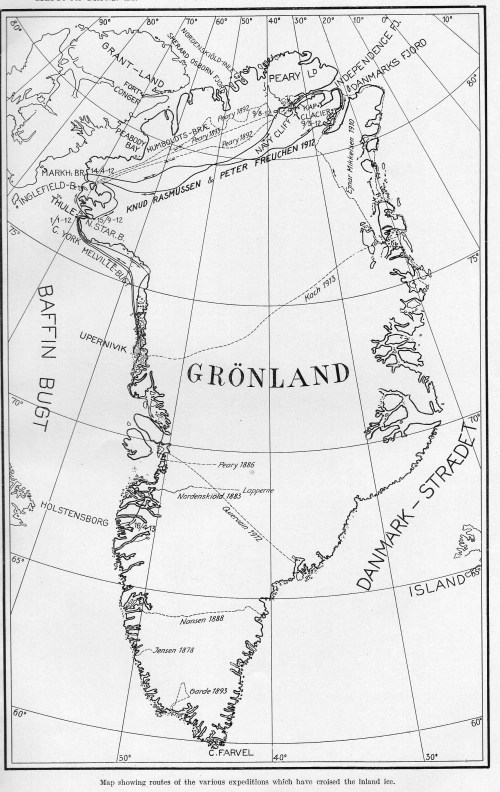
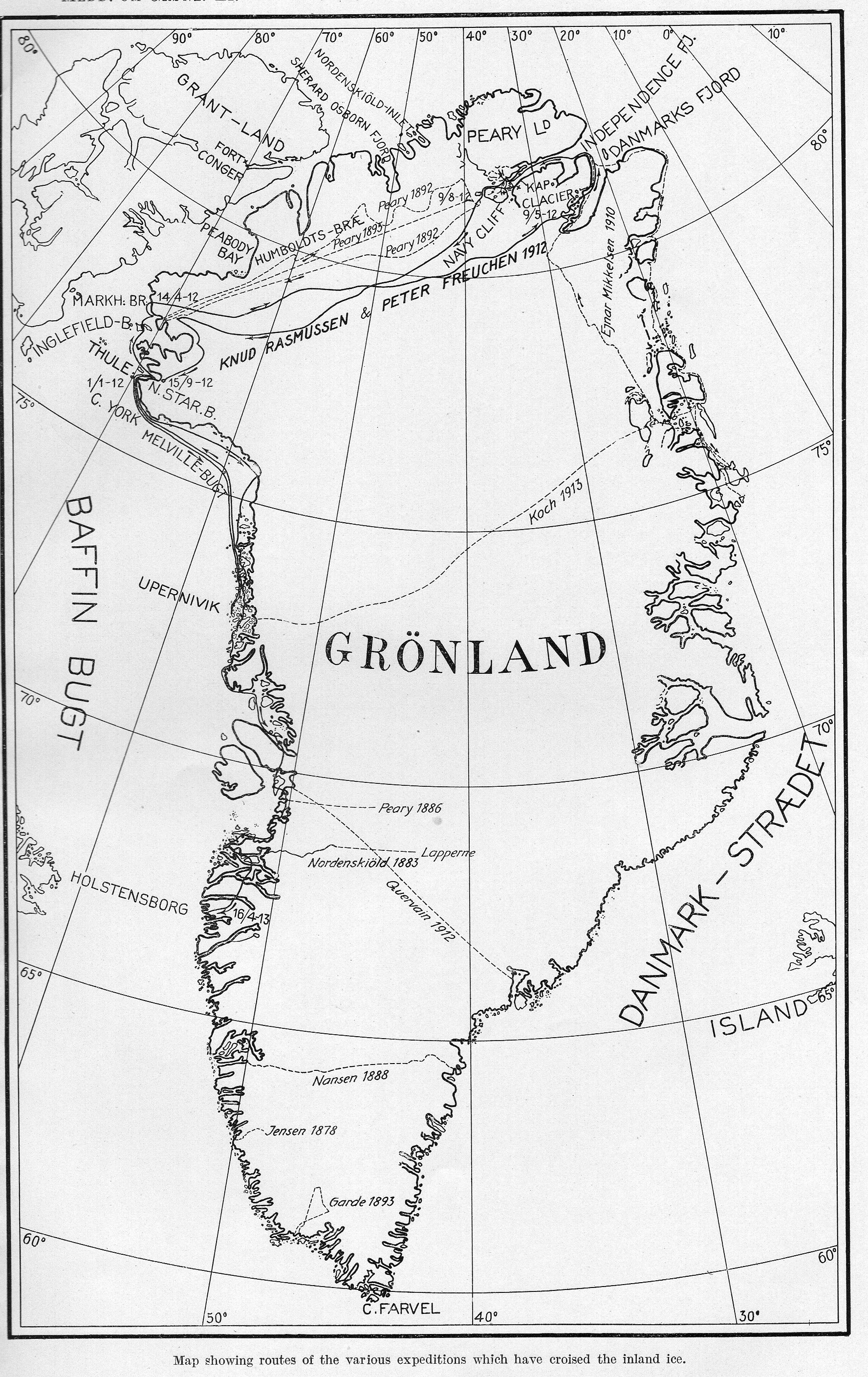
Map of Greenland as included in the Report of the First Thule Expedition 1912 by Knud Rasmussen also showing contemporary expeditions across the Greenland ice sheet.
The Greenland mapping and early science was done painstakingly via sled dog teams by hardy people and adventurous spirits who had to find and hunt game to avoid death by starvation. Rasmussen, Freuchen, and their Inuit companions Uvdloriaq and Inukitsoq set out over Greenland’s inland ice from Thule on April 19, 1912 with 54 dogs to return 5 months later with only 8 dogs.

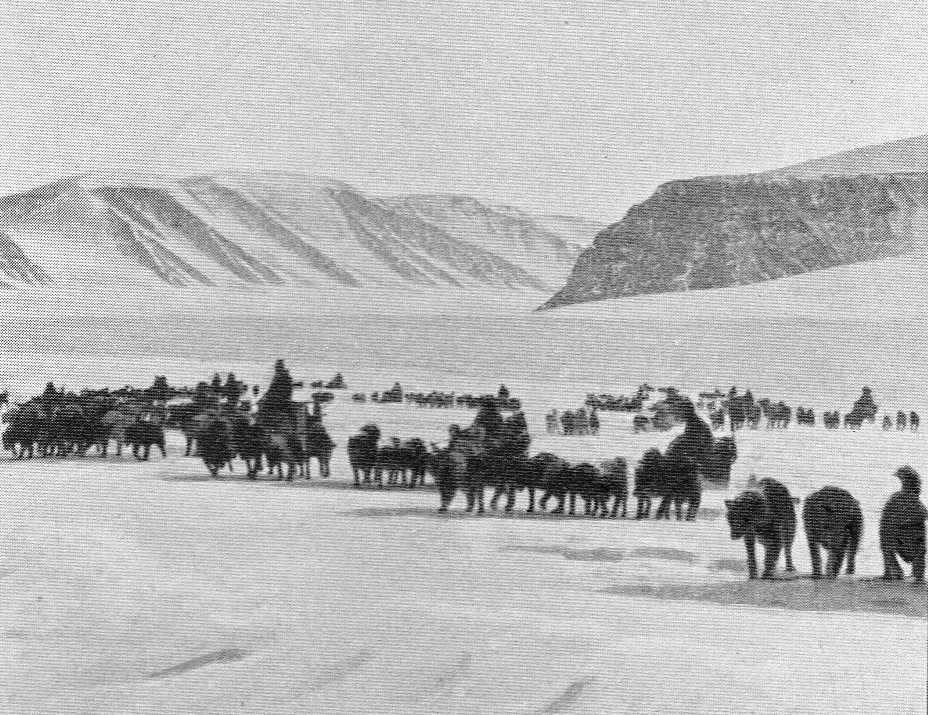
Ascent of the Inland ice in April 1912 as the First Thule Expedition starts from Clemens Markham’s Glacier to Independence Fjord. All 4 explorers returned, but only 8 of the 54 dogs did.
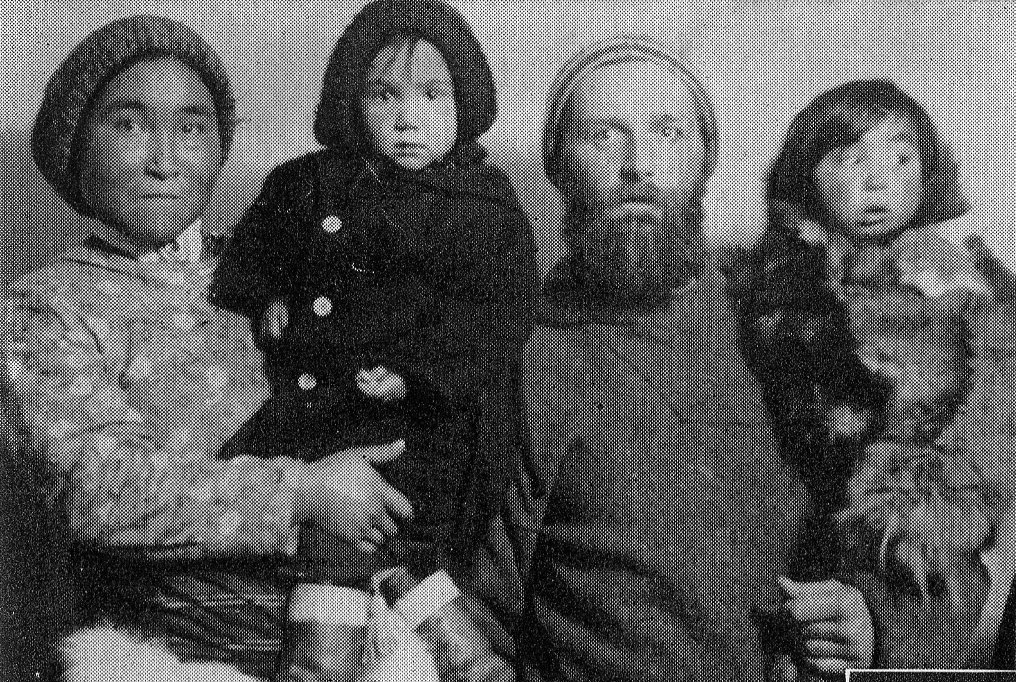
This was the First Thule Expedition that was supported by the Thule Trading Post at North Star Bay that Rasmussen and Freuchen had privately established in the fall of 1909. Today it is the location of Thule Air Force Base. My father-in-law served here for a year as a young Airman in the 60ies. It is also where our Nares Strait science party will board the Canadian Coast Guard Ship Henry Larsen Aug.-1, 2012. I am thinking of Peter Freuchen and his Inuit wife Naravana, Knud Rasmussen, and Independence Fjord on this Independence Day.
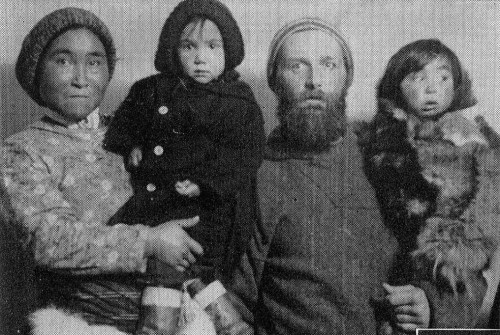
The Freuchen family on a visit to Denmark: Naravana, Pipaluk, Peter, and Mequsaq [Source: Freuchen, P., 1953: Vagrant Viking. Julian Messner Inc., NY, 312 pp.]
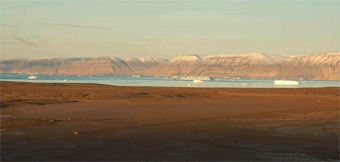
Independence Fjord in the summer of 2007 as seen from Kap Moltke looking south. [Source: web]
Independence Fjord in north-east Greenland was named by Robert E. Peary on America’s birthday 120 years ago on July 4, 1892 when he was the first white person to get there. Prehistoric people of the Independence cultures left artifacts from 3000 years ago. Hunting was good then, too. The 120 year old photograph of Peary shows him standing atop Navy Cliff next to a cairn with two Star Spangled Banners fluttering in the wind. The view eastward is along the 120 mile (200 km) long and 19 miles (30 km) wide Independence Fjord that opens into the Greenland Sea.
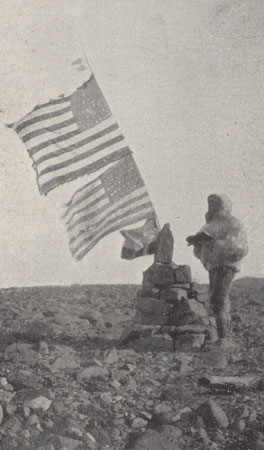
Peary at Navy Cliff, Greenland on July 4, 1892 atop Independence Fjord. [Photo Credit: Bowdoin College]
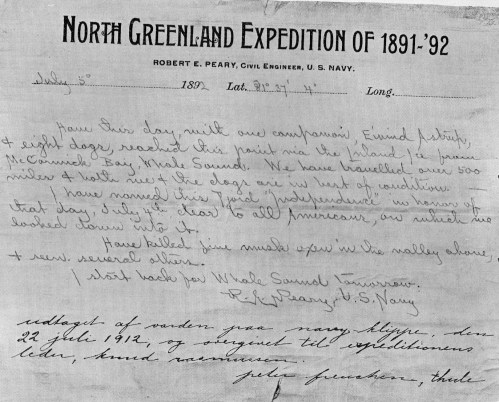
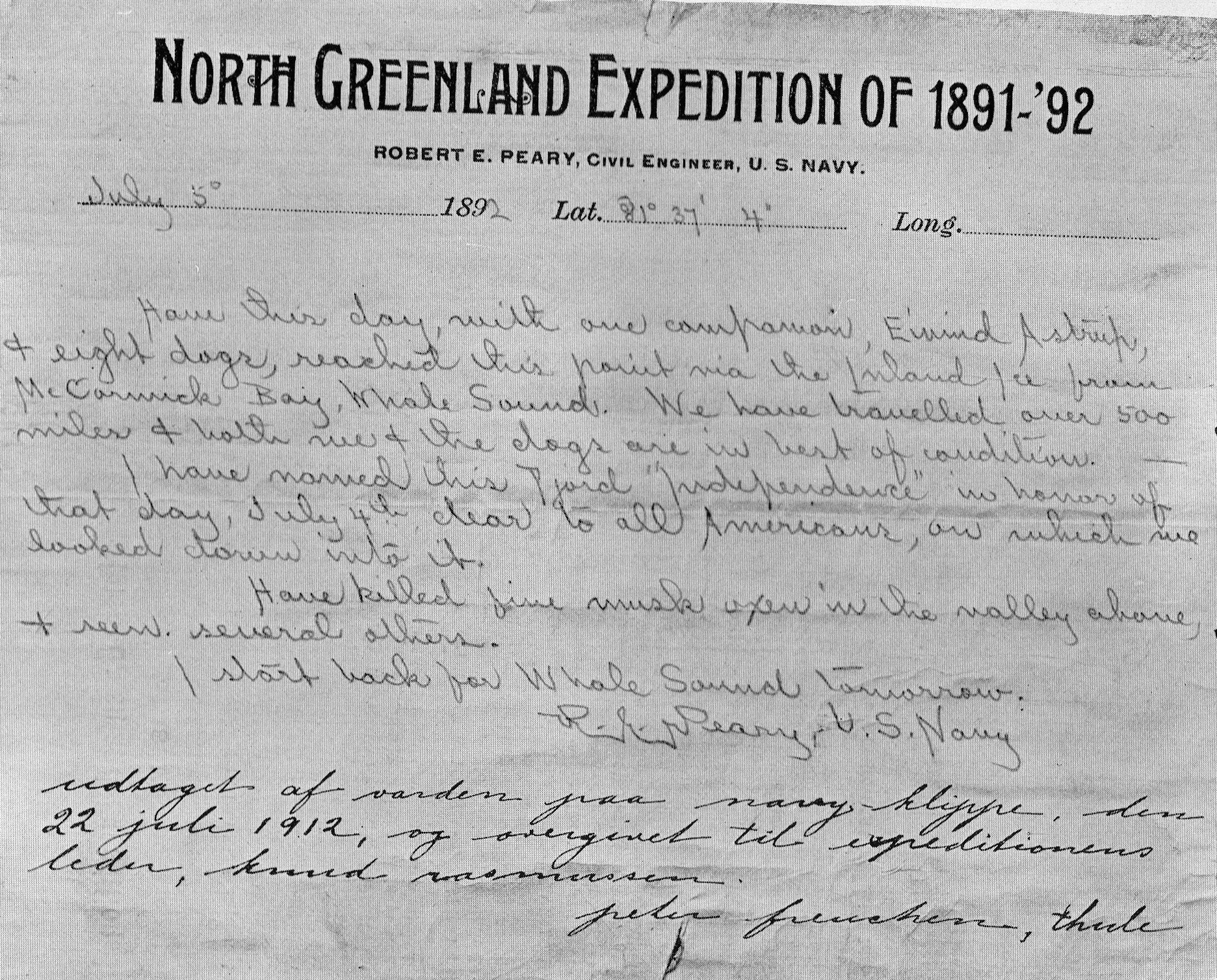
Note left by R.E. Peary on July 5, 1892 at a cairn at Navy Cliff overlooking Independence Fjord which he named here such. The darker pencil at the bottom is Peter Freuchen’s.
Peter Freuchen of the Thule expedition recovered Peary’s note 100 years ago. He then made and left a copy, added his own note, and headed home to Thule, Greenland. Besides checking on Peary the two Danes were also looking for a lost Danish expedition led by Einar Mikkelsen, who in turn was looking to recover the bodies of two Danish explorers of Independence Fjord, Ludvig Mylius-Erichsen and Niels Peter Hoegen-Hagen who had died nearby in 1907. Almost all these explorers have mountains, glaciers, land, and capes named after them or their sponsors, only Independence Fjord is different.
Independence Fjord celebrates the birthday of a young nation, the idea of a painfully evolving democracy, work still in progress. Peary may have made many claims that were not always supported by the evidence he presented, such as claiming to have reached the North Pole. He was no scientist, but a manager driving hard to secure funds, a ruthless self promoter, and autocrat assigning native women to men of his liking. But in this one instance of naming one of Greenland’s grand fjords Independence Fjord, he did good. Recall that this was the time when unelected kings, queens, generals, and dictators were ruling over expanding colonial empires. It was a few years before World War I and its follow-up World War II that caused global devastation to usher in a new set of world powers. The idea of independence is symbolized both in Independence Fjord and Independence Day. Both celebrate the same thing: freedom. There will be fireworks tonight …
P.S.: Some maps
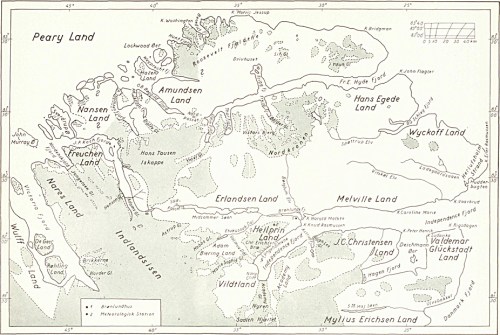
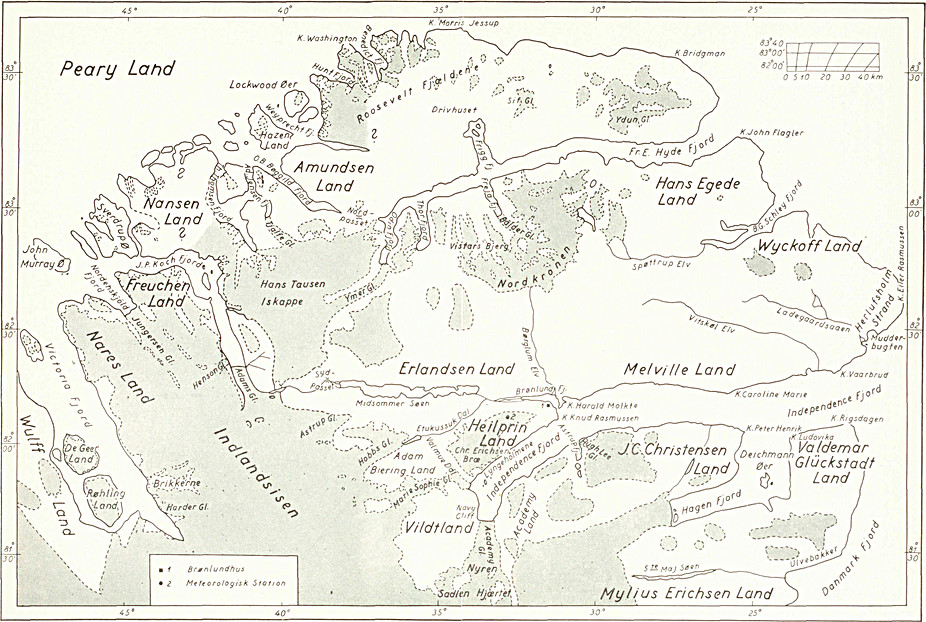
North-East Greenland [Source: web]
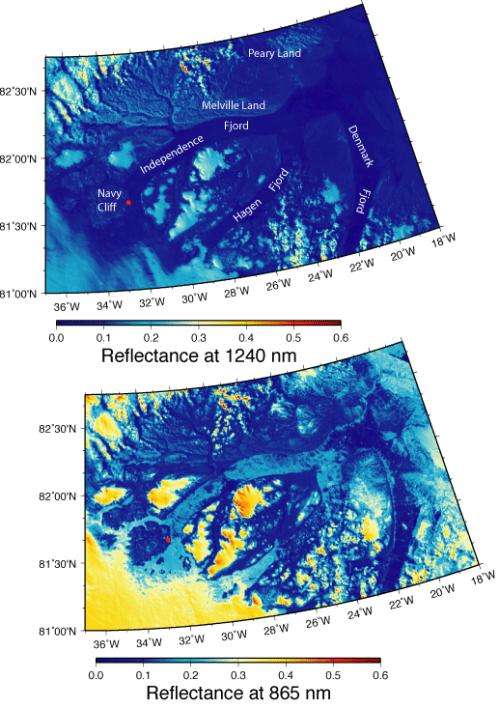
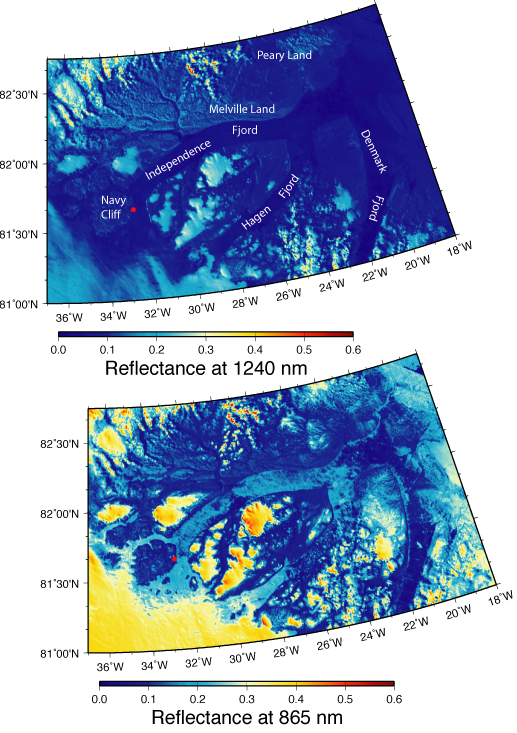
MODIS-Terra imagery of Independence Fjord for June 18, 2012. Top panel shows reflectance in the near infra-red (1240 nm) emphasizing land while the bottom panel shows reflectance in the visible red (865 nm) emphasizing ice. The red dot indicates Navy Cliff, the vantage point at the western terminus of Independence Fjord with Academy Glacier to its south-east and Sophie Marie Glacier to its north-west.

Book Review: We, the Drowned
An epic journey often ends at home. Odysseus was sailing home towards his wife and family, Jason and the Argonauts return home to Thessaly with the Golden Fleece, King Arthur’s Knights return to Camelot after they fail or succeed at their Grail Quest, and, in more modern literature, Frodo returns to the Shire. The hero of an epic fights to preserve his home, and is drawn back there after many adventures. Similarly, sailors paint their bodies with reminders of home: names of loved ones, swallows who travel far but always return to the nest, and navigational stars pointing them home.
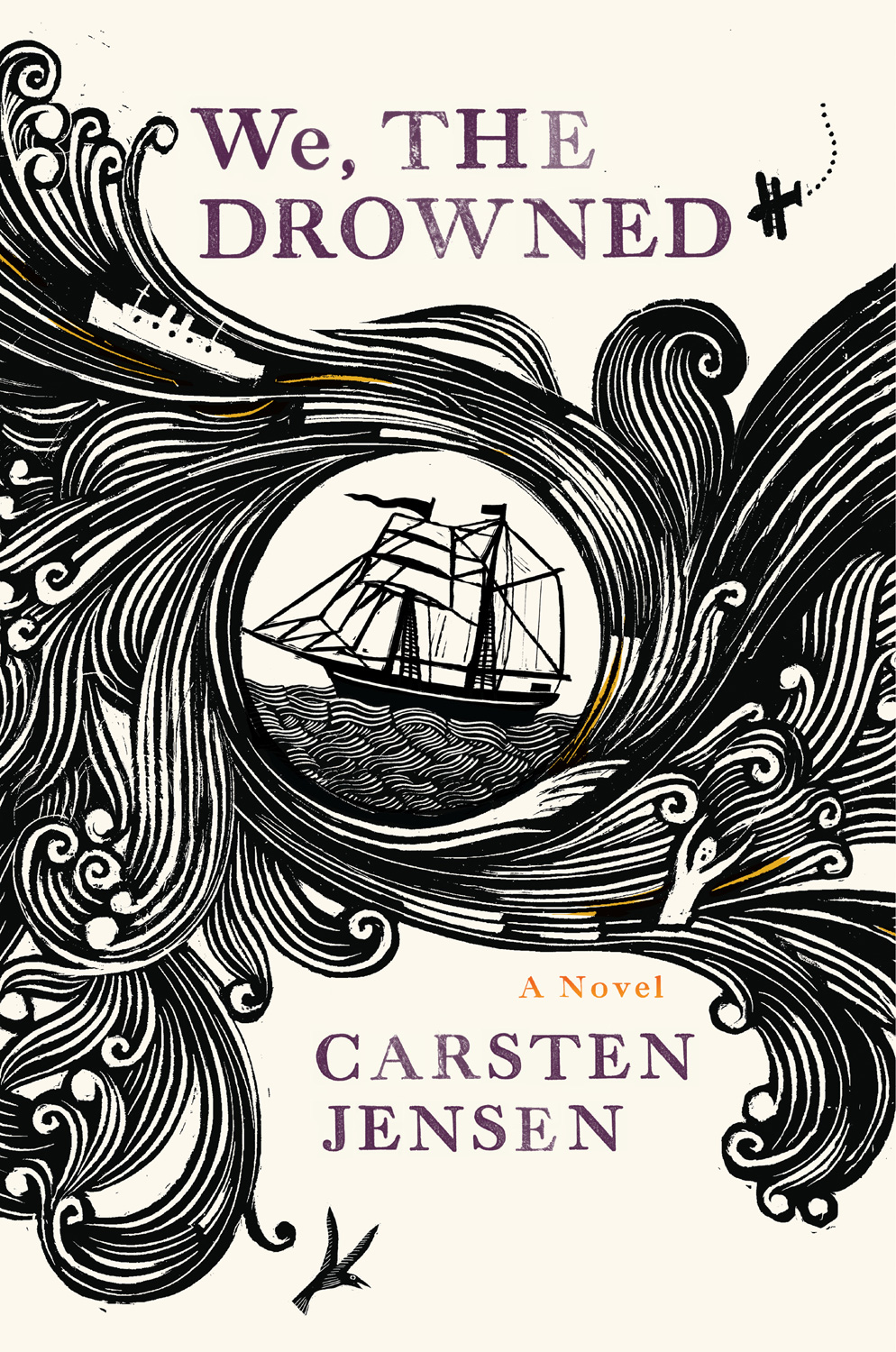
Appropriately, Carsten Jensen’s novel We, the Drowned centers its epic tales of traveling the seven seas on the place all of the characters at one point call home: the port town of Marstal, Denmark. Spinning tales of adventure spanning more than a century, Jensen draws from the rich history of Marstal, where he grew up, as well as generations of nautical literature.
Told in a series of shorter stories, reading We, the Drowned is more like listening to the bedtime stories of childhood and the legends you hear around the campfire than reading a 700-page tome. The story loosely follows three generations of Marstallers as they are drawn to the magic and adventure of the sea, living their lives at the beck and call of King Neptune.
The tale begins with Laurids Madsen, the sailor who “went up to Heaven and came down again, thanks to his boots,” and who eventually disappears into an Australian port. The story of his son and their generation growing up is fraught with the misery of a sadistic teacher and lost fathers, but Albert, Laurids son, becomes determined to find him. Albert becomes a central focus of the book, representing Marstal’s past, present and future.
The stories range from shrunken heads and selfish traders to brutal wars and sweet romances. These adventures occur wherever the winds blow the sailors of Marstal, including the coasts of Pacific Islands, the Americas, the depths of Africa, and the frigid waters of the Arctic.
We, the Drowned is a fascinating nautical epic, exploring all of the fantastic, wonderful, terrible and awesome faces of the ocean and the people who travel King Neptune’s realm.