Category Archives: Polar Exploration

Antarctic Plane Crash Kills 3 Canadians

Polar research requires ships, planes, and helicopters to supply bases and move people, instruments, fuel, and food to places where instruments need to placed, recovered, or serviced. While these activities are fairly routine and safe where most of us live, they are neither routine nor safe in extreme cold, extreme winds, or extremely remote places such as Arctic Canada, Greenland, or Antarctica.

I just learnt from an NSF Press Release that a Kenn Borek Twin Otter crashed into Mount Elizabeth in the Queen Alexandra Range of the Transantarctic Mountains at an elevation of about 3,900 m or 11,000 feet less than 2 weeks ago. All three Canadian crew aboard were killed. The plane was in transit from a research station at the South Pole to the Italian station at Terra Nova Bay to support Italian field work.

A memorial ceremony for the aircrew at NSF's Amundsen-Scott South Pole Station [Photo Credit: Blaise Kuo Tiong, NSF]

A memorial ceremony for the aircrew at NSF’s Amundsen-Scott South Pole Station [Photo Credit: Blaise Kuo Tiong, NSF]

Here are the words of Dr. Kelly Falkner, Director of NSF’s Polar Division (source):

January 28, 2013
On behalf of the U.S. National Science Foundation and all in the U. S. Antarctic Program, I wish to extend our profound sympathies to the families, friends, and colleagues of the three Kenn Borek Twin Otter crew, whose deaths in Antarctica while en route to support the Italian national Antarctic science program have recently been confirmed.

We have been privileged to experience first-hand their professionalism, skill, and dedication to the arduous task of supporting science in an extremely remote and inhospitable environment. In many ways, their contributions make possible hard won but vital advances in scientific knowledge that serve all of mankind. Although everyone associated with the pursuit of science in Antarctica makes personal sacrifices to do so, very infrequently and sadly, some make the ultimate sacrifice.

While it may come as little consolation at this very sorrowful time, the families, friends, and colleagues of the crew members should know that the thoughts of everyone in the U.S. Antarctic Program were with them through the long ordeal of the past few days and remain so now.

To the families and friends of the crew, I commend your loved ones for their commitment and dedication to their profession and offer our condolences. The sense of loss is keenly felt throughout the U.S. program and no doubt throughout the international Antarctic community.

-NSF-

I am also thinking of Marty Bergmann, a Canadian Polar scientist turned administrator. He perished 2 summers ago in a plane crash outside Resolute, Nunavut in the Canadian High Arctic working his Government Canada job to tirelessly help others in their Arctic research. Unlike the photo below, I remember him with a massive ear-to-ear grin on his face and a twinkle in his eye.

The Royal Canadian Geographic Society will recognize Martin Bergmann, the director of the Polar Continental Shelf Program who died in a plane crash in Resolute last year, by creating a medal for excellence in Arctic leadership, science and exploration. [Credit: CBC News]

Martin Bergmann, Director of the Polar Continental Shelf Program who died in a plane crash in Resolute Aug.-20, 2011. [Credit: CBC News]
Shots of Airborne Lasers at Petermann Gletscher, Greenland

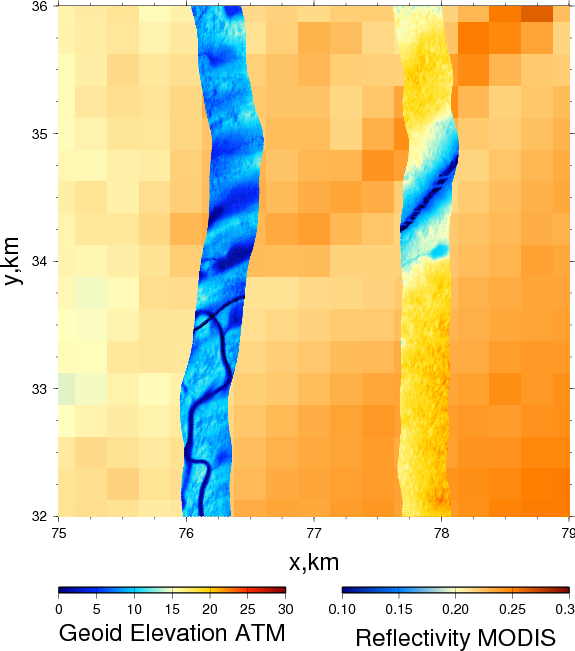
If shots of whiskey make you dizzy, shots of laser stun. NASA stunned me this week, when I discovered that they provide millions such shots of Greenland from which to construct detailed images of the landscape. The shots are free, no age-limit. This is better than the usual remote sensing or photography of “just” brightness. The laser gives us height, and not just the perception of it by shadows and fake angles of illumination, but hard and direct measurements of, well, height above sea level. Have a look at several million such shots of Petermann Gletscher taken in 2010 before the glacier broke to Manhattan-sized pieces:

Petermann Glacier surface elevation from laser shots on Mar.-24, 2010 at the site where the Manhattan-sized ice island formed Aug.-6, 2010. The background shows the same scene at the same time at 250-m resolution from MODIS (see below). Colors along the 350-m wide laser track line show height above sea level in meters.

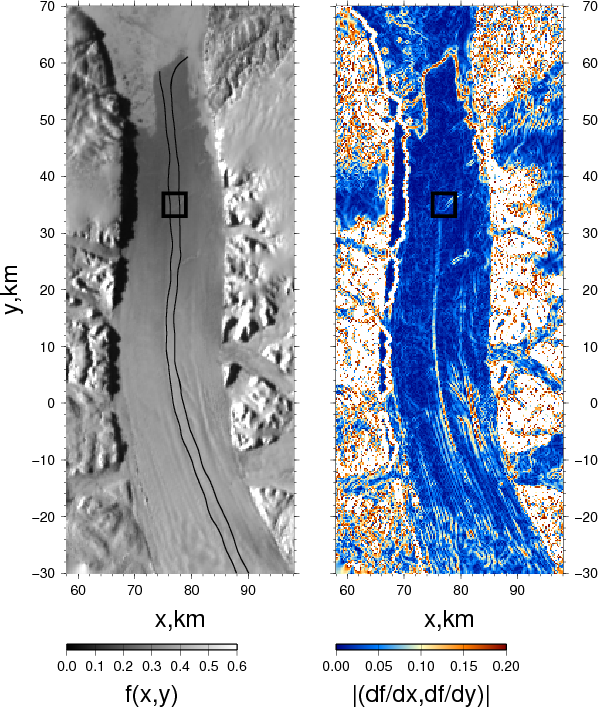
Petermann Glacier on March 24, 2010 as seen from MODIS satellite at 250-m resolution with two flight tracks along which laser data are collected. The black box shows the site of the figure above. The color figure on the right shows the slope or gradients of the data shown on left. It emphasizes regions where brightness changes fast. Multivariate calculus is useful!

We see two tracks: the one on right (east) has the ice stick more than 20-m above sea level (yellow colors) while about a mile to left (west) the ice’s surface elevation is only 10-m above sea level (light blue). Since the ice is floating and densities of ice and water are known, we can invert this height into an ice thickness. Independent radar measurements from the same track prove that this “hydrostatic” force balance holds, the glacier is indeed floating, so, multiply surface elevation by 10 and you got a good estimate of ice thickness. The dark blue colors of thin ice show meandering rivers and streams, ponds and undulations, as well as a rift or hairline fracture from east to west. This rift is visible both in the right and left track, it is the line along which the glacier will break to form the 2010 ice island. All ice towards the top of this rift has long left the glacier and some of it has hit Newfoundland as seen from the International Space Station by astronaut Ron Garan:

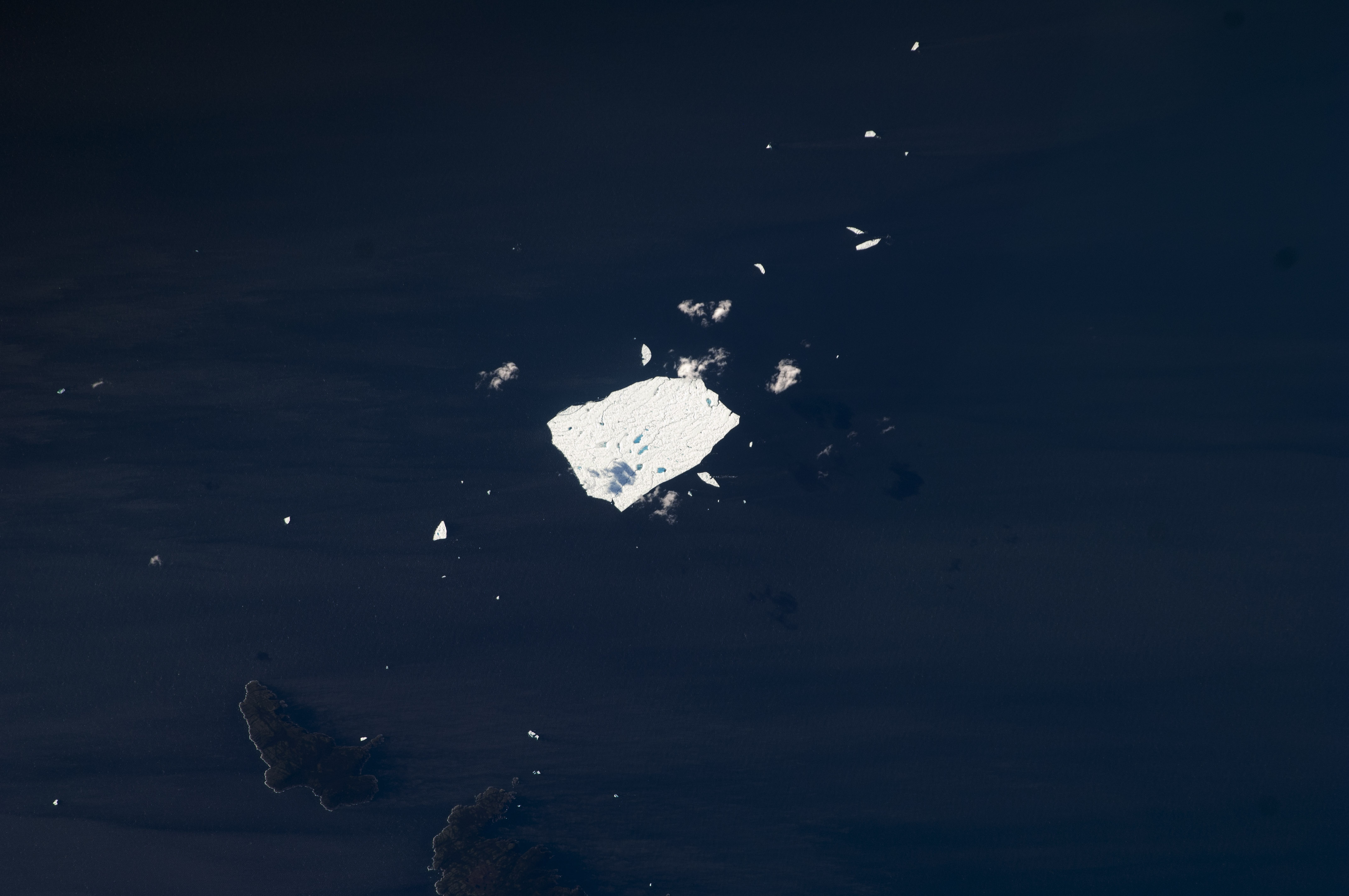
Last remnant of Petermann Ice Island 2010-A as seen from the International Space Station on Aug.-29, 2011 when it was about 3.5 km wide and 3 km long [Photo credit: Ron Garan, NASA]

Both are images of Petermann ice. The photo measures the brightness that hits the lens, but the laser measures both brightness and ice thickness. The laser acts like flash photography: When it is dark, we use a flash to provide the light to make the object “bright.” Now imagine that your camera also measures the time between the flash leaving your camera and brightness from a reflecting object to return it. What you think happens at an instant actually takes time as light travels fast, but not infinitely fast. So you need a very exact clock to measure the distance from your camera to the object. Replace the flash of the camera with a laser, replace the lens of your camera with a light detector and a timer, place the device on a plane, and you got yourself an airborne topographic altimeter. So, what use is there for this besides making pretty and geeky pictures?

The laser documents some of the change in “climate change.” Greenland’s glaciers and ice-sheets are retreating and shrinking. Measuring the surface and bottom of the ice over Greenland with lasers and radars gives ice thickness. The survey lines above were flown in 2002, 2003, 2007, 2010, and 2011. These data are a direct and accurate measure on how much ice is lost or gained at Petermann Gletscher and what is causing it. My bet is on the oceans which in Nares Strait and Petermann Fjord have increased the last 10 years to melt the floating glacier from below.

There is more, but Mia Zapata of the Gits sings hard of “Another Shot of Whiskey.” What a voice …

ResearchBlogging.org

Johnson, H., Münchow, A., Falkner, K., & Melling, H. (2011). Ocean circulation and properties in Petermann Fjord, Greenland Journal of Geophysical Research, 116 (C1) DOI: 10.1029/2010JC006519

Krabill, W., Abdalati, W., Frederick, E., Manizade, S., Martin, C., Sonntag, J., Swift, R., Thomas, R., & Yungel, J. (2002). Aircraft laser altimetry measurement of elevation changes of the greenland ice sheet: technique and accuracy assessment Journal of Geodynamics, 34 (3-4), 357-376 DOI: 10.1016/S0264-3707(02)00040-6

Münchow, A., Falkner, K., Melling, H., Rabe, B., & Johnson, H. (2011). Ocean Warming of Nares Strait Bottom Waters off Northwest Greenland, 2003–2009 Oceanography, 24 (3), 114-123 DOI: 10.5670/oceanog.2011.62

Thomas, R., Frederick, E., Krabill, W., Manizade, S., & Martin, C. (2009). Recent changes on Greenland outlet glaciers Journal of Glaciology, 55 (189), 147-162 DOI: 10.3189/002214309788608958

CCGS Henry Larsen: More on People, Places, and Services

The Canadian Coast Guard Ship is powered by such a diverse and talented group of women and men from Newfoundland, Labrador, and beyond, that one or even two posts here hardly do justice to describe how well they run their ship and its many facilities that many mid-sized cities do not have. Monday I wrote about the people who run the power plant and electric departments as well as the seamen who fight fires and run fishing fleet and port facilities. Today I want to show the airport and talk a little about the civil administration that oversees and manages all aboard the ship.

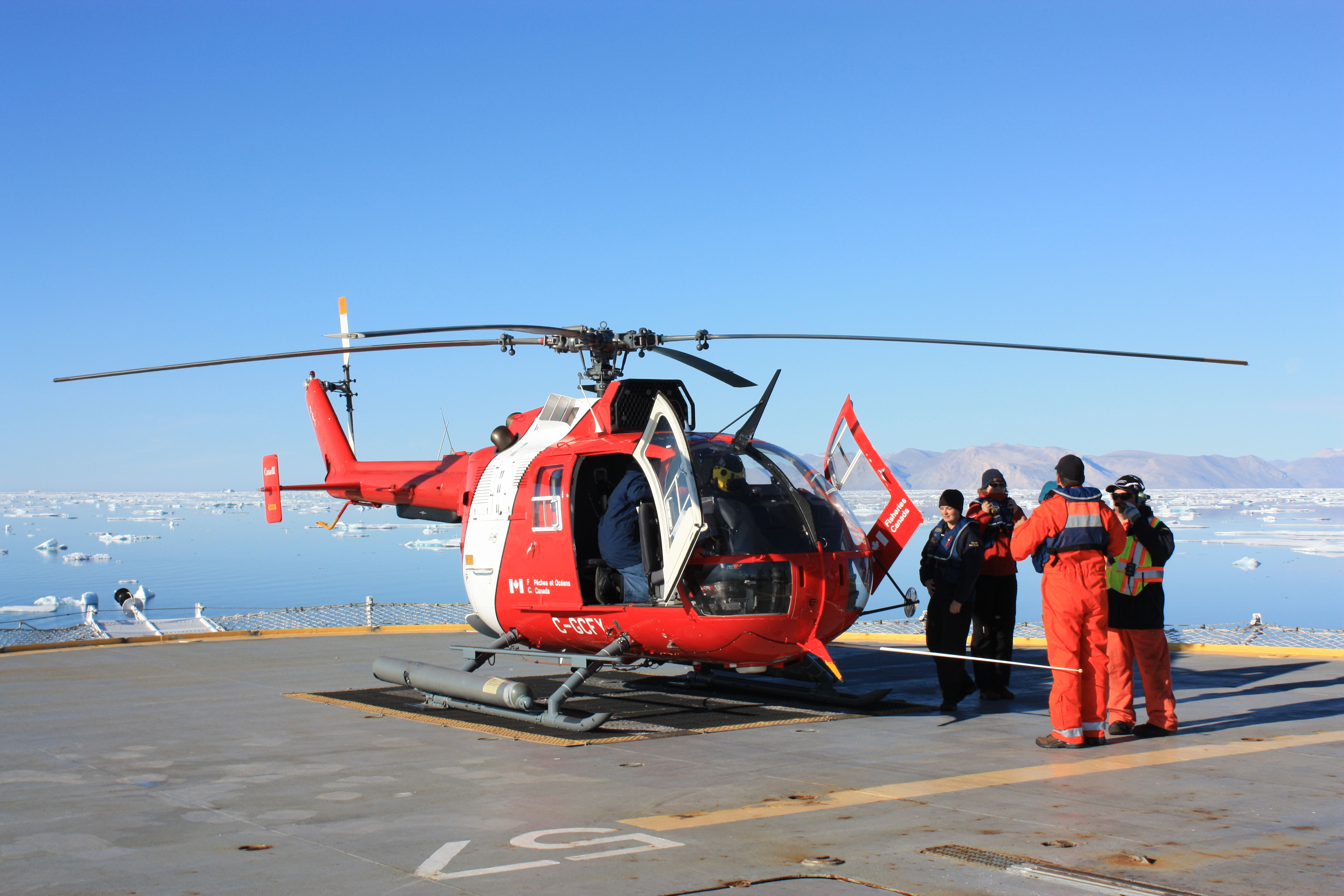
Landing deck of the CCGS Henry Larsen with aircraft preparing for take-off to survey the ice conditions ahead. Shown are Chief Officer Brian Legge (far right) who is in command of the airport and is talking to Pilot Don Dobbin (2nd from right), scientist Renske Gelderloos (3rd from right), Ice Services Specialist Erin Clarke (4th from right), and Helicopter Engineer Pierre Autran performs last checks inside the helicopter. [Photo Credit: Canadian Coast Guard Ship Henry Larsen]

The airport consists of hangar, landing pad, helicopter, traffic control, and fire fighting stations. Don Dobbin was our pilot and Pierre Autran his engineer who was pulled out of retirement for this trip. Incidentally, Pierre and I had sailed together on the same ship in 1993 more than 200 miles north of eastern Siberia. Then all flights were prohibited by Russian aviation authorities: Politics were different 20 years ago, one hopes. No such threat of being shot down existed this year between Greenland and Canada, but for severe ice conditions and poor internet connections, the airport was very busy almost every day for both ice surveys ahead and behind the ship. It also supported landing parties to set up and/or service 4 weather stations.

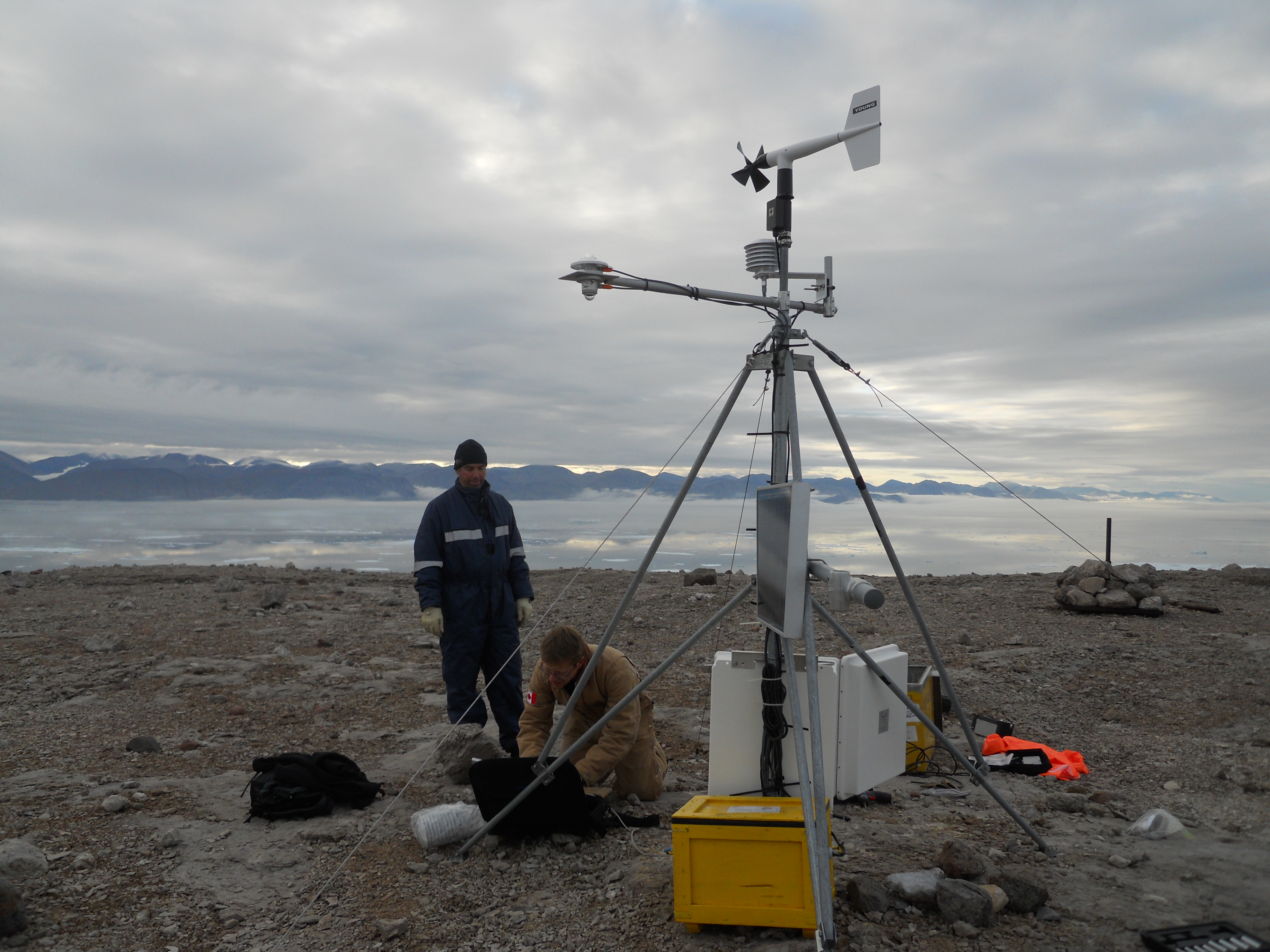
Helicopter pilot Don Dobbin with scientist Dave Riedel on Hans Island servicing a weather station in the center of Nares Strait. Ellesmere Island in the background. [Photo Credit: Allison Einolf, Minnesota]

The air traffic control takes place both on the flight deck where Chief Officer Brian Legge is in charge and from the bridge where the officer-of-the-deck is in overall command as either First Officer Chris Steward or Second Officer Rebecca Acton-Bond place the ship, alert the entire ship, and often oversee other science operations as well. All of these are demanding jobs, all these jobs need precision in the concise communication of orders and permissions granted or denied as well as execution of all operations, because helicopter operations are probably one of the most dangerous and critical operations possible on the ship.

Attention to detail, clear communication, and calm execution lower the risk of death and destruction that helicopters can and often do cause. The National Science Foundation sent me to a 4-day course in helicopter safety and what to do if accidents happen over water or on land. It was a sobering course. For this reason, perhaps, Captain Wayne Duffett is almost always on the deck during flight operations, but as all good chief executives, he lets his officers and navigators run the operations but is available for help on consultation should it be needed.

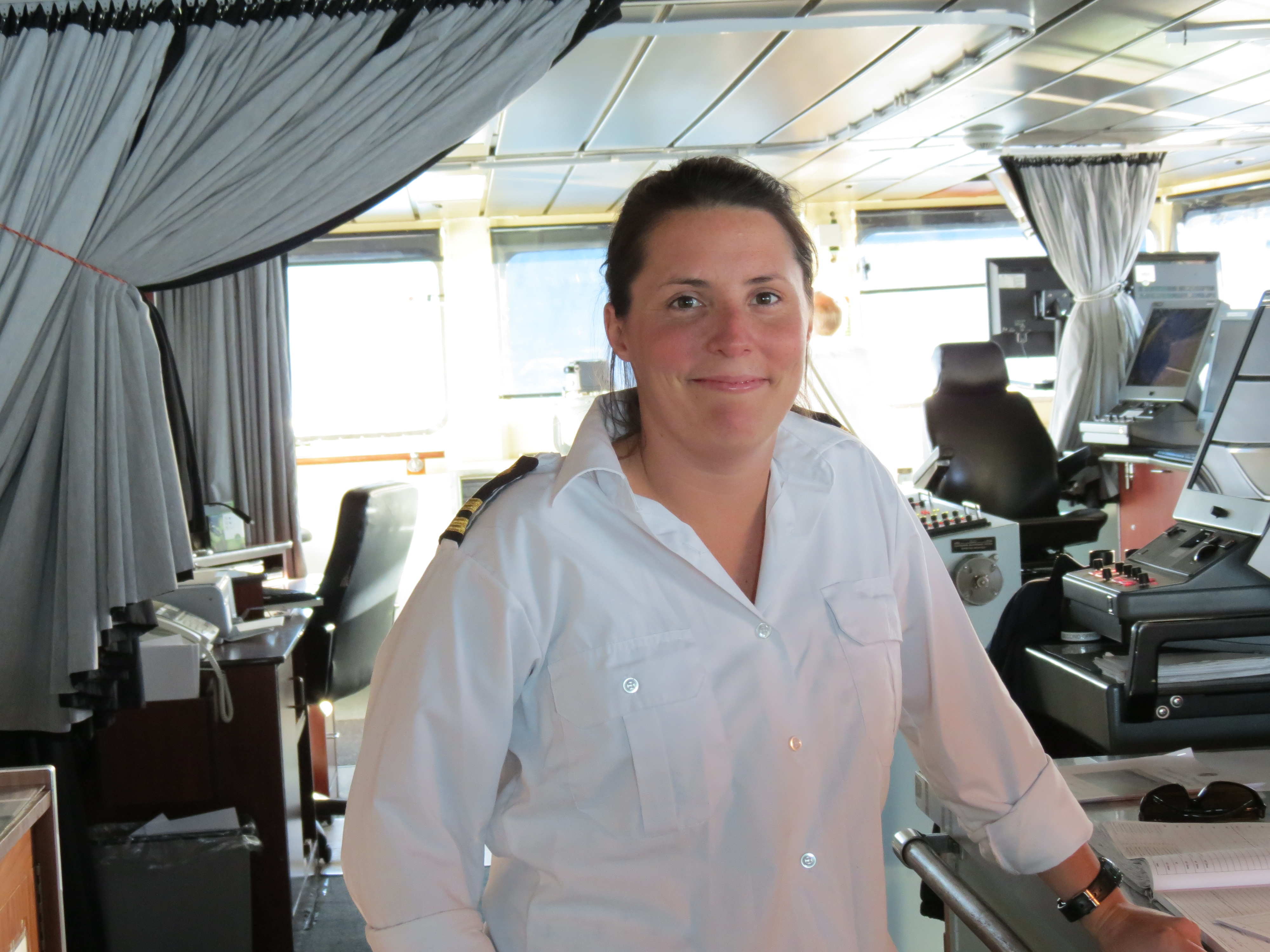
Second Officer and navigator Rebecca Acton-Bond on a sunday on the bridge of the CCGS Henry Larsen in August of 2012 in Nares Strait. [Photo Credit: Canadian Coast Guard, Kirk McNeil, Labrador]

Leading Seaman and helmsman Melvin Cobb on the bridge. [Photo Credit: Canadian Coast Guard Ship Henry Larsen]

The navigator always works with a helmsman or quartermaster who steers the ship following instructions of the officer of the deck, they are on the look-out for ice and bergs to find the best routes. “Best” here refers to the route that requires the least amount of ice breaking. So, if there is one thing that icebreakers like the Larsen are really good at, it is how to avoid ice, because it is a violent and high-energy activity. Fuel is not cheap and less ice is broken, the faster and more efficient the tasks at hand can be accomplished.

And as all people on the ship, everyone has more than one job and this includes the helmsmen and quartermasters like Melvin Cobb or firefighters like Derick Stone, Carl Rose, Paul Gillingham, and Rueben Hillier. They are often members of the deck crew that help landing parties to get ashore and stay save while ashore. This involves the zodiac as well as guns to protect from polar bears:

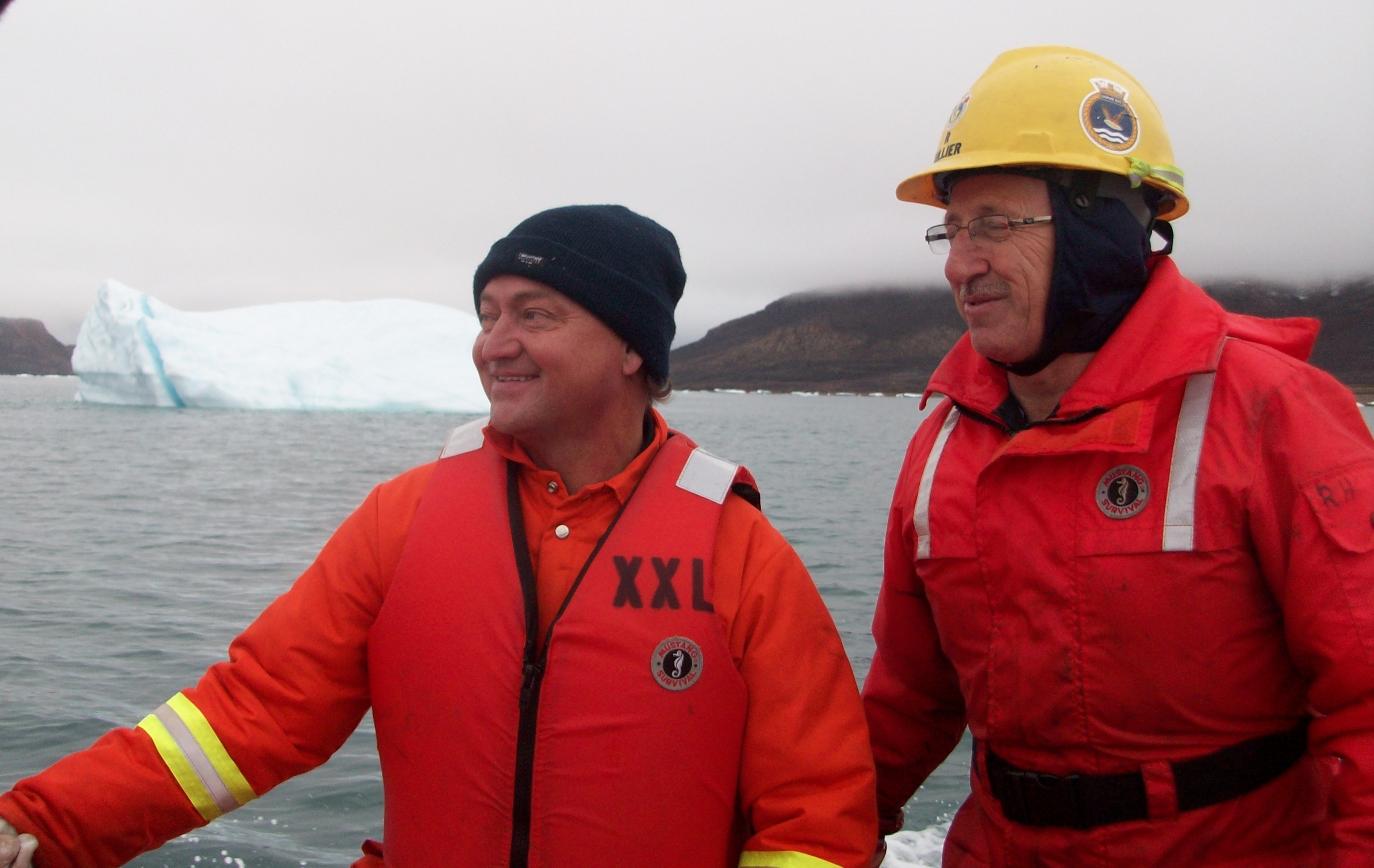
Seamen Paul Gillingham and Rueben Hillier in the zodiac steered by Chief Officer Brian Legge in Alexandra Fjord, Ellesmere Island on Aug.-13, 2012. A tide gauge was recovered and re-deployed near this site. [Photo Credit: Canadian Coast Ship Henry Larsen, Barbara O’Connell]

Zodiac launched for a landing part to dismantle a weather station at Cape Baird, Ellesmere Island. Chief Officer Brian Legge at the helm with Melvin Cobb and Derick Stone in the back and center left of the boat filled with scientists Humfrey Melling, David Riedel, Andreas Muenchow, and Renske Geldeloos. [Photo Credit: Canadian Coast Guard Ship Henry Larsen]

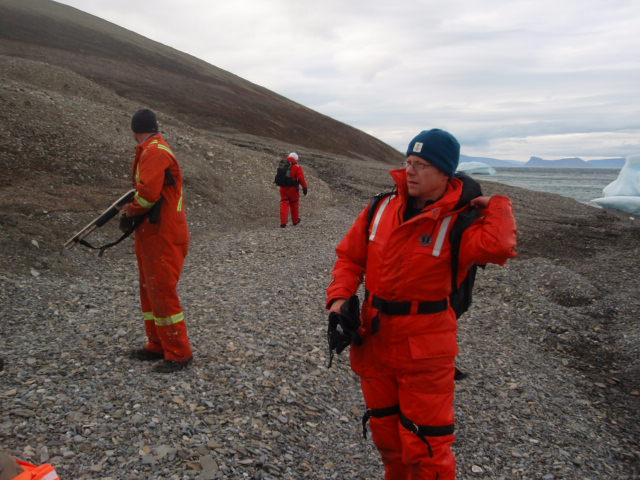
Landing party at Cape Baird, Ellesmere Island to dismantle a weather station. Scientists David Riedel (foreground) and Humfrey Melling (background) are protected by Melvin Cobb (with gun) from polar bears. View is towards the north-west across Lady Franklin Bay to the west of Nares Strait. [Photo Credit: Renske Gelderloos, Oxford University]

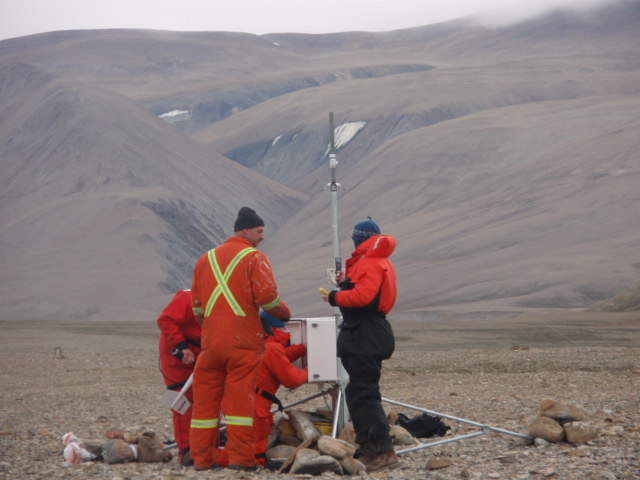
Taking down a weather station on Cape Baird, Ellesmere Island, view is to the south-west. People from right to left, the author, David Riedel (kneeling), Melvin Cobb, and Humfrey Melling (covered). [Photo Credit: Renske Gelderloos, Oxford University]

Polar bear on an ice floe in Kennedy Channel as seen from the bridge as the ship was approaching a station a day’s polar bear walk from Cape Baird. [Photo Credit: Canadian Coast Guard Ship Henry Larsen]

There is still more to describe such as the hospital, the restaurant and bar, as well as the superior fishing of sailors and fishermen from Newfoundland to find and hook valuable items such as sensors and computers that some scientists left unattended for 3 or 5 or 9 years at the bottom of the unspoiled seas that border Arctic Greenland and Canada. There will be more … as there are more great people who make great science possible.

CCGS Henry Larsen: People, Places, Services

The Canadian Coast Guard Ship Henry Larsen sailed this summer on a challenging science mission to Nares Strait, Petermann Glacier, and beyond. It reached its farthest North ever at 82 degrees and 15 minutes North latitude. This week I like to focus on the 39 people who make this ship what it really is: a complex community with all the functionality of a city. Captain Wayne Duffett is in overall command. His job will overwhelm lesser minds as he has to manage an airport, a fire department, a power plant, a sanitation department, a hospital, a restaurant, a hotel, a supermarket, a weather station, a port facility, a civil administration, etc., etc. Oh yeah, The CCGS Henry Larsen is also a ship that he moves through ice in uncharted waters to support 8 scientists from 3 countries. All of this is done with only 22 crew and 17 officers who work around the clock on a variety of schedules.

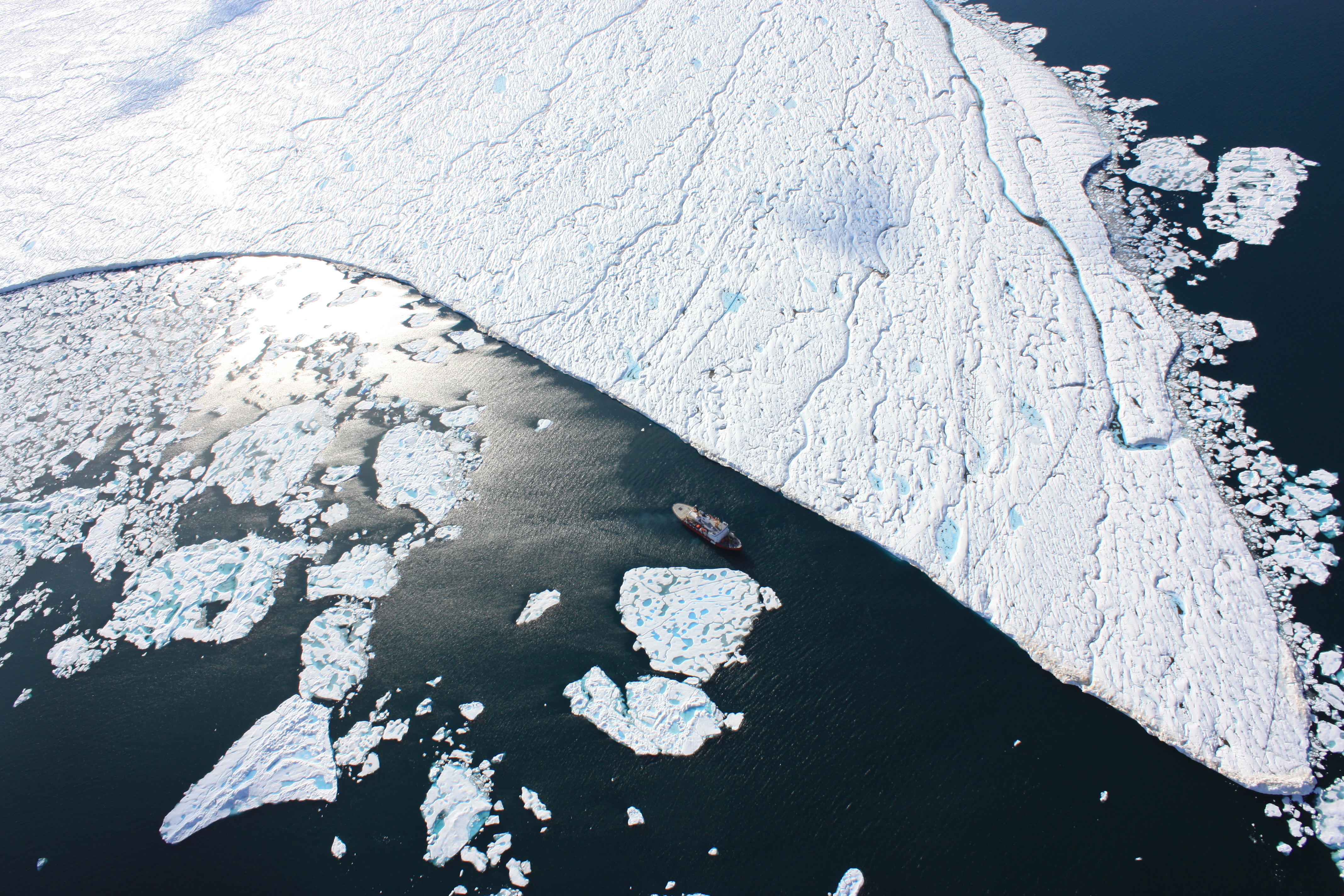
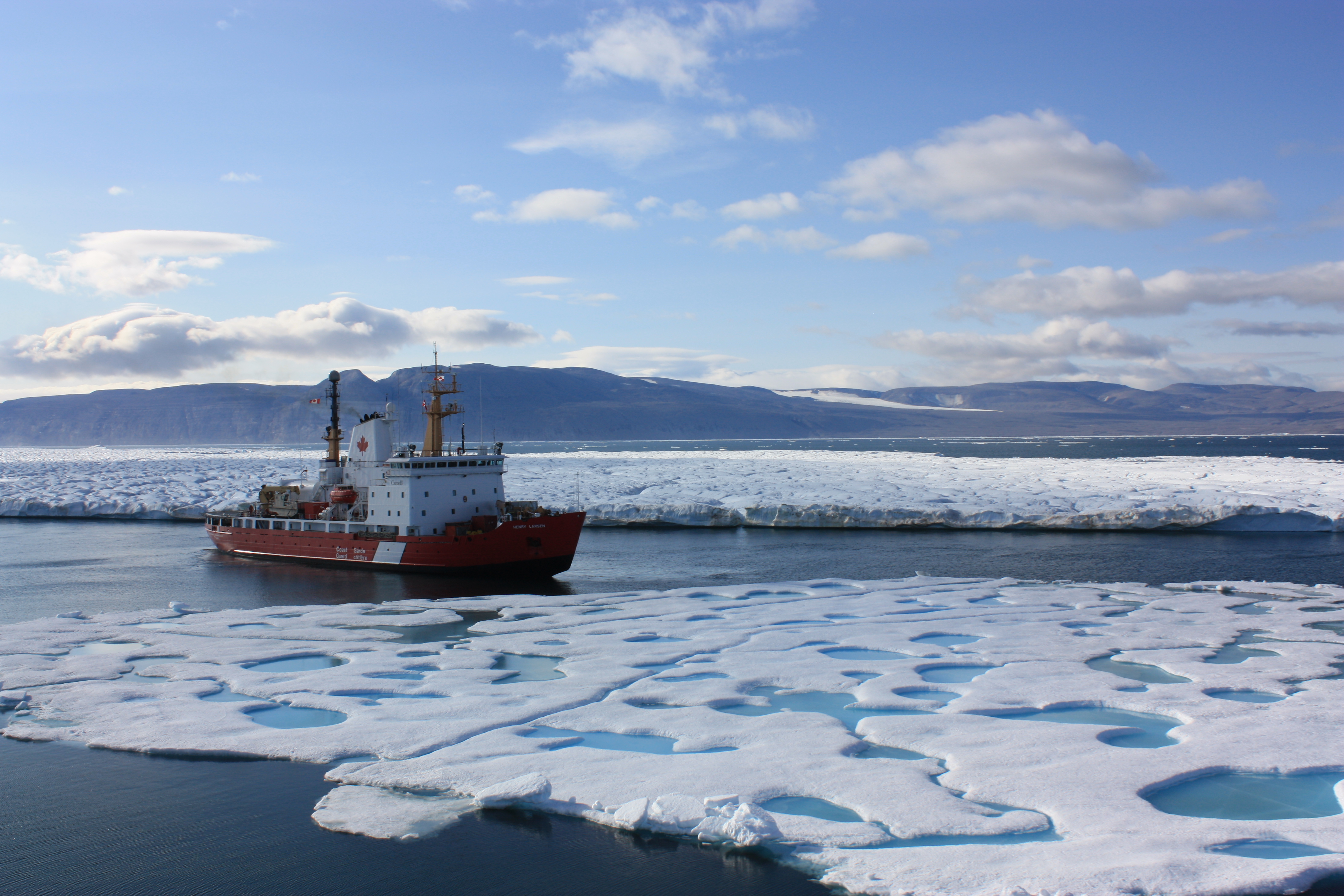
CCGS Henry Larsen next to the Petermann Ice Island PII-2012 on Aug.-10, 2012. The south-western tip of PII-2012 at the bottom right of the image was used by Captain Wayne Duffett as a reference point for the motion of PII-2012. The exact place of this point was monitored at hourly intervals via helicopter while the ship was operating inside the fjord landward of the ice island. [Photo Credit: Canadian Coast Guard Ship Henry Larsen/Jo Poole]


Canadian Coast Guard Ship Henry Larsen at the entrance to Petermann Fjord on Aug.-10, 2012. The ice island PII-2012 is in the background with puddles on sea ice in the foreground. Polaris Bay, Greenland is in the far back. [Photo Credit: CCGS Henry Larsen and Jo Poole.]

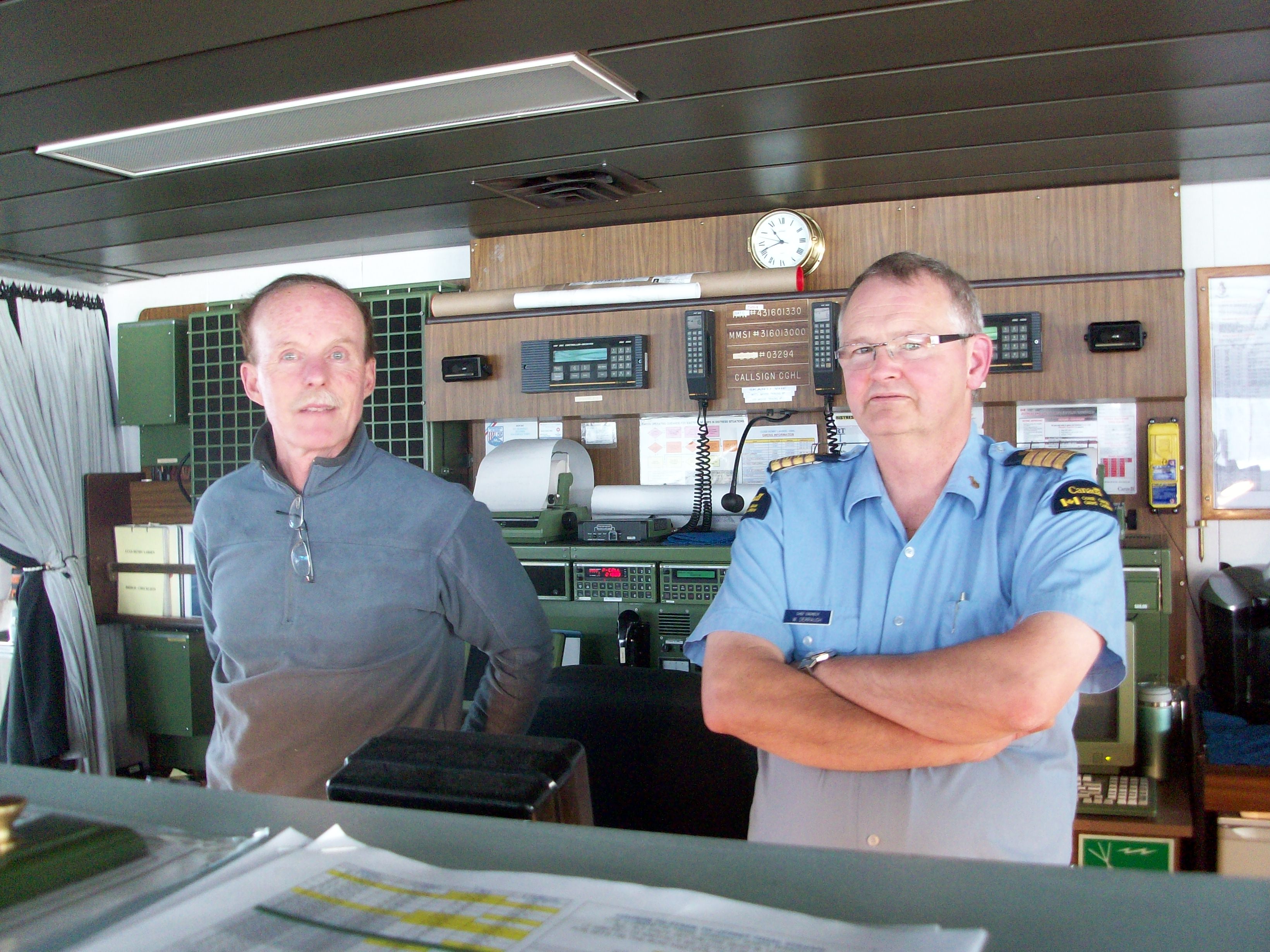
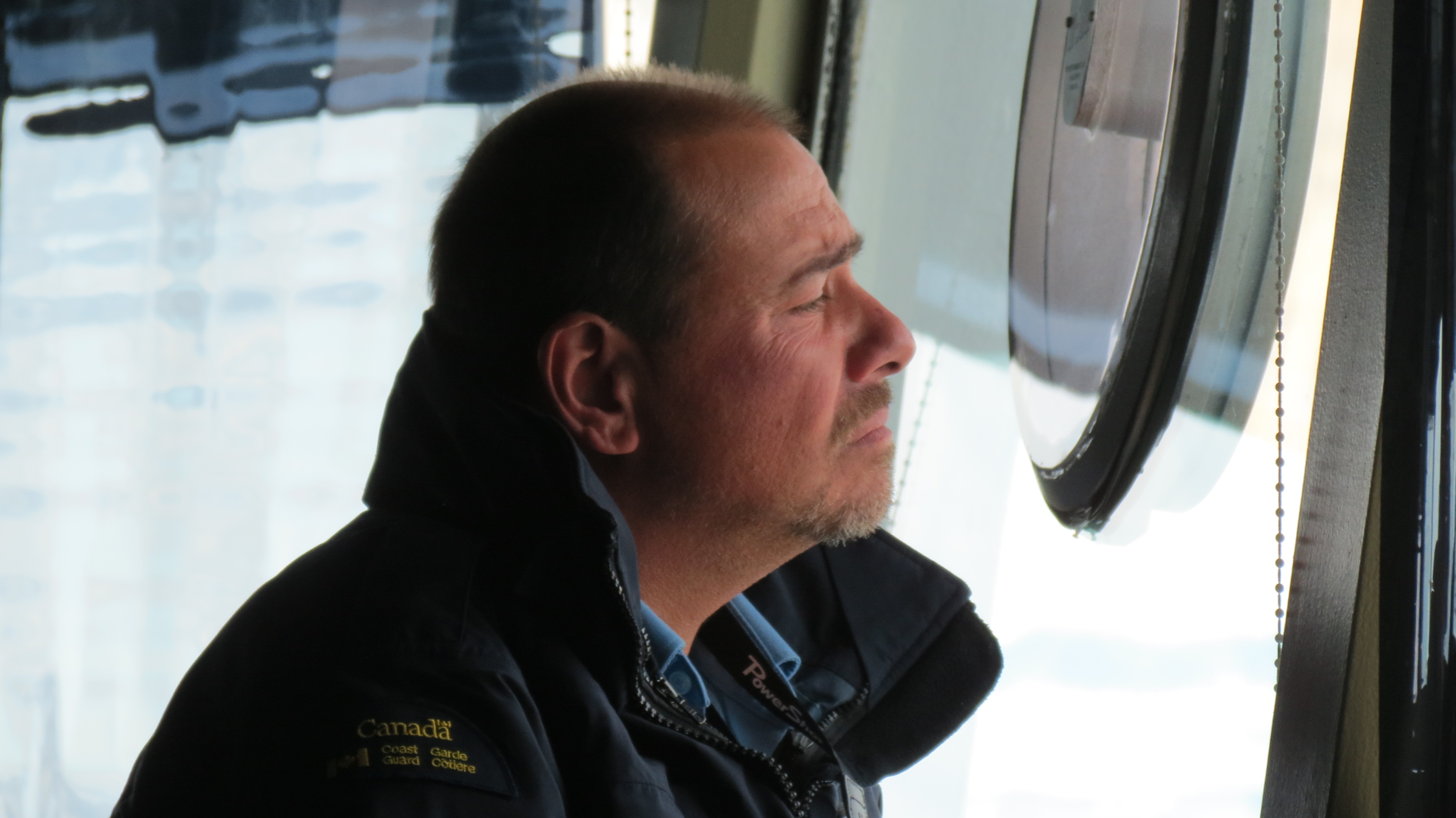
The ship may occupy an area of only 2,000 m^2 (100 meters long and 20 meters wide), but it functions as a self-contained universe at sea. Perhaps the most important and largest department with 13 people is the power plant that produces energy to move the ship and to provide electricity and heat to make all other departments’ work possible. The 13 members are quiet and thoughtful men often working in the background in cramped, hot, and dirty spaces below decks. It is very hard to get good pictures of them, but here are two, one of Chief Engineer William Derraugh and Second Electrical Officer Anatoly Eltsov:

Chief Engineer William Derraugh on the bridge of the CCGS Henry Larsen in Aug.-2012 with Senior Scientist Dr. Humfrey Melling. [Photo Credit: Barb O’Connell, Canadian Coast Guard.]


Electrical Officer Anatoly Eltsov during a thoughtful moment on the bridge of the Canadian Coast Ship Henry Larsen in Nares Strait. [Photo Credit: Kirk McNeil, Canadian Coast Guard]

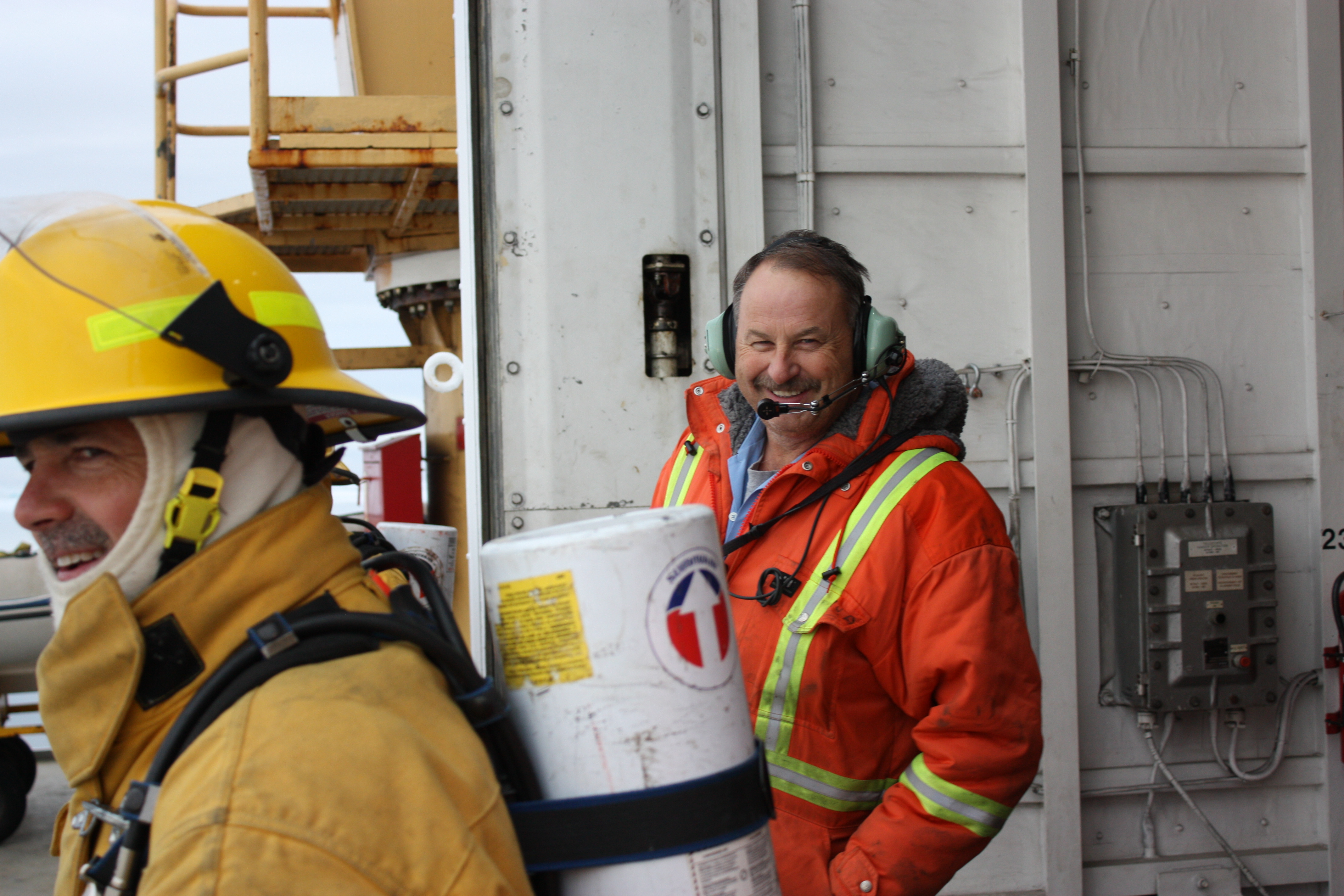
The second-largest department is the fire department that also run the port facilities, the fishing fleet, and provide general support on deck, on the bridge, on the water, and on land to a range of activities. There are nine men in this department that are led by the boatswain or bosun Don Barnable with Chief Officer Brian Legge in command. The men of this department are perhaps the most vocal and visible on the ship as they work so many jobs wearing many hats, uniforms, and arms. I can and will fill entire picture galleries of their work, here are just three images that barely serve as teasers, perhaps:

Boatswain Don Barnable and Seaman Derick Stone working at the airport aboard the CCGS Henry Larsen as traffic control and fire fighter, respectively. [Photo Credit: Jo Poole, British Columbia]


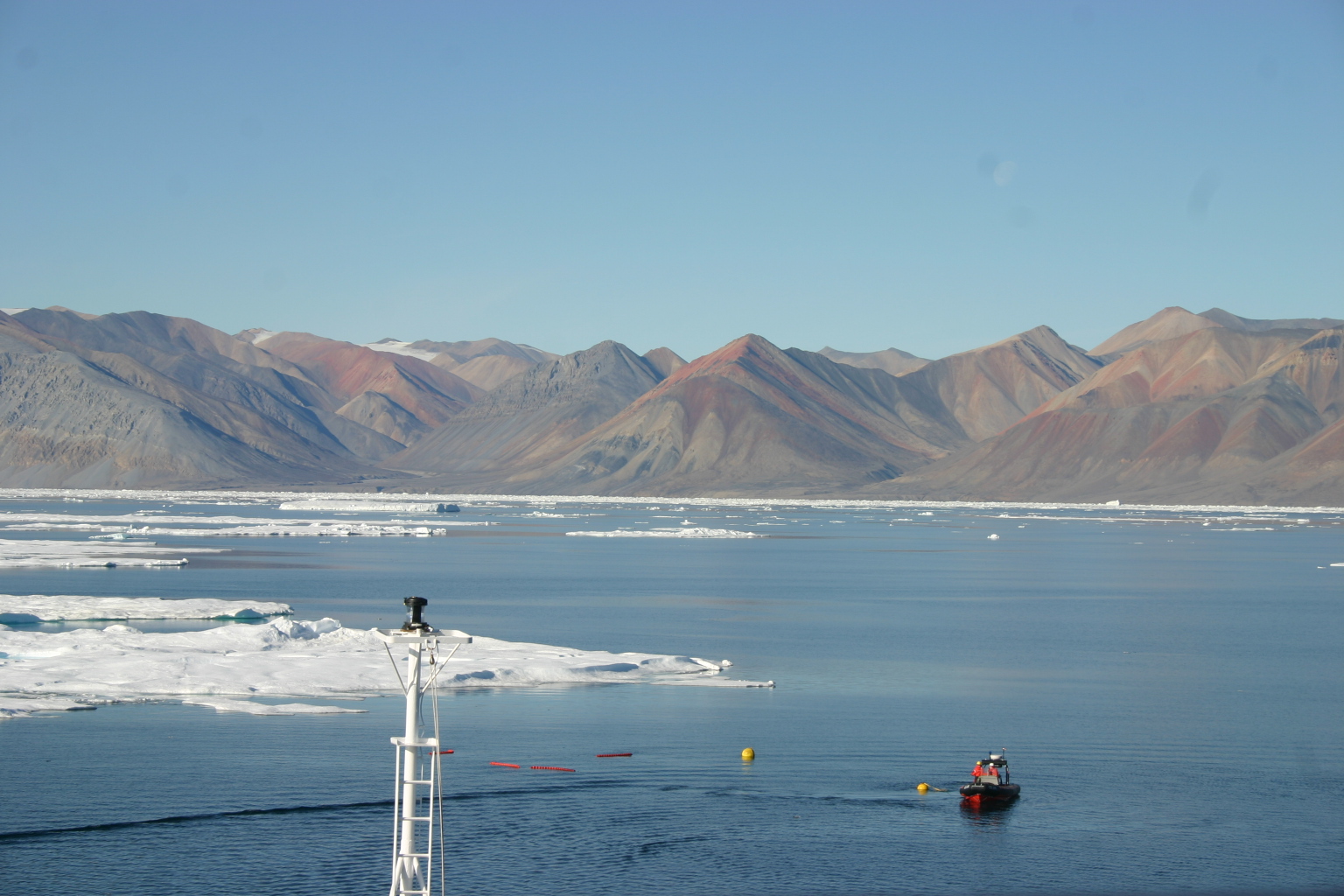
Zodiac of the CCGS Henry Larsen recovering a mooring in Kennedy Channel on Aug.-6 with Chief Officer Brian Legge at the helm. Ellesmere Island, Canada is in the background. [Photo Credit: Canadian Coast Guard Ship Henry Larsen]


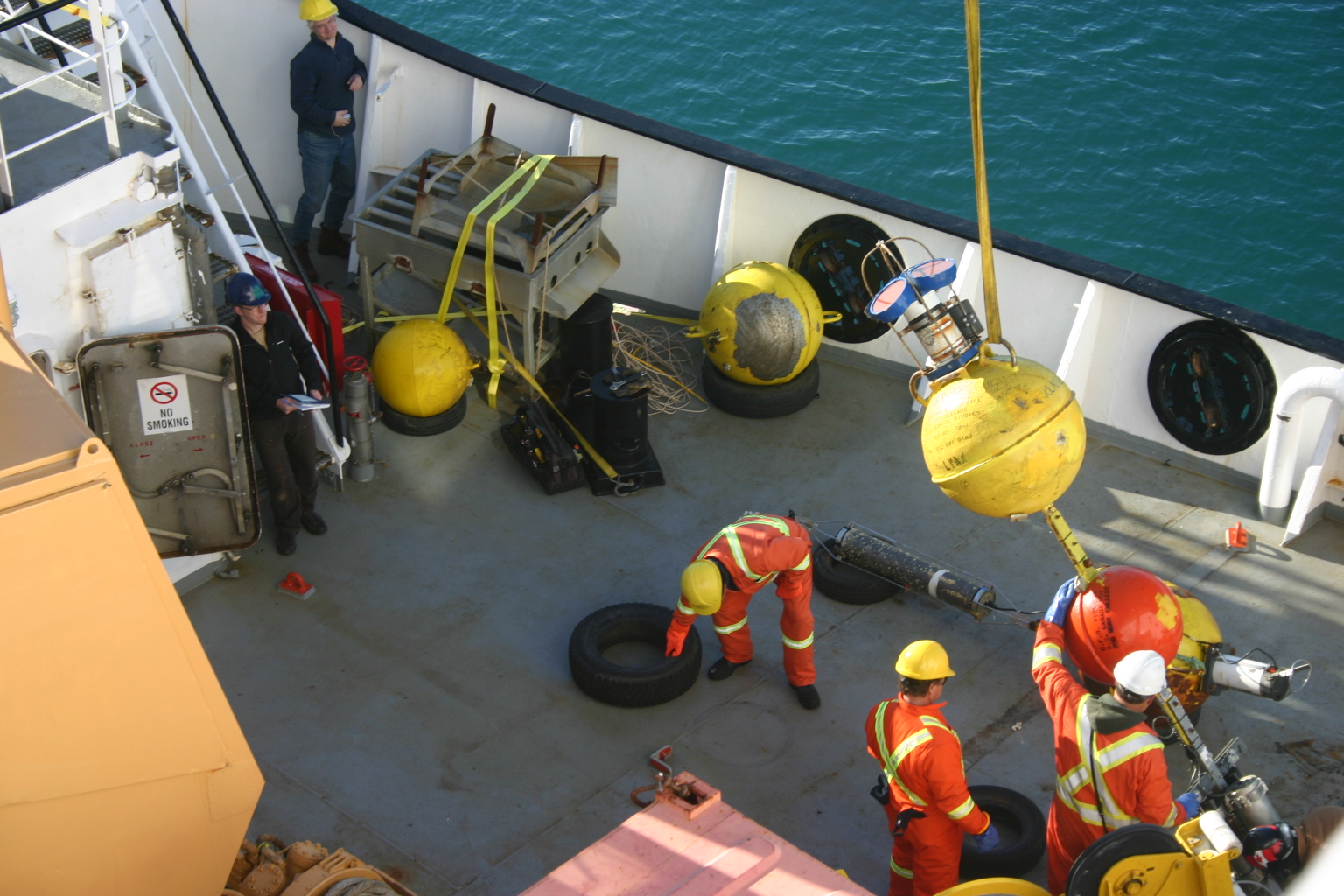
Deck crew of CCGS Henry Larsen led by boatswain Don Barnable (white helmet) recovering a mooring over the side where the zodiac delivered it to the crane. Two scientists in the background waiting for the deck to be secure. [Photo Credit: Canadian Coast Guard Ship Henry Larsen]

I will have to stop here for now, and will report tomorrow and thursday about the logistics, communication, aviation, hospital, and civil administration departments. There is just too much going on aboard a ship that acts like a complex, advanced, and very mobile city. And with mobile I do not just mean a structure of steel, but a structure made of sailors, navigators, scientists, and engineers.

Nares Strait 2012: Of Walrus, Polar Bears, Narwhales, and Nibbles

Andreas Muenchow, Aug.-13, 2012 off Pim Island 78:50N 74:21W

Steaming out of Alexandra Fjord after another successful mooring recovery, we are heading south to service two automated weather stations at the southern entrance to Nares Strait. During the last 3 days we have seen schools of narwhales in Petermann Fjord, a polar bear on an ice floe in Kennedy Channel just off Hans Island, and now several schools of walrus in Alexandra Fjord. I do not recall this much wild life during prior trips to Nares Strait.

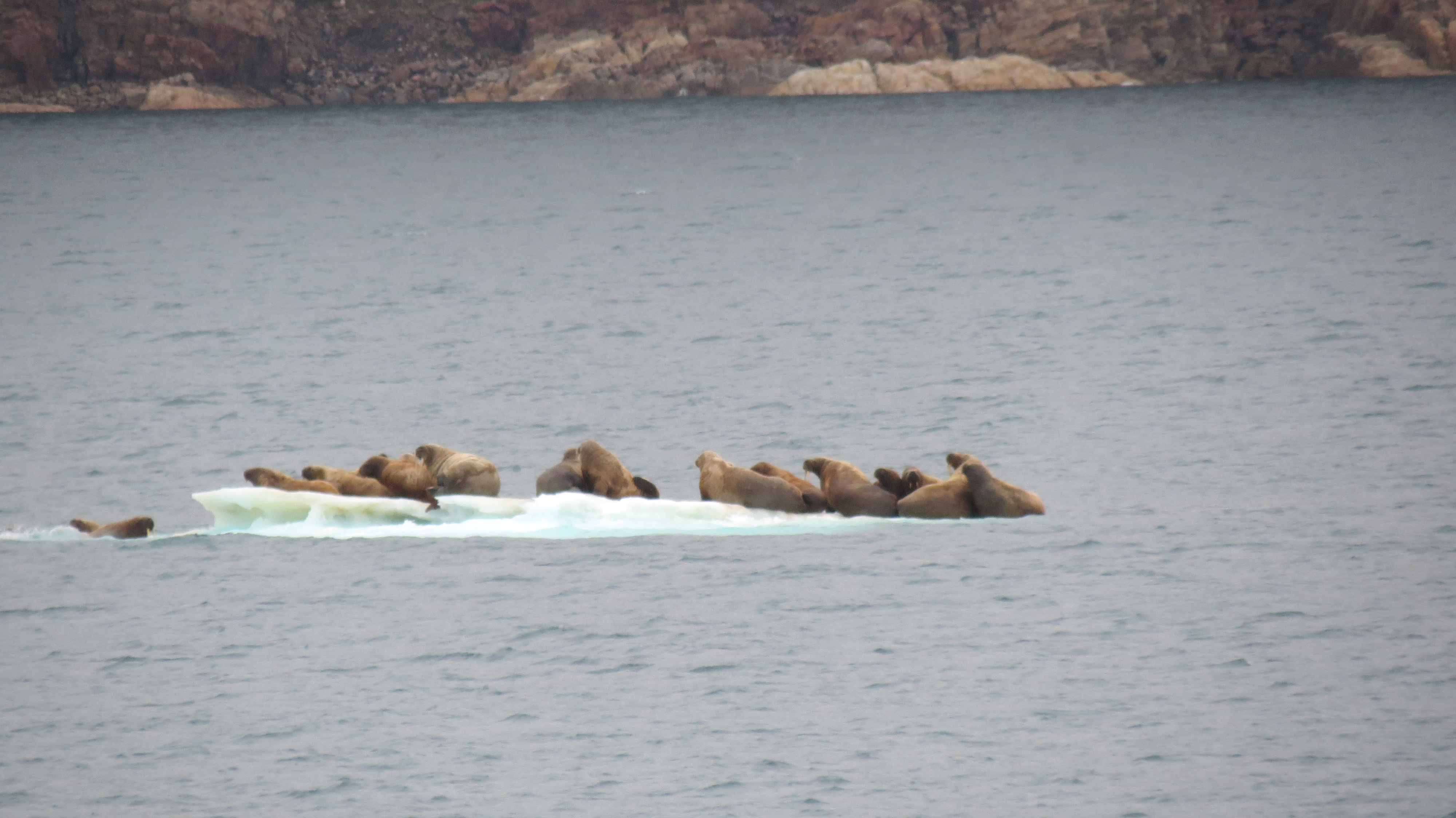
Walrus on an ice floe in Alexandra Fjord on Aug.-13, 2012. [Photo Credit: Kirk McNeil, Labrador, Canadian Coast Guard Ship Henry Larsen]

Most wildlife is first seen on the bridge of the CCGS Henry Larsen. An announcement is usually made via the ship’s loudspeakers that often pipe music or the report of the day. It is a funny sight to see 10 scientists and 10-20 crew scrambles for cameras and a good viewing position. The officer in charge aboard the bridge is also in charge of the ship’s camera whose pictures are placed on a public computer for all aboard to access. I also placed several videos from Petermann Fjord and glacier on the same public access point. It is remarkable how freely everyone aboard shares photos, videos, as well as data, experiences, and skills. It makes for a most pleasant atmosphere working and living together for the 2-3 weeks we scientists are aboard.

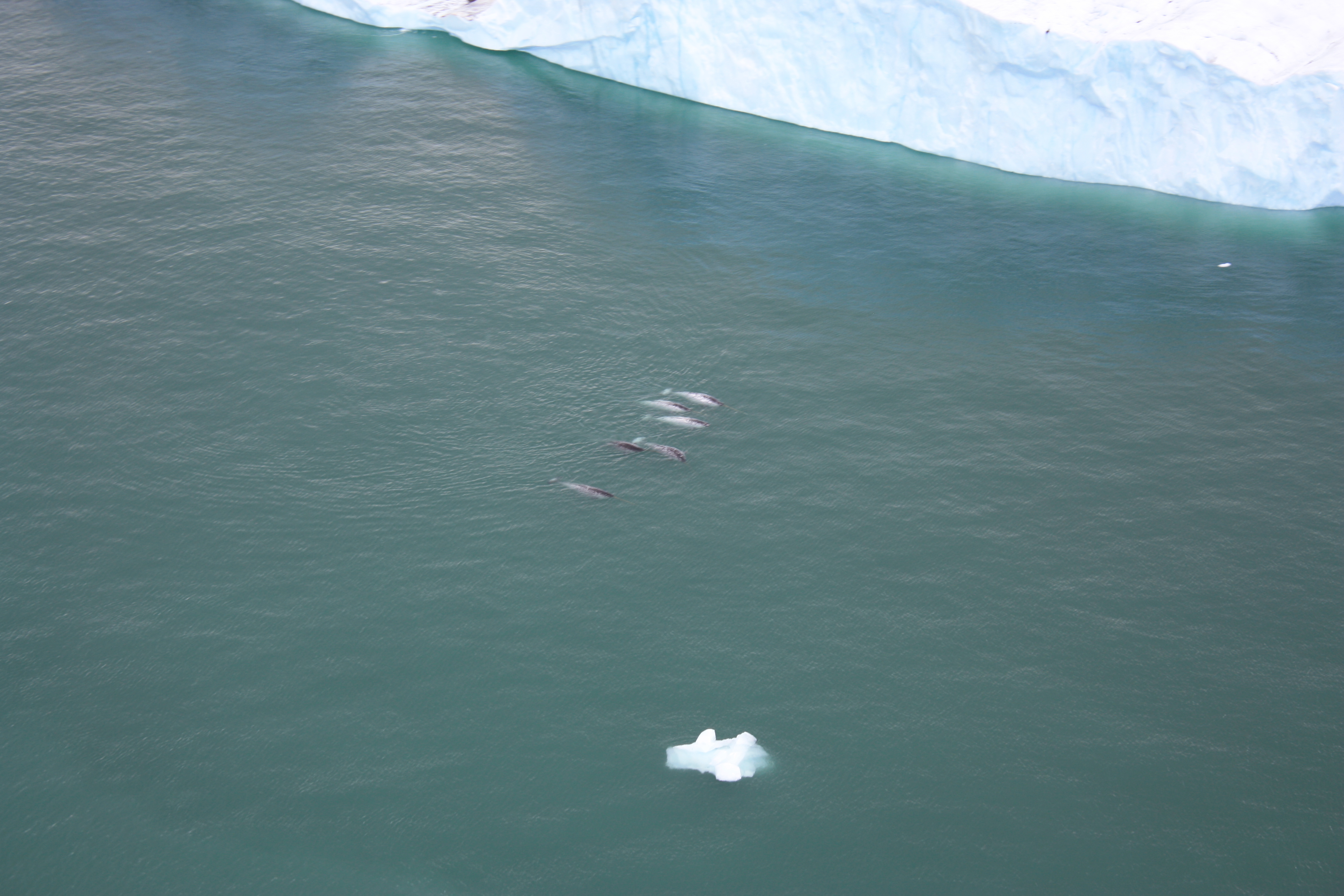
Narwhales at the seaward front of Petermann Gletscher on Aug.-10, 2012. [Photo Credit: Canadian Coast Guard Ship Henry Larsen, Jo Poole, British Columbia]

As for the narwhales of Petermann Fjord, our sadly absent colleague Dr. Helen Johnson of the University of Oxford was the first person to ever report these bottom-feeding mammals deep inside Petermann Fjord from a helicopter flight in 2009. She also conducted the zodiac survey along the edge of the floating glacier that broke off in 2010 and some more in 2012. Narwhales have been observed to dive down to over 1000 meters depth to feed via tiny pressure and temperature profilers attached their thick skins. The data were transmitted via satellite when the whales surfaced for breathing.

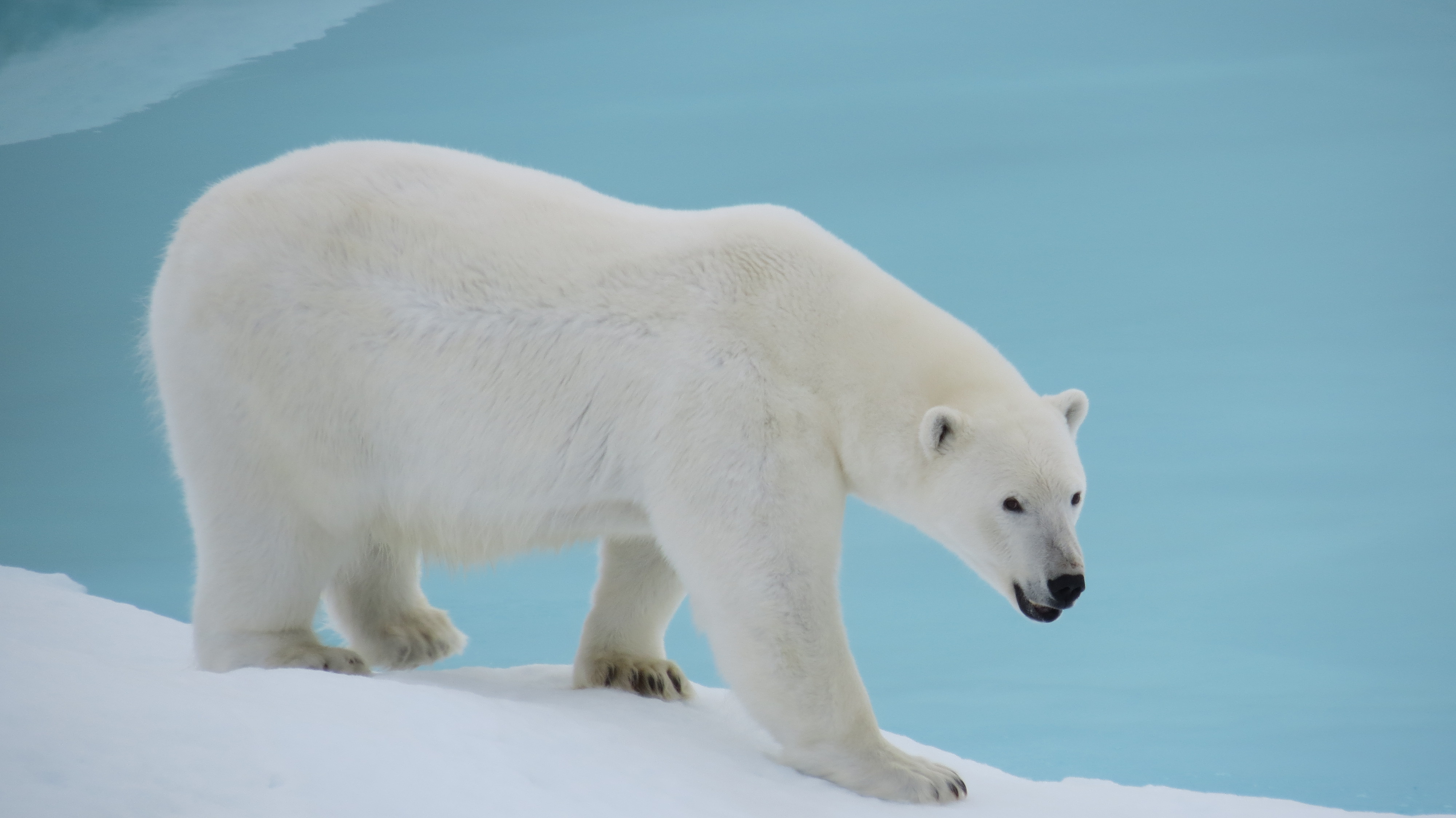
Polar bear as seen in Kennedy Channel on Aug.-12, 2012. [Photo Credit: Kirk McNeil, Labrador from aboard the Canadian Coast Guard Ship Henry Larsen]

The polar bear knows no fear and approaches every moving object, including a red icebreaker without fear, but lots of curiosity and investigates. Our polar bear perhaps thought that the big red moving ship was a wounded, blood-soaked food item. Everything is food for polar bears; some have been successful to tear down automated weather stations. Two polar bears were sighted from the ship’s helicopter today while landing a party of three to install a new weather station with an Iridium link for real-time data display. Everyone tried to finish the job as quickly as possible to get off the small island without encountering the bears.

Which brings me to the last item of this post: I have been struggling for 2 days with “nibbles” while trying to extract information on how battery voltage changed over time on some of our moorings in order to track down and diagnose a potential malfunction in one of our instruments. And the problem was that some information within a he binary data stream was separated by nibbles. It is a beautiful new word that I learnt 2 days ago from our Chief Scientist Dr. Humfrey Melling. Lots of the many data streams we are dealing with from our moored instruments, our survey instruments, our weather stations, our e-mails, etc., etc. are digital data that are stored as binary (composed of “0” and “1”) or hexadecimal numbers (composed of 1,2,3,4,5,6,7,8,9,A,B,C,D,E,F) where our decimal number 255, for example is coded as 11111111 in binary or FF in hexadecimal. The number 255 is represented as 8 bits, which equals 1 byte, which equals 2 nibbles. So a “nibble” is half a byte and the F of a hexadecimal number represents the information content of 1 nibble. To get my voltage recordings, I had to separate a single byte into its two nibbles to allocate one (along with another byte) battery voltage while the other was allocated to a second independent battery voltage.

If this sounds “geek,” it is. In order to watch the narwhales, walrus, and polar bears for a short moment of being an intermittent tourist, more advanced skills and a wicked sense of humor and hard work are absolutely essential to be a scientist a research expedition such as the one we are about to conclude. We just finished our last CTD cast at 1:30 am local time to measure temperatures and salinities within one nautical mile off Greenland near 78.5 North and 72.5 West. Rain turned to snow … winter is upon us at 2am on Aug.-14 already.

Addendum: Added photos on Sept.-13, 2012.