Author Archives: Andreas Muenchow

Nares Strait 2012: Of Walrus, Polar Bears, Narwhales, and Nibbles

Andreas Muenchow, Aug.-13, 2012 off Pim Island 78:50N 74:21W

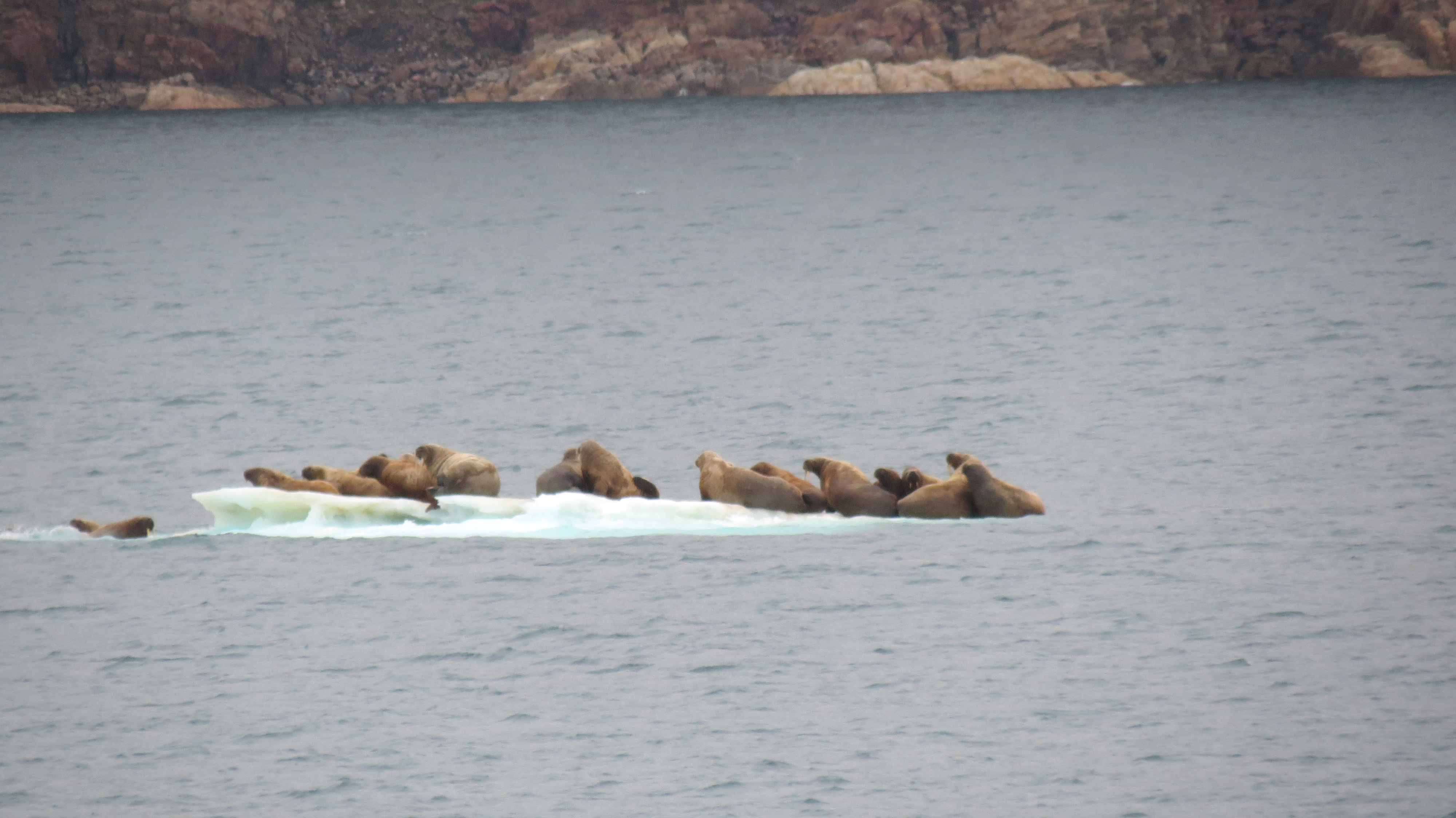
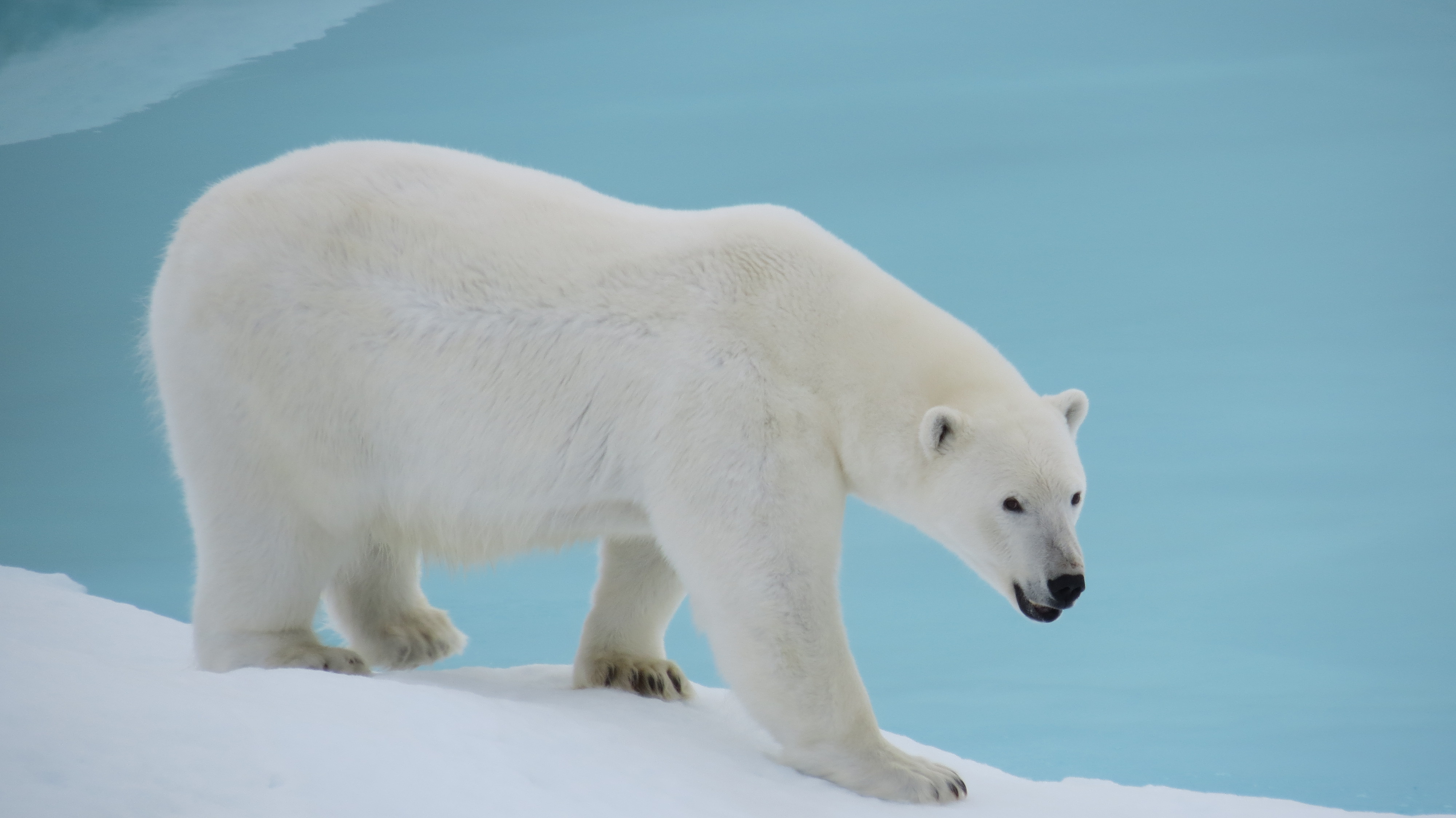
Steaming out of Alexandra Fjord after another successful mooring recovery, we are heading south to service two automated weather stations at the southern entrance to Nares Strait. During the last 3 days we have seen schools of narwhales in Petermann Fjord, a polar bear on an ice floe in Kennedy Channel just off Hans Island, and now several schools of walrus in Alexandra Fjord. I do not recall this much wild life during prior trips to Nares Strait.
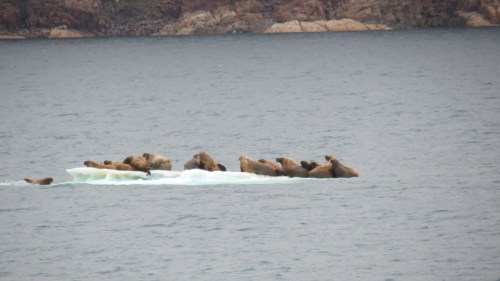
Walrus on an ice floe in Alexandra Fjord on Aug.-13, 2012. [Photo Credit: Kirk McNeil, Labrador, Canadian Coast Guard Ship Henry Larsen]

Most wildlife is first seen on the bridge of the CCGS Henry Larsen. An announcement is usually made via the ship’s loudspeakers that often pipe music or the report of the day. It is a funny sight to see 10 scientists and 10-20 crew scrambles for cameras and a good viewing position. The officer in charge aboard the bridge is also in charge of the ship’s camera whose pictures are placed on a public computer for all aboard to access. I also placed several videos from Petermann Fjord and glacier on the same public access point. It is remarkable how freely everyone aboard shares photos, videos, as well as data, experiences, and skills. It makes for a most pleasant atmosphere working and living together for the 2-3 weeks we scientists are aboard.
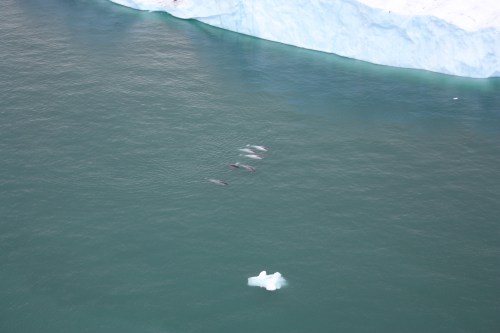
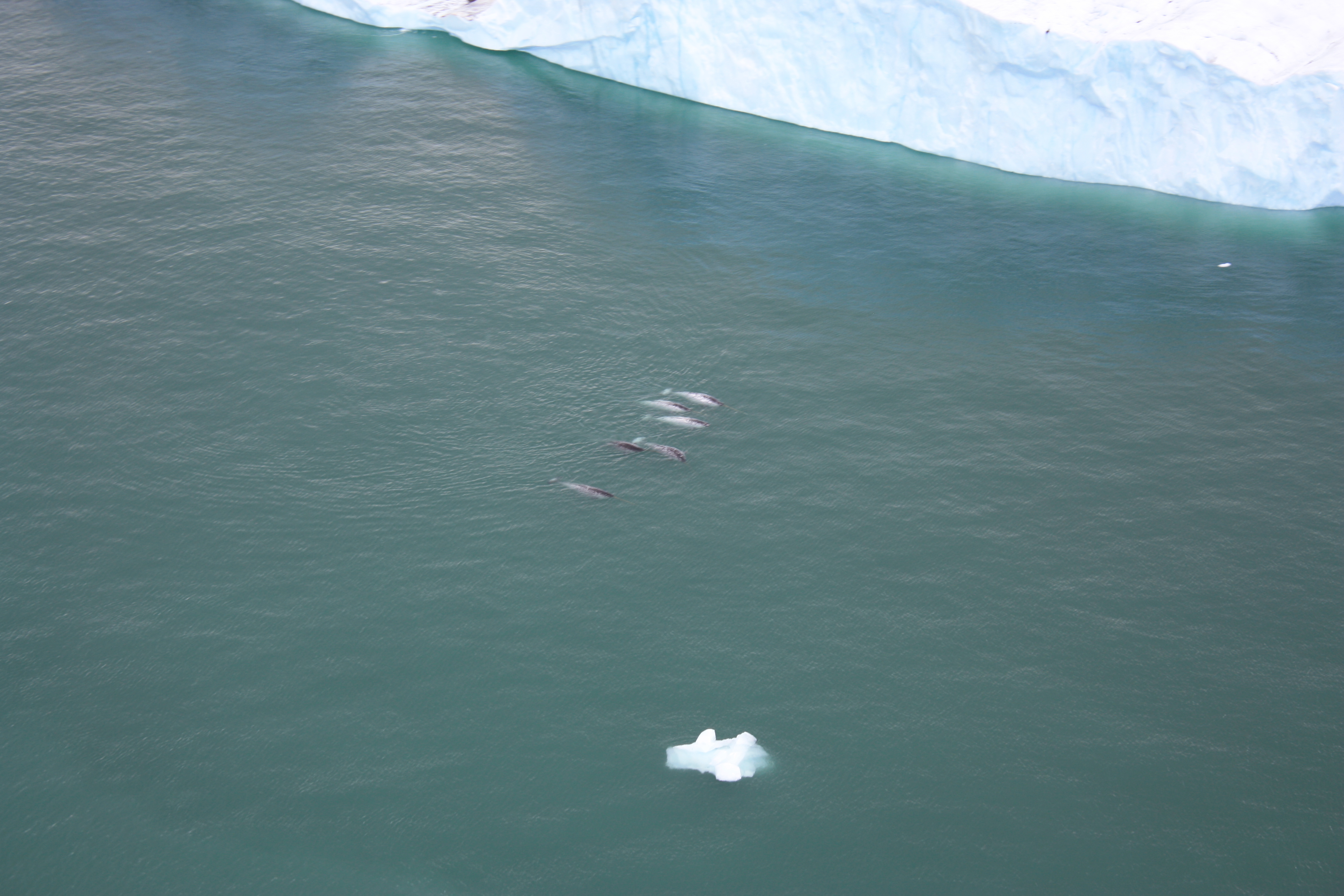
Narwhales at the seaward front of Petermann Gletscher on Aug.-10, 2012. [Photo Credit: Canadian Coast Guard Ship Henry Larsen, Jo Poole, British Columbia]

As for the narwhales of Petermann Fjord, our sadly absent colleague Dr. Helen Johnson of the University of Oxford was the first person to ever report these bottom-feeding mammals deep inside Petermann Fjord from a helicopter flight in 2009. She also conducted the zodiac survey along the edge of the floating glacier that broke off in 2010 and some more in 2012. Narwhales have been observed to dive down to over 1000 meters depth to feed via tiny pressure and temperature profilers attached their thick skins. The data were transmitted via satellite when the whales surfaced for breathing.
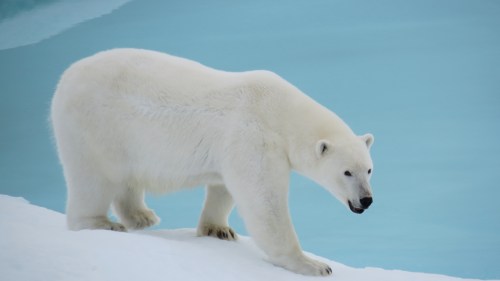
Polar bear as seen in Kennedy Channel on Aug.-12, 2012. [Photo Credit: Kirk McNeil, Labrador from aboard the Canadian Coast Guard Ship Henry Larsen]

The polar bear knows no fear and approaches every moving object, including a red icebreaker without fear, but lots of curiosity and investigates. Our polar bear perhaps thought that the big red moving ship was a wounded, blood-soaked food item. Everything is food for polar bears; some have been successful to tear down automated weather stations. Two polar bears were sighted from the ship’s helicopter today while landing a party of three to install a new weather station with an Iridium link for real-time data display. Everyone tried to finish the job as quickly as possible to get off the small island without encountering the bears.

Which brings me to the last item of this post: I have been struggling for 2 days with “nibbles” while trying to extract information on how battery voltage changed over time on some of our moorings in order to track down and diagnose a potential malfunction in one of our instruments. And the problem was that some information within a he binary data stream was separated by nibbles. It is a beautiful new word that I learnt 2 days ago from our Chief Scientist Dr. Humfrey Melling. Lots of the many data streams we are dealing with from our moored instruments, our survey instruments, our weather stations, our e-mails, etc., etc. are digital data that are stored as binary (composed of “0” and “1”) or hexadecimal numbers (composed of 1,2,3,4,5,6,7,8,9,A,B,C,D,E,F) where our decimal number 255, for example is coded as 11111111 in binary or FF in hexadecimal. The number 255 is represented as 8 bits, which equals 1 byte, which equals 2 nibbles. So a “nibble” is half a byte and the F of a hexadecimal number represents the information content of 1 nibble. To get my voltage recordings, I had to separate a single byte into its two nibbles to allocate one (along with another byte) battery voltage while the other was allocated to a second independent battery voltage.

If this sounds “geek,” it is. In order to watch the narwhales, walrus, and polar bears for a short moment of being an intermittent tourist, more advanced skills and a wicked sense of humor and hard work are absolutely essential to be a scientist a research expedition such as the one we are about to conclude. We just finished our last CTD cast at 1:30 am local time to measure temperatures and salinities within one nautical mile off Greenland near 78.5 North and 72.5 West. Rain turned to snow … winter is upon us at 2am on Aug.-14 already.

Addendum: Added photos on Sept.-13, 2012.

Nares Strait 2012: Charting New Waters in Petermann Fjord

By Andreas Muenchow, off Joe Island, Greenland, Aug.-11, 2012

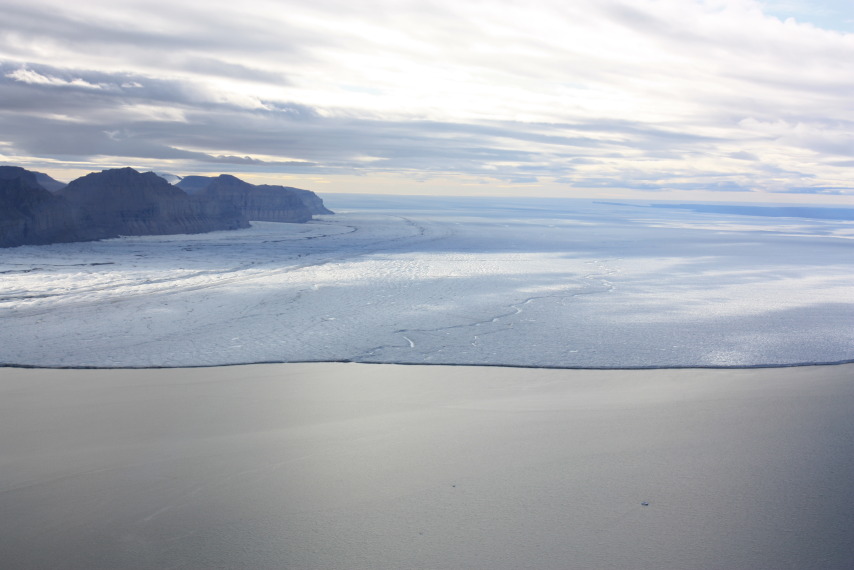
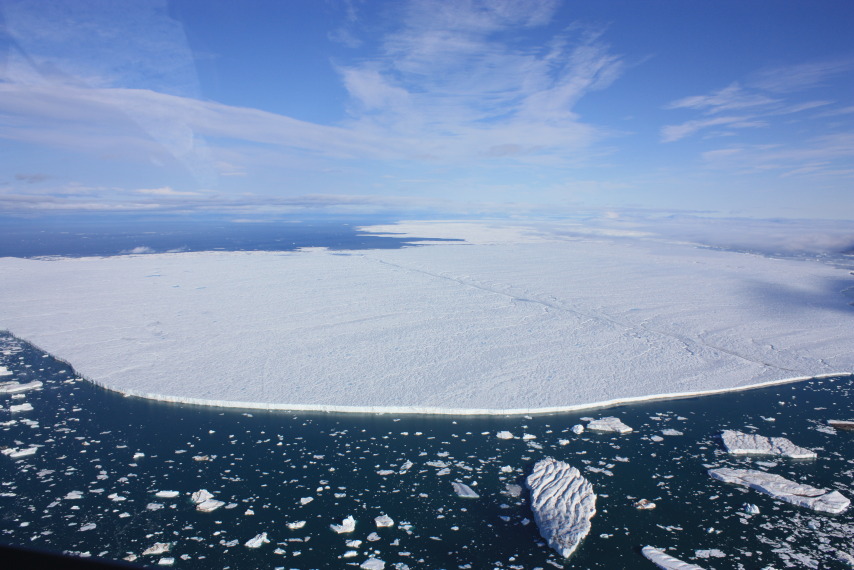
We just left Petermann Fjord, squeezing by a Manhattan-sized ice island blocking much of its entrance. An armada of 100s of ship-sized tabular icebergs were all jockeying for positions behind the big one. Captain Wayne Duffett of the Canadian Coast Guard commanded the CCGS Henry Larsen into the new waters of Petermann Fjord, Greenland, with skill, experience, and a calculated dose of daring, trusting both his instincts and his crew. These new waters were formed when Petermann Glacier lost as much as 1/3 of its floating ice shelf during massive break-off events in 2010 and again in 2012. The Henry Larsen was the first and only ship for years to sail and survey this mare incognita for the last 22 hours. It was a long day.

I slept only one of the last 24 hours, skipped dinner, and will head for breakfast in 10 minutes. Being excited and working hard with 24 hours of daylight is exhausting, draining, but also immensely satisfying. We completed a spatial bathymetric survey, collected water and water properties along the new seaward face of the glacier from the surface to 1200 meter depth, and did the same for a section along the axis of the fjord that used to be covered by an ice-shelf.

I tried to document and capture the changing icy seas and their interactions with both land and ocean by taking plenty of photos and video, to later share with those who cannot be here. Several pods of narwhales — they really do have 3-ft long tusks (a tooth really) — were feeding on ocean fronts within a mile of Petermann Glacier’s new face…

Breakfast is ready; I am sending this off as is, without much editing (too tired) {Editor’s note:  Good thing there are those less distracted by the excitement of new icy worlds to do some proofreading…}, then some sleep while those who sleep will install a new weather station on Joe Island.  Science aboard a ship like the CCGS Henry Larsen never really stops…

Nares Strait 2012: Tide Gauge Recovered after 9 Years

Andreas Muenchow, Aug.-8, 2012, off Cape Baird

In 2003 we deployed a tide gauge that was recovered today after attempts in 3 different years to do so failed. Discovery Harbor near Fort Conger was the most northern location at 81 42’ North and 64 1’ West of a large moored array placed in 2003. It was at Fort Conger, that Lt. Greeley of the U.S. Army waited in vain for a supply ship that never arrived, but this sad story is for another day and I like to write about happier news: Our 2003 tide gauge lay in wait for 9 years and 1 day precisely. A 2006 attempt to reach this northern location by ship failed on account of heavy ice cover, a 2007 attempt by helicopter succeeded to establish acoustic communications, but failed to recover the sensor package, and a 2009 attempt by ship failed again because of difficult ice conditions.

The odds of a recovery were slim, but 4 hours ago a crew of five found the tide gauge the same way that skilled fishermen of Newfoundland recover lost traps and fish for halibut: with a line of hooks operating small ships smartly. Chief Officer Brian Legge, Seamen Derick Stone and Carl Rose, as well as scientists Ron Lindsay and Jonathon Poole found the proverbial needle (read tide gauge) in the hey stack (read Arctic Ocean). The entrance to Discovery Harbor was guarded by yet another ship-sized piece of Petermann Glacier ice, this one grounded, as well as several large and small sea ice floes, all moving rapidly with the tides and currents. Even navigating the zodiac through this maze to a fixed location was a major accomplishment.

The long-lost tide gauge is a 2 feet cylinder filled with electronics, but 9 years moored to the floor at 20 meter depth turned it into a complex biology habitat attracting wild life much like the artificial reefs created along Delaware by sunken New York City’s discarded subway trains. Mollusks, seaweed, clams, barnacle, algae, and bacterial slime all attached themselves to every surface. Arctic shrimp perhaps feeding on algae or slime were captured along with the gauge. Seaman Derick Stone, who has never seen an Arctic shrimp (neither have I), quickly brushed it away and back into the ocean muttering something about  “Scorpions in the Arctic.” A second specimen was captured alive and returned to the ocean after a brief inspection. It was agreed, that there was no enough meat on this 2-inch long and skinny shrimp

As a sign of respect to the gods of the icy seas a majority of PhDs aboard solemnly swore to give the long lost sensor 3 days of rest before stripping it bare to reveal its guts, check health and status and retrieve recordings. Pranksters aboard this ship, at least one with a PhD, already alerted me to schemes of hostile capture and ransom requests; I suspect ransom to be paid in treasures, valuable certificates, and screech. Little do these pranksters know of web streaming, local area networks, advanced image processing, and other counter-intelligence operations … to be continued.

P.S.: Oh, we also completed section work (temperature, salinity, water samples) in Robeson Channel to the north of Petermann Fjord where a few segments of Petermann Glaciers former ice shelf are both grounded and moving off the coast of Greenland. Presently off Cape Baird to perhaps recover an automated weather station to be placed instead at Joe Island at the southern entrance to Petermann Fjord, weather permitting. We got 40 kts winds from the south, braking waves, as well as balmy air temperatures of 4 degrees Celsius or so.

Nares Strait 2012: Heading North Passing Petermann Fjord and Ice Islands

Andreas Muenchow, Aug.-7, 2012 in Hall Basin

Petermann Fjord is within sight and at least 5 ship-sized segments from Petermann Glacier are around us drifting to and fro with the tides. RadarSat imagery received this morning aboard the CCGS Henry Larsen indicates that the Manhattan-sized ice island PII-2012 has moved over 3 nautical miles seaward in the last 36 hours (5 kilometers per day) during winds from the south-west. The north-eastern tip of PII-2012 has left the fjord past Offley Island.

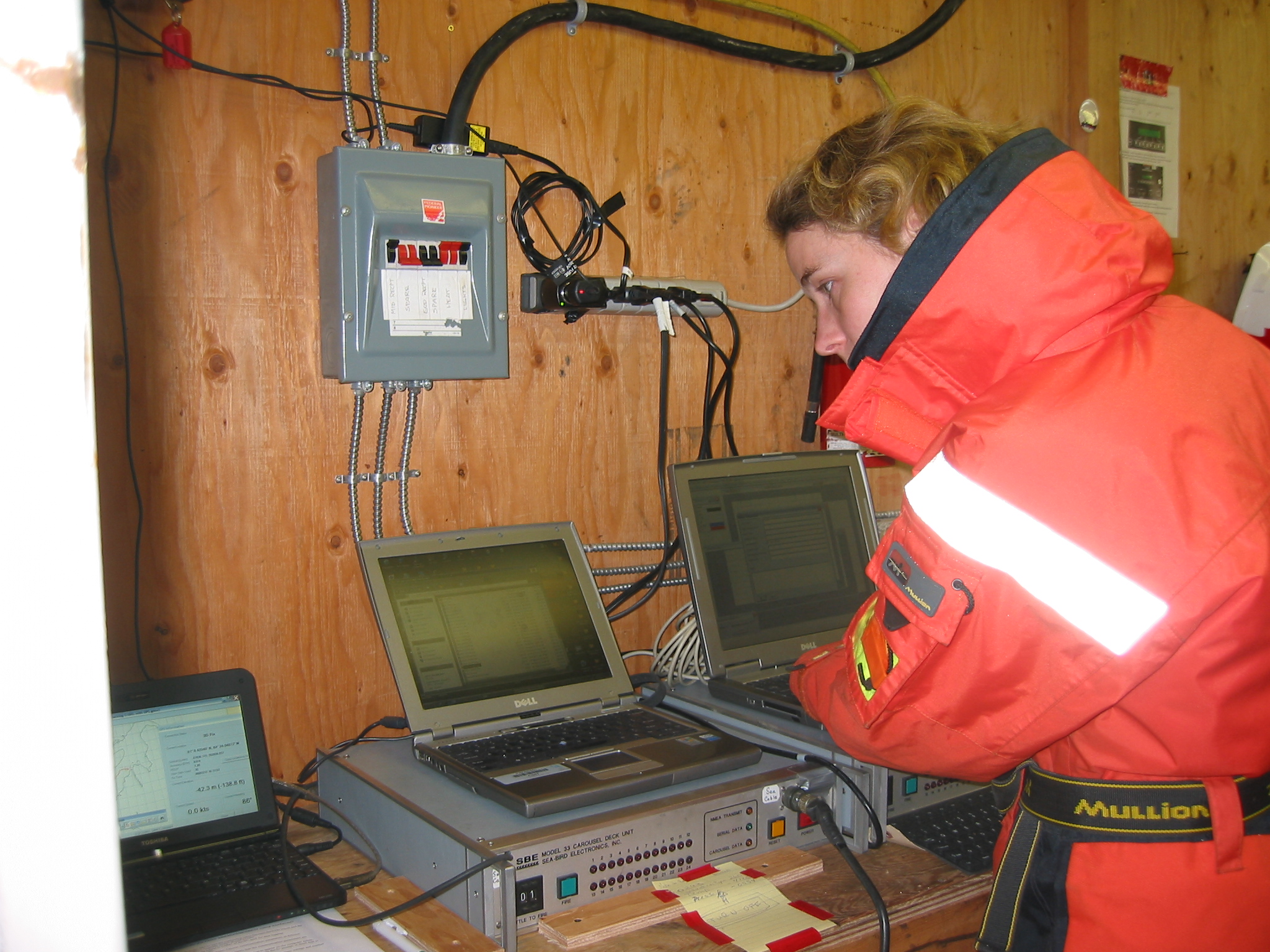
We are about 20 miles to the south at 81 degrees 14 minutes north and 65 degrees west firing bottles to collect water samples across a section that Petermann’s ice island PII-2012 will cross perhaps as early as the next week. Dr. Renske Gelderloos just tells the bridge from a van on the fore deck, that all 12 bottles have been fired as the instrument package traveled from the surface to 451 meter depth and back. Additionally, we collect temperature and salinity more continuously as an electromagnetic sensor is lowered via the same cable as the bottles. I am one of two winch operators while Dr. Gelderloos is the command and control center next to me operating 3 laptops concurrently.

Dr. Renske Gelderloos of Oxford University in command and control of data collection operations aboard the CCGS Henry Larsen.

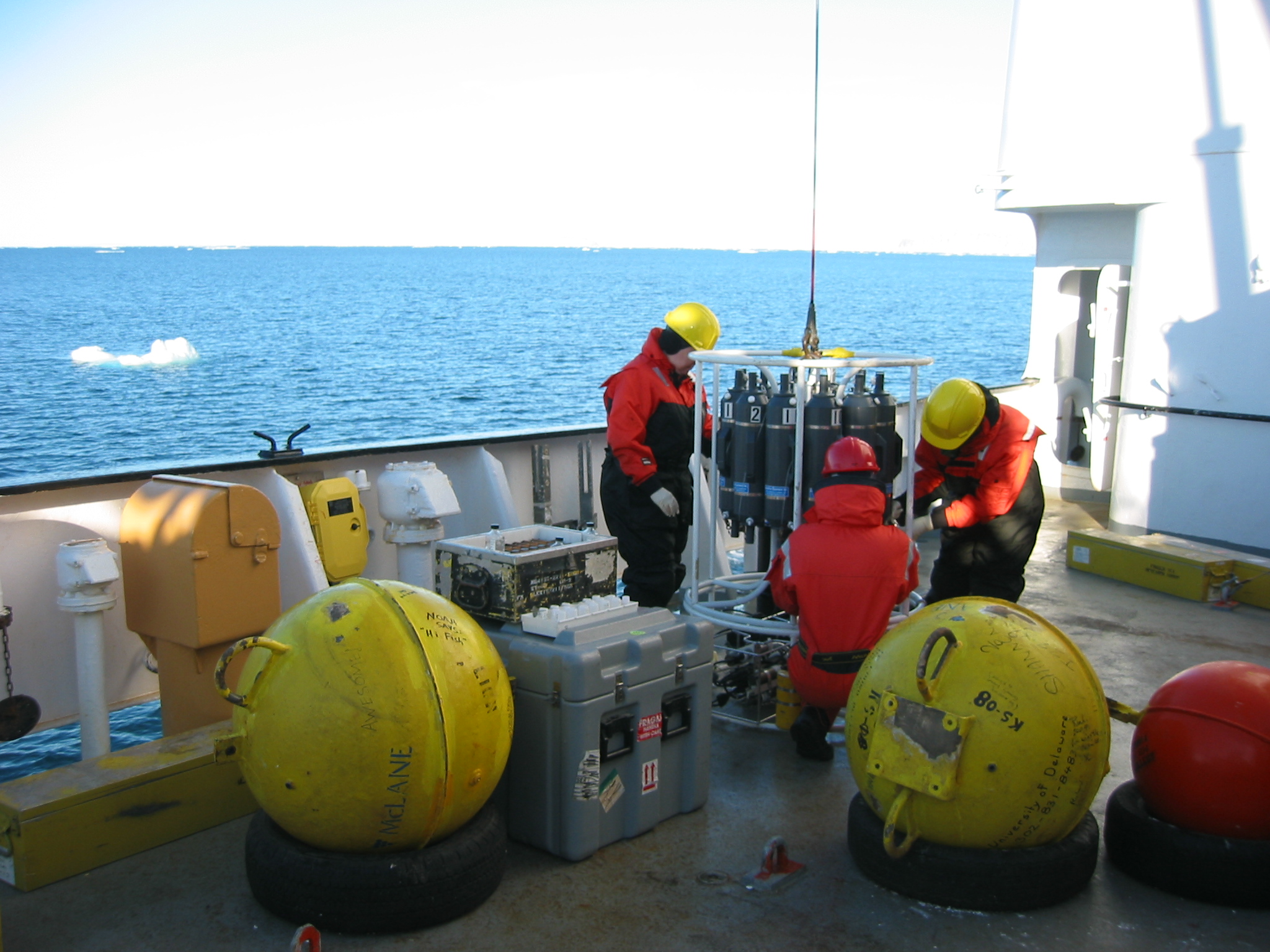
Pat Ryan (left), Humfrey Melling (center), and Allison Einolf (right) collecting water samples aboard the CCGS Henry Larsen in Hall Basin in August 2012.

PhD student Patricia Ryan, dressed in a warm Mustang suit, is one of the water samplers to transfer water into tiny sample bottles for later chemical analyses. She just hands me a USB JumpDrive with 3-years of data of temperature, salinity, and pressure from a moored sensor we recovered yesterday. The latest profile is completed and I am off to process the new data further.

I missed dinner at 5pm, because it took us 5 hours until 8pm local time to finish the 7 stations of a section from Greenland to Ellesmere Island, Canada. I am back to writing now at 11:35 pm local time after lots of cheerful banter, quick clean-up for the day, 2 beers at the bar, and an hour staring into Petermann Fjord from the west-by-northwest. I can’t see the ice island even though I see Offley Island and I know the ice island is right next to it. The ice sheet spilling over the vertical walls of Petermann Fjord are visible in the distance, too. It is raining now. Air temperatures are 0.7 degrees Celsius (about 34 Fahrenheit) which is a little cooler than is normal for this time of the year. We are now another 50 km to the north at 81 degrees and 44 minutes North latitude that is farther north of Petermann Fjord and its ice island.

I can see five ship-sized segments of Petermann Glacier’s ice shelf, but I cannot discern the Manhattan-sized PII-2012 across Hall’s Basin. We have open water to our south and some loosely scattered ice to our north along Ellesmere Island. We are still heading north towards Robeson Channel to perhaps reach Alert on the Arctic Ocean or to perhaps repeat a section that was done for the first and last time in 2003 when the USCC Healy was here at the beginning of our Nares Strait project. It is past midnight now, Wednesday has started, time for bed. [81 49’ N, 63 09’ W at 04:20 UTC, 00:20 local]

Nares Strait 2012: From Thule towards Smith Sound

The CCGS Henry Larsen lifted anchor about 6 hours ago sailing north towards Nares Strait and Petermann Glacier. Air temperatures in port were a balmy 10.5 C this morning, but now have dropped to 6.3 C this evening at sea. We are steaming at almost 9 kts with clear skies overhead most of the day. We hit a fog bank or two and I mistook the blowing fog horn for a fire alarm.

The day was largely spent with setting up gear, re-arranging lab spaces indoors and deck spaces outdoors. The usual drills and introductions to emergency procedures (fire, abandon ship, helicopter) to a few hours, too. Access to the internet is severly limited: it takes about 1 second to send and receive 64 bytes from the ship to either Delaware, England, or California. About 20-40 of these “pings” fail, meaning that actual data transmission and receive rates are even slower.

There are faster connections aboard, but those are limited to the ice observer who receives severely downgraded RadarSat imagery for ice navigation that will guide ship and helicopter for visual observations on where to go and what ice to avoid. Petermann Ice Island apparently moved another 4 km and has its tip now sticking almost into Nares Strait perhaps touching coast near Offley Island at the north-eastern side of Petermann Fjord. That image is 24 hours old, we may receive a new one over night.

Local time (same as Montreal or New York) in 9pm and the sun is still about 30 degrees above the horizon, no darkness all night. Greenland and its ice cap are visible in the distance, about 30 miles to my right. A few icebergs are scattered loosely here and there. We are 48 people aboard … more laters.