
Tag Archives: sea level rise

New Ice Island Forming at Pine Island Glacier, Antarctica

A new ice island is about to form as spring and summer arrive in Antarctica. NASA researchers working on Pine Island Glacier (PIG) as part of the IceBridge Mission discovered a 30 km wide rift some 25 km from the ocean during overflights in a DC-8 research aircraft.The rift will eventually will break off into a tabular iceberg about 10 times the size of Manhattan. The rift is wide enough to be visible in optical satellite imagery that has a spatial resolution of 250 meters. A BBC report credits NASA scientist stating that this large calving of an ice island is part of a natural, roughly decadal cycle.
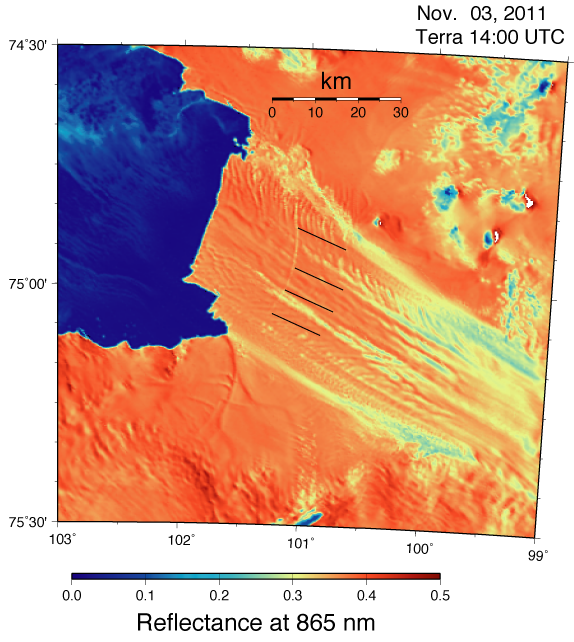
Pine Island Glacier from MODIS/Terra with crack visible at 250-m spatial resolution.
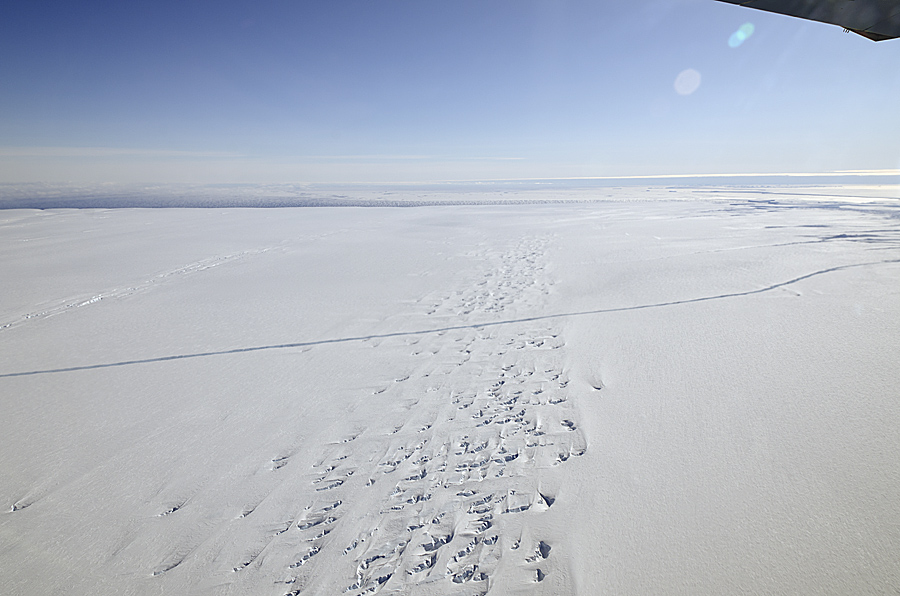
A crack runs across the floating ice shelf of Pine Island Glacier in Antarctica, seen from NASA's DC-8 on Oct. 14, 2011. Credit: Michael Studinger/NASA

Antarctic massive ice sheets contain 70% of all freshwater and 90% of all ice on earth. Most of this is contained within the stable East Antarctic ice sheet where temperatures have increased little. In contrast, the West Antarctic ice sheet has seen warming by about 0.2 degrees Celsius and a net loss of ice to raise global sea level by perhaps 2-3 inches in 100 years. The grounding line Pine Island Glacier (where ocean, bedrock, and ice meet) has retreated for several decades as warmer ocean waters near the bottom cross a sill and plunge into a landward depression of the bedrock. This leads to enhanced melting of the floating ice-sheet and a potential instability that could lead to a collapse of the ice-shelf and much enhanced discharge of the Pine Island Glacier to draw down a large fraction of the West Antarctic Ice Sheet.
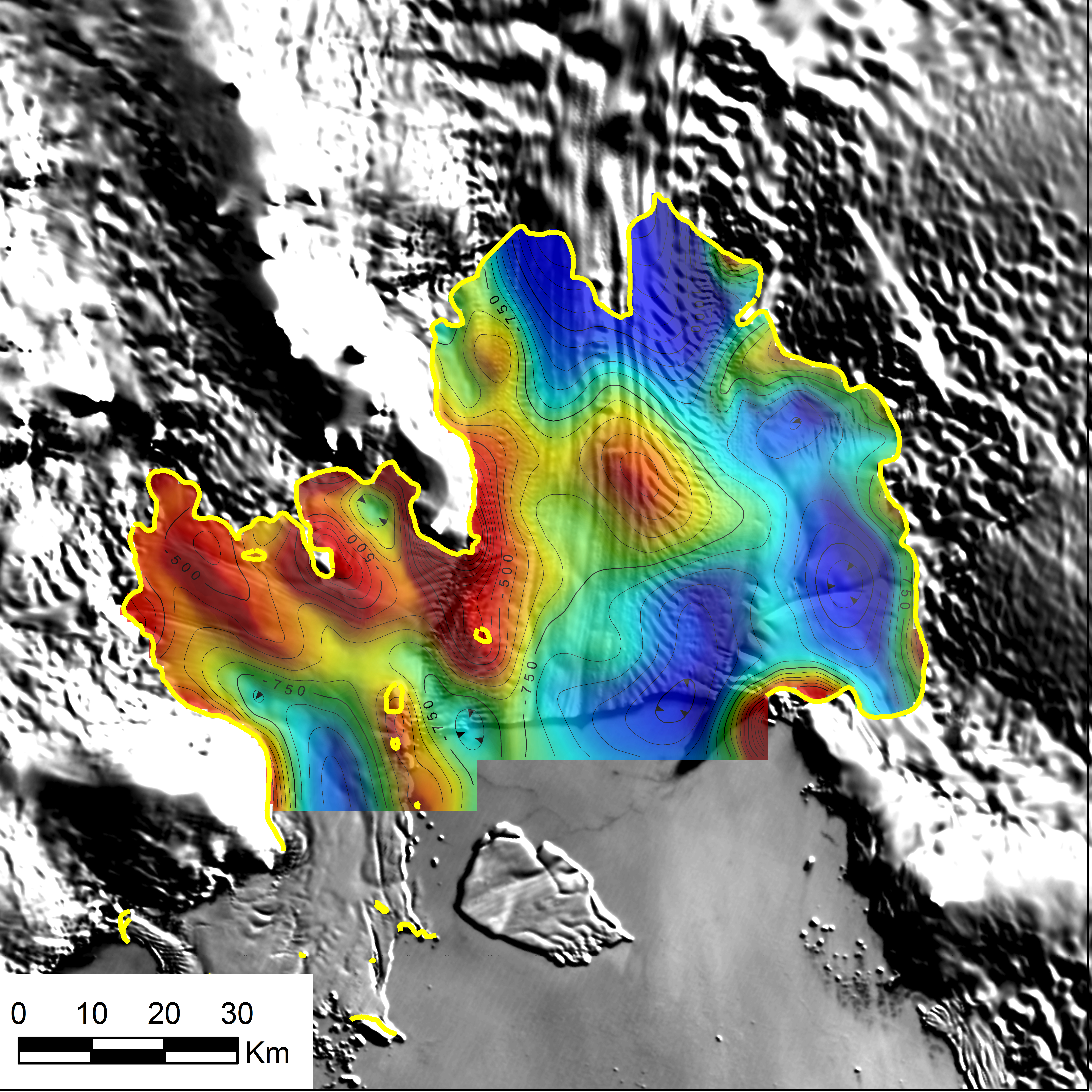
Bottom topography under Pine Island Glacier and grounding line. Blue colors show greater depths and its connection to the open ocean (bottom, north). (credit: NASA)

A similar physical process, albeit at a smaller scale, is potentially working at Petermann Glacier off Greenland where the grounding line is at a local maximum of bedrock elevation. Petermann’s grounding line has probably not moved substantially the last 100 years or so.

More detail on the evolving Pine Island Glacier, Antarctica event can be found at a NASA media briefing.

Ice Islands, Oil Fields, and Sea Level

A piece of ice, the size of four Manhattans, is heading our way. It broke free from northern Greenland last summer and has become home to seals and sea life off Labrador and Newfoundland, Canada. Ocean currents continue to propel it towards Hibernia oil fields and the rich fishery grounds of the Grand Banks. It is a tourist attraction as well.

Ice Island off Labrador 20 km from the coast in water 100-200 m deep (from Terra/MODIS).

This largest break-up from Greenland for at least 80-years has raised fears, that a warming climate will raise global sea level. While melting all of Greenland’s ice sheet would increase sea level in Delaware and Bangladesh by over 20 feet, this is unlikely to happen for the next 500 years. But how much does Greenland melt now? How much will our local sea level change the next few years as a result? Will it be inches or feet by the end of this century?

In order to answer these questions, we need to understand how the melting of Greenland’s ice works, if it melts all the time, if it melts everywhere, and if its melting is accelerating. We all know that glaciers grow when snow accumulates atop and shrink when icebergs break off. As big as the ice island from Petermann was, it contributes only a seventh to Petermann’s normal overall loss. Ocean warming and circulation cause most of the rest. During both the cold darkness of winter and bright coolness of summer, the ocean melts the most ice below the surface where it is thickest.

Furthermore, this melting can accelerate ice streams discharging ice hundreds of miles inland when thrown off-balance. Presently, these ice streams are held in place by a delicate balance of forces at the point where ocean, glacier, and the bottom meet. If this triple intersection of water, ice, and rock retreats into an existing landward cavity, then ocean water will rush in, enhance ice-ocean contact, increase the rate of melting, collapse the ice shelf, and thus raise global sea level. That’s bad for Delaware and Bangladesh, because it increases coastal erosion, flooding, and loss of wetlands that are nurseries for fish, crab, and shrimp.

Ice islands breaking off Greenland are visible and dramatic, but the cost of them breaking oil rigs off Newfoundland are small compared with the costs of rising sea level due to accelerating ice streams and disintegrating ice shelves. These sucker punches will be costly for us in Delaware and Bangladesh. An ice island or two … pocket change.