
Tag Archives: ice island

Last Image of Nares Strait from Europe’s Environmental Satellite

The European Space Agency announced today that one of its primary environmental satellites died. For over a months now engineers could neither receive data nor send commands to the 10-year old veteran of earth science research whose design life was 5 years. The last image received for my study area between northern Greenland and Canada shows Petermann Gletscher and ice-covered Nares Strait:
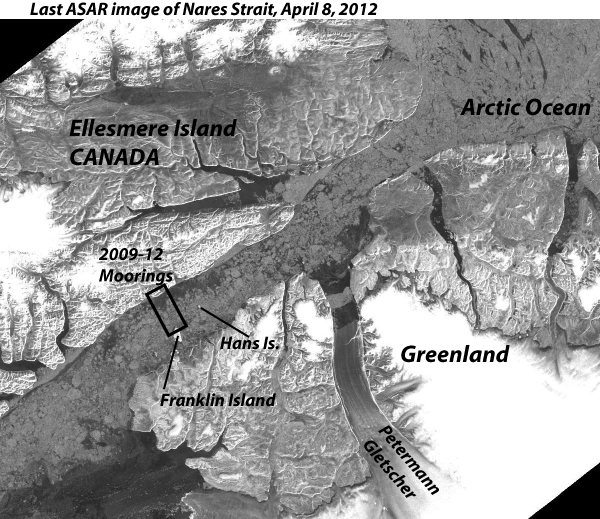
The rectangle between Franklin Island, Greenland and Ellesmere Island, Canada shows the site where in August 2012 we hopefully will recover data from an array of ice and ocean sensing equipment that we put there in 2009.

It was during this 2009 International Polar Year expedition to Nares Strait that I discovered satellite remote sensing in a new way, that is, accessing the raw digits sent down to earth from the NASA’s Aqua and Terra satellites that contain Moderate Resolution Imaging Spectroradiometer (MODIS) sensors. These two sensors are as old or older than its European companion. MODIS are now the only optical sensors at better than daily resolution which check the land, ocean, and ice now that the European satellite is not talking with us anymore.

For me, the most spectacular use of Europe’s EnviSat was its ability to document how the 2010 Petermann Ice Island wiggled its way out of its constraining fjord into Nares Strait. A movie of daily radar images is attached:
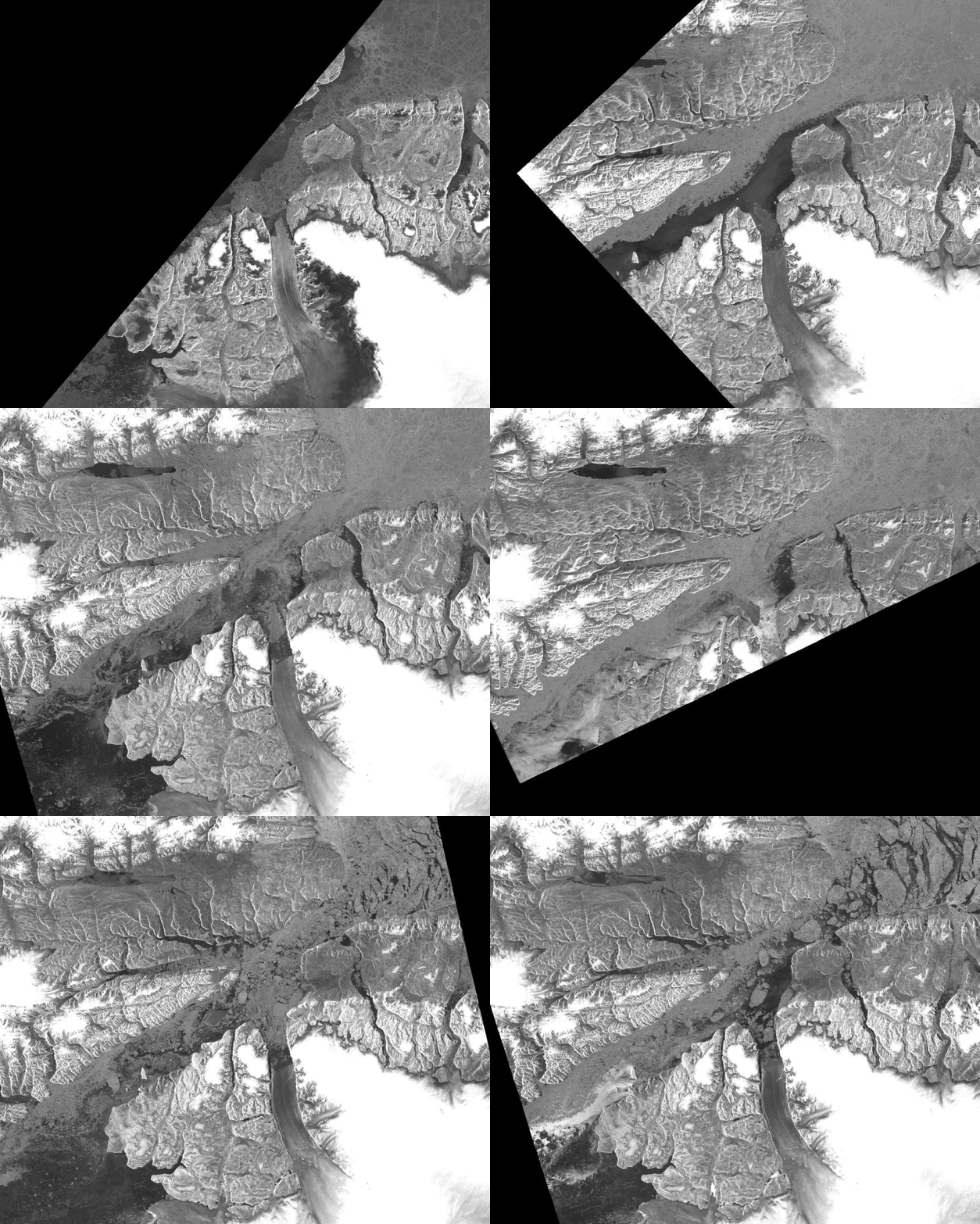
Petermann Ice Island 2010 slow movement through Petermann Fjord, break-up on Joe Island, and swift movement southward in Nares Strait. Click on image to start movie.

Unlike its Canadian counterpart, RadarSat, the imagery from the European radar (ASAR) was distributed widely, free of charge, and became useful to research communities and a wider public. The Danish Meteorological Institute provides an archive of imagery from both US and European satellites for all of coastal Greenland that just lost its European imagery (http://ocean.dmi.dk/arctic/modis.uk.php). Unlike the now defunct EnviSat, RadarSat is a for-profit commercial enterprise unaffordable to scientists or a public. The Canadian government funded development, launch, and initial data processing before giving it away to a private corporation. Ironically, the largest paying customer for its expensive products is the Canadian Government, but the data are rarely used for public education or research. They may as well be secret.

So, the demise of EnviSat is sad news. It removes a semi-public eye in the sky. Lets hope, that its replacement by the European Space Agency receives the urgent attention that it deserves.
Ice Drift from Nares Strait to Newfoundland: The 1871 Polaris Expedition and Petermann Ice Islands

“Nineteen ship-wrecked members of the Polaris expedition of 1871-72
drifted on ice floes a distance of over 2500 km from Nares Strait near
79°N latitude to Newfoundland. Surviving this six months long ordeal,
they inadvertently mapped for the first time a drift of icy waters
from the Arctic to the North Atlantic Ocean. That they survived to
tell the tale is tribute to two Inuit, Joe Ebierbing and Hans Hendrik,
whose hunting skills and diligence provided food for the entire party
(Hendrik, 1878). Almost a century later, 1962-64, ice island WH-5 was
carefully tracked via ships and aircraft from north of Ellesmere
Island (83°N) to the Atlantic via Nares Strait (Nutt, 1966). The
movements of ice and water so revealed are one link in the global
hydrological cycle whose significance to global climate has yet to be
understood …” [from Muenchow et al. (2007)]

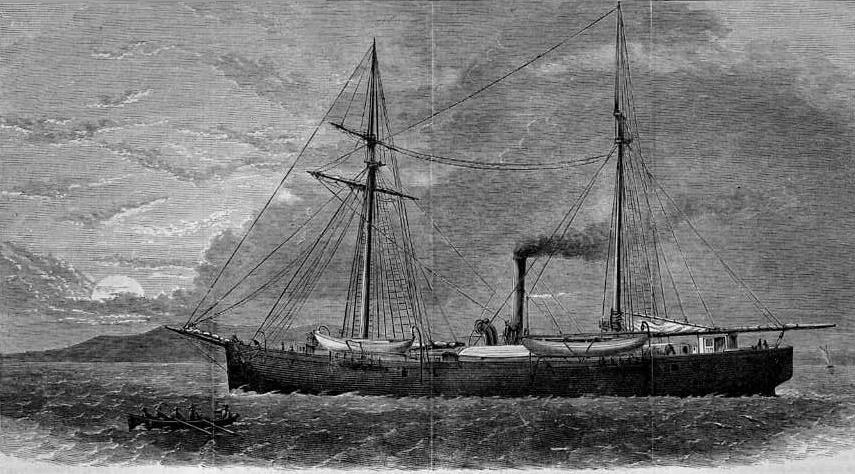
'Captain Hall's Arctic Expedition -- The "Polaris"'', a wood engraving published in ''Harper's Weekly'', May 1873.

The BBC contacted me this morning asking great questions related to the Petermann Ice Islands and icebergs. These reminded me of the opening paragraph quoted from a paper on the oceanography of Nares Strait. I published it in 2007 with two friends and fellow sailors of icy waters, Kelly Falkner and Humfrey Melling. In 2003 we sailed together on the US Coast Guard icebreaker Healy and making detailed measurements on ice, water,and bottom sediments. We reported strong southward currents from the Arctic Ocean into Baffin Bay opposing the local winds. Ocean currents were particular strong about 100 meters below the surface on the Canadian coast of Nares Strait. I am still working on these data as they relate to the flux of fresher Arctic waters into the Atlantic Ocean and their climate impacts.

There is history and drama in these places: Hall Basin is named after the leader of the Polaris Expedition, Charles Francis Hall, an American who was likely poisoned in 1871 with arsenic by his German Chief Scientist Dr. Emil Bessel aboard the Polaris beset in ice in Hall Basin. Bessel has a tiny fjord off Greenland named after him, it is located about 10 miles south of Petermann Fjord, named after August Heinrich Petermann, a German cartographer who traveled little himself but mapped much of what others had traveled. Joe Island, named after the Inuit hunter Joe Ebierbing of the Polaris ice drift, is the island that broke the 2010 Petermann Ice Island at the entrance of Petermann Fjord into PII-A and PII-B. The second Inuit hunter of the infamous 1872 drift, Hans Hendrick has Hans Island named after him which is very much in the center of Nares Strait and is currently claimed by both Canada and Denmark.

The Wikipedia entry on the Polaris Expedition has a well-written introduction while the book by Pierre Berton”The Arctic Grail”provides the story along with many other foolish and professional travails to reach the North Pole during the 19th and early 20th centuries.