
Tag Archives: climate change

Pine Island Glacier Grounding and Unhinging

I can’t get Pine Island Glacier, Antarctica out of my mind. Checking my e-mail over breakfast, I was alerted to the forum post of Dr. King, a geophysicist working at the University of Newcastle in northern England. His post provided a hint and link to data on where all glaciers around Antarctica are grounded. The file at the National Snow and Ice Data Center was too slow to download at home, so I quickly bicycled to work, got the data, wrote a little script , and plotted Pine Island Glacier’s grounding and “coastline”:
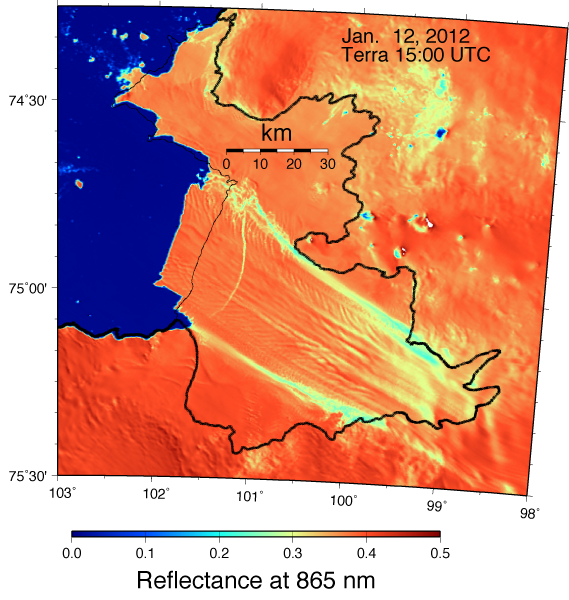
Pine Island Glacier, Antarctica as seen Jan.-12, 2012 from MODIS Terra. The blue colors top-left are ocean, red-yellow are ice. Thick black line shows where the glacier is grounded to the bedrock below sea level, that is, all "red" areas to the left (west) of this line are floating on the ocean. The thin black line is the "coastline." Grounding and coastlines are from National Snow and Ice Data Center'. North is to the top.

The image indicates a problem in a rapidly changing world: Both the “coastline” and the “grounding line” change with time, rapidly so. The black lines shown above come from hundreds of cloud-free satellite images from the 2004/05 summer in Antarctica. Dr. Scambos, Lead Scientist for the National Snow and Ice Data Center painstakingly analyzed these data and assembled them into the “Mosaic of Antarctica.” The derived coastline for the Pine Island region suggests, that the glacier advanced over 10 km in 7 years. The crack behind it identifies the next ice island that, I speculate, has already separates from the glacier, as its front is moving 10 times faster than the glacier itself. The grounding line looks different from one that I have seen before, too, e.g.,
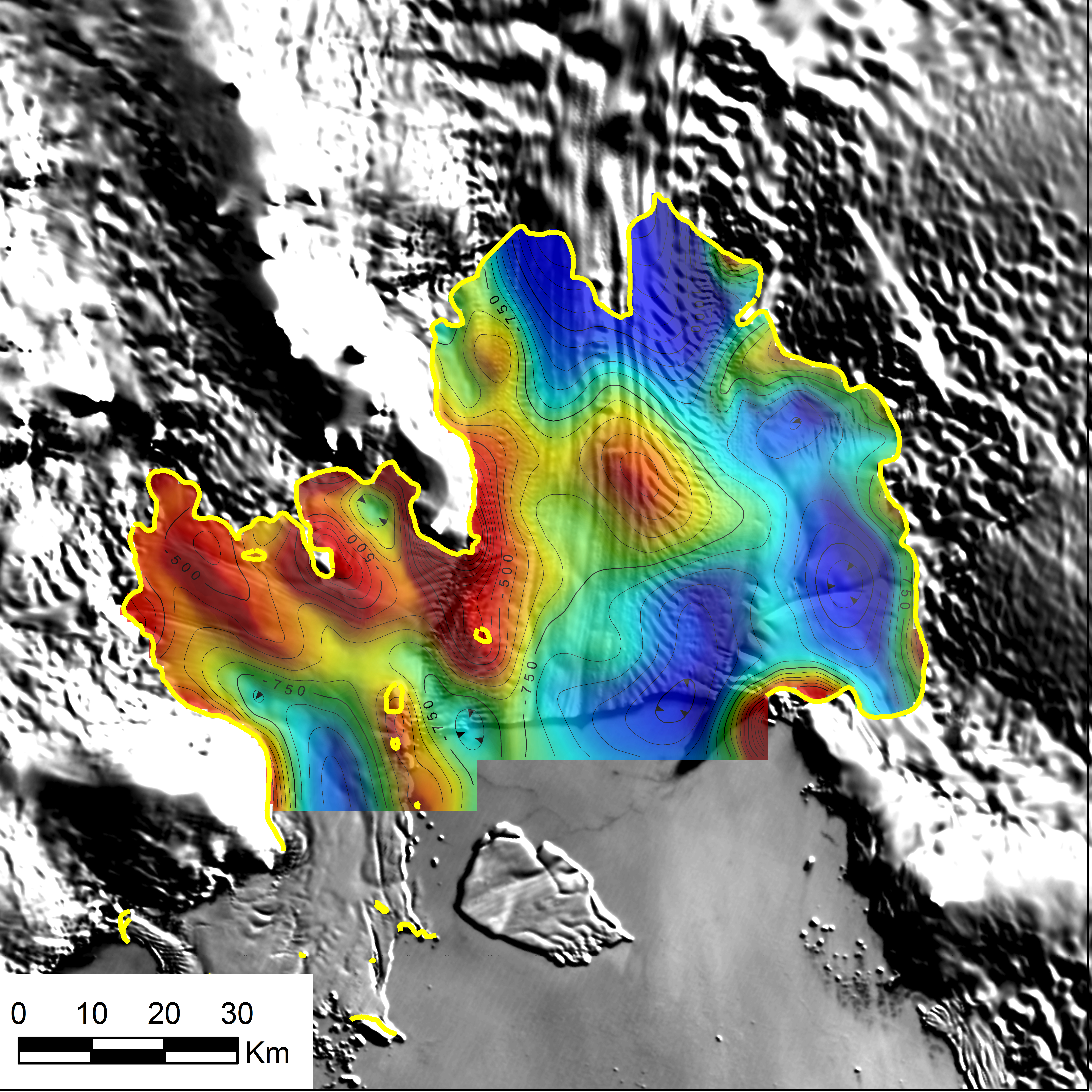
Bottom topography under Pine Island Glacier and grounding line. North is to the bottom. (NASA)

Trying to resolve this issue, I google searched “Pine Island Grounding Line” only to find a number of excellent science essays and publications on the impacts that Pine Island Glacier and its streaming ice have on climate change and global sea level rise:

Good science essays hide in strange places: “West-Antarctic Ice: Slip-sliding Away” by Dr. Bruce E. Johansen of the University of Nebraska makes reference to a 2010 publication in the Proceedings of the Royal Society of Dr. Katz, University of Oxford. This theoretical fluid dynamicist modeled “Stability of ice-sheet grounding lines” . It is a very theoretical paper whose results are summarized in The New Scientist. This is where I am now, hoping on my bicycle to visit my BrewHaHa coffee shop to read the paper away from my desk over lunch.

Oh, I also stumbled into a NASA animation of how Pine Island and adjacent ice streams accelerate and become thinner very far inland as a result. The graphics are stunning, the data are free, and the message is scary, yet, the science is exciting and I feel very lucky to be able to study this. Watch it, get hooked on science, and have fun.
Global Weight Watch: Slimmer Greenland and Fatter Tropics

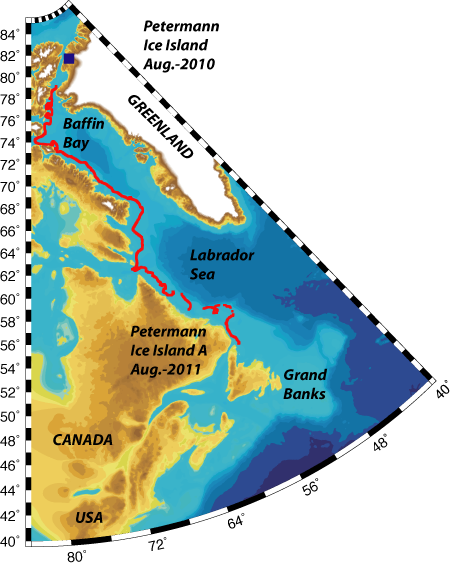
An ice island four times the size of Manhattan separated from Petermann Glacier, Greenland last year. Today one of these Manhattans reached the coast of Newfoundland. Never before has as large a piece of ice from Greenland reached this far south. Does this show a warming climate taping into Greenland’s 20 feet potential to raise global sea level?

Track of Petermann Ice Island from Aug.-2010 through Aug.-2011 traveling in shallow water from northern Greenland along Baffin Island and Labrador to Newfoundland.

Greenland’s glaciers always melt with pieces breaking off. This raises sea level if Greenland receives less snow atop than it loses ice at the bottom. For the last 10 years Greenland lost about 200 trillion pounds of mass, net, per year. [At 5 cents per pound, this pays off the federal debt within a year.] Distributing this mass over all oceans, we raise global sea level by one inch in 75 years. Nothing to worry about, but there is a twist: Weight watching satellites show that Greenland becomes thinner, while the Tropic grow fatter. Records of weight gain and loss are too short to draw firm conclusions, yet, but they are consistent across the globe and the trends of gain and loss are increasing, too.

We do not understand the physics, stability, and uncertainty of these increasing gains and losses well enough to make reliable predictions. If the climate over Greenland is stable, as it has been for the last 10,000 years, then this matters little. If the present equilibrium reaches a tipping point, where a small change will kick us into different stable state, then we can expect sea level to increase 10 times or more. We understand tipping points in theory, but not in practice. In practical terms, we do not know if our children must deal with two inches of sea level from Greenland by the end of this century or 80 inches or none at all. We know only too well, however, that low-lying places like Bangladesh, the Netherlands, and New Orléans struggle with the sea level we have now.

Greenland’s ice island off Newfoundland indicates a globally connected world. Burning stuff over Europe, America, and increasingly Asia creates heat that melts Greenland at a rate that is increasing. What happens in Greenland does not stay in Greenland, but it impacts Rome, Miami, and Shanghai. More ice and rising sea level will come. To play it safe, let’s think smartly what and how we burn. To play it loose and reckless: burn, baby, burn … or was it drill?

Winners and Losers of Climate Change

People with computers live long, prosperous lives, those without die early. Does this correlation mean that computers make us live longer? Of course not, but on average computer users live longer the same way that global temperatures increase as more people use computers. Does this now mean that warmer temperatures are good for you? Absolutely, if you have a computer …

Sum of undepleted CO2 emissions (top) 1950-200 and expected death by malaria, hunger, diarrhea, and flooding (bottom) as adapted from Patz et al. (2007)

I came across a report sponsored by the medical journal “The Lancet” and the University College of London entitled “ Managing the health effects of climate change.” There are pictures of glaciers, volcanos, floods, and many dazzling graphs. The most stunning is a distorted and bulging earth (Patz et al., 2007).

On top it shows the total undepleted CO2 put into the air from 1950-2000. The larger a region on the map, the more CO2 a region puts into the air. On the bottom, it shows how many people will likely die as a result of calamities that are larger in a warming climate for the 2000-2030 period. The larger the region on the map, the more people will be wiped out.

Enjoying a high standard of living fueled by burning coal, oil, and gas, we Europeans and North-Americans use energy to keep our computers, cars, and industries running. In the process we released about 10-30 pounds of CO2 per person per day averaged of the last 50 years. We are immune to malaria, a disease fostered by warmer climates; we got a strong economy to feed and cloth us so we do not starve; and except for the poor of New Orleans who drowned in hurricane Katrina, we rarely die of floods.

The situation is different in Africa and Asia. The average CO2 released is well below 2 pounds per person per day. There just are not as many computers, cars, and industries there. Instead, malaria is the main killer as it reproduces fast. Rising sea levels caused by a warming climate will cause more flooding of poorly protected areas where more poor people will drown.

No single flood, malaria, or drought will ever be caused by global warming alone. Global warming is an abstract and statistical concept that varies by region and over time. It is always present and poses an ethical dilemma: those with computers cause most of the global warming, but we do not pay the full price, while those without computers who contribute the least to the warming, they will pay more than full price. Hardly seems fair, but such is life … and we need our computers.