Category Archives: Ice Island

Why Petermann Glacier and Fjord?

The National Science Foundation (NSF) declined to fund a Physical-Ocean-Ice-Shelf-Experiment (POISE) at Petermann Fjord in northern Greenland this year. The reviews by three anonymous peers, a panel of eight scientists, and two sympathetic program managers were all very good, but not without criticism.
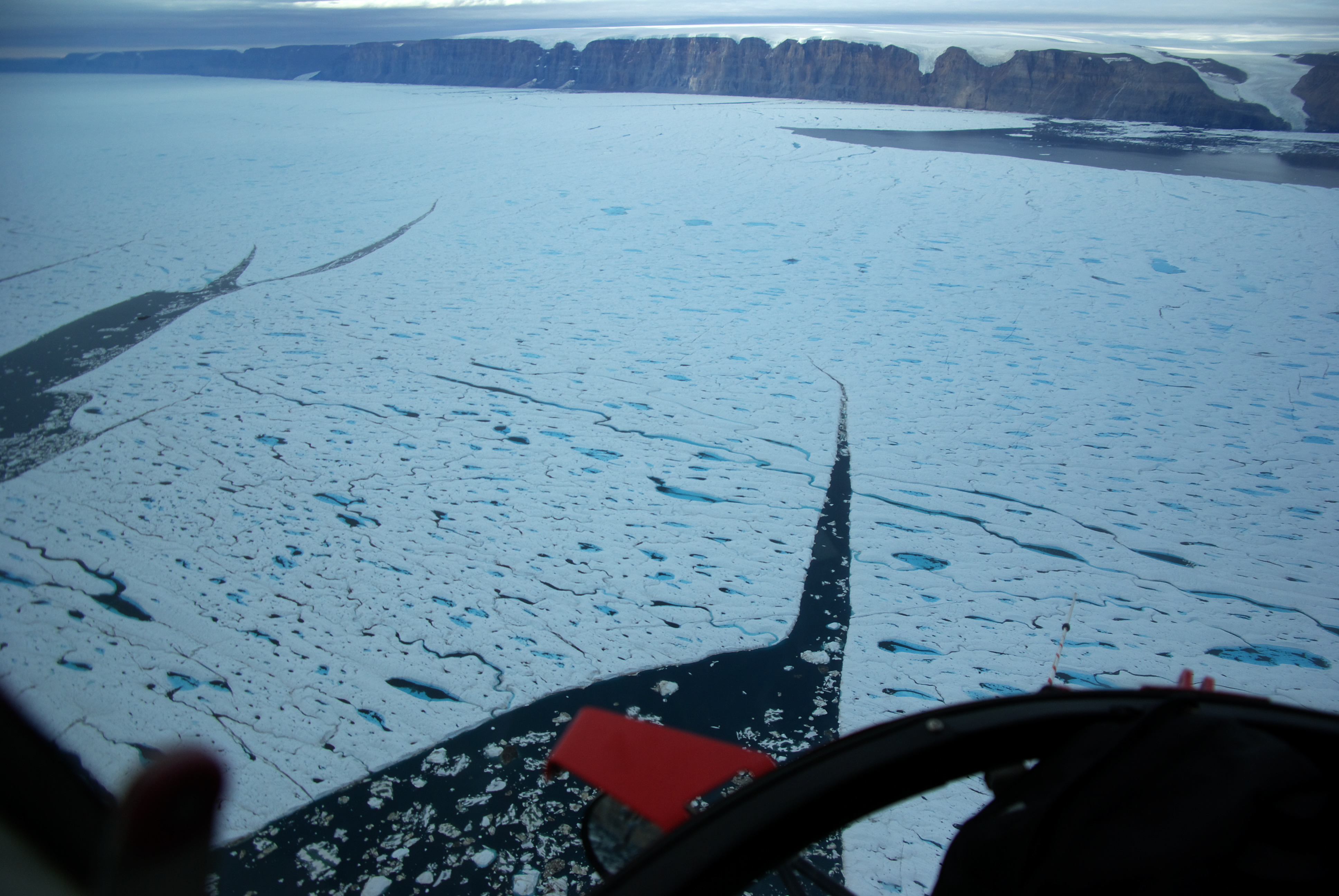
Floating ice shelf of Petermann Glacier in August 2009 as seen from a helicopter of the Canadian Coast Guard Ship Henry Larsen. View is to the south-east with the glacier to the left and the ocean to the right. Photo by David Riedel, British Columbia.

Our admittedly expensive 4-year proposal was rejected along with at least five competing proposals in the same general subject area, because we did not show why a study of ice-ocean interaction of glaciers and ice-sheets has to take place at Petermann Glacier, a remote location less than 800 miles from the North Pole. Claiming this glacier to be unique, we made a fatal mistake, because NSF cares little about each glacier, but cares much about the underlying physical problem, that is, how do tidewater glaciers with floating ice shelves interact with the ocean they float on.

There are several glaciers in Greenland that have extensive ice shelves. To the best of my knowledge, they are all in northern Greenland. Nioghalvfjerdsfjorden and Petermann Fjord contain the largest floating areas exposed to the oceans on the east and west coasts of Greenland, respectively. Both these glaciers have seen preliminary studies during the last 15 years including radar measurements that describe the geometry of the ice shelves, the bedrock below, as well as the ice streams to connect the glaciers to the inland ice. Smaller and less studied glaciers with past or present ice shelves are Steensby, Ryder, and C.F. Ostenfeldt in the north-west as well as Academy and Marie-Sophie glaciers in the north-east (Weidick, 1995).

The most extensive ice shelves are located around Antarctica, however, and one thus may wonder, what uniform physics can and should be studied in northern Greenland that also applies to the ice sheets in the south? I would need some scaling law or normalization scheme that connects many glaciers into an organizational scheme. In physical oceanography the near-balance of a density-driven (internal) pressure gradient and the effects of a rotating earth provides a dynamical scale that connects river discharges off Delaware, with ice patterns off Eastern Greenland, and algae bloom patters off northern Norway, among many other phenomena. What dynamical metric connects the ice sheets of Greenland to each other and to those off Antarctica?

Petermann Ice Island PII-A Breaks into Two

The 35 square kilometer sized ice island from Petermann Glacier PII-A has split into two pieces of about equal size over the last 4 days while moving almost 10 km per day to the south along the 150 meter contour of water depth.

Petermann Ice Island PII-A as seen by MODIS/Terra as one piece on Aug.-14, 2011 and as two pieces on Aug.-22, 2011 (click to enlarge).

It cleared the Grey Islands to its north and may now turn counter-clockwise around deeper water to the north of Horse Islands. The Canadian Ice Service continues to watch the many icebergs that PII-A has spawned all along the Great Northern Peninsula of Newfoundland with daily charts and RadarSat imagery. While the data from the NASA’s MODIS mission resides in the public domain serving a global community, the Canadian RadarSat is commercial product unaffordable serving only a select few.

The two new ice islands should perhaps be called PII-Aa and PII-Ab. While their size no longer compares well to that of all of Manhattan, each is about as big as 5 Central Parks of Manhattan, or about 10,000 times my garden which is a third of an acre.

Petermann Ice Island PII-A on the move again

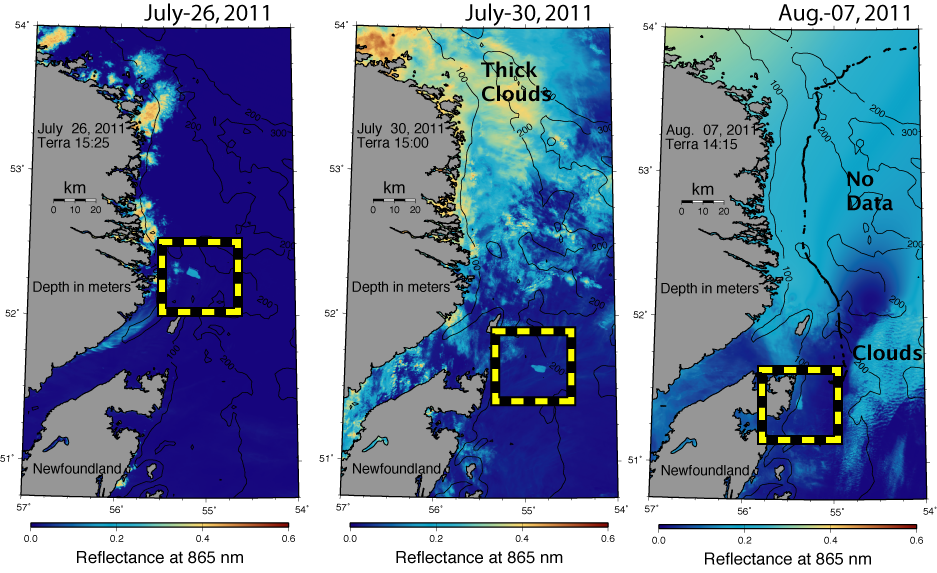
Sitting stuck on the bottom at 80 meters depth for the past week off St. Anthony’s, PII-A is in the move again heading south by south-east (click on image to enhance). It is melting only at the surface, breaking off smaller icebergs, because the ocean water temperatures near the bottom are colder than the freezing point of fresh water. The ocean’s salinity ensures that the freezing point of sea water is close to -1.7 C while that of fresh water is 0.0 C. More details on how the waters off Labrador and Newfoundland looked like in 2009 within a climate context is Colbourne et al. (2010) (big file, slow link).

Petermann Ice Island PII-A on Aug.-7 and Aug.-14, 2011 off St. Anthony, Newfoundland over contours of bottom depth. Black dotted line is the track until Aug.-9, 2011 from a beacon on PI-A

Petermann Ice Island PII-A Within Three Miles off Newfoundland

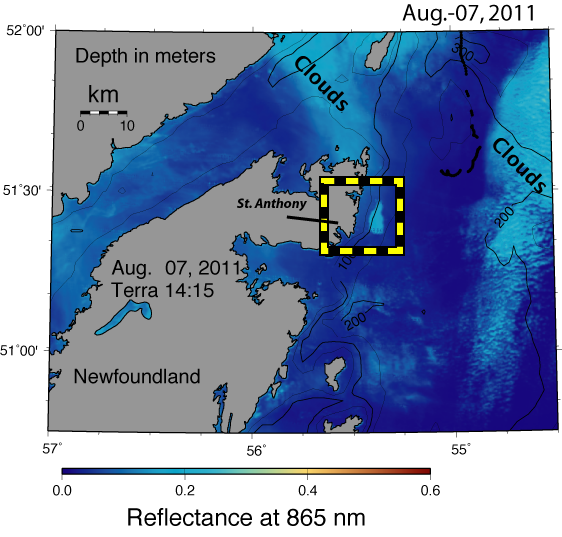
The Petermann Ice Island PII-A is within 5 km (3 miles) from the shores off St. Anthony, Newfoundland. The MODIS Terra image of this morning shows PII-A sitting in water 100 meters (330 feet) deep. The island may be partially grounded, because its thickness is close to the water depth.

Petermann Ice Island PII-A 3 miles from shore.

Petermann Ice Island PII-A off Labrador and Newfoundland.

The dotted black line shows the track of PII-A until last week as determined from one of three beacons placed by the Canadian Coast Guard and Ice Service.

Global Weight Watch: Slimmer Greenland and Fatter Tropics

An ice island four times the size of Manhattan separated from Petermann Glacier, Greenland last year. Today one of these Manhattans reached the coast of Newfoundland. Never before has as large a piece of ice from Greenland reached this far south. Does this show a warming climate taping into Greenland’s 20 feet potential to raise global sea level?

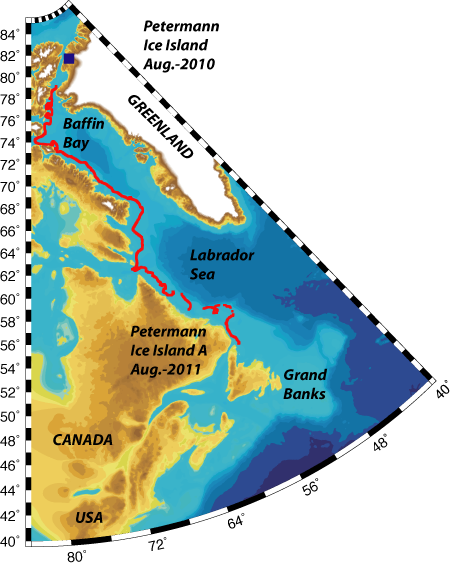
Track of Petermann Ice Island from Aug.-2010 through Aug.-2011 traveling in shallow water from northern Greenland along Baffin Island and Labrador to Newfoundland.

Greenland’s glaciers always melt with pieces breaking off. This raises sea level if Greenland receives less snow atop than it loses ice at the bottom. For the last 10 years Greenland lost about 200 trillion pounds of mass, net, per year. [At 5 cents per pound, this pays off the federal debt within a year.] Distributing this mass over all oceans, we raise global sea level by one inch in 75 years. Nothing to worry about, but there is a twist: Weight watching satellites show that Greenland becomes thinner, while the Tropic grow fatter. Records of weight gain and loss are too short to draw firm conclusions, yet, but they are consistent across the globe and the trends of gain and loss are increasing, too.

We do not understand the physics, stability, and uncertainty of these increasing gains and losses well enough to make reliable predictions. If the climate over Greenland is stable, as it has been for the last 10,000 years, then this matters little. If the present equilibrium reaches a tipping point, where a small change will kick us into different stable state, then we can expect sea level to increase 10 times or more. We understand tipping points in theory, but not in practice. In practical terms, we do not know if our children must deal with two inches of sea level from Greenland by the end of this century or 80 inches or none at all. We know only too well, however, that low-lying places like Bangladesh, the Netherlands, and New Orléans struggle with the sea level we have now.

Greenland’s ice island off Newfoundland indicates a globally connected world. Burning stuff over Europe, America, and increasingly Asia creates heat that melts Greenland at a rate that is increasing. What happens in Greenland does not stay in Greenland, but it impacts Rome, Miami, and Shanghai. More ice and rising sea level will come. To play it safe, let’s think smartly what and how we burn. To play it loose and reckless: burn, baby, burn … or was it drill?