Tag Archives: travel

Glaciers, Geocaching, and Greenland Goals

I thought it silly when my wife suggested to go geocaching with her. She told me it was to hunt for treasures and as a professor of physical ocean science and engineering this was not for me. But my wife is persistent, I am curious, and when she explained that a GPS, hiking, and computer mapping was involved, I gave it a try and have been hooked ever since. My first geocaching hiking trip took place on Anacortes Island, Washington in 2013 where our youngest son then lived. Here we are walking past rock carved 10,000 years ago by a tiny glacier at N 48° 29.498 W 122° 41.799 N that discharged ice into Puget Sound:
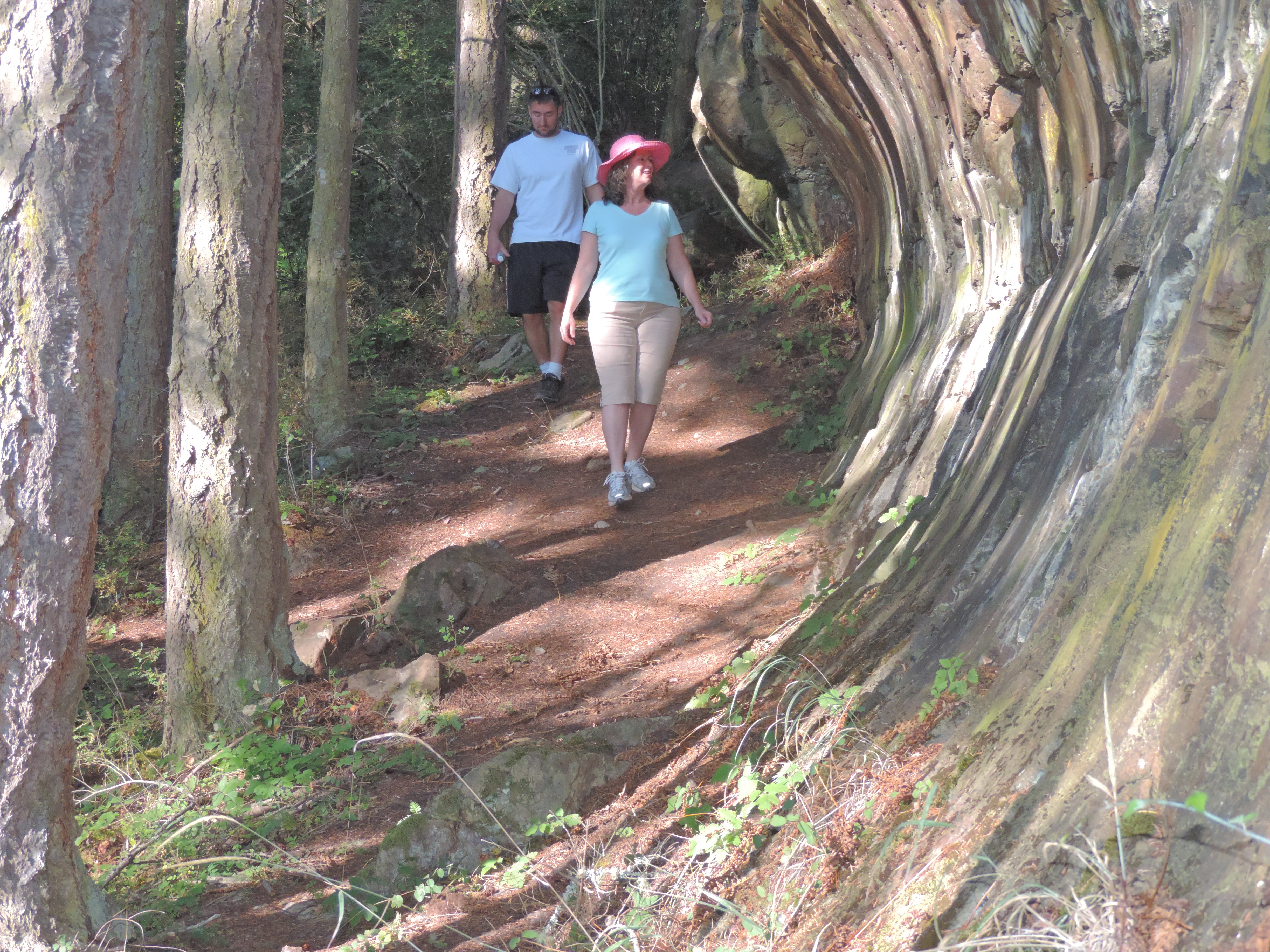
Glacier carved outcrop in Washington Park, Anacortes Island, WA.

Glacier carved outcrop in Washington Park, Anacortes Island, WA.

Since this first geocaching trip, I have found more than 200 geocaches in places small and remote and places large and urban. The treasure is in the walking and trying to find a path towards a destination, but the destination is secondary as many discoveries are made along the way.

This often happens in science also. One needs to know a destination, have a goal, formulate a hypothesis, but much science, learning, and discovering happens along the path towards that goal. With a GPS the destination is easy, it is a fixed point on earth, but it is harder in science. It can be useful to roam widely, but a set of intermediate goals can help to stay focused. For example, I want to understand how Greenland will change as we warm the earth. That’s a big question with impacts on floods in Europe, storms in the Americas, and rising sea level everywhere. This is a 100-year problem that many people work on; so my personal goal is to focus on how the oceans melt glaciers from below. This is a 10-year problem. It is a step towards the larger goal, but 10 years is still long even though I work with people in Germany, Canada, Denmark, England, Sweden, and Norway:

View to the south on the climb down from Tromsdalstinen.

View to the south on the decent from Tromsdalstinen on a geocaching trip in 2014 out of Tromso, Norway.

The photo above was made during one of my geocaching trip in northern Norway. Three physical oceanographers had gotten off the ship after they deployed ocean current measuring devices off eastern Greenland near a larger ice sheet. The experiment was designed to measure the ocean heat and its movement towards two large outlet glaciers. One has a wide and stable floating ice shelf, Nioghalvfjerdsfjorden (79N Glacier) while Zachariae Isstrom a few miles south lost its wide, long, and apparently unstable ice shelf that still shows in this 2002 image:

North-east Greenland: 79N Glacier and Zachariae Isstrom in 2002.

North-East Greenland in 2002 when both 79N Glacier (near 79 30′) and Zachariae Isstrom (near 79 00′) had extensive ice shelves (black areas are open ocean).

It puzzles me how two adjacent glaciers can and do behave so differently. If we understand how Greenland is melting, then we should explain the difference convincingly, but I am still looking for people who can. Lots of theories, lots of ideas, and lots of modeling, but there are not many observations to make the skimpy and often contradictory evidence convincing. And this finally leads me to my last point and the goal that I set for myself for the next 5-10 years:

I like to measure the ocean, the ice, and the air above and below floating glaciers via a small network of sensors. Now that two large ice islands spawned at Petermann Gletscher in 2010 and 2012, I believe that the remaining ice shelf will stay largely put for the next few years, that is, move at 1 km per year towards Nares Strait:
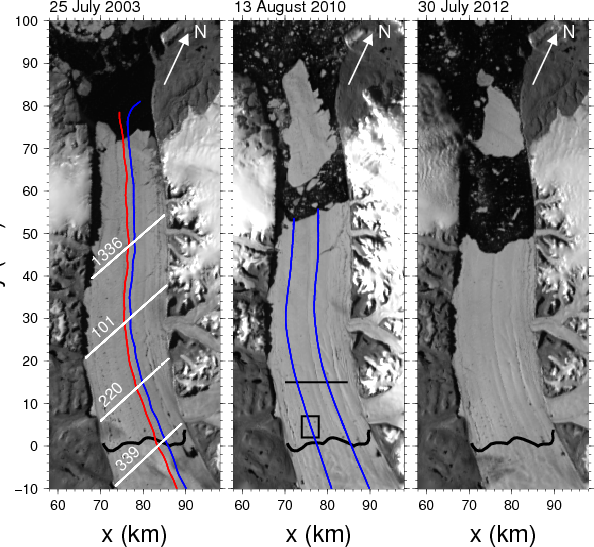
Petermann Gletscher through calving events. White lines show ICESat tracks; red (ambient ice shelf) and blue (central channel) show repeat-track airborne surveys.

Petermann Gletscher through calving events. White lines show ICESat tracks; red (ambient ice shelf) and blue (central channel) show repeat-track airborne surveys.

The hardest part in reaching this goal is to get measurements from under the 200-600 meter thick ice. This requires holes drilled through the glacier, it requires ocean sensors to be lowered into the water below the glacier, and it requires connections to relay data back to the surface at all hours for many year. I  perhaps have a first chance towards this goal when the Swedish icebreaker Oden will work for a month in Petermann Fjord this year. People from the British Antarctic Survey will be aboard and they plan to drill holes for other scientific purposes. When they are done, the holes freeze over, unless someone (me, me, me, please, pretty, pretty please) has instruments to put in there. I just word that I will be aboard the ship as well and I am feverishly working towards this goal with much help from others. More on this in later posts. All science is a group effort.

I close with a photo to show how the ice-covered ocean of Petermann Gletscher looks during the polar day. Would it not be great to know the temperature of the water below and the air above this more than 200 meter thick glacier ice at all times posted for everyone to use with an internet connection?
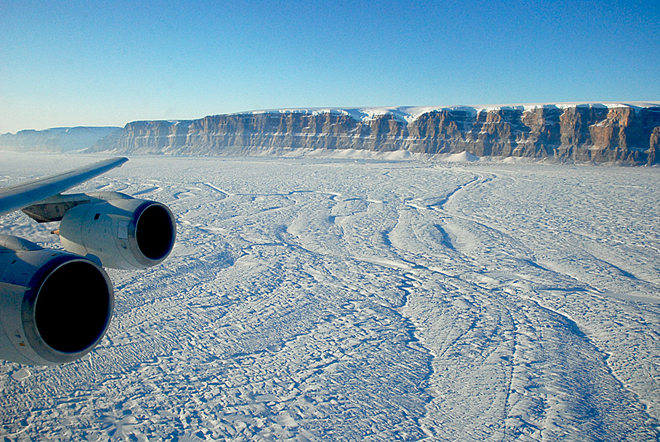
March-24, 2010 view of Petermann Glacier from NASA's DC-8 aircraft. Photo credit goes to Michael Studinger of NASA's IceBridge program.

March-24, 2010 view of Petermann Glacier from NASA’s DC-8 aircraft. Photo credit goes to Michael Studinger of NASA’s IceBridge program.
American Adventures Abroad: The Four Germanies

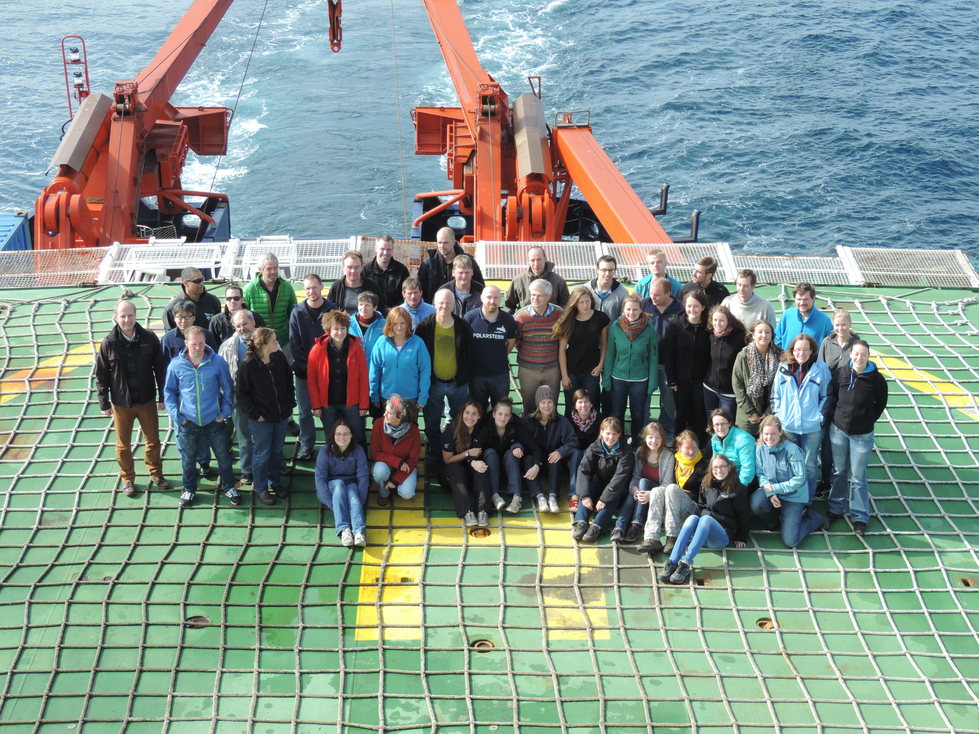
I am American and damn proud of it. I was born in Germany, left almost 30 years ago, and, like a plant from another ecosystem, I am exposed to the new Germany for the first time. I know the difficult histories of both West and East Germany that since 1989 are one united country. The 100 people aboard the research icebreaker R/V Polarstern perhaps represent this new country well. Most crew and scientists were born and raised in either East or West Germany, extinct countries which each had a range of characters to form a distinct and diverse German fabric:

The first person I met when boarding the ship in dry dock was X. After introducing myself as an American scientist to sail the FS Polarstern in stilted if decent German, he revealed to me that he volunteered in the NVA, the soviet-style Nationale Volks-Armee for more than 10 years. Like many low-level Nazis a generation or two before him, he argues that not all was bad in the regime that he served. While this may be true, it strikes me odd, that this is the first things one reveals of oneself and a regime that created walls and killing zones to prevent its own citizens from leaving. Suspecting an uneasy history of guilt, I did not argue despite strong feelings to present different perspectives. Hence his next move is to state that American activities in Europe, Asia, South-America, Middle East, and Africa are the root source of all the problems in these regions. Again, not taking the bait, I listen, ask gentle probing questions to expose more detail, however, not much follows after the first rant that, perhaps, reflects a general feeling more than fact. I heart variations of this theme often in Germany both at sea and on land.

Our nurse and stewardess Kerstin also hails from the former East-Germany where she grew up the same time that I did in West-Germany, but unlike X., she embraces life as it presents itself without resentment, regret, or judgment. She signed on for a year working aboard Polarstern for a sense of adventure and to see the world in a different way. She is naturally curious on all things that relate to people, science, and life. She has little interest in politics, ideologies, and theories on how the world works, but she uses her own mind, experiences, and stories to make everyone around her laugh often. People like her should run the world.

The second Mate, Felix, was in charge when I boarded the ship. He is probably in his early 30ies and gave me the first tour of the ship in dry dock, a task that revealed a deep pride in the ship, its capabilities, and all it represents in a forward-looking modern Germany. He has clearly sailed to many ports and dealt successfully with people of different countries, cultures, and educations. Despite cursing and cussing of an ol’ salt, he is a hard-working, no-nonsense guy who gets things done efficiently. He also smokes like a chimney and likes to drive the ship while breaking sea ice. He did this often and smartly throughout the expedition.

A wonderful surprise to me aboard this ship is the large number of foreigners. There are three Danes aboard one of whom hails from New Zealand; two Canadians, two Belgians, and two Englishmen are aboard; while Brazil, China, Netherlands, Poland and the USA are each represented by one scientist. The two Canadians may as well come from two different countries, as one hails from English-speaking British Columbia and the other from French-speaking Montreal. Catherine’s Quebecoise language and perspectives are the most beautiful of all on this diverse ship. I could listen to her for hours …

Then there is a fourth group aboard who are perhaps the largest: They are the very young Germans who were born after the collapse of the communist empires in the East and they will become the new Germany. It is a foreign country to me, one I like from the distance, and it is a very young country with much potential to make a positive impact in the world.

Science party aboard R/V Polarstern after 4 weeks at sea in July 2014.

Science party aboard R/V Polarstern after 4 weeks at sea in July 2014.

Norway, Norwegians, and Normal

The best part of my High School was getting out of it early to ski from Oslo to Trondheim across Norway’s Hardangervidda in 1981 Continue reading

Polar Night and Science in Tromso, Norway

Crossing the Arctic Circle for the first time in winter, I was stunned last Sunday by the amount of light that still reaches Tromso, Norway located Continue reading