Category Archives: Nares Strait 2012

Nares Strait 2012: Tide Gauge Recovered after 9 Years

Andreas Muenchow, Aug.-8, 2012, off Cape Baird

In 2003 we deployed a tide gauge that was recovered today after attempts in 3 different years to do so failed. Discovery Harbor near Fort Conger was the most northern location at 81 42’ North and 64 1’ West of a large moored array placed in 2003. It was at Fort Conger, that Lt. Greeley of the U.S. Army waited in vain for a supply ship that never arrived, but this sad story is for another day and I like to write about happier news: Our 2003 tide gauge lay in wait for 9 years and 1 day precisely. A 2006 attempt to reach this northern location by ship failed on account of heavy ice cover, a 2007 attempt by helicopter succeeded to establish acoustic communications, but failed to recover the sensor package, and a 2009 attempt by ship failed again because of difficult ice conditions.

The odds of a recovery were slim, but 4 hours ago a crew of five found the tide gauge the same way that skilled fishermen of Newfoundland recover lost traps and fish for halibut: with a line of hooks operating small ships smartly. Chief Officer Brian Legge, Seamen Derick Stone and Carl Rose, as well as scientists Ron Lindsay and Jonathon Poole found the proverbial needle (read tide gauge) in the hey stack (read Arctic Ocean). The entrance to Discovery Harbor was guarded by yet another ship-sized piece of Petermann Glacier ice, this one grounded, as well as several large and small sea ice floes, all moving rapidly with the tides and currents. Even navigating the zodiac through this maze to a fixed location was a major accomplishment.

The long-lost tide gauge is a 2 feet cylinder filled with electronics, but 9 years moored to the floor at 20 meter depth turned it into a complex biology habitat attracting wild life much like the artificial reefs created along Delaware by sunken New York City’s discarded subway trains. Mollusks, seaweed, clams, barnacle, algae, and bacterial slime all attached themselves to every surface. Arctic shrimp perhaps feeding on algae or slime were captured along with the gauge. Seaman Derick Stone, who has never seen an Arctic shrimp (neither have I), quickly brushed it away and back into the ocean muttering something about  “Scorpions in the Arctic.” A second specimen was captured alive and returned to the ocean after a brief inspection. It was agreed, that there was no enough meat on this 2-inch long and skinny shrimp

As a sign of respect to the gods of the icy seas a majority of PhDs aboard solemnly swore to give the long lost sensor 3 days of rest before stripping it bare to reveal its guts, check health and status and retrieve recordings. Pranksters aboard this ship, at least one with a PhD, already alerted me to schemes of hostile capture and ransom requests; I suspect ransom to be paid in treasures, valuable certificates, and screech. Little do these pranksters know of web streaming, local area networks, advanced image processing, and other counter-intelligence operations … to be continued.

P.S.: Oh, we also completed section work (temperature, salinity, water samples) in Robeson Channel to the north of Petermann Fjord where a few segments of Petermann Glaciers former ice shelf are both grounded and moving off the coast of Greenland. Presently off Cape Baird to perhaps recover an automated weather station to be placed instead at Joe Island at the southern entrance to Petermann Fjord, weather permitting. We got 40 kts winds from the south, braking waves, as well as balmy air temperatures of 4 degrees Celsius or so.
Nares Strait 2012: Of Cod’s Tongues, Scrunchions, Screech — and so much more

Allison Einolf, Aug.-8, 2012

Tomorrow will mark our first full week aboard the CCGS Henry Larsen. In one week, I have learned a lot of things, ranging from what cod tongues taste like to the details of sea ice crystal formation to the usefulness of a balaclava in the Arctic. It’s been an incredible week.

Being on the Larsen is almost like being on a mobile town from Newfoundland. Most of the crew speak in heavy accents that sound more Irish than what I would normally consider Canadian, and cod tongues, scrunchions, and Screech are normal fare. I tasted cod tongues today, and I made my entire table laugh with the face I made. They aren’t bad, but I’m not fond of seafood that tastes particularly fishy, and I should’ve gotten tartar sauce with them. Scrunchions I didn’t try (Dave, one of the Canadian scientists, describes them as “essence of pork”), but Screech is something I actually like.

Andreas and Pat had instilled in me a fear of Screech before we came to the ship. The vague stories of screeching ceremonies (in which you become an honorary Newfoundlander) painted a false picture of a terrifying rum known as Screech. In reality, it’s quite tasty rum, and it’s now my go-to drink at the bar.

The last few days have been full to the brim with the retrieval of moorings from 2009 and CTD and rosette survey lines. We successfully retrieved 6 of 7 sets of instruments that were deployed here in 2009, but so far at least two of the instruments were severely damaged. A few of them seem to have hitched a ride with the Petermann ice island in 2010, and they are definitely worse for it.

Today we finished the second of our survey lines. We alternate between lowering the conductivity, temperature, and depth sensor (CTD) and the rosette, which collects bottles of water at different depths. We then do what Humfrey Melling calls “piddling the bottles,” or collecting samples from the collected water. We’re taking samples to process for data regarding barium, oxygen-18, salinity, and nutrients like phosphate or sulfate.

In the week we’ve been on the Larsen, I’ve learned a lot and even gained a few pounds from the huge servings of food we’re given at every meal. It’s amazing how quickly I’ve settled in. I feel like I’ve been here much longer than a week, but I’m glad I haven’t because it means I get another week and a half on this ship in the beautiful wilderness of the Arctic.


Nares Strait 2012: Heading North Passing Petermann Fjord and Ice Islands

Andreas Muenchow, Aug.-7, 2012 in Hall Basin

Petermann Fjord is within sight and at least 5 ship-sized segments from Petermann Glacier are around us drifting to and fro with the tides. RadarSat imagery received this morning aboard the CCGS Henry Larsen indicates that the Manhattan-sized ice island PII-2012 has moved over 3 nautical miles seaward in the last 36 hours (5 kilometers per day) during winds from the south-west. The north-eastern tip of PII-2012 has left the fjord past Offley Island.

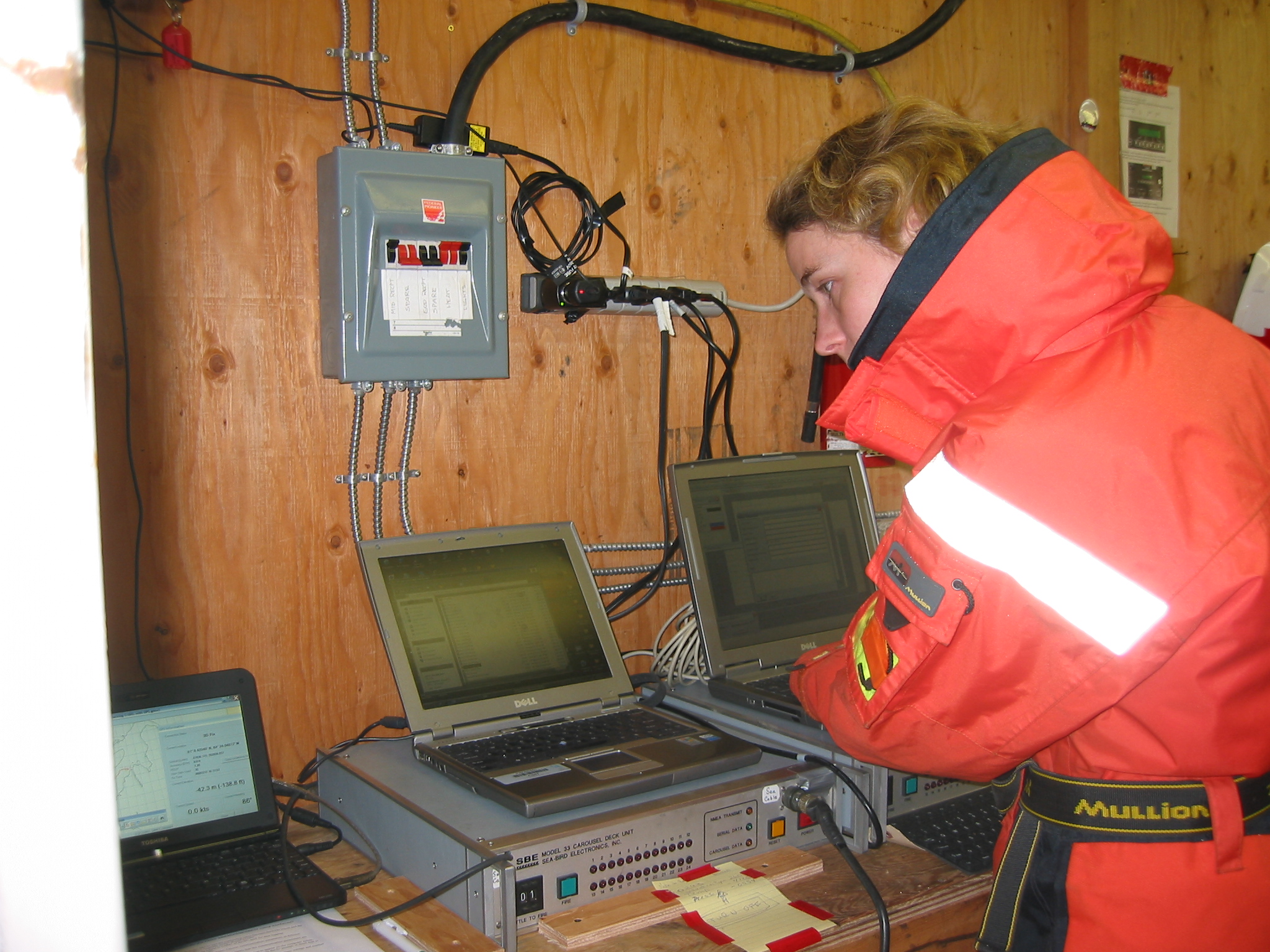
We are about 20 miles to the south at 81 degrees 14 minutes north and 65 degrees west firing bottles to collect water samples across a section that Petermann’s ice island PII-2012 will cross perhaps as early as the next week. Dr. Renske Gelderloos just tells the bridge from a van on the fore deck, that all 12 bottles have been fired as the instrument package traveled from the surface to 451 meter depth and back. Additionally, we collect temperature and salinity more continuously as an electromagnetic sensor is lowered via the same cable as the bottles. I am one of two winch operators while Dr. Gelderloos is the command and control center next to me operating 3 laptops concurrently.

Dr. Renske Gelderloos of Oxford University in command and control of data collection operations aboard the CCGS Henry Larsen.

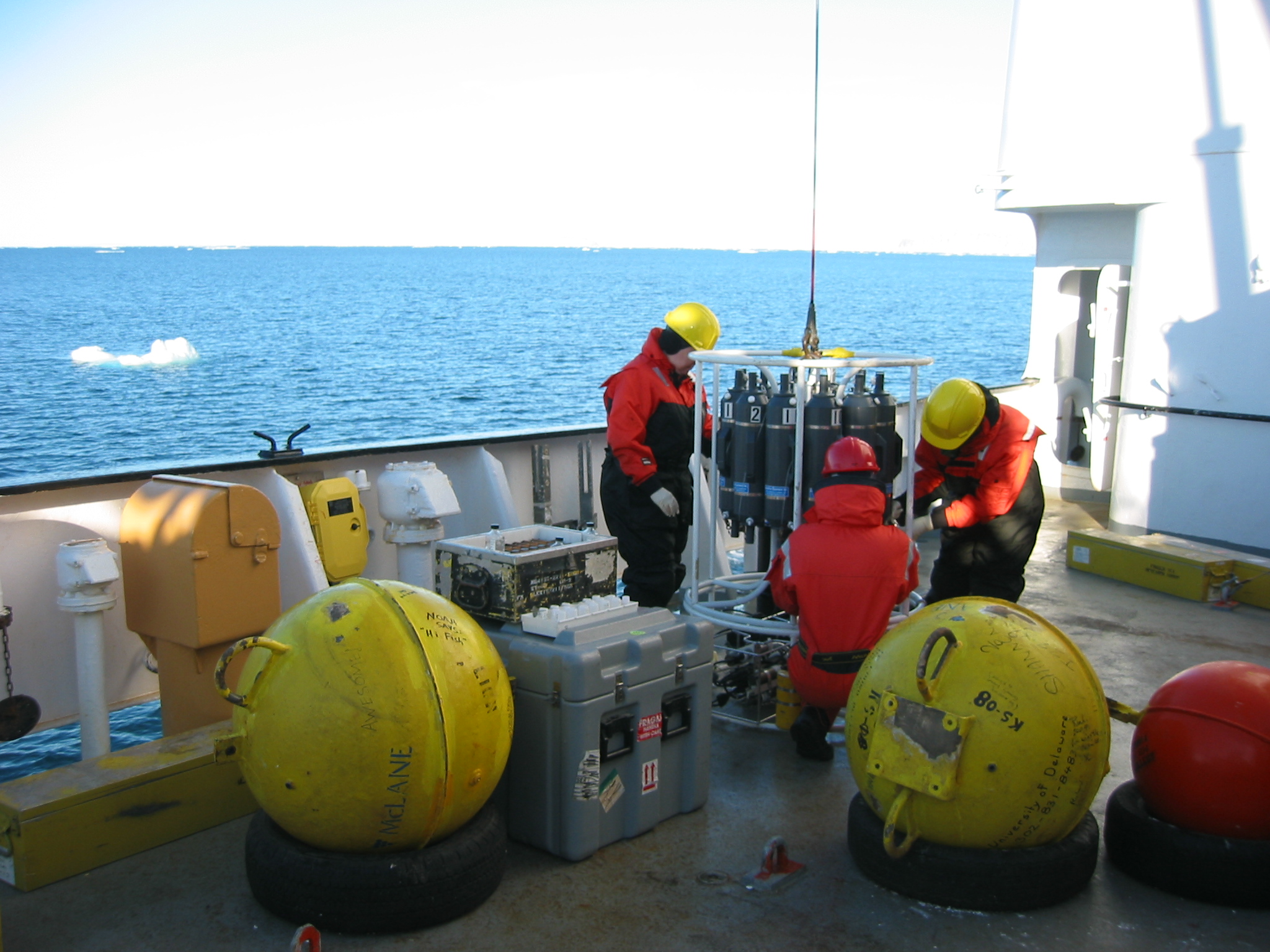
Pat Ryan (left), Humfrey Melling (center), and Allison Einolf (right) collecting water samples aboard the CCGS Henry Larsen in Hall Basin in August 2012.

PhD student Patricia Ryan, dressed in a warm Mustang suit, is one of the water samplers to transfer water into tiny sample bottles for later chemical analyses. She just hands me a USB JumpDrive with 3-years of data of temperature, salinity, and pressure from a moored sensor we recovered yesterday. The latest profile is completed and I am off to process the new data further.

I missed dinner at 5pm, because it took us 5 hours until 8pm local time to finish the 7 stations of a section from Greenland to Ellesmere Island, Canada. I am back to writing now at 11:35 pm local time after lots of cheerful banter, quick clean-up for the day, 2 beers at the bar, and an hour staring into Petermann Fjord from the west-by-northwest. I can’t see the ice island even though I see Offley Island and I know the ice island is right next to it. The ice sheet spilling over the vertical walls of Petermann Fjord are visible in the distance, too. It is raining now. Air temperatures are 0.7 degrees Celsius (about 34 Fahrenheit) which is a little cooler than is normal for this time of the year. We are now another 50 km to the north at 81 degrees and 44 minutes North latitude that is farther north of Petermann Fjord and its ice island.

I can see five ship-sized segments of Petermann Glacier’s ice shelf, but I cannot discern the Manhattan-sized PII-2012 across Hall’s Basin. We have open water to our south and some loosely scattered ice to our north along Ellesmere Island. We are still heading north towards Robeson Channel to perhaps reach Alert on the Arctic Ocean or to perhaps repeat a section that was done for the first and last time in 2003 when the USCC Healy was here at the beginning of our Nares Strait project. It is past midnight now, Wednesday has started, time for bed. [81 49’ N, 63 09’ W at 04:20 UTC, 00:20 local]

Nares Strait 2012: A Bird’s Eye View of Nares Strait

Allison Einolf, Aug.-7, 2012

I know next to nothing about helicopters. They’ve always seemed exciting, but I couldn’t tell you anything about make or model or what makes one helicopter better than the next. As it turns out, helicopters are just as exciting as they seem on television.

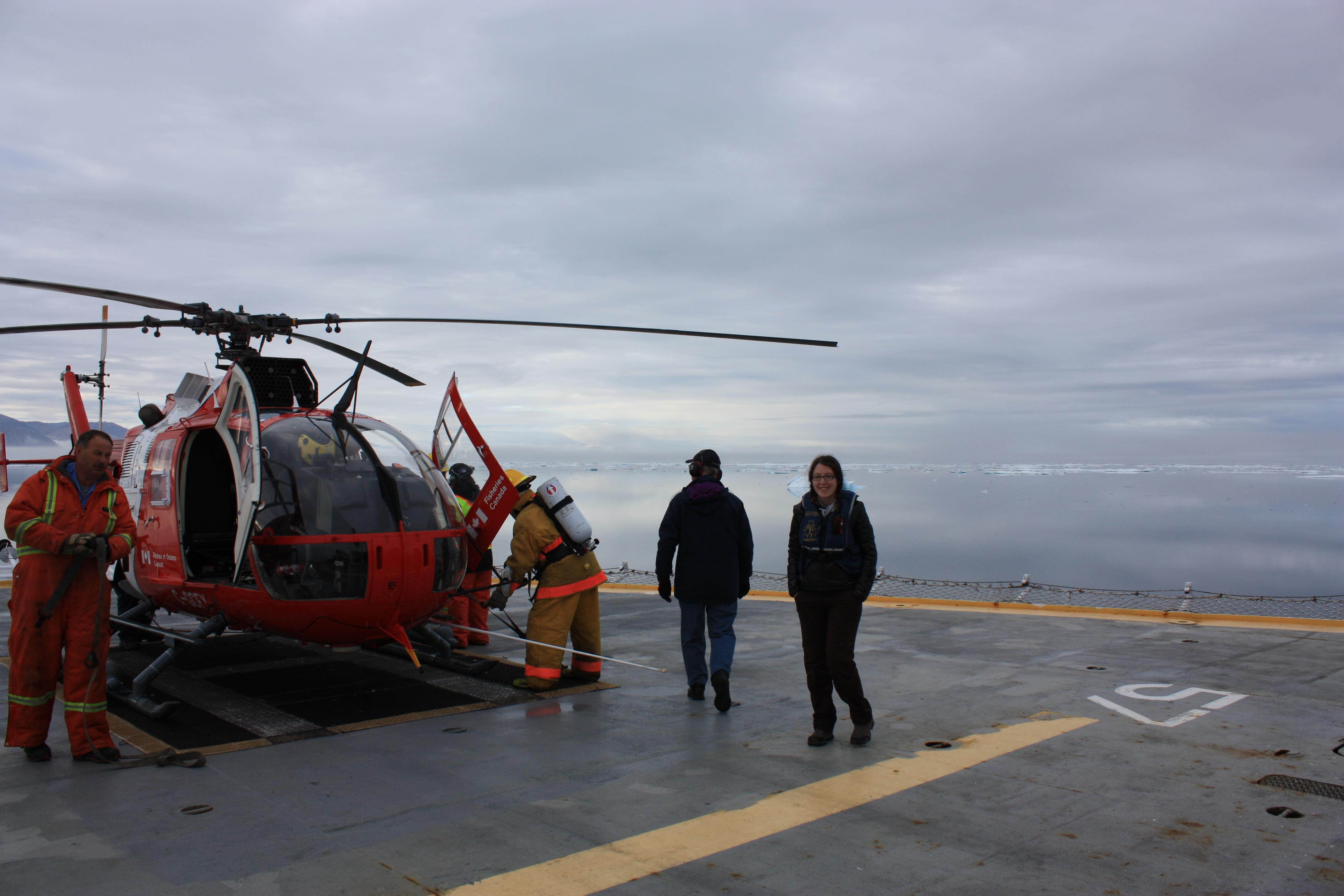
Sunday morning, as our group of eight scientists met to discuss the plan for the day, Brian, the Chief Officer, interrupted to ask if anyone wanted to tag along on the first helicopter ride of the trip. Renske’s hand immediately shot up into the air, and I volunteered a little more slowly. We quickly wrapped up our meeting, and Renske and I layered on jackets and headed up to the flight deck.

Allison Einolf getting ready for an ice recon flight on the flight deck of the CCGS Henry Larsen. [Photo Credit: Jo Poole, British COlumbia]

The purpose of the flight was to give the Ice Services Specialist, Erin, a chance to look ahead at the ice cover up to Hans Island, where we were headed. She was going to make a chart of the ice to help guide the ship through the path of least resistance, and maybe do a little sightseeing. An air of excitement filled the helicopter because neither she nor the pilot, Don, had ever been up here in Nares Strait either.

Once the first bit of work was done, we flew over to Ellesmere Island to see the amazing folded ranges. The colors there are amazing – bright reds and yellows in layers, crunched up in beautiful synclines and anticlines. The hills are scored with avalanche chutes and based with alluvial fans. There are glaciers nested in the folds of the mountains, and it is simply breathtaking.

There is a stark contrast between Greenland and Ellesmere Island on either side of the Kennedy Channel. I was awestruck by Greenland while we were in Thule, but Ellesmere Island makes the Greenland side of the strait look dull and gray in comparison. It’s one of the first things you notice up here, and many members of the crew point it out on sunny days. The contrast brings up all sorts of questions about the rocks even for the casual observer.

A few theories have come up over the years as to what made the sides of the channel so different. Some think that the channel lies along some sort of fault or plate boundary, and some argue that plate tectonics has nothing to do with it. No matter how I look at it, something has to have been vastly different on each side of the strait because the Greenland side has all of these horizontal layers in a much grayer rock, and the Ellesmere side is more than just colorful layers – they bend and contort in violent and beautiful ways that seem much more active than the Greenland layers.

Both sides of the Nares Strait are beautiful in their own ways, and the view from a helicopter was spectacular. We were able to land on Hans Island, which is a great example of the carbonate rock of Greenland, and is apparently rife with marine fossils. We also flew over Franklin Island and farther south to Rawlings Bay and Jolliffe Glacier. It was the first time I had seen a large glacier close up, and it was amazing to see the ridges in the ice, and I was surprised by how much a glacier seems to look and act like a very slow moving river.

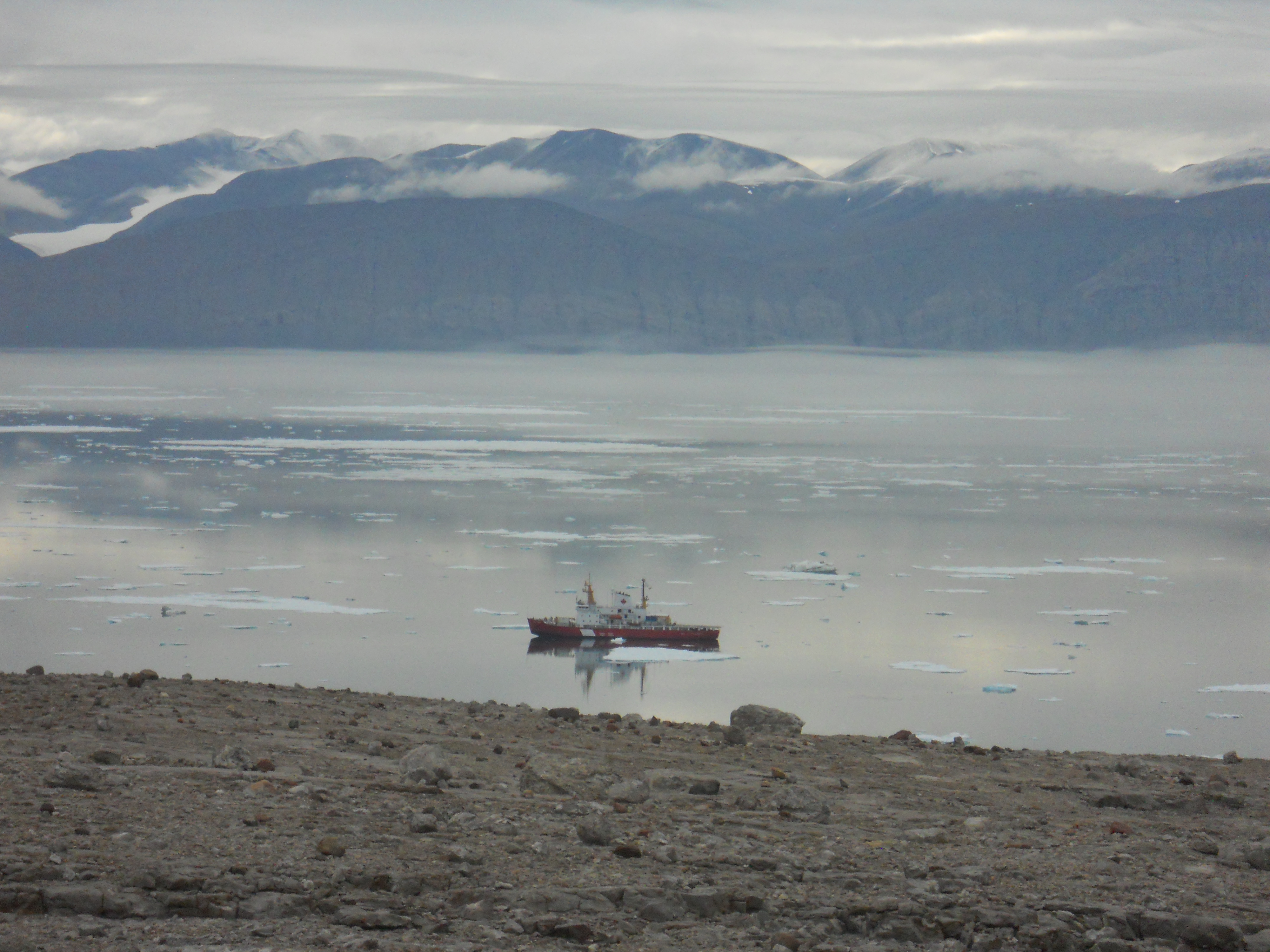
CCGS Henry Larsen as seen from atop Hans Island. The view is to the west with Ellesmere Island in the background. [Photo Credit: Allison Einolf, University of Delaware undergraduate intern]

As we flew into the fjord, I was continually amazed by how nearly vertical some of the layers of the rock were, and by the bright reds and yellows of the rock. Flying back to the ship we flew over the mountains and I was amazed by the way the rock beneath us dropped away completely as we flew into Nares Strait. The geology, the ice, and the experience of being in a helicopter were all so incredible.

Nares Strait 2012: Long Hours Recovering Moorings

Andreas Muenchow, Aug.-7, 2012, 12:22 am

Everyone can throw instruments into the ocean, but only few can recover the same instruments 3 years later. And fewer people yet can recover instruments that were hit hard by Petermann’s Ice Island of 2010 (PII-2010). Today, we did exactly that:

Starting at 8am sharp yesterday, we recovered six of seven moorings from the 300-400 m deep ocean floor. Only one is still left. The attention to detail three years ago, when we deployed the moorings, paid off.

We are now parked next to a massive multi-year ice floe for a night without darkness at 80:43.0 North latitude and 67:17.9 West longitude. For the last 3 hours our group celebrated today’s success at the only bar within 300 miles while downloading an incredible amount of data from instruments to laptops. Among the three of us from Delaware we got 5 computers. The groups from British Columbia, Canada and Oxford, England are no different. Science is both a social and an individual activity, as oceanographer Henry Stommel said with true wisdom. There is lots and lots of scientific computing taking place right now, well past mid-night, when most aboard are sleeping.

The recovery of a sensor package begins with sending acoustic signals to an acoustic receiver attached to a tiny motor at the bottom of the ocean. After waking up said receiver near the bottom of the ocean, we send a command through the water with sound waves to turn a motor that separates a hook from a heavy anchor. Buoys attached above the acoustic release raise the entire sensor package to the surface. A zodiac with Chief Officer Brian Legge and a Leading Seaman aboard heads out to grapple the surfaced instrument package that is then hauled aboard the ship by a crew led most competently by bosun Don Barnable. Once aboard the ship a flock of scientists, engineers, technicians, and students crowd over all the elements of the sensor package to document, detach, secure, and move all the many pieces of the mooring.

The ice-profiling sonars originally designed and developed by our Chief Scientist Dr. Humfrey Melling was abused by PII-2010 the most. Two instruments moored 8 km apart were hit in almost identical fashion with ¾ inch thick protective stainless steel attached to the vibrating ceramic plates was bent into strange shapes by more than 80 meters thick ice. Data are downloaded right now to pin point the timing of the impact, but I am pretty sure it was PII-2010 in September of that year.

In addition to the two ice profiling sonars that measured ice thickness overhead from 2009 through 2012 at better than half hourly periods, we also recovered two acoustic Doppler current profilers that measure ocean currents in 40 different layers from the bottom to the surface. Furthermore, two moorings each measure ocean temperature, salinity, and pressure (CT/D) every fifteen minutes for the same 3 years complement the available data. The survival of the CT/D is remarkable for the mooring string contains instruments at 30 meters below the surface. Since our ice-profiling sonar at 80 meters depth was hit by PII-2010, these much shallower CT/D moorings were also hit by PII-2010. Their slick and smart design to slip through cracks and hooks on the underside of the ice made them survive the certain strikes by ice and ice islands.

This was a long and eventful day when we perhaps accomplished 80% of the tasks we set out to accomplish in the 8 days we have in Nares Strait. Our design decisions made 3 years ago paid off as we recovered almost all equipment hopefully holding 3 years of data. These 3 years of data include both the 2010 and 2012 calving events from Petermann Glacier, but they also contain data on the physical context within which these dramatic events took place. Our work has only just begun … as we are preparing to encounter Petermann’s 2012 ice island … I stop here at 1:11 am local time, cloudy skies and lots of ice around.

[Images will be placed when we return, as internet access aboard the ship is limited to text only.]